.MY DAUGHTER-IN-LAW TOLD ME TO EAT LEFTOVERS WHILE HER WEALTHY PARENTS ENJOYED THE FEAST I HAD SPENT TWO DAYS COOKING. I TOOK MY FOOD HOME AND STOPPED PAYING THEIR BILLS. THREE WEEKS LATER, MY SON ARRIVED WITH A SEALED ENVELOPE AND SAID, “MOM, YOU DESERVE TO KNOW WHAT REALLY HAPPENED THAT NIGHT…”
## PART 1 — THE DINNER I WASN’T ALLOWED TO EAT
At sixty-four, I thought I understood what it meant to sacrifice for family.
I had raised my son alone, worked for thirty years, paid off my modest house, and spent most of my retirement savings helping him build a comfortable life.
But one Sunday evening, my daughter-in-law reminded me exactly where she believed I belonged.
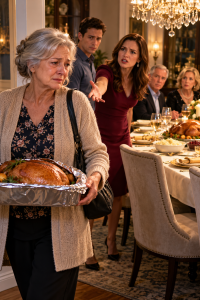
“Dorothy, the leftovers are in the refrigerator,” Vanessa said without looking at me. “You can eat those in the kitchen. We’re keeping the dining table for my parents tonight.”
I stared at her.
Behind her, the dining room glowed beneath an expensive chandelier. Four crystal glasses stood beside the finest plates. A roast turkey, golden potatoes, and bowls of fresh vegetables covered the table.
Her parents, Richard and Patricia, were already seated.
My son, Ethan, stood beside his wife’s chair.
Nobody spoke.
I had spent two days preparing that dinner.
I had bought the turkey, made the stuffing from scratch, baked two pies, and prepared the creamy potatoes my granddaughter loved. I had even driven nearly an hour to deliver everything because Vanessa had told me she wanted to impress her parents.
Now I was being directed toward the refrigerator like a delivery person who had stayed too long.
“Vanessa,” I said carefully, “did you forget that I was invited to dinner?”
She sighed.
“Dorothy, please don’t make this awkward. My parents are visiting from out of state, and we want tonight to be special.”
I looked at Ethan.
He lowered his eyes.
That hurt more than anything his wife had said.
“Ethan?”
He shifted uncomfortably.
“Mom, maybe we can talk about it later.”
Later.
That was always the word my son used when he didn’t want to defend me.
I had heard it when Vanessa criticized my clothes at Christmas. I had heard it when she complained that I visited too often, even though she regularly called me to babysit. And I had heard it when she asked me to pay for things their household supposedly couldn’t afford.
There had always been a reason to keep quiet.
I opened the refrigerator.
Inside sat a container of three-day-old pasta, half a sandwich, and a plastic bowl of wilted salad.
I looked at the food I’d prepared on the counter.
Then I looked at the empty space where my place setting should have been.
Something inside me finally went still.
I closed the refrigerator.
“Very well,” I said.
Vanessa smiled as if the problem had been solved.
I picked up the large roasting pan containing my homemade turkey, covered it carefully, and carried it toward the front door.
Her father stood up.
“Dorothy, where are you going?”
“Home.”
Vanessa hurried after me.
“What are you doing with the turkey?”
I turned toward her.
“I cooked it. I paid for it. And since I’m not welcome at the table, I see no reason to leave it here.”
Her mouth fell open.
“You can’t be serious!”
For the first time that evening, I smiled.
“I’m entirely serious.”
I carried the food to my car, placed the roasting pan on the passenger seat, and fastened the seat belt around it.
Then I drove home.
Halfway down the road, my phone began buzzing.
Ethan had sent a message.
*Mom, you embarrassed us. Vanessa’s parents are waiting for dinner.*
I pulled into a safe parking area and read it twice.
Not once did he ask why I’d left.
Not once did he apologize.
He was worried about the dinner.
I put the phone away and continued home.
That night, after putting the food in my refrigerator, I sat at my kitchen table and reviewed my bank statements.
For years, I had paid Ethan’s car insurance, covered the family’s phone plan, sent them money for my granddaughter’s expenses, and helped with their mortgage whenever they claimed to be struggling.
I had never demanded gratitude.
But I had started to realize that my generosity had become an expectation.
So I made three decisions.
First, I arranged for Ethan and Vanessa to take responsibility for their own phone bills after receiving proper notice.
Second, I informed Ethan that I would no longer cover his car insurance once the current policy ended, giving him enough time to arrange his own coverage.
Third, I canceled the automatic monthly transfer I had been sending them.
I would still help my granddaughter when she genuinely needed something. I would still buy her birthday presents, attend her school events, and spend time with her.
But I would no longer use my retirement income to subsidize two adults who treated me as though I were an inconvenience.
The following week, Vanessa called.
“Dorothy, the phone company says we’re being moved to a different plan. Is that your doing?”
“Yes.”
“And Ethan says you’re not paying his insurance anymore.”
“That’s correct.”
Her voice sharpened.
“Are you punishing us because of one dinner?”
“No, Vanessa. I’m changing an arrangement that no longer works for me.”
She hung up.
Three days later, she arrived at my house with a key she’d kept for emergencies.
She tried the lock.
It didn’t turn.
I had changed it.
When she saw me standing in the doorway, she raised the key.
“You changed the locks?”
“Yes.”
“Without telling us?”
“It’s my home.”
She stared at me as though she couldn’t believe what she was hearing.
Then she said the words that revealed exactly what she thought of our relationship.
“After everything we’ve done for you, how could you do this to us?”
I almost laughed.
Everything they’d done for me?
I had spent years helping them, yet somehow I was the one who owed them an explanation.
I calmly reminded her that I had paid for their bills because I loved my family, not because they had purchased ownership over my money.
She left furious.
I believed that was the end of it.
Then, three weeks later, Ethan arrived alone.
He looked exhausted. His eyes were red, and he was carrying a sealed envelope.
“Mom,” he said, “I need to tell you the truth about that dinner.”
He placed the envelope on my kitchen table.
Then he whispered, “Vanessa didn’t just forget to give you a place at the table. She had a reason for making sure you left.”
## PART 2 — THE SECRET MY SON HAD BEEN TOO AFRAID TO TELL ME
I stared at my son.
“What reason?”
Ethan pulled out a chair but didn’t sit down.
“Before I explain, I need you to understand something. I should have defended you that night. I knew what Vanessa was doing was wrong, and I was too afraid to confront her.”
I folded my hands.
“I’m listening.”
He opened the envelope.
Inside were printed emails, copies of bank statements, and a letter from a financial adviser.
At first, I didn’t understand what I was looking at.
Then I noticed my name.
Dorothy Hale.
Below it was a list of figures from an account I had never seen before.
“Ethan, what is this?”
He swallowed.
“Vanessa has been talking to her parents about your house.”
My stomach tightened.
“My house?”
He nodded.
“She knows you’ve paid off the mortgage. She also knows you have retirement savings. For months, she’s been trying to persuade me to convince you to sell your home and move into a smaller apartment.”
I felt the room grow cold.
“Why?”
“Because she wants us to buy a larger house closer to her parents. She thinks we could use the money from your property to help with the down payment.”
I stared at him.
“She wants me to sell my home to finance hers?”
Ethan lowered his head.
“Yes.”
For several seconds, I couldn’t speak.
That little house had been my sanctuary for thirty years. It was where I had raised Ethan, celebrated his graduation, and sat beside my husband during his final illness.
Every wall held a memory.
Every corner reminded me of a life I had built through hard work.
And Vanessa had been discussing it as if it were an asset waiting to be claimed.
“Did you agree to this?” I asked.
“No, Mom. But I didn’t stop her from talking about it. I kept telling myself she’d eventually drop the idea.”
“Why did she want me gone from the dinner?”
Ethan rubbed his face.
“Her parents had asked questions about your finances. Vanessa told them you were planning to sell your house and help us. They were coming to dinner expecting you to discuss the arrangement.”
I stared at him in disbelief.
“I never agreed to anything.”
“I know.”
“Did you tell them that?”
He hesitated.
“Not clearly enough.”
The answer hurt.
He continued explaining that Vanessa had been embarrassed when I arrived with the food because she wanted the evening to appear sophisticated and controlled. She had planned to bring up the house after dinner, believing I would feel pressured to agree in front of her parents.
When I left with the turkey, the conversation collapsed.
Then, in the days that followed, Vanessa began blaming Ethan for losing the financial support she had counted on.
He had finally seen the messages she had exchanged with her mother.
One sentence had stopped him cold:
*Once Dorothy agrees to sell, we’ll have enough for the down payment. She won’t need that big house anymore.*
I read it twice.
Then I put the paper down.
“What did you say to her?”
Ethan’s eyes filled with tears.
“I told her I wouldn’t ask you for a single dollar. I told her your house wasn’t ours to plan around.”
I looked at him for a long moment.
“Why did it take you so long to say that?”
He looked devastated.
“Because I was afraid of losing my marriage. I thought if I kept everyone happy, things would work themselves out. But I was asking you to pay the price for my cowardice.”
I hadn’t expected that answer.
For the first time in years, my son wasn’t making excuses.
He was taking responsibility.
I reached for the letter from the financial adviser.
“What is this?”
“Vanessa had arranged a meeting with someone who helps families plan property purchases. She sent them information about your house and asked what it might sell for. The adviser replied that they couldn’t discuss your finances without your authorization.”
I felt a wave of relief.
At least no one had accessed my accounts or transferred my money.
But the fact that they had discussed my home without my knowledge was painful enough.
“Ethan,” I said, “I love you. I will always love you. But I need you to understand that my retirement is not a family emergency fund.”
He nodded.
“I understand.”
“And I will never be pressured into giving away my home.”
“You shouldn’t have to be.”
I studied his face.
He looked older than he had three weeks earlier.
“Where is Vanessa now?”
“At her parents’ house. We argued about the messages. She says I betrayed her by showing you the truth.”
“And what do you think?”
He took a shaky breath.
“I think I should have told you before that dinner. I think I should have defended you when she told you to eat leftovers. And I think I’ve spent too long confusing keeping the peace with doing the right thing.”
Tears filled my eyes.
I wanted to tell him that everything was forgiven immediately.
But love didn’t mean pretending years of hurt had never happened.
“I’m glad you came here,” I said. “But trust takes time, Ethan.”
“I know, Mom.”
He stood and hugged me.
For the first time in a long while, the embrace felt honest.
After he left, I put the documents in a safe place and arranged a meeting with my own attorney and financial adviser. I confirmed that my accounts, property records, and estate documents were secure and that no one could make decisions about my assets without my authorization.
I also decided that any future financial help for my granddaughter would be handled directly by me, in a way that protected her needs without giving anyone else control over my money.
I thought the worst of the story was over.
But two days later, Vanessa returned.
This time, she wasn’t angry about the phone bill.
She stood on my porch with tears running down her face.
“Dorothy,” she said, “please. I need to explain something about the envelope.”
I remained in the doorway.
“What could you possibly need to explain?”
She looked down at her hands.
“The documents Ethan showed you weren’t the whole story.”
My heart sank.
“What does that mean?”
She took a shaky breath.
“It means I wasn’t the only person who wanted you to sell your house.”
Then she looked directly into my eyes.
“Ethan knew about the plan long before I did.”
## PART 3 — THE CHOICE THAT FINALLY MADE MY SON GROW UP
For a moment, I couldn’t move.
“What did you just say?”
Vanessa wiped her cheeks.
“Ethan told me years ago that your house would eventually be part of his inheritance. He said you had promised that the property would stay in the family. I thought you had already agreed to help us.”
I felt a painful pressure in my chest.
I turned away and walked to the kitchen, needing a moment to understand what she had said.
Had Ethan promised her something that wasn’t his to promise?
When he arrived that evening, I asked him directly.
“Did you tell Vanessa that my house would eventually belong to you?”
He didn’t deny it.
“I told her I hoped to inherit it someday. I shouldn’t have said it that way. I never meant that I had a right to it while you were alive.”
“Did you tell her I had promised to sell it?”
“No, Mom. I never said that. But I let her believe we might be able to use it to help buy a bigger house. I should have corrected her immediately.”
I sat down.
“Ethan, do you understand why this hurts so much?”
He nodded.
“You worked your whole life for this house,” he said. “And I treated it like something I could plan around.”
I looked at my son.
There was no easy answer.
He had not stolen my money. He had not forged my signature or transferred my property. But he had allowed his wife to believe that my future could be arranged around their ambitions.
And when she disrespected me at dinner, he had stayed silent.
That was the real wound.
“Your father and I worked hard for what we had,” I told him. “We wanted you to have opportunities we never had. But helping you build your life was never supposed to mean giving up my own.”
Ethan began to cry.
“I know.”
“I don’t think you understood before now.”
He lowered his head.
“No. I didn’t.”
We sat quietly for a while.
Then I told him what I had decided.
“My house is staying in my name. My retirement money will be used for my retirement. And if I choose to leave anything to you someday, that will be my decision—not an arrangement made before I’m even gone.”
He nodded.
“That’s fair.”
I wasn’t sure he fully understood how much courage it had taken me to say those words.
For years, I had feared that setting boundaries would cost me my family.
Now I was learning that boundaries were sometimes the only way to discover whether a relationship could survive without money holding it together.
Over the next several months, Ethan and Vanessa faced difficult conversations about their finances and their marriage.
They began paying their own bills. They adjusted their spending. They abandoned the idea of buying a larger house until they could afford it without relying on my property.
Ethan also began attending counseling to work through the guilt and fear he’d carried since his father’s death. He admitted that he’d become so afraid of disappointing people that he often agreed to things he knew were wrong.
Vanessa eventually apologized to me in person.
Not a quick apology made to restore the monthly transfers.
A real one.
She came to my house without demanding to be let in. She stood on the porch and said, “I treated you as though your kindness was something I was entitled to. You deserved better from me.”
I listened.
“I appreciate you saying that,” I replied. “But rebuilding our relationship will take more than one conversation.”
She nodded.
“I understand.”
I didn’t immediately give her another key.
I didn’t restart the payments.
And I didn’t pretend that the dinner had never happened.
But I agreed to start again, slowly, because I wanted peace—not revenge.
The following Sunday, Ethan called.
“Mom, would you like to come over for dinner?”
I paused.
“Who’s cooking?”
He laughed nervously.
“I am. And before you ask, there will be a place set for you.”
I smiled.
“I’ll bring dessert.”
When I arrived, the table was simple. There were no crystal glasses or expensive flowers, just plates, ordinary food, and my granddaughter Maya running toward me with open arms.
“Grandma! Daddy made spaghetti!”
Ethan appeared from the kitchen wearing an apron.
“I may have overcooked it a little.”
Maya giggled.
Vanessa came over and took my coat.
“I’m glad you’re here, Dorothy.”
I looked around the table.
There were four places.
One for Ethan.
One for Vanessa.
One for Maya.
And one for me.
A chair had been pulled out beside my granddaughter.
I sat down.
It wasn’t a luxurious dinner.
The sauce was too thick, the bread was slightly burnt, and Ethan had forgotten to buy Parmesan cheese.
But when he placed a plate in front of me, he looked me in the eyes and said, “Thank you for coming, Mom.”
And I realized that this was what I’d wanted all along.
Not the money.
Not the perfect meal.
Not even an apology.
I wanted to feel that I belonged in my own family.
After dinner, Maya climbed into my lap and showed me a drawing she’d made at school.
It was a picture of our family standing around a big table.
At the top, she’d written:
*EVERYONE GETS A SEAT.*
I held the paper against my chest.
Sometimes, children understand the simplest truths better than adults.
In the months that followed, I continued to love my family, but I no longer confused love with unlimited financial support.
I helped Maya when she needed school supplies. I attended her dance recital. I took her to the park and bought her ice cream.
But I also traveled with my friends, planted flowers in my garden, and finally took the seaside vacation I’d postponed for years because someone in my family always needed money.
My home remained mine.
My savings remained under my control.
And my relationships slowly became more honest.
One afternoon, Ethan came over to help me repair a loose shelf in the kitchen.
As he put away his tools, he looked at me.
“Mom, do you think Dad would be disappointed in me?”
I considered the question carefully.
“No,” I said. “I think he’d want you to learn from your mistakes. And I think he’d be proud that you’re trying to become a better man.”
Ethan nodded, his eyes shining.
Then he hugged me.
“I’m sorry I didn’t stand up for you that night.”
I held him close.
“I know, sweetheart.”
That evening, I warmed the leftover turkey I’d brought home from the dinner that changed everything.
I placed a small portion on a plate and sat by my kitchen window, looking out at the garden.
I remembered driving home with that roasting pan buckled into the passenger seat, feeling foolish and heartbroken.
At the time, I thought I had lost something.
Perhaps I had.
I had lost the illusion that giving everything would guarantee that I was valued.
But in its place, I had gained something far more important.
The courage to say no.
The freedom to enjoy the life I’d worked so hard to build.
And the chance to love my son without paying for his approval.
**I once believed that being a good mother meant making sure my family never went without. Now I understand that being a good mother also means teaching them that my love is a gift—not a debt they can collect, and not a price I must pay for a seat at the table.**