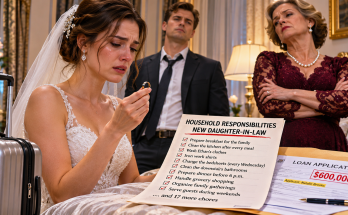
.MY DAUGHTER-IN-LAW MADE ME SIT IN THE GARAGE WHILE HER FAMILY CELEBRATED INSIDE THE HOUSE I HAD PAID FOR—SO I QUIETLY STOPPED FUNDING THEIR LUXURY LIFESTYLE. TWO WEEKS LATER, MY SON SHOWED UP AT MY DOOR WITH A HIDDEN DOCUMENT AND WHISPERED, “MOM, I FINALLY KNOW WHY MY WIFE NEVER WANTED YOU AT OUR FAMILY DINNERS…”
## PART 1 — THE GARAGE WAS WHERE THEY THOUGHT I BELONGED
The night my daughter-in-law told me to eat dinner in the garage, I didn’t argue.
I didn’t cry.
I didn’t even raise my voice.
I simply looked at the woman standing in front of me, smiled politely, and said, “Of course, dear.”
Then I picked up my handbag and walked toward the garage.
What she didn’t know was that, before the night ended, I would make a phone call that would change everything.
My name is Margaret Wilson. I was sixty-seven years old, a retired school principal, and a widow who had spent most of her life believing that family was the one thing money could never replace.
My husband, Robert, and I had worked for thirty-eight years to build a comfortable life. We never owned expensive jewelry or traveled in luxury, but we saved carefully, paid off our home, and raised our only son, Daniel, to understand the value of hard work.
When Robert died, Daniel was the only person I had left.
At least, that’s what I believed.
Five years earlier, Daniel married Vanessa, a woman who could charm an entire room within minutes. She was beautiful, confident, and exceptionally good at making people believe she was generous.
In the beginning, I liked her.
I helped them purchase their first home by contributing $85,000 from my retirement savings. When Daniel’s business struggled, I covered several months of expenses. When Vanessa wanted to start an online boutique, I lent her money for inventory.
I never demanded repayment.
I never asked for interest.
Whenever Daniel thanked me, I told him the same thing.
“Build a good life, sweetheart. That’s all your father and I ever wanted.”
But gradually, something changed.
Vanessa began making comments about my clothes.
She complained that I called too often.
She suggested that I should spend more time with people my own age instead of visiting their house.
Then came the family gatherings.
Whenever Vanessa’s wealthy parents visited, I was suddenly given a reason not to join them.
Sometimes there wasn’t enough room at the table.
Sometimes they were discussing business.
Sometimes Vanessa claimed her mother preferred a quieter atmosphere.
And every time, Daniel told me the same thing.
“Mom, please don’t take it personally. You know how Vanessa is.”
I kept making excuses for him because I couldn’t bear to believe that my own son had become comfortable watching his wife disrespect me.
Then came Vanessa’s fortieth birthday.
She planned an elaborate celebration at the beautiful house Daniel and I had helped purchase. There were flowers in crystal vases, a professional caterer, expensive wine, and more guests than I could count.
I arrived early carrying a homemade apple pie.
It was Robert’s favorite recipe, and Daniel had loved it since childhood.
Vanessa opened the door wearing a silk dress.
Her smile disappeared when she saw me.
“Oh, Margaret. I didn’t realize you were coming so early.”
“You told me to arrive at five.”
She glanced at her watch.
“Right. Well, the guests aren’t here yet.”
I stepped inside.
“Where would you like me to put the pie?”
She pointed toward the kitchen without answering.
I placed it on the counter and began helping the caterer arrange the desserts. For nearly two hours, I carried plates, folded napkins, and filled glasses while Vanessa’s friends arrived.
Not once did she introduce me properly.
When someone asked who I was, she simply said, “Daniel’s mother.”
No warmth.
No acknowledgment that I had helped them build the life they were celebrating.
Then Vanessa’s parents arrived.
Her father, Charles, wore an expensive suit. Her mother, Linda, carried a designer handbag and immediately began complimenting the house.
“Vanessa, darling, this place looks incredible! You two have done so well for yourselves.”
Vanessa smiled.
“We’ve worked very hard.”
I stood beside the kitchen counter, holding a stack of plates.
I almost laughed.
Almost.
Because I remembered sitting at my banker’s desk five years earlier, signing the transfer that had helped them secure the house.
But I said nothing.
At seven o’clock, everyone gathered around the dining table.
I started toward an empty chair beside Daniel.
Vanessa stepped in front of me.
“Oh, Margaret. Could you do me a favor?”
“What is it?”
“Would you mind sitting in the garage for dinner? My parents brought some business associates, and we need every seat in the dining room.”
I stared at her.
“The garage?”
She gave a small, impatient sigh.
“It’s clean. There’s a chair and a little table. You can eat there comfortably. I just don’t want tonight to become awkward.”
I looked past her.
Daniel was standing beside his father-in-law.
He had heard every word.
Our eyes met.
I waited for him to say something.
Anything.
Instead, he looked away and adjusted his cuff.
That was the moment something inside me broke—not loudly, but completely.
I had spent years telling myself that my sacrifices were acts of love.
Now I realized that my silence had allowed other people to treat my love as an entitlement.
I picked up my handbag.
“Certainly,” I said.
Vanessa looked relieved.
I walked through the kitchen, opened the garage door, and sat on a folding chair beside the lawn mower.
A small plastic table stood near the wall. Someone had left a paper plate and a bottle of water on it.
Through the open doorway, I could hear laughter from the dining room.
Then I heard Vanessa’s father say, “You know, Daniel, you’ve done exceptionally well. Not everyone your age can afford a house like this.”
Daniel replied, “Thank you, sir. We were fortunate.”
Fortunate.
I looked at the photograph of Robert in my handbag.
We had worked overtime, skipped vacations, and saved for decades. I had given Daniel money that I should have kept for my own retirement.
And now I was sitting beside a lawn mower while strangers praised my son’s success.
I didn’t eat the food Vanessa eventually sent out.
Instead, I packed my pie back into its container, stood up, and walked to my car.
Before leaving, I sent Daniel a short message.
*I hope you enjoyed your evening. We need to discuss the financial arrangements between us.*
He replied almost immediately.
*Mom, please don’t start drama on Vanessa’s birthday.*
I stared at the screen.
Then I put the phone away and drove home.
That night, I opened the folder where I kept my financial records.
There were monthly transfers to Daniel’s business.
Payments toward their property expenses.
A loan I had made to Vanessa’s boutique.
And a standing arrangement under which I had been helping with costs they claimed they couldn’t manage.
I reviewed every document carefully.
I wasn’t going to punish my son.
I wasn’t going to take back money that I had freely given.
But I was going to stop funding expenses I could no longer afford or justify.
The next morning, I contacted my financial adviser and attorney. We reviewed my obligations, identified which payments I could lawfully discontinue, and prepared written notice where necessary.
I canceled the voluntary monthly transfers.
I informed Vanessa that the boutique loan would be handled according to our written agreement, rather than through informal promises.
I also told Daniel that I would no longer pay expenses for his household.
Then I sat down with a cup of tea and waited.
It took four days for Vanessa to call.
“Margaret, there’s been a mistake,” she said sharply. “The money you usually send hasn’t arrived.”
“There hasn’t been a mistake.”
“What do you mean?”
“I won’t be sending it anymore.”
She fell silent for a moment.
Then her voice became colder.
“You’re doing this because of the birthday dinner?”
“I’m doing this because I need to protect my retirement and make my own financial decisions.”
“You’re making Daniel’s life difficult.”
“No, Vanessa. Daniel and I are adults. He can make his own arrangements.”
She hung up.
For the next ten days, Daniel didn’t call.
I cried more than I expected, but I didn’t reverse my decision.
Then, on a rainy Tuesday evening, someone knocked on my front door.
It was Daniel.
He looked exhausted. His shirt was wrinkled, his eyes were red, and he held a thick brown envelope beneath his arm.
“Mom,” he said, stepping inside. “I need to apologize.”
I stood quietly.
He placed the envelope on the kitchen table.
“There’s something I found in Vanessa’s desk. I wasn’t looking for it. I was trying to find our mortgage papers.”
His hands trembled.
“Mom, I think I’ve been lied to for years.”
I looked at the envelope.
“What did you find?”
Daniel swallowed hard.
Then he opened it and pulled out a document bearing my name.
“Vanessa told me you gave us the money for the house because you wanted to help us,” he whispered. “But this document says something completely different.”
He pushed the paper toward me.
I read the first paragraph.
And suddenly, I understood why Vanessa had spent so many years trying to keep me away from her family.
**Because the money I had given my son wasn’t the only thing she had been hiding.**
—
## PART 2 — THE DOCUMENT THAT EXPOSED THE LIE
For several seconds, I couldn’t speak.
The document was a copy of a financial agreement signed five years earlier, shortly before Daniel and Vanessa purchased their house.
I remembered the meeting clearly.
Daniel had explained that the bank needed additional proof of funds before finalizing the purchase. I had agreed to contribute $85,000 toward the down payment, believing it would give my son a more secure start in life.
But the document in front of me described the money as a loan.
Not a gift.
And beneath the financial terms was a clause I had never seen before.
It stated that, if the property were sold or refinanced under certain conditions, my contribution would be acknowledged and settled according to the agreement.
I looked at Daniel.
“Did you know about this?”
He shook his head.
“Vanessa told me you insisted on making it a gift. She said you didn’t want anything in writing because you were helping your own son.”
I studied his face.
“Did you ever ask me?”
His eyes filled with tears.
“No.”
That answer hurt more than I expected.
I had made mistakes. I had given too much, stayed quiet too long, and confused financial support with family harmony.
But Daniel had also chosen not to ask questions.
He had accepted the story that made his life easier.
“What else is in the envelope?” I asked.
Daniel pulled out several pages.
There were emails between Vanessa and her father, bank correspondence, and a printed message from a private family conversation.
I didn’t read everything immediately.
Instead, I asked Daniel to explain what had happened.
He told me that their financial situation had become more complicated than he realized. Vanessa’s boutique had accumulated debts, and the household expenses were higher than they could comfortably manage.
When Daniel suggested selling the house or reducing their spending, Vanessa became furious.
She told him that her parents would be humiliated if they learned the truth.
Then he found the envelope.
Inside were documents showing that Vanessa had repeatedly described my contribution differently depending on whom she was speaking to.
To Daniel, it had been a gift.
To the bank, it had been presented as part of their available funds.
In private messages to her father, she referred to the money as something she had successfully obtained from me.
Daniel stared at the table.
“She told her parents she had negotiated everything herself,” he said. “She said you offered the money because you were desperate to stay involved in our lives.”
I closed my eyes.
For years, I had wondered why Vanessa treated my presence as an inconvenience.
Now I began to understand.
She had built a story in which she was the successful daughter, Daniel was the ambitious husband, and I was an interfering older woman who occasionally helped when asked.
The truth threatened that image.
But I wasn’t going to make accusations based on a handful of documents.
“Daniel,” I said, “we need to be careful. Some of these papers may be incomplete, and we don’t know whether every statement is accurate. Have you spoken to an attorney?”
“Not yet.”
“Then we will start there.”
He looked surprised.
“You’re not angry?”
I gave a tired laugh.
“Of course I’m angry. But anger won’t tell us what these documents legally mean.”
The following morning, I met with my attorney, Helen Brooks, and brought copies of the records.
She reviewed the agreement, the transfer records, and the correspondence Daniel had found.
Her expression grew serious.
“This needs a proper legal review,” she said. “The agreement may be important, but we need to establish exactly what was signed, whether the terms were incorporated into the property transaction, and whether the parties understood the same arrangement.”
I nodded.
I wasn’t interested in inventing a claim or using the law to frighten my family.
I wanted the truth.
Helen explained that we should preserve the documents, verify their origins, and avoid making threats before the facts were established.
She also recommended that Daniel obtain independent legal advice rather than relying on anyone connected to Vanessa’s family.
For the first time, my son seemed to understand how serious the situation was.
Over the next week, we gathered the original bank records and reviewed the correspondence surrounding the house purchase.
Several details became clearer.
My contribution had been transferred directly into the transaction.
There was also a separate written record indicating that the money was not intended to be an unconditional gift.
But one issue remained unresolved: whether the final property documents reflected that understanding correctly.
Helen said we would need further information before drawing conclusions.
Meanwhile, Daniel returned home and confronted Vanessa.
He told me about the conversation the next day.
At first, she denied everything.
Then she claimed she had only used different language because she didn’t want her parents to worry.
When Daniel showed her the emails, she accused him of invading her privacy.
Finally, she said something that made him realize how far apart they had become.
“You need to choose,” she told him. “Your mother or your wife.”
Daniel sat in my kitchen and repeated those words.
I reached across the table.
“You don’t have to choose between loving your mother and being a responsible husband. But you do have to choose honesty.”
He stared at his hands.
“I should have stood up for you at the birthday dinner.”
“Yes,” I said softly. “You should have.”
He began to cry.
“I saw you walk into the garage, Mom. I watched you go, and I still didn’t say anything. I told myself it was easier to keep the peace.”
I took a deep breath.
“Keeping the peace isn’t the same as doing the right thing.”
For a while, neither of us spoke.
Then Daniel asked whether I would ever forgive him.
I looked at the little boy I had once walked to school, the teenager who had cried when his father died, and the grown man who had allowed his wife to humiliate me.
“I love you,” I told him. “But forgiveness doesn’t mean pretending nothing happened. You need to show me that you understand what you did.”
He nodded.
“I will.”
A few days later, Vanessa’s father called me.
I almost didn’t answer.
“Margaret,” Charles said, sounding unusually uncomfortable. “I think we need to discuss what has happened.”
“What exactly do you want to discuss?”
He hesitated.
“Vanessa has told us that you are threatening to take their house.”
I sat straighter.
“I have made no such threat.”
“She says you gave them money and are now demanding it back.”
“That is not what I said. I am seeking legal advice about an agreement I recently discovered.”
Charles went quiet.
Then he admitted that Vanessa had told her parents a very different story about the original contribution.
He had believed the money was a gift she had persuaded me to provide.
He had also believed that I was wealthy enough to help without any effect on my own financial security.
I explained that I was retired, that my savings were finite, and that no one had the right to assume I could support another household indefinitely.
Charles apologized for his part in the misunderstanding.
It wasn’t a complete resolution, but it was the first honest conversation we’d ever had.
Then he told me something unexpected.
“Margaret, there’s one more thing you should know. Vanessa asked me to keep a letter from you several years ago. She said it was a private matter and that Daniel didn’t need to see it.”
My stomach tightened.
“What letter?”
“I don’t know exactly what it said. She brought it to our house, and I put it in a file with some of the documents from the property purchase.”
“Do you still have it?”
“I believe so.”
I asked him not to alter or discard anything. Helen could arrange a proper way to obtain the letter and verify its contents.
That afternoon, Daniel came to my house again.
He looked frightened.
“Mom, Vanessa says her father has contacted you.”
“He has.”
Daniel lowered his head.
“She told me you were trying to turn her parents against her.”
“I haven’t asked anyone to take sides.”
He sat down.
Then he said the words I would remember for the rest of my life.
“Mom, I think she knew all along that you believed the money was a loan. She just counted on me never checking.”
I didn’t answer immediately.
Because if he was right, this wasn’t merely a disagreement about money.
It was a betrayal that had been allowed to grow for years because everyone had found it easier to remain silent.
Two days later, Helen contacted me.
Charles had located the letter.
It was sealed in an old folder, dated five years earlier, and addressed to me.
But it had never reached my hands.
Helen arranged for the document to be reviewed and its origin assessed before anyone relied on it.
When I finally read the letter, my hands began to shake.
It contained a message from Vanessa written shortly before the house purchase.
She had asked me to sign the financial papers carefully because she wanted Daniel to have security if anything happened to me.
But the final paragraph was what stopped my heart.
**“Please don’t tell Daniel about the separate agreement. If he knows the money is a loan, he may refuse to accept your help.”**
I read it twice.
Then I looked at Helen.
“What does this mean?”
She folded her hands.
“It means we need to establish whether this letter is authentic and how it relates to the signed documents. But if it is genuine, it could be important evidence of what Vanessa understood at the time.”
I stared at the paper.
For five years, I had believed I was helping my son build a future.
Now I had reason to believe that someone had deliberately kept us from understanding the same financial arrangement.
And the next step would determine whether the truth could finally be established.
—
## PART 3 — THE DAY MY SON FINALLY STOOD BESIDE ME
The legal review took several weeks.
During that time, I didn’t contact Vanessa to argue. I didn’t post accusations online or involve distant relatives in the dispute.
I had learned something important.
When emotions are high, the loudest person isn’t necessarily the one telling the truth.
I wanted the facts established properly.
Helen examined the financial agreement, the bank records, and the correspondence. Daniel obtained his own legal advice, and the relevant documents were reviewed alongside the records from the original property transaction.
The results were not as simple as I had hoped.
Some of the paperwork supported my understanding that the contribution was intended to be repaid under certain circumstances. Other documents were less clear.
The letter appeared consistent with the records from that period, although its legal significance still had to be considered alongside the signed agreements.
What mattered most was that the evidence contradicted Vanessa’s claim that the entire arrangement had always been understood as an unconditional gift.
Helen advised us to pursue a negotiated resolution rather than turn the dispute into a public battle.
I agreed.
I didn’t want to destroy Daniel’s home.
I wanted the truth acknowledged, my financial interests protected, and the relationship with my son given a chance to heal.
When Daniel learned what the review had found, he asked me to meet him at a quiet café.
He arrived early and stood when I entered.
For a moment, I saw the little boy who used to run toward me after school.
Then he pulled out my chair.
“Mom, I owe you an apology.”
I sat down.
“I’m listening.”
He took a deep breath.
“I spent years believing that keeping Vanessa happy was the same as protecting my marriage. When she criticized you, I told you to ignore it. When she excluded you, I asked you to be patient. And when she sent you to the garage, I did nothing.”
His voice cracked.
“I watched my own mother be humiliated because I was afraid of an argument.”
I felt tears gathering, but I let him continue.
“I also never checked the paperwork because I trusted the explanation that made my life easier. I should have asked you directly. I should have listened.”
He looked at me.
“I can’t undo any of it. But I’m sorry.”
I reached across the table and held his hand.
“Daniel, I never expected you to agree with me about everything. I never expected you to fight with your wife for my sake. I only expected you to remember that I was a person who deserved respect.”
He nodded, wiping his eyes.
“I understand that now.”
“Then show me.”
He promised he would.
And this time, I believed that he understood what the promise required.
Over the following weeks, Daniel and Vanessa began working with their respective advisers to resolve the financial dispute.
They reached a written settlement that clarified the treatment of my contribution and established a practical arrangement consistent with the legal advice they received.
I won’t pretend the process was easy.
There were difficult conversations, painful admissions, and moments when I wondered whether our family would ever feel normal again.
But the uncertainty finally began to lift.
Vanessa eventually came to my house.
She arrived without her usual designer handbag or carefully practiced smile. She stood at the door looking nervous.
“Margaret, may I come in?”
I stepped aside.
We sat at the kitchen table where Daniel had first shown me the envelope.
For several minutes, she said nothing.
Then she looked at me.
“I treated you terribly.”
I waited.
“I convinced myself that because you had helped us financially, you would always help us. I started seeing your generosity as something we could depend on instead of something you chose to give.”
Her eyes filled with tears.
“And at the birthday dinner, I was embarrassed by the idea of my parents asking questions about how we had afforded everything. So I pushed you aside rather than face the truth.”
She paused.
“I knew you were hurt, and I let Daniel believe you were simply being difficult. I should never have done that.”
I looked at her for a long time.
“Why did you think making me feel small would make your life bigger?”
She lowered her head.
“I don’t know.”
I believed that she was sorry, at least in that moment.
But I also knew that an apology was only the beginning.
“Vanessa, I can accept an apology,” I said. “But trust takes longer. I won’t return to the old financial arrangements, and I won’t accept being treated as an inconvenience in exchange for being part of this family.”
She nodded.
“I understand.”
“I hope you do.”
When she left, I didn’t feel triumphant.
I felt tired.
But it was a different kind of tiredness—the exhaustion that comes after finally saying what should have been said years earlier.
A month later, Daniel invited me to dinner.
I almost declined.
Then he called and said, “Mom, I’d really like you to come. And this time, there’s something I want you to see.”
When I arrived, the dining table was set for four.
Daniel stood in the doorway.
Vanessa came from the kitchen carrying a bowl of roasted vegetables.
Her parents were there, too.
Charles approached me.
“Margaret, I owe you an apology for believing a story without hearing yours.”
Linda nodded.
“We should have asked questions instead of making assumptions.”
I thanked them.
Then I noticed something unusual.
There was a place card at the head of the table.
It read:
**MARGARET — FAMILY**
I stared at it.
Daniel walked over and gently pulled out the chair.
“That’s your seat, Mom.”
For a moment, I couldn’t speak.
It wasn’t the chair itself that mattered.
It was the fact that my son had finally understood that I shouldn’t have to earn a place in his life by paying for it.
We sat down together.
The conversation was awkward at first. Nobody pretended the past had disappeared. But for the first time in years, I was included in the discussion instead of treated like a problem to be managed.
After dinner, Daniel walked me to my car.
“Mom?”
“Yes?”
“I’ve been thinking about Dad.”
I smiled sadly.
“So have I.”
“He used to say that the way people treat you when they think you have nothing to offer tells you more than the way they treat you when they need something.”
I felt my throat tighten.
“That sounds like your father.”
Daniel looked toward the house.
“I wish he’d been here to teach me that before I made so many mistakes.”
I touched his cheek.
“Your father would have wanted you to learn. Not to spend the rest of your life punishing yourself.”
He hugged me.
And this time, I hugged him back without pretending that everything was already forgiven.
Months passed.
I began spending more time with my friends. I joined a local gardening club, took a short trip I’d postponed for years, and finally replaced the old living-room sofa Robert and I had bought when we first married.
I stopped checking my bank account to see whether Daniel’s household needed another transfer.
I stopped worrying that saying no would make me a bad mother.
And I discovered that protecting my peace didn’t mean I loved my son any less.
It meant I had finally learned to love myself, too.
Daniel and Vanessa continued working through the consequences of their decisions. Their marriage had difficult days, but they began making financial choices together rather than relying on assumptions and hidden arrangements.
Vanessa didn’t become a different person overnight.
Neither did Daniel.
But they learned that family relationships could not survive on appearances alone.
One Sunday, Daniel visited me with a small framed photograph.
It showed Robert holding Daniel when he was a baby. My husband was smiling down at our son, looking as though the entire world had been placed in his arms.
Daniel placed it on my mantelpiece.
“I found it in an old box,” he explained. “I thought you should have it here.”
I ran my fingers over the frame.
“Thank you, sweetheart.”
He looked around my living room.
“You seem happier, Mom.”
“I am.”
“Because we fixed things?”
I thought about the question.
“Partly. But mostly because I finally stopped believing that I had to sacrifice everything to prove that I loved you.”
Daniel nodded slowly.
Then he said, “I don’t ever want you to feel that way again.”
I smiled.
“Then remember this. Love is something we give freely. Respect is something we owe one another. And money should never be the price of belonging to a family.”
He hugged me before leaving.
That evening, I sat beside Robert’s photograph and thought about the night I had eaten no dinner in the garage.
At the time, I had believed that moment represented the end of my relationship with my son.
Instead, it became the moment I stopped accepting a relationship built on silence.
I had once believed that being a good mother meant saying yes whenever my child needed me.
Now I understood that a good mother could also set boundaries, ask difficult questions, and refuse to be mistreated.
I still loved Daniel.
I still wanted Vanessa to become a better person.
And I still hoped that our family would grow closer with time.
But I no longer confused generosity with obligation or forgiveness with forgetting.
Because the greatest lesson I learned wasn’t about money, property, or a hidden document.
It was this:
**You can love your family with your whole heart without allowing them to treat you as though your only value is what you can give them.**
And sometimes, the moment you finally stand up for yourself is the moment your family gets its first real chance to stand together.