# My Seven-Year-Old Nephew Whispered, “Aunt Rachel… Please Don’t Let Dad Find Out I Told You.”
## PART 1 — The Secret Under the Bed
My name is Rachel Morgan.
I never imagined that one sentence from a child could change the way I saw my own family forever.
My older brother, David, had always been the person everyone admired.
He was successful.
Confident.
The kind of man people trusted immediately.
He owned several restaurants, lived in a beautiful house outside Denver, and always appeared to have the perfect family.
His wife, Lauren, was equally impressive.
They hosted holiday dinners.
They donated to charities.
They posted pictures online showing their happy life with their two children.
Their son, Noah, was seven years old.
And until that winter, I believed he was the luckiest kid in the world.
Then came Thanksgiving.
I drove three hours to David’s house with gifts in my trunk and excitement in my heart.
Noah used to run toward me the second I arrived.
“Rachel!”
He would jump into my arms.
But that day was different.
He opened the door slowly.
No smile.
No excitement.
Just a quiet:
“Hi, Aunt Rachel.”
I immediately noticed something.
He kept pulling down the sleeves of his shirt.
Even though the house was warm.
“Are you cold?”
He shook his head.
“No.”
Something about his voice bothered me.
Inside, everything looked perfect.
The table was decorated.
The fireplace was glowing.
David was laughing with guests.
Lauren was serving food.
Nobody looking from the outside would have noticed anything wrong.
But I did.
Because I noticed Noah.
Every time David spoke loudly, Noah stopped moving.
Every time Lauren walked near him, he became quiet.
At dinner, David placed a plate in front of Noah.
“Finish everything.”
Noah looked down.
“I’m not hungry.”
David’s smile disappeared.
“You know the rule.”
Noah picked up his fork.
His hands were shaking.
I watched carefully.
After dinner, Noah disappeared upstairs.
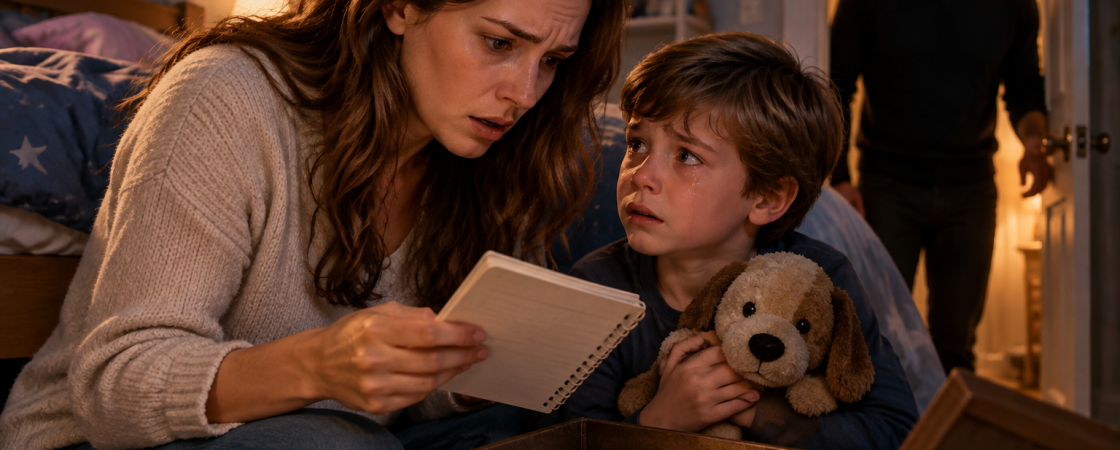
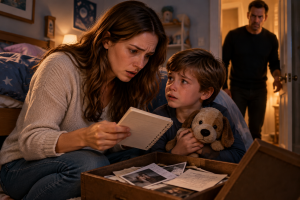
A few minutes later, I found him sitting on the floor of his bedroom.
He was holding an old stuffed dog.
“Hey.”
He looked up.
“Can I ask you something?”
“Of course.”
He looked toward the door.
Then whispered:
“Do you think kids can make mistakes and still be loved?”
My heart sank.
“Of course.”
“Even big mistakes?”
“Yes.”
He looked down.
“Okay.”
A long silence passed.
Then he whispered:
“Can I show you something?”
He crawled underneath his bed and pulled out a small box.
Inside were papers.
Photographs.
And a notebook.
I looked at him.
“What is this?”
He swallowed.
“Things I wrote down.”
I opened the notebook.
The pages were filled with dates.
Short sentences.
Things a seven-year-old should never have needed to record.
**Dad got angry again.**
**Mom said not to tell anyone.**
**I broke a glass and Dad said I was useless.**
My hands started shaking.
“Noah…”
He grabbed my sleeve.
“Please don’t tell Dad.”
“Why?”
His eyes filled with tears.
“Because last time someone asked questions, Dad got really mad.”
I felt my stomach turn.
“Who asked questions?”
“My teacher.”
“What happened?”
“She stopped coming to our house.”
I stared at him.
That didn’t make sense.
Then I heard footsteps in the hallway.
Noah immediately closed the notebook.
David appeared at the door.
“What are you two doing?”
I forced a smile.
“Just talking.”
His eyes moved to the box.
“What’s that?”
Noah froze.
Before David could walk closer, I stood up.
“Just old toys.”
David stared at me.
Too long.
Then he smiled.
“Dinner is almost ready.”
After he left, Noah whispered:
“He knows when people are trying to help.”
I looked at the little boy sitting in front of me.
And I made a decision.
I wasn’t leaving him alone.
That night, after everyone went to sleep, I sat in my car outside David’s house.
I opened my laptop.
Years earlier, I had worked in financial investigations.
I knew how to find patterns.
I knew how to preserve information.
I knew how to document without alerting the person being investigated.
I started saving everything Noah had shown me.
Then I noticed something strange.
The notebook wasn’t the only thing in the box.
At the bottom was a folded medical document.
I opened it.
My heart stopped.
It was a hospital report.
For Noah.
The date was two years earlier.
The injury listed was:
**Broken wrist.**
The explanation:
**Accidental fall.**
But underneath was a handwritten note from the doctor.
One sentence.
**“Child appeared fearful when asked how injury occurred.”**
I stared at the paper.
Noah had been hurt before.
And someone had believed him.
The next morning, I called a friend who worked in child advocacy.
I didn’t accuse anyone.
I gave only facts.
She told me what steps to take.
Then she called me back three hours later.
Her voice sounded different.
“Rachel?”
“Yes?”
“I checked what records were available.”
“What did you find?”
A pause.
Then:
“Noah has had five medical visits in three years.”
My hands went cold.
“Five?”
“Yes.”
“Why?”
“Different injuries.”
I closed my eyes.
“What kind?”
She took a breath.
“Bruises. A burn. A shoulder injury.”
I couldn’t speak.
Then she said:
“Rachel… someone has been explaining these away for a long time.”
“Who?”
Another pause.
Then:
“Your brother.”
—
# PART 2 — The Pattern Nobody Wanted to See
I spent the next week trying not to make a mistake.
That was the hardest part.
Every instinct told me to confront David.
To demand answers.
To ask how he could hurt his own child.
But anger doesn’t always protect people.
Sometimes it gives the person causing harm time to hide.
So I stayed calm.
I kept visiting.
I kept listening.
And I watched.
I noticed things I had ignored before.
The way Noah apologized for things he didn’t do.
The way he asked permission to drink water.
The way he looked at his father before answering simple questions.
Children shouldn’t be afraid of every wrong answer.
One afternoon, I picked Noah up from school.
He was excited because he had made a drawing.
Then he suddenly stopped.
“What happened?”
He looked toward the school entrance.
“My teacher said she wants to talk to you.”
My heart tightened.
“Why?”
He whispered:
“Because she noticed.”
“Noticed what?”
He didn’t answer.
Inside the school, his teacher, Ms. Harper, looked nervous.
“I wasn’t sure if I should say anything.”
“You can tell me.”
She closed the classroom door.
“Noah is a wonderful child.”
“I know.”
“But he apologizes constantly.”
I looked down.
“He thinks everything is his fault.”
I felt sick.
“Has he ever said anything?”
“Not directly.”
“Then why are you concerned?”
She opened a folder.
Inside were drawings Noah had made.
One showed a little boy standing outside a house.
Another showed a man with angry eyes.
Another showed a child hiding.
“He says they’re just drawings.”
“But?”
“But children often communicate through drawings when they don’t feel safe speaking.”
That night, I made a difficult call.
I reported what I knew.
Not assumptions.
Not accusations.
Facts.
The next day, authorities began the process of evaluating Noah’s situation.
Then something unexpected happened.
Lauren called me.
Her voice was shaking.
“Rachel.”
“Yes?”
“Please don’t tell them everything.”
I froze.
“What?”
“Please.”
“Lauren, what are you talking about?”
She started crying.
“I know.”
Those two words stopped me.
“You know?”
“Yes.”
My heart pounded.
“Know what?”
Silence.
Then:
“I know what David does.”
I couldn’t speak.
“Then why didn’t you stop him?”
She cried harder.
“Because I was scared.”
“Of him?”
“Yes.”
I sat there silently.
Then Lauren said something that changed everything.
“Rachel, David has been hiding something bigger.”
“What?”
“He doesn’t just control Noah.”
“What does that mean?”
“He has been controlling everyone around him.”
She told me David had spent years creating a perfect image.
He threatened employees.
Manipulated family members.
Used money to make problems disappear.
Then she whispered:
“He has a file.”
“What file?”
“About everyone.”
My stomach tightened.
“Why?”
“Insurance.”
“Against what?”
She hesitated.
“Against people leaving him.”
That night, police searched David’s office.
They found financial records.
Private recordings.
Documents.
But the biggest discovery wasn’t about Noah.
It was about me.
Because inside David’s locked cabinet was a folder with my name on it.
I opened it.
Inside were printed emails.
Photos.
Notes.
And one page that made my blood run cold.
It said:
**“Rachel Morgan may become a problem if Noah talks.”**
I stared at the words.
David wasn’t just hiding what happened.
He was watching me.
Then my phone rang.
Unknown number.
I answered.
A man’s voice said:
“Rachel, if you want Noah safe, you need to listen carefully.”
“Who is this?”
A pause.
Then:
**“Someone who helped David hide everything.”**
—
# PART 3 — The Person Who Protected the Secret
I didn’t sleep that night.
I kept thinking about one thing.
Someone had helped David.
Someone had known.
The next morning, I met the person who called me.
It was David’s former assistant.
Her name was Olivia.
She looked exhausted.
“I should have spoken sooner.”
“Why didn’t you?”
“Because I was afraid.”
She placed a folder on the table.
Inside were copies of emails.
Messages.
Reports.
“David paid people to stay quiet.”
I looked through the documents.
Teachers.
Employees.
Even a doctor.
My stomach turned.
“He covered everything.”
Olivia nodded.
“He knew exactly how to make people doubt themselves.”
Then she handed me one final document.
A resignation letter.
From Noah’s former school counselor.
I read it.
The counselor had tried to report concerns.
After that, David threatened legal action.
The counselor quit.
I closed my eyes.
All those people had seen pieces of the truth.
But nobody had the whole picture.
Until Noah.
A few months later, Noah was living somewhere safe.
He was getting help.
He was learning that mistakes didn’t make him unlovable.
One afternoon, I visited him.
He showed me a drawing.
This time it was different.
It showed a house.
A tree.
And a family.
“What is this?”
He smiled.
“My new life.”
I hugged him.
“You like it?”
“Yes.”
Then he asked:
“Am I still allowed to miss my dad?”
I felt tears in my eyes.
“Yes.”
“Even if he hurt me?”
“Yes.”
“Why?”
“Because feelings are complicated.”
He thought about that.
Then nodded.
Years later, I still remember the little boy who whispered:
“Would you believe me?”
Because that question wasn’t really about whether I believed him.
It was about whether any adult would finally listen.
And I learned something important.
Children don’t always need someone to be their hero.
Sometimes they just need one person brave enough to believe them.
But there was one thing I never expected.
Months after David was arrested…
I received a letter.
No return address.
Inside was a single photograph.
It showed Noah’s old bedroom.
The same room where he kept his notebook.
On the back were five words:
**“You still don’t know everything.”**