PART 1 — MY PARENTS SUED ME FOR GRANDPA’S FARMHOUSE. THEY HAD NO IDEA WHO THEIR DAUGHTER HAD BECOME.
The moment I walked into a Maryland courtroom wearing my Navy dress uniform, my parents stopped smiling.
My father laughed when he first saw me.
My mother whispered, “She still thinks that ridiculous uniform makes her somebody.”
But neither of them knew what was about to happen.
Then Judge Albright examined the medals on my chest, looked at my face, and suddenly froze.
He leaned forward and whispered:
“My God… is that really her?”
My father’s smile disappeared.
Because after twelve years of pretending I didn’t exist, my parents had finally discovered something about the daughter they had spent their entire lives underestimating.
And they were about to regret bringing me into that courtroom.
Two days earlier, I had been trimming rose bushes outside my small home near Annapolis when a cream-colored envelope arrived.
It was from the county courthouse.
The case number was 5192C.
The plaintiffs were Donald and Patricia Holloway.
My parents.
And the defendant was me.
Joanna Holloway.
My own mother and father were suing me over my grandfather’s farmhouse.
I sat at my kitchen table, reading the papers again while my old hound, Buster, rested his head against my knee.
“Well, Buster,” I whispered, “I suppose they’ve found another reason to hate me.”
It had been twelve years since I last visited my childhood home.
When I joined the Navy, my father called my decision embarrassing.
He wanted a daughter who would marry a respectable man, raise children, and stay close to home.
My mother wanted someone who would never challenge her opinions.
Instead, I became a military officer.
After I completed officer training, neither parent attended my graduation.
My father never called.
My mother sent me one message:
“We raised a polite daughter, not a military officer.”
I read it once.
Then I stopped asking them to be proud of me.
I built my career without their support.
I served overseas, led personnel, coordinated dangerous operations, and made decisions that sometimes determined whether young sailors came home alive.
Then an explosive device struck our convoy transport during a deployment.
I survived.
But my knee didn’t.
Multiple surgeries followed. My leg was reconstructed, and I returned home with permanent scars, a painful limp, and a military disability pension.
I rarely discussed what happened overseas.
My grandfather Walter had always been different from my parents.
He believed in me.
Before he passed away, he left me his countryside farmhouse on Sycamore Ridge Road.
It was the only place in my family where I had ever felt genuinely loved.
Since 2013, I had personally paid every property tax bill on that land.
Every single year.
Even while stationed overseas.
My parents, however, were now telling the court that they had paid everything themselves.
They claimed I had abandoned the property and demanded legal control over it.
It was a lie.
And I knew exactly how much evidence I had to prove it.
That evening, I opened the wooden chest at the foot of my bed.
Inside were my Navy dress uniform, my ribbons, official service records, and a folded burial flag belonging to my late teammate, Wayne.
I carefully lifted the uniform.
“Looks like we’re going to court, Buster.”
The next morning, I drove past Grandpa Walter’s farmhouse.
The old hickory tree was dying. The paint was peeling, and one corner of the porch had begun to sag.
But it was still home.
I remembered Grandpa standing on that porch, holding a hammer and telling me:
“Never let anybody convince you that you don’t deserve the things you’ve worked for.”
I had never forgotten those words.
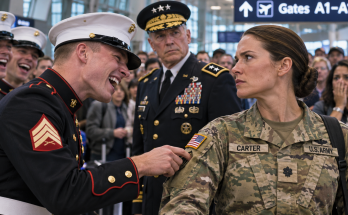
At the courthouse, I entered the courtroom wearing my complete Navy dress uniform.
My father immediately looked annoyed.
My mother stared at my ribbons as though they offended her.
Judge Albright entered and reviewed the case file.
“Mr. Holloway, you claim your daughter abandoned this property?”
“Yes, Your Honor,” my father answered confidently. “We’ve been maintaining it and paying all the expenses for years.”
The judge turned toward me.
“Commander Holloway, would you like to respond?”
My father’s expression changed.
He hadn’t expected the judge to address me by my rank.
I slowly stood, ignoring the pain in my reconstructed knee.
“Yes, Your Honor.”
But before I could continue, Judge Albright raised one hand.
“Actually, Commander, there’s something in this file your parents apparently don’t realize I already know.”
The courtroom became completely silent.
He reached into the thick folder and removed an official county document.
I recognized the signature immediately.
Grandpa Walter’s.
Then Judge Albright looked directly at my father.
And for the first time that morning, my father looked terrified.
Because the document in the judge’s hand contained a secret that could destroy the entire lawsuit.
And my parents had no idea what Grandpa had arranged before he died.
PART 2 — THE JUDGE OPENED GRANDPA’S DOCUMENT. MY FATHER COULDN’T EVEN LOOK AT ME.
My father suddenly shifted in his chair.
My mother stopped playing with her pearls.
Judge Albright carefully unfolded the document and examined the signature.
“Mr. Holloway, do you recognize this?”
My father swallowed.
“I… I don’t know what that is, Your Honor.”
The judge adjusted his glasses.
“This is a notarized property transfer and estate declaration signed by Walter Holloway before his death.”
My heart started beating faster.
Grandpa had never told me everything about his final arrangements.
I knew he had left me the farmhouse.
I knew the property had been legally transferred.
But I had never imagined he had prepared something else.
Judge Albright continued.
“According to this document, the farmhouse and its surrounding acreage were legally transferred to Joanna Holloway. The transfer was recorded, and the ownership was never revoked.”
My mother suddenly interrupted.
“That’s impossible! Walter would never have done that without discussing it with us!”
The judge looked over his glasses.
“Mrs. Holloway, your father-in-law was not legally required to obtain your permission.”
My father leaned forward.
“Your Honor, we were the ones looking after that property. We spent money on repairs. We maintained the land. She was never there!”
I remained silent.
The judge turned another page.
“Then perhaps you can explain these financial records.”
He placed several pages on the bench.
They were property tax receipts.
Every payment had been made from my military account.
The dates stretched back to 2013.
Some payments had been made while I was stationed overseas.
Others had been made during rehabilitation after my injury.
My father stared at the documents.
My mother looked at me.
“Where did you get those?”
I answered calmly.
“From my financial records. I have copies of every payment.”
My father shook his head.
“She’s manipulating the situation. We were only trying to protect the family property.”
Judge Albright interrupted him.
“Then why did you file a sworn statement claiming you personally paid every property tax bill?”
Nobody answered.
I reached into my folder and removed another document.
It was a bank statement showing the recurring payments.
Then I produced the county payment confirmations.
Finally, I placed a copy of Grandpa’s recorded deed on the table.
My father’s face had turned pale.
But I wasn’t finished.
“Your Honor, there’s something else.”
Judge Albright nodded.
I explained that I had discovered a second document among Grandpa’s old belongings.
It was a handwritten letter, dated several months before his death.
Grandpa had written that he knew my parents wanted control of the farmhouse.
He had watched them argue about selling the land for years.
He didn’t want the property divided or sold without my consent.
He had also included a specific instruction.
If anyone ever challenged my ownership, the original deed and supporting records were to be provided to the court.
My mother began shaking her head.
“That old man was confused near the end. He didn’t understand what he was signing.”
The judge looked at her sharply.
“Mrs. Holloway, the notary’s certification confirms that he signed this document voluntarily and was properly identified. Do you have evidence to challenge its validity?”
She said nothing.
My father suddenly stood.
“This is ridiculous! She’s our daughter! We have a right to that property!”
For the first time, I looked directly at him.
“No, Dad. You don’t.”
His face twisted.
“You ungrateful little girl. We raised you!”
I felt my damaged knee throbbing beneath my uniform.
But I stood straight.
“You raised me to believe that family meant something. Grandpa taught me that family also means protecting the people you love.”
My father opened his mouth.
Then the judge raised his hand.
“Mr. Holloway, sit down.”
He slowly lowered himself into his chair.
Judge Albright reviewed the remaining pages.
Then he asked the court clerk to bring forward the county’s official property record.
A few minutes later, the clerk returned with another folder.
The judge opened it.
His expression changed.
“There’s one more issue we need to address.”
My mother looked nervous.
My father looked confused.
Judge Albright turned toward them.
“According to the records, there was an additional filing concerning this property last year.”
My stomach tightened.
I had never seen that document.
The judge continued.
“It appears someone attempted to register a financial interest in the farmhouse without the legal owner’s authorization.”
My father suddenly looked down.
My mother grabbed his arm.
And then the judge read the name listed on the application.
Donald Holloway.
I stared at my father.
He had not simply claimed to pay the bills.
He had attempted to obtain legal control of property that did not belong to him.
And now the court wanted an explanation.
PART 3 — MY FATHER TRIED TO STEAL GRANDPA’S FARMHOUSE. THEN THE JUDGE REVEALED THE FINAL DOCUMENT.
For several seconds, nobody moved.
My father stared at the table.
My mother whispered something to him, but he didn’t answer.
Judge Albright placed the filing on the bench.
“Mr. Holloway, did you submit this application?”
My father cleared his throat.
“I was trying to protect the property.”
“Protect it from whom?”
He glanced toward me.
“From her. She was never around. We didn’t know what she was doing with the place.”
I almost laughed.
Not because anything was funny.
But because the man who had ignored twelve years of my military service was now pretending he had been worried about my responsibilities.
I finally spoke.
“Your Honor, I was overseas serving this country. When I returned, I was recovering from injuries sustained during deployment. But I never stopped paying for that property.”
I placed my final folder on the table.
Inside were copies of my deployment records, payment confirmations, property tax statements, and correspondence with the county.
The judge examined them carefully.
Then he asked my parents a question.
“Do either of you have a single document showing that you legally own this property?”
My mother looked at my father.
My father looked toward the floor.
Neither answered.
Judge Albright leaned back.
“Then I believe we have enough information to address this matter.”
He reviewed the deed one final time.
The courthouse was so quiet that I could hear the pages turning.
Then he announced his findings.
The property transfer was valid.
The recorded ownership belonged to me.
The tax records contradicted my parents’ sworn claims.
And the filing attempting to establish my father’s financial interest had no demonstrated legal basis.
My father suddenly raised his voice.
“You’re going to let her take everything from her own family?”
Judge Albright looked directly at him.
“Mr. Holloway, your daughter is not taking anything from you. The property was never yours.”
My mother’s eyes filled with tears.
She turned toward me.
“Joanna, please. We can settle this privately. We’re still your parents.”
I looked at her for a long moment.
I remembered being seventeen and telling her I wanted to join the Navy.
I remembered her saying she would rather tell people I had moved away than admit her daughter had chosen a military career.
I remembered my graduation ceremony.
The empty seats.
The phone calls that never came.
And the message that had stayed with me for twelve years.
“We raised a polite daughter, not a military officer.”
I took a slow breath.
“Mom, I didn’t stop being your daughter when I joined the Navy. You stopped treating me like one.”
She covered her mouth.
My father shook his head angrily.
“After everything we’ve done for you!”
I looked at him.
“What exactly have you done for me, Dad?”
He had no answer.
The judge then issued his ruling.
The lawsuit was dismissed based on the evidence presented, and my ownership rights remained intact.
The court also directed that the disputed property filing be referred for further review.
My parents were no longer smiling.
As I gathered my documents, Judge Albright asked me to wait.
“Commander Holloway.”
I turned.
He stood slightly and looked at my uniform.
“I want you to know that I remember your grandfather. Walter spoke about you often.”
My eyes began to sting.
The judge continued.
“He once told me that his granddaughter was the strongest person in his family. He said she had spent her life protecting people who couldn’t always protect themselves.”
I couldn’t speak.
Then he added quietly:
“He was very proud of you.”
Those six words hurt more than anything my parents had said.
Because the person whose approval I had wanted most was no longer alive to say them.
I walked out of the courtroom slowly.
My knee still hurt.
My uniform still felt heavy.
But for the first time in twelve years, I didn’t feel like I needed to prove anything to anyone.
Outside, I sat in my car and opened Grandpa Walter’s old letter again.
At the bottom, beneath his signature, he had written one final sentence:
“Joanna, a home isn’t just a piece of land. It’s the place where someone remembers who you really are. Keep yours, and never let anyone make you ashamed of the person you’ve become.”
I wiped my eyes.
Then I drove back toward Sycamore Ridge Road.
The farmhouse was waiting.
The porch needed repairing.
The hickory tree needed attention.
And the roses Grandpa had planted years ago were growing wild along the fence.
I knew exactly what I would do next.
I would restore the house.
Not because it was valuable.
But because it was the last thing my grandfather had given me that still felt like home.
My parents had spent twelve years pretending I was a family disappointment.
They had walked into court believing they could take away the one thing Grandpa had left me.
Instead, they learned that the daughter they had dismissed had built a life they knew absolutely nothing about.
And I learned something, too.
Sometimes the greatest victory isn’t making the people who hurt you regret what they did. It’s finally realizing that you no longer need their approval to live a meaningful life.
What would you have done in Joanna’s position? Would you ever forgive parents who tried to take away the only home your grandfather left you?