PART 1 — THE THREE EMPTY CHAIRS
The first thing I noticed when I opened my eyes was the sound of the heart monitor.
Beep.
Beep.
Beep.
My chest felt as though someone had placed a heavy stone on it, and every breath reminded me that only a few hours earlier, surgeons had been fighting to keep me alive.
I was lying in a private hospital room in Portland, Oregon, recovering from emergency heart surgery.
My name is Eleanor Whitmore. I was sixty-seven years old, a widow, and the mother of three grown children.
For most of my life, I believed being a good mother meant sacrificing everything for your children, even when they were old enough to stand on their own.
I had worked two jobs when they were young.
I had skipped vacations, worn the same winter coat for fifteen years, and quietly emptied my savings whenever one of them needed help.
When my husband died eight years earlier, I promised myself I would never allow my children to struggle if I could do something about it.
Perhaps that was my mistake.
The night before my surgery, all three of them had stood beside my hospital bed.
My oldest son, Robert, had kissed my forehead and promised, “Mom, don’t worry. We’ll all be here when you wake up.”
My daughter, Melissa, had squeezed my fingers.
“I’ll bring you your favorite flowers tomorrow.”
And my youngest son, Daniel, had smiled reassuringly.
“You’re not getting rid of us that easily.”
I remembered those promises as I slowly turned my head toward the chairs beside my bed.
They were empty.
All three chairs.
I looked toward the doorway, expecting someone to walk in.
Nobody came.
A nurse eventually entered to check my blood pressure.
“Good morning, Mrs. Whitmore. How are you feeling?”
“Where are my children?”
She glanced at the computer screen before answering.
“They were here earlier, but they left.”
“Left?”
“Yes. They stayed until the surgery was finished. They said they couldn’t afford to keep paying for parking.”
I stared at her.
“Parking?”
She nodded awkwardly.
“They mentioned the hospital charges were adding up.”
For several seconds, I couldn’t find my voice.
I had just undergone a dangerous operation.
My children knew there was a possibility I might never wake up.
And they had left because of parking fees?
“Did they say when they would return?”
The nurse hesitated.
“They didn’t give us a specific time.”
I turned toward the window.
Rain was falling against the glass, and the gray morning sky seemed to reflect exactly how I felt.
I didn’t want to cry.
I had spent too many years pretending I was stronger than I actually was.
But the tears came anyway.
I remembered Robert’s university tuition, which I had paid by working night shifts.
I remembered Melissa’s wedding, where I sold my diamond earrings to help cover the reception.
I remembered Daniel’s first apartment, the deposit for which had come from my retirement savings.
I had never kept a record of what I gave them.
They were my children.
I believed love wasn’t supposed to come with invoices.
Yet there I was, lying in a hospital bed, wondering whether I had become such a burden that even sitting beside me was too expensive.
The nurse noticed my monitor speeding up.
“Please don’t upset yourself, Eleanor. You need to rest.”
I nodded, but my heart was already breaking in a way no surgeon could repair.
About twenty minutes later, someone knocked.
A tall gentleman entered wearing a beautifully tailored charcoal suit, a white shirt, and a dark green tie.
He appeared to be in his early sixties.
His silver hair was neatly combed, and he carried a brown leather briefcase.
The nurse immediately stood straighter.
“Good morning, Mr. Bennett.”
He smiled politely.
“Good morning. Is this Eleanor Whitmore?”
I wiped my cheeks.
“Yes. Have we met?”
He approached my bed.
“Not recently. But I have been looking for you for almost forty years.”
I stared at him in confusion.
He pulled a chair closer and sat down.
“My name is Jonathan Bennett.”
I searched my memory.
Nothing.
Then he said something that made my breath catch.
“When I was eleven years old, you bought my breakfast and lunch at school for nearly two years.”
Suddenly, a forgotten memory returned.
A little boy.
Thin, quiet, and always wearing the same faded brown sweater.
His name had been Johnny.
He attended Lincoln Elementary School, where I worked as a cafeteria assistant before becoming a full-time administrative clerk.
His mother had passed away, and his father struggled with alcoholism.
Johnny often arrived at school without breakfast.
Sometimes he pretended he wasn’t hungry because he didn’t have money for lunch.
I remembered him sitting alone at the end of the cafeteria table, watching other children eat.
One winter morning, I found him standing near the kitchen, holding an empty lunch tray.
“Didn’t you get your lunch today, sweetheart?” I had asked.
He shook his head.
“I’m not hungry.”
But I knew he was.
So I purchased him a meal.
The next day, I did it again.
And the day after that.
Eventually, I arranged for him to receive breakfast and lunch every school day.
I never told him I was paying.
I simply said the school had extra meal vouchers.
Now this well-dressed stranger was sitting beside my hospital bed, holding an old photograph.
He placed it on my blanket.
It showed a skinny eleven-year-old boy standing beside a woman in a cafeteria.
I recognized myself immediately.
“Oh, Johnny…”
His eyes filled with tears.
“Nobody has called me that in decades.”
I reached for his hand.
“I remember you. You were such a sweet little boy.”
He smiled.
“You were the first person who made me feel that I mattered.”
He explained that after graduating, he had received a scholarship, attended medical school, and eventually founded a healthcare company.
Today, he owned a network of hospitals, rehabilitation centers, and medical research facilities across the country.
But he had never forgotten the woman who had quietly fed him when he had nothing.
“I built my first foundation in your honor,” he said.
I shook my head.
“You don’t have to honor me. I only bought you lunch.”
He leaned forward.
“Mrs. Whitmore, you gave me something much more important than lunch. You gave me the feeling that somebody cared whether I survived another day.”
I began crying again.
He gently held my hand.
Then his expression changed.
He glanced at the empty chairs.
“Where is your family?”
I tried to smile.
“They had other things to do.”
He didn’t look convinced.
I finally told him what the nurse had said.
“They left because parking was too expensive.”
Jonathan remained silent.
Then he opened his briefcase.
“I was hoping to meet your children today,” he said.
“Why?”
“Because I wanted to thank you properly and perhaps give your family some good news.”
He removed a thick folder.
“But before I explain that, there’s something I discovered while trying to locate you.”
My stomach tightened.
“What is it?”
He opened the folder and placed several documents on my blanket.
The first page contained the name of my son, Robert.
The second contained Melissa’s.
The third contained Daniel’s.
I looked up.
“Why do you have my children’s names?”
Jonathan took a slow breath.
“Because your children have been making decisions about your future without telling you.”
My fingers became cold.
“What decisions?”
He looked directly into my eyes.
“Mrs. Whitmore, your children didn’t leave this hospital because they couldn’t afford parking.”
He turned the first document toward me.
“They left because they believed something was about to happen to your money.”
And then he showed me a document that made me forget the pain in my chest.
It was a request concerning the control of my entire estate.
My oldest son had signed it.
And the date was three days before my surgery.
PART 2 — THE SECRET MY CHILDREN WERE HIDING
I stared at the document for so long that the words began to blur.
My son Robert’s signature was unmistakable.
I had watched him practice that signature when he was learning to write.
Now it appeared beneath a request asking for authority over my financial affairs.
“Jonathan, what is this?”
He placed another paper beside it.
“It is an application to establish financial control over an elderly family member who may be unable to manage her own affairs.”
I shook my head.
“But I’m not incapable of managing my affairs.”
“I know.”
“I pay my bills. I manage my pension. I take care of my house.”
“I know that too.”
“Then why would Robert do this?”
Jonathan didn’t answer immediately.
Instead, he asked me a question.
“Have you recently discussed selling your house?”
I frowned.
“Robert mentioned it last month. He said the property was becoming too expensive for me to maintain.”
“And did you agree?”
“No. My husband and I built that house together. I want to stay there as long as I can.”
Jonathan nodded.
“What about your savings?”
I swallowed.
“I have a retirement account, a small pension, and whatever remains from my husband’s insurance.”
“Have you given your children access to those accounts?”
I looked down.
“Robert helps me with some paperwork. Melissa has my banking information because she pays a few bills for me when I’m traveling. Daniel has a spare key to my house.”
Jonathan closed his eyes briefly.
“Mrs. Whitmore, I think you need to hear everything before you make any decisions.”
He removed another document.
This time, it was a printed email.
The subject line read:
THE HOUSE MUST BE SOLD BEFORE THE END OF THE YEAR.
I felt my stomach turn.
The message was from Robert to Melissa and Daniel.
It discussed my house, my savings, and a possible transfer of ownership.
One sentence was highlighted.
Once Mom is discharged, we need to move quickly before she changes her mind again.
I could barely breathe.
“Why would they want my house?”
Jonathan explained that he had learned about the situation through an attorney who had contacted his hospital foundation.
Apparently, my children had been asking questions about assisted-living arrangements and legal guardianship.
They had also been trying to determine how quickly my property could be sold if I were declared unable to manage my affairs.
But the worst part was still coming.
Jonathan opened a separate envelope.
Inside was a bank statement.
My name appeared at the top.
I recognized the account.
It was the savings account my husband and I had spent thirty years building.
I had never touched it except during emergencies.
The balance was much lower than I remembered.
“That can’t be right.”
Jonathan gently pushed the document closer.
“Do you recognize these withdrawals?”
I examined the transactions.
Five thousand dollars.
Eight thousand dollars.
Twelve thousand dollars.
Then another transfer.
My hands began trembling.
“I didn’t authorize these.”
Jonathan nodded.
“The transfers appear to have been made through credentials associated with someone who had access to your account.”
I felt a strange emptiness inside me.
“Who?”
He didn’t want to say it.
I looked at the document again.
The account activity included an electronic transfer to a company called Whitmore Property Holdings.
I had never heard of it.
“Who owns that company?”
Jonathan answered quietly.
“Your oldest son.”
I covered my mouth.
Robert.
My own son.
The boy I had raised alone after his father died.
The boy whose university education I had paid for.
The boy who had hugged me the night before my surgery and promised he wouldn’t leave.
I wanted to believe there was some mistake.
“There must be an explanation,” I whispered.
Jonathan nodded.
“That’s possible. But the documents need to be examined by an independent attorney.”
I looked at him.
“How did you find all this?”
He explained that after locating me, he had asked a professional investigator to help verify my current address and family circumstances.
During that process, he discovered that several companies connected to my children had recently made inquiries involving my property.
He had not accessed my private bank account.
Instead, an attorney representing a separate property transaction had raised concerns about the documents being presented.
The attorney had contacted Jonathan because my name appeared in an unrelated medical foundation record, and he recognized the connection to the woman who had once helped him.
That was when Jonathan decided to investigate further through proper legal channels.
He wanted to make sure I was safe.
I looked toward the window.
The rain had become heavier.
“Do my children know you’re here?”
“No.”
“Will they come back?”
Jonathan hesitated.
“Your daughter called the hospital this morning.”
My heart lifted.
“Melissa?”
“Yes.”
“What did she say?”
He looked down at the folder.
“She asked whether you had regained consciousness and whether you were able to sign documents.”
I closed my eyes.
Not whether I was in pain.
Not whether I needed anything.
Whether I could sign documents.
I felt tears sliding down my cheeks again.
Jonathan reached for a tissue.
“Please don’t blame yourself.”
I laughed bitterly.
“How could I not? I raised them.”
He looked at me with an expression I would never forget.
“Mrs. Whitmore, kindness is not a mistake. Trusting your children doesn’t make you foolish. Their decisions are their responsibility, not yours.”
I held his hand.
For the first time that morning, I felt that somebody was truly listening.
Then the hospital room door suddenly opened.
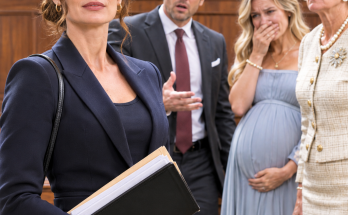
Robert walked in.
He was wearing an expensive navy jacket and carrying a leather laptop bag.
Behind him came Melissa, dressed in a cream-colored coat.
Daniel followed, looking at his phone.
They all stopped when they noticed Jonathan.
Robert frowned.
“Who are you?”
Jonathan stood.
“Jonathan Bennett.”
Robert looked confused.
Then he recognized the name.
“The hospital owner?”
“That’s correct.”
Robert immediately changed his expression.
He extended his hand.
“Robert Whitmore. I’m Eleanor’s oldest son.”
Jonathan shook his hand politely.
“I know.”
Robert looked toward the folder on my blanket.
“What’s all this?”
Before I could answer, Melissa hurried toward my bed.
“Mom! How are you feeling?”
She kissed my cheek.
For one brief second, I wanted to believe she had come because she missed me.
Then she glanced at the documents.
“Have you signed anything yet?”
The question landed like a stone.
I stared at her.
“Signed what?”
Robert stepped forward.
“Mom, we’re here to discuss your recovery and some arrangements that need to be made.”
“What arrangements?”
He glanced at Jonathan.
“Perhaps this isn’t the right time.”
Jonathan calmly replied.
“Actually, I believe this is exactly the right time for Eleanor to understand what is happening with her property and financial affairs.”
Robert’s expression hardened.
“That’s a private family matter.”
Jonathan nodded.
“Then you should have kept it within the family instead of involving outside attorneys.”
Daniel finally looked up from his phone.
“What is he talking about?”
I turned toward my youngest son.
“Daniel, did you know your brother was trying to arrange the sale of my house?”
He went pale.
Melissa looked at Robert.
Robert immediately interrupted.
“Mom, you’re confused because of the medication. We can discuss this when you’re feeling better.”
I stared at him.
“Don’t blame my medication for asking you a question.”
Nobody spoke.
Then Jonathan removed one final document from his folder.
“This is a copy of the proposed agreement your attorney submitted.”
Robert reached for it.
Jonathan moved it away.
“I wouldn’t recommend touching documents that are not yours.”
Robert’s jaw tightened.
“Who do you think you are?”
Jonathan’s voice remained calm.
“Someone who remembers exactly what your mother did for a little boy when nobody else cared.”
He turned toward me.
“Eleanor, there’s something else you should know.”
He opened a second folder.
Inside was a letter bearing the seal of his charitable foundation.
“Three months ago, I established a trust in your name.”
I looked at him in disbelief.
“What kind of trust?”
“A charitable foundation dedicated to helping elderly patients who have no family support during major medical treatment.”
He paused.
“And I intended to appoint you as its honorary chairperson.”
My eyes widened.
Robert suddenly became very interested.
“How much money are we talking about?”
Jonathan didn’t look at him.
“That isn’t the important part.”
But Robert asked again.
“Is there a financial benefit?”
Jonathan finally turned toward him.
“Your mother will decide whether she wants to participate. No one else.”
Then he placed a final envelope in front of me.
“However, Eleanor, I discovered something concerning the foundation’s original paperwork.”
I opened it slowly.
My name appeared on the first page.
Beneath it was a paragraph describing a donation commitment.
But I had never signed it.
I looked at Jonathan.
“What is this?”
His voice became very quiet.
“Someone has been using your identity to negotiate access to money that doesn’t belong to them.”
Robert suddenly stepped backward.
Melissa’s face turned white.
Daniel looked from one person to another.
And for the first time since entering the room, none of my children had anything to say.
PART 3 — THE DAY MY CHILDREN LOST EVERYTHING THEY THOUGHT THEY DESERVED
The silence in that hospital room was almost unbearable.
I looked at my three children.
Robert stood near the window.
Melissa had lowered her eyes.
Daniel was holding his phone so tightly that his knuckles had turned white.
I had spent sixty-seven years believing that no matter what happened, my children would always stand together.
Now I was beginning to understand that they had been standing together for a very different reason.
“Tell me the truth,” I said.
My voice was weak, but I made sure they heard every word.
“Did you use my name to obtain money?”
Robert immediately shook his head.
“Mom, you’re misunderstanding everything.”
“Then explain it.”
He glanced toward Jonathan.
“This man has no right to interfere with our family.”
Jonathan calmly replied.
“I have no intention of controlling your family. I’m here because your mother deserves to know the truth.”
Robert turned toward me.
“Mom, we’ve been trying to protect you.”
“From what?”
“From financial problems. Your house is too much for you. Your medical expenses are going to become enormous. We thought it would be better if we managed everything.”
I looked at him.
“By taking money from my savings?”
He became defensive.
“I never took anything that wasn’t eventually going to belong to us.”
Those words hurt more than anything else.
Eventually going to belong to us.
He was already speaking about my belongings as if I were dead.
Melissa stepped closer.
“Mom, please. We didn’t want you to be upset.”
I turned toward her.
“Did you know about the transfers?”
She began crying.
“Robert said it was temporary.”
“Did you know about the assisted-living applications?”
She nodded slowly.
“And did you know they were trying to sell my house?”
Her tears continued.
“Yes.”
I looked at Daniel.
“What about you?”
He stared at the floor.
“I knew they were planning something, but I didn’t know everything.”
“Did you know about the legal paperwork?”
He nodded.
I felt something inside me finally break.
Three children.
Three different excuses.
Not one person willing to tell me the truth.
Jonathan quietly asked whether I wanted him to call the independent attorney who had reviewed the documents.
I nodded.
“Yes, please.”
Within twenty minutes, a woman named Patricia Lawson entered the room.
She was an experienced attorney specializing in elder financial protection.
She introduced herself and explained that she had no financial relationship with Jonathan or his foundation.
Her job was to protect my legal rights and make sure any decisions I made were voluntary.
She reviewed the documents one by one.
Then she explained something that changed the entire situation.
The proposed legal arrangement would have allowed Robert to control certain financial decisions if I were declared unable to manage them.
However, the application contained statements about my mental condition that had not been supported by any independent medical assessment.
It also included a proposed transfer of my property to a company connected to Robert.
The application had not been approved.
But it had already raised serious concerns.
Patricia looked directly at me.
“Mrs. Whitmore, you are entitled to independent medical assessments, independent legal advice, and control over your own financial decisions unless a court determines otherwise. Nobody can simply take those rights away because they are your children.”
I nodded slowly.
Then she showed me another document.
It was an agreement involving my house.
My children had planned to sell the property for approximately $480,000.
The estimated value was much higher.
A significant portion of the expected proceeds was supposed to be transferred to a private company.
Robert’s company.
I stared at the page.
“Why would you sell it for so little?”
Robert finally lost his temper.
“Because we needed the money!”
The room went silent.
He ran a hand through his hair.
“My business is struggling, Mom. I’ve got debts. I’ve got employees depending on me. I thought selling the house would solve everything.”
I looked at him.
“So you decided to sell my home?”
“I was going to explain!”
“When?”
He had no answer.
Then Melissa began speaking.
“Robert told us that once you moved into assisted living, we could handle the property. He said it was better for everyone.”
I turned toward her.
“And what would happen to me?”
She looked down.
“We were going to find somewhere comfortable.”
“Did you ever ask me what I wanted?”
She didn’t answer.
Daniel suddenly spoke.
“Mom, I need you to understand something.”
I looked at him.
He was crying now.
“I didn’t want any of this. Robert said you would eventually agree. He said we were only moving things around until the business recovered.”
I shook my head.
“You could have called me. You could have visited me. You could have told me what was happening.”
He lowered his head.
“I know.”
I looked at the three empty chairs.
Then I remembered the nurse telling me that my children had left because parking was expensive.
I finally understood why that excuse had been so carefully chosen.
They wanted to leave without appearing cruel.
They wanted me to believe they had been forced to go.
But the truth was that they had already made plans for a future in which I would no longer make my own decisions.
Patricia asked whether I wanted to revoke the financial authorizations I had previously granted.
I nodded.
“Yes.”
She explained the process and began preparing the necessary documents.
I also instructed her to request a complete review of the suspicious transactions and preserve all relevant records.
Robert stepped forward.
“Mom, don’t do this.”
I looked at him.
“Do what?”
“Destroy the family.”
For the first time, I almost laughed.
I had spent my entire life trying to keep that family together.
I had paid their bills, forgiven their mistakes, and defended them when others questioned their behavior.
Yet when I was lying unconscious in an operating room, they had been discussing the future of my house.
“Robert,” I said quietly, “I didn’t destroy this family. I simply stopped pretending everything was fine.”
He looked away.
Jonathan remained beside my bed.
He didn’t interrupt.
He didn’t threaten anyone.
He simply held my hand while Patricia explained the next steps.
Over the following weeks, the truth became even clearer.
The independent review found that money had been transferred from my savings without my informed authorization.
Some of the transfers were connected to Robert’s business.
The attempted property arrangement was halted.
The suspicious financial documents were referred to the appropriate authorities and reviewed by independent professionals.
Melissa admitted that she had helped gather personal information for the proposed application.
Daniel admitted that he had known about the plan but had remained silent because he feared losing his brothers’ and sister’s approval.
There were difficult conversations.
There were legal consequences.
And there were apologies.
But I learned something important.
An apology does not automatically rebuild trust.
Trust must be earned again, one honest decision at a time.
Meanwhile, Jonathan kept his promise.
He visited me regularly during my recovery.
Sometimes he brought flowers.
Sometimes he brought books.
Once, he brought an old photograph from Lincoln Elementary School.
It showed the two of us standing outside the cafeteria nearly forty years earlier.
I laughed when I saw it.
“You look exactly the same,” I told him.
He smiled.
“I was hoping you would say that.”
He eventually explained the charitable foundation he had established.
It would help elderly patients who had no one to support them during surgery or recovery.
It would provide transportation assistance, temporary accommodation for family members, and emergency support for patients facing unexpected medical expenses.
He asked whether I would consider becoming its honorary chairperson.
I accepted.
Not because I wanted recognition.
But because I remembered what it felt like to sit alone in a room, wondering whether anybody cared.
Three months later, I attended the foundation’s opening ceremony.
The room was filled with doctors, nurses, volunteers, and people whose lives had been changed by the program.
Jonathan stood at the microphone.
He told the audience about a little boy who once sat hungry in a school cafeteria.
He explained how a woman with very little money had quietly made sure he never missed a meal.
Then he invited me to the stage.
I walked slowly, still recovering from surgery.
The audience stood and applauded.
Jonathan handed me a small wooden box.
Inside was the original school meal card I had given him decades earlier.
On the back, he had written:
You fed a hungry child when you had almost nothing. I hope you know that the kindness you gave me became the foundation of everything I built.
I couldn’t hold back my tears.
For years, I had measured my worth by how much I could do for my children.
Now I was beginning to understand that my life had value beyond what anyone could take from me.
My children eventually began visiting again.
Robert came first.
He apologized, although it took him a long time to understand that saying sorry was only the beginning.
Melissa started calling every Sunday.
Daniel began helping with small things around the house without asking for anything in return.
I didn’t immediately restore their access to my finances.
I didn’t hand over my house.
And I didn’t pretend the past had disappeared.
But I also didn’t close my heart completely.
People sometimes ask me whether I regret helping my children so much.
My answer is no.
I regret allowing my love to become an excuse for them to disregard my boundaries.
I still love them.
They are my children.
But I finally understand that being a mother doesn’t mean surrendering your dignity.
One afternoon, nearly six months after my operation, Jonathan visited me at home.
He noticed three photographs sitting on the fireplace.
One of Robert.
One of Melissa.
One of Daniel.
Beside them was the old photograph of a little boy standing in a school cafeteria.
Jonathan smiled.
“You kept it.”
“Of course,” I replied.
He sat down beside me.
“Do you ever wish things had turned out differently?”
I looked toward the photographs.
“Every day.”
He nodded.
Then I added something I had learned during the hardest season of my life.
“But I no longer wish I had given less love. I only wish I had remembered to give some of that love to myself.”
Jonathan reached into his coat pocket and handed me a small envelope.
“What is this?”
“Something I wanted you to have.”
Inside was a photograph of the new children’s hospital wing his foundation had helped build.
A plaque beside the entrance read:
THE ELEANOR WHITMORE CENTER FOR COMPASSIONATE CARE.
I covered my mouth.
“Jonathan, you didn’t have to do this.”
He smiled.
“Yes, I did. You spent your life making sure nobody went hungry. I wanted the world to remember the woman who taught me that compassion is never wasted.”
I looked at him through my tears.
Then I asked the question that had been sitting in my heart for months.
“Why did you really come to see me that morning?”
He took my hand.
“Because I wanted to thank you before it was too late.”
He paused.
“And because I heard that you were having surgery, and I didn’t want you waking up in an empty room.”
For a long moment, neither of us spoke.
Then I leaned back in my chair and looked at the afternoon sunlight coming through the window.
The same sunlight I had watched from my hospital bed.
Back then, I believed three empty chairs meant my life had become meaningless.
I was wrong.
Sometimes the people you sacrifice everything for are not the people who stand beside you when you need them.
And sometimes someone you helped decades ago returns when you least expect it, carrying a kindness you thought had long since been forgotten.
I had spent forty years remembering a hungry little boy.
I never imagined he would spend the next forty years remembering me.
And if there is one thing I hope my children eventually understand, it is this:
A mother’s love should never be mistaken for an unlimited supply of money, forgiveness, or permission to take away her choices.
I can love my children without giving them control over my life.
I can forgive them without pretending they never hurt me.
And I can grow older without becoming invisible.
Because the most valuable thing I ever gave away was never money.
It was kindness.
And that kindness found its way home when I needed it most.