**PART 1 — THE WOMAN HE THOUGHT HE COULD CONTROL**
My mother’s boyfriend once told me that women like me had no place in the military.
He said it while standing beneath a framed photograph of himself wearing an old Army uniform, his arms crossed and his chin raised as if he were still commanding an entire battalion.
“Real soldiers understand discipline,” Richard Cole declared. “They don’t spend their lives looking for excuses.”
I was thirty-three years old, a U.S. Army major, and an intelligence officer who had spent years working in assignments I couldn’t discuss with anyone outside authorized channels.
Richard knew none of that.
As far as he was concerned, I was his girlfriend’s disappointing daughter who occasionally disappeared for work and returned home without explaining herself.
My mother, Elaine, had been dating him for fourteen months.
Since he entered her life, the house where I grew up had become a place where she apologized for things that had never been her fault.
Richard criticized her cooking, questioned her spending, and corrected her whenever she disagreed with him. He had even started deciding which relatives were welcome to visit.
Whenever I challenged him, he called me disrespectful.
Whenever I defended my mother, he accused me of interfering.
And whenever I mentioned my military career, he laughed.
“You’re probably pushing paperwork in some office,” he told me one morning. “Don’t confuse yourself with people who’ve actually served.”
I looked at him over my coffee.
“Is that what you think?”
“I’m certain of it.”
I could have shown him my identification card.
I could have told him my rank.
Instead, I let him keep talking.
My mother watched us from the kitchen doorway, nervously twisting a dish towel between her fingers.
“Richard, she’s only here for the weekend,” she said softly. “Can we please enjoy our time together?”
He turned toward her.
“I’m trying to help her. Someone needs to teach her some respect.”
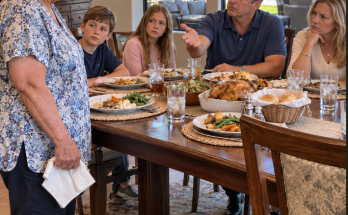
That evening, Richard announced that several active-duty soldiers would be joining us for dinner.
He had met them through a veterans’ organization and had spent weeks telling anyone who would listen about his supposed military accomplishments.
According to Richard, he had once commanded hundreds of soldiers, led dangerous overseas operations, and retired as a highly respected senior enlisted leader.
He even claimed that former colleagues still called him for advice.
I had never seen a single document confirming his stories.
But I had seen the way he treated my mother.
And I had noticed something else: whenever anyone asked him specific questions about his service, he quickly changed the subject.
On the afternoon of the dinner, Richard found me carrying groceries into the kitchen.
“Listen carefully,” he said. “These men are serious professionals. I don’t want you embarrassing me with your attitude.”
“I wasn’t planning to.”
“Good. You’ll stay in the kitchen until I call you. Let the adults talk.”
I slowly put the grocery bags on the counter.
“The adults?”
His face tightened.
“Don’t start.”
Then he leaned closer and delivered the insult he had apparently been saving for the occasion.
“You should be grateful I’m willing to show your mother what real discipline looks like. You’re a grown woman with no idea how the world works.”
I glanced at my mother.
She looked down.
That hurt more than his words.
I had spent years accepting difficult assignments, missing family celebrations, and keeping quiet about things I could never explain. I had done it because my work mattered and because I believed my mother deserved a daughter who stood for something.
Yet inside her own home, she seemed afraid to defend me.
I nodded once.
“All right, Richard.”
He smiled triumphantly.
He thought he had won.
What he didn’t know was that one of the soldiers attending his dinner had served alongside me during a joint operation several years earlier.
And when that officer walked through the front door, Richard would have no idea that the person he had ordered into the kitchen was the very officer whose decisions had once helped bring his team home safely.
**PART 2 — THE MOMENT THE ROOM WENT SILENT**
At six-thirty, the doorbell rang.
Richard immediately straightened his jacket and hurried to greet his guests.
Three soldiers entered the living room, followed by a senior officer named Colonel James Walker.
Richard shook their hands enthusiastically.
“Gentlemen! Welcome. I’ve been looking forward to this.”
He gestured toward the dining room, where he had arranged a generous meal and placed a bottle of expensive whiskey on the table.
“Tonight, we’re going to have a proper conversation about leadership.”
I remained in the kitchen, preparing the last of the food.
Through the open doorway, I heard Richard begin telling a story about his supposed years in command.
He described an operation overseas, claiming he had coordinated the movement of several teams through dangerous territory.
I stopped cutting vegetables.
The details were wrong.
Not slightly wrong.
Completely wrong.
He had mixed together two separate incidents, assigned himself a role he had never held, and described a unit that had not even been part of the operation he was discussing.
I set down the knife.
My mother appeared beside me.
“Please don’t argue with him tonight,” she whispered.
“I’m not looking for an argument, Mom.”
“I know. But you know how he gets when people question him.”
I studied her face.
“When did you become afraid of disagreeing with someone in your own home?”
Her eyes filled with tears.
Before she could answer, Richard called from the living room.
“Elaine! Bring out the food. And tell your daughter to stay where she belongs.”
My mother flinched.
Something inside me finally settled.
Not anger.
Clarity.
I walked to the small bedroom where I had left my garment bag.
Inside was my Army dress uniform, carefully prepared for a formal military ceremony I had attended earlier that week.
I changed, pinned everything into place, and checked my appearance in the mirror.
Then I returned to the kitchen and picked up the serving tray.
When I entered the living room, the conversation stopped.
Richard looked up first.
His smile disappeared almost immediately.
“What are you wearing?”
I placed the tray on the sideboard.
“My uniform.”
“I can see that. Why are you wearing it here?”
Before I could answer, Colonel Walker stood up so quickly that his chair moved backward across the floor.
His eyes were fixed on my rank insignia.
Then he recognized my face.
“Major Bennett?”
I turned toward him.
“Good evening, Colonel.”
He came to attention and saluted.
“Ma’am!”
The other soldiers immediately stood.
One returned my salute with unmistakable recognition.
“Major! It’s an honor to see you again.”
Richard stared at them.
“What is this?”
Colonel Walker lowered his hand.
“Mr. Cole, may I ask how you know Major Bennett?”
Richard’s mouth opened.
“She is Elaine’s daughter. She’s visiting from work.”
The colonel’s expression changed.
“Yes, I gathered that. I’m asking how you know her professionally.”
Richard looked from one officer to another.
“I don’t. I mean, she’s in the Army, apparently, but—”
“But?” I asked quietly.
He turned toward me.
“You never told us you were a major.”
I held his gaze.
“You never asked.”
Colonel Walker looked between us.
“Major Bennett led the intelligence coordination team during our joint assignment three years ago. Her work was instrumental in resolving a situation that could have cost several people their lives.”
One of the younger soldiers nodded.
“I remember that operation, sir. She stayed on the communications line until every team had been accounted for.”
Richard’s face lost its color.
I didn’t enjoy seeing him embarrassed.
But I refused to rescue him from the consequences of his own behavior.
The colonel glanced at the photograph on the wall.
Then he looked back at Richard.
“You mentioned earlier that you retired as a senior enlisted commander. Which unit did you serve with?”
Richard shifted in his chair.
“Several units. It was a long career.”
“Of course. What years were you assigned to your final command?”
“It’s been a long time. I don’t remember every date.”
The colonel nodded politely.
“Understood.”
But the question had exposed the problem.
Richard had spent the evening speaking as though he had led men in situations he couldn’t accurately describe.
Now, surrounded by people who understood military service, he could no longer hide behind impressive stories.
He turned toward me, attempting to recover his authority.
“Olivia, this is getting out of hand. Take that uniform off and go back to the kitchen. We have guests.”
Colonel Walker’s expression hardened.
“Mr. Cole, she is a commissioned officer in the United States Army. You will address her with the same basic respect you would expect anyone to show you.”
The room fell completely silent.
My mother stood near the doorway, one hand pressed against her mouth.
For the first time since Richard had entered her life, someone had challenged him without apologizing afterward.
But the evening wasn’t over.
Because when Colonel Walker asked Richard to clarify one final detail about his military record, Richard made a mistake that would change my mother’s life as well as mine.
**PART 3 — THE TRUTH HE COULDN’T HIDE**
Richard attempted to laugh.
“This is absurd. I don’t need to prove my service to anyone in my own home.”
Colonel Walker remained calm.
“Of course not. But you introduced yourself as a senior enlisted leader and described specific operations. I was simply asking about your experience.”
Richard pointed toward me.
“She is the problem. She’s always been difficult. She thinks a uniform gives her the right to disrespect people.”
I shook my head.
“I haven’t disrespected you, Richard. I’ve listened to you insult me for two days, and I haven’t raised my voice once.”
“You should have told me who you were!”
“I tried to tell you about my work. You laughed and said I pushed paperwork.”
The younger soldier looked uncomfortable.
My mother finally stepped forward.
“Richard, why did you tell everyone you had commanded soldiers overseas?”
He turned toward her sharply.
“Elaine, stay out of this.”
“No,” she replied.
Her voice was trembling, but she didn’t retreat.
“You’ve spent more than a year telling me that your military career made you a better man than everyone around you. You said my daughter was a disappointment because she didn’t know discipline. You made me believe I was wrong every time I defended her.”
Richard stared at her.
“I was trying to help this family.”
“Then why did you tell her to hide in the kitchen?”
He had no answer.
Colonel Walker gently interrupted.
“Mr. Cole, I don’t know the details of your service, and I won’t speculate about them. But I would encourage you not to claim responsibilities you cannot substantiate.”
Richard’s face reddened.
“You’re all making a mistake.”
He looked at the soldiers, apparently expecting someone to defend him.
Nobody did.
Then the youngest officer spoke.
“Sir, with respect, we came here because you invited us to discuss military leadership. We didn’t come to watch you humiliate someone.”
Richard looked as though he had been struck.
I walked toward the dining table and set down my hands.
“I’m not asking anyone to admire me,” I said. “I’m asking to be treated like a human being in my mother’s home.”
My mother began to cry.
“Olivia, I’m sorry.”
I turned toward her.
She took my hands.
“I should have stood up for you. I kept telling myself that if I stayed quiet, things would eventually improve. I didn’t realize how much I was asking you to endure.”
I squeezed her hands gently.
“You don’t have to choose between having a relationship with me and keeping peace with someone who treats you badly.”
She nodded, wiping her cheeks.
Then she turned to Richard.
“I need you to leave tonight.”
His expression changed instantly.
“Elaine, don’t be ridiculous.”
“I mean it.”
“You’re throwing away our relationship over a misunderstanding?”
“No,” she said. “I’m ending a relationship in which I became afraid to speak in my own home.”
Richard looked toward the soldiers one last time, perhaps hoping they would intervene.
Colonel Walker simply stepped aside, leaving the doorway clear.
Richard collected his jacket and left without another word.
When the front door closed, my mother sat down and covered her face.
I sat beside her.
For a while, neither of us spoke.
Then she looked up.
“Are you going to be all right?”
I smiled sadly.
“Mom, I’ve been all right for a long time. I just needed you to see me.”
Colonel Walker and the other soldiers stayed for dinner. We spoke about service, leadership, and the importance of treating people with dignity regardless of their rank.
Before leaving, the colonel shook my hand.
“Major, it’s good to see you again.”
“Thank you, sir.”
He smiled.
“And for what it’s worth, the best leaders I’ve known never needed to humiliate anyone to prove they were in charge.”
After the guests departed, my mother and I cleaned the kitchen together.
It felt like being a child again, except this time she didn’t tell me to keep quiet when I disagreed with someone.
In the weeks that followed, she began rebuilding her confidence. She made her own decisions, reconnected with old friends, and learned that setting boundaries wasn’t the same as being unkind.
Our relationship wasn’t repaired overnight, but it became more honest.
As for me, I returned to my assignment with a renewed understanding of something my career had taught me repeatedly.
Authority is not the same as character.
A title cannot make a dishonest person honorable, and a quiet person is not necessarily a weak one.
Richard had invited soldiers into my mother’s home to prove that I needed discipline.
Instead, his own behavior revealed the truth about him.
And the moment I walked into that living room wearing my uniform, I didn’t need to threaten him, expose private information, or demand an apology.
I simply stood there as the person I had always been.
Sometimes, the strongest response to someone who underestimates you is not revenge.
It’s refusing to shrink yourself to make them comfortable.
**And that night, for the first time in a very long time, my mother finally understood the difference.**