PART 1 — THE NIGHT MY SON ASKED ME TO LEAVE
My name is Margaret Briggs, and I’m seventy-one years old.
Two years after losing my husband, Harold, I made a decision I would eventually regret.
I moved in with my son.
Daniel insisted it was the best thing for me.
“Mom, you shouldn’t be living alone. Come stay with us. We have plenty of room.”
His wife, Renee, smiled and nodded.
“Of course, Margaret. You’re family.”
I believed them.
So I sold the house Harold and I had shared for thirty-eight years.
I left behind the yellow kitchen where we celebrated birthdays, the rose bushes Harold planted for me, and the little porch where we spent countless mornings drinking coffee together.
I moved into Daniel’s beautiful house in Scottsdale, Arizona.
At first, everything seemed wonderful.
My grandchildren hugged me every morning.
Renee invited me to help decorate the house.
Daniel occasionally took me out for lunch.
I thought I had found a new home.
But slowly, things changed.
First, Renee began asking me to prepare dinner.
Then she asked me to handle the children’s school lunches.
Soon, I was doing laundry, cleaning the kitchen, picking up groceries, and driving my grandchildren to their activities.
Whenever Daniel and Renee wanted a weekend away, I was expected to watch the children.
I never complained.
I loved my grandchildren.
But I began noticing something painful.
Nobody seemed to remember that I was also a person who needed rest.
One afternoon, I overheard Renee speaking to Daniel in their bedroom.
“Your mother doesn’t contribute anything financially.”
I stopped outside the door.
Daniel sighed.
“She helps with the kids.”
“Helping with the kids doesn’t pay the mortgage, Daniel. We’re supporting another adult.”
I waited for him to defend me.
Instead, he said:
“I know. We’ll have to figure something out.”
I quietly walked away.
That evening, I cooked dinner as usual.
Nobody noticed that I barely touched my food.
Then something unexpected happened.
Three months earlier, I had purchased a lottery ticket at a gas station after a routine medical appointment.
I hadn’t even planned to buy one.
It was simply an impulse.
Two days later, I checked the winning numbers.
Every single number matched.
I had won $89 million.
I remember standing in the kitchen, staring at the ticket for nearly ten minutes.
I didn’t scream.
I didn’t celebrate.
I called an attorney.
Within days, I had financial advisers, estate planners, and legal professionals helping me protect my identity and establish a secure financial structure.
I decided not to tell anyone.
Not Daniel.
Not Renee.
Not even my closest friends.
I wanted to understand who people were when they believed I had nothing to offer them.
And unfortunately, my son was beginning to show me.
A few weeks later, Daniel and Renee became obsessed with a beautiful Craftsman-style property on Willow Creek Lane.
It had four bedrooms, a large kitchen, a beautiful garden, and a spacious front porch.
Renee talked about it constantly.
“The children would have so much room.”
Daniel agreed.
“We could finally have the house we’ve always wanted.”
They visited the property three times.
They even started discussing furniture arrangements.
But before they could make an offer, another buyer purchased it.
They were devastated.
For weeks, Renee complained about losing the house.
I listened quietly.
I knew something they didn’t.
But I said nothing.
Then came the dinner that changed everything.
It was a Thursday evening.
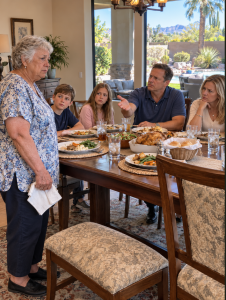
Renee had prepared roast chicken, and the children were sitting quietly around the dining table.
I had spent the afternoon preparing their school uniforms and organizing their backpacks.
Daniel barely spoke throughout dinner.
Finally, he placed his fork down.
“Mom, can we talk about something?”
I looked up.
“Of course, sweetheart.”
He exchanged a glance with Renee.
Then he asked:
“When are you finally going to find somewhere else to live?”
For a moment, I thought I had misunderstood.
“I’m sorry?”
Renee folded her arms.
“Margaret, we think it’s time you had your own place again.”
I looked at Daniel.
“Did something happen?”
He shook his head.
“It’s just that the children are getting older. We need more space. And honestly, living together isn’t working anymore.”
I looked around the table.
My granddaughter stared at her plate.
My grandson stopped eating.
They already knew.
This conversation had clearly happened before I arrived.
I swallowed.
“Daniel, I sold my house because you asked me to move here.”
He looked uncomfortable.
“We appreciate everything you’ve done, Mom.”
Renee interrupted.
“But you can’t expect us to rearrange our entire lives forever.”
I slowly folded my napkin.
Then I stood.
“Of course.”
Daniel looked surprised.
“That’s it?”
I nodded.
“I’ll make arrangements.”
I walked upstairs, entered the guest bedroom, and closed the door.
For several minutes, I sat on the edge of the bed.
I thought about Harold.
I thought about the house we’d built together.
And I thought about the son I had raised.
Then I opened my notebook and wrote five things:
- Find a home of my own.
- Protect my money.
- Never beg anyone to value me.
- Remember how they treated me.
- Build a life that belongs entirely to me.
The next morning, I called my attorney.
Then I called a real estate agent.
And six days later, I made an offer on the very property Daniel and Renee had desperately wanted.
But I didn’t purchase it under my own name.
I purchased it through a private property company.
The same company name that Daniel had seen on several financial documents over the years without ever asking what it meant.
When the offer was accepted, I smiled for the first time in weeks.
Because my son had no idea what was coming.
PART 2 — THE HOUSE MY SON THOUGHT HE HAD LOST
Six days after that terrible dinner, I moved out of Daniel’s house.
I didn’t make an announcement.
I didn’t argue with Renee.
I simply packed my belongings, thanked the children, and left.
Daniel helped carry two suitcases to the car.
“Mom, are you sure you’re going to be okay?”
I looked at him.
“I’m seventy-one, Daniel. I’ve survived quite a lot.”
He gave an awkward smile.
“Call us if you need anything.”
I nodded.
But I already knew I wouldn’t be calling.
My new home was being prepared.
The property on Willow Creek Lane needed a little work, so I arranged for a designer to update the kitchen, replace some old flooring, and restore the garden.
I kept the original wooden staircase.
I kept the beautiful front porch.
And I planted twelve rose bushes along the walkway.
Harold would have loved them.
For the first time in two years, I could wake up without wondering what someone else expected me to do that day.
I could make breakfast whenever I wanted.
Read a book without interruption.
Invite friends over.
Sit in the garden.
I even hired a housekeeper to help with the heavier work.
It felt wonderful.
Meanwhile, Daniel and Renee continued living their lives.
I heard from my grandchildren occasionally.
They told me their parents were still disappointed about losing the Willow Creek property.
Renee had apparently mentioned it several times.
Then, one Sunday afternoon, Daniel called.
“Mom, how are you settling into your new place?”
“Very well, sweetheart.”
“Where did you end up?”
I smiled.
“Not too far away.”
He laughed.
“You’re being mysterious.”
“Perhaps.”
There was a short silence.
Then he asked:
“Are you renting?”
I looked toward the garden.
“No, Daniel. I purchased a home.”
He sounded surprised.
“You bought one?”
“Yes.”
“With what money?”
I could hear Renee speaking in the background.
I answered calmly.
“Some savings, sweetheart.”
He didn’t ask anything else.
But I knew that question would eventually return.
Three days later, Renee called.
“Margaret, Daniel told me you bought a house.”
“I did.”
“That’s wonderful. Where?”
“Willow Creek Lane.”
There was silence.
Then she laughed nervously.
“Wait. Which house?”
“The Craftsman property you liked so much.”
I heard her inhale sharply.
“That’s impossible.”
“Why?”
“Because that house was purchased by an investment company!”
I smiled.
“Perhaps they decided to sell it to me.”
Renee didn’t answer.
Then she asked:
“Margaret, how much did you pay?”
“That’s a personal matter.”
Her tone changed.
“Are you sure you can afford it?”
I looked at the beautiful living room around me.
“I think I’ll manage.”
She ended the call shortly afterward.
I assumed that would be the end of it.
But the following morning, Daniel appeared at my front door.
He was standing on the porch holding a folder.
“Mom, we need to talk.”
I opened the door.
“Come in.”
He stepped inside and looked around.
His eyes moved from the polished staircase to the new kitchen.
Then toward the large windows overlooking the garden.
“Wow,” he whispered.
I offered him coffee.
He declined.
Instead, he placed the folder on the table.
“Mom, something strange is happening.”
“What is it?”
He opened the folder.
Inside were property records, a copy of the sale information, and the name of the company that had purchased the house.
He pointed toward the document.
“Do you recognize this company?”
I looked at it.
It was the company my attorneys had established.
I nodded.
“Why?”
Daniel leaned forward.
“Because this company owns several properties around Arizona. It also has investments in commercial real estate.”
I remained quiet.
He continued.
“It’s connected to someone extremely wealthy. I was reading about it last night.”
I took a sip of coffee.
“Interesting.”
Daniel frowned.
“Mom, how did you afford this house?”
I finally looked directly at him.
“Daniel, why does that matter?”
He seemed caught off guard.
“Well, you’re my mother.”
“And?”
He lowered his voice.
“Renee and I were thinking maybe we could discuss something.”
I already knew where the conversation was heading.
He continued.
“We’ve been struggling to find a house that suits our family. The Willow Creek property was perfect. We wondered whether you might consider letting us buy it from you.”
I stared at him.
“You want to buy my house?”
“Not necessarily buy it immediately. We could arrange something.”
I placed my cup down.
“Daniel, six days before I purchased this property, you asked me when I was moving out of your house.”
He looked uncomfortable.
“Mom, that’s not fair.”
“Isn’t it?”
He rubbed his forehead.
“We were under pressure. We didn’t mean to hurt you.”
I looked at him for a long moment.
Then I said:
“I’m not selling my home.”
His expression hardened.
“Why not?”
“Because I love it.”
He stood up.
“Fine. But don’t expect us to keep asking.”
He walked toward the door.
Before leaving, he turned around.
“Mom, I hope you haven’t made some terrible financial decision.”
I smiled sadly.
“I hope you haven’t made a terrible decision about your family.”
He left without another word.
That evening, I received a message from my attorney.
The final financial documentation was ready.
He also had something important to tell me.
A reporter had contacted his office asking whether I was the anonymous winner of the $89 million lottery prize.
Someone had apparently begun connecting the property company to the winning ticket.
I stared at the message.
For three months, I had kept my secret.
Now I wondered how much longer I could.
And then my phone rang again.
It was Daniel.
His voice sounded completely different.
“Mom, I just found something.”
“What?”
He paused.
“Your name is connected to the company that bought Willow Creek.”
My heart remained steady.
“Yes, Daniel.”
He swallowed.
“Mom… how much money do you actually have?”
I looked through the window at the house Harold and I would have dreamed of owning.
Then I answered:
“More than enough to live comfortably for the rest of my life.”
But I wasn’t prepared for what he asked next.
“Mom, did you win the lottery?”
PART 3 — THE $89 MILLION SECRET
I didn’t answer immediately.
For several seconds, neither of us spoke.
Then Daniel whispered:
“Mom?”
I took a breath.
“Yes, Daniel. I won.”
He sounded as though someone had knocked the air out of him.
“How much?”
“Eighty-nine million dollars.”
Silence.
Then he said something I will never forget.
“Why didn’t you tell me?”
I almost laughed.
Not because it was funny.
Because the question was unbelievable.
I looked around my beautiful home.
The house I had purchased without asking anyone’s permission.
The home where nobody expected me to cook, clean, babysit, or justify my existence.
Then I answered.
“Because I wanted to know whether you loved having me in your life when you believed I had nothing.”
He didn’t respond.
I continued.
“For two years, I lived in your house. I helped raise your children. I cooked your meals. I did your laundry. I gave up my own home because you told me I needed family.”
“Mom, we never meant—”
“Please let me finish.”
He became quiet.
“When I won the money, I didn’t tell anyone because I didn’t want money to change my relationships. But I also didn’t want to discover that the only reason someone wanted me around was what I could provide.”
My voice began trembling.
“And unfortunately, Daniel, you gave me my answer.”
He sighed.
“Mom, I was wrong.”
“Were you?”
“Yes.”
“Would you have asked me to leave if you knew I had $89 million?”
He didn’t answer.
That silence told me everything.
Then he said:
“Renee and I were under a lot of pressure. We have bills, the children’s expenses, and the mortgage. We weren’t thinking clearly.”
I closed my eyes.
“Daniel, I understand financial pressure. Your father and I struggled for years. But we never made someone feel unwanted because they needed a place to live.”
He began crying.
“I’m sorry, Mom.”
I believed he was sorry.
But I still didn’t know whether he was sorry for hurting me or for discovering that I had money.
The following weekend, Daniel and Renee came to visit.
They brought flowers.
Renee hugged me tightly.
“Margaret, we owe you an apology.”
I invited them inside.
We sat in the living room.
Daniel looked around.
“It’s a beautiful house, Mom.”
“Thank you.”
Renee placed her handbag beside the sofa.
“We’ve been talking, and we think perhaps we should spend more time together as a family.”
I nodded.
“That’s a lovely idea.”
Then Daniel cleared his throat.
“There’s something else.”
I looked at him.
He hesitated.
“We wondered whether you might be willing to help us financially.”
There it was.
I wasn’t surprised.
He explained that they had accumulated debts, that the mortgage payments were becoming difficult, and that the children needed additional support.
I listened without interrupting.
When he finished, I asked one question.
“Daniel, if I hadn’t won the lottery, would you still have come to visit me today?”
He looked down.
Renee immediately answered.
“Of course we would!”
I looked at her.
“Then why didn’t you visit me during the first week after I moved out?”
She opened her mouth.
Nothing came out.
I continued.
“Why didn’t you ask whether I had somewhere safe to sleep? Why didn’t you ask whether I needed help unpacking? Why was the first conversation about my new home about how much money I had spent?”
Daniel covered his face.
“Mom, please.”
I stood and walked toward the window.
“I don’t want to punish either of you. I don’t want revenge. And I don’t want my grandchildren to lose their grandmother.”
I turned back toward them.
“But I will not buy your affection.”
Daniel began crying.
For the first time, he seemed to understand that money couldn’t repair everything he had broken.
I made my decision.
I would establish education funds for my grandchildren.
They would each have money available for college, training, or other approved educational expenses.
But the funds would be protected and managed independently.
I would also support charitable organizations helping elderly people who had been abandoned, neglected, or financially exploited by their families.
I would not hand Daniel and Renee a fortune simply because they had discovered I possessed one.
If they wanted a relationship with me, they would have to rebuild it.
Without money.
Without conditions.
And without expecting me to serve them.
Several months passed.
Daniel began visiting regularly.
Sometimes he came alone.
Sometimes he brought the children.
He started asking about my garden, my health, and the books I was reading.
Renee eventually apologized privately.
It wasn’t a perfect reconciliation.
Trust doesn’t return simply because someone says they’re sorry.
But things slowly improved.
One afternoon, my granddaughter asked me a question while we were sitting on the porch.
“Grandma, why didn’t you tell Dad you were rich?”
I smiled.
“Because I wanted your father to remember that I was his mother before he remembered that I had money.”
She thought about that for a moment.
Then she leaned against my shoulder.
“I think Grandpa Harold would be proud of you.”
I looked toward the roses.
I could almost imagine Harold sitting beside me, holding his morning cup of tea.
And for the first time in a long while, I felt completely at peace.
I was seventy-one years old.
I had $89 million.
A beautiful home.
A garden full of roses.
And something far more valuable than any lottery prize.
I finally understood that being family doesn’t give someone the right to take your dignity.
You can love your children without allowing them to use you.
You can forgive someone without giving them control over your life.
And you can walk away from a table where nobody appreciates your presence.
Because sometimes the greatest victory isn’t making someone regret how they treated you.
It’s building a life where their approval is no longer necessary.
THE END.