PART 1 — “DADDY, PLEASE DON’T LEAVE MOMMY THERE.”
It had been barely an hour since we buried my wife when my seven-year-old son said something that made me question everything.
“Daddy, we need to go back.”
I looked down at him.
“Back where, buddy?”
He pointed toward the cemetery.
“Mommy is calling me.”
I felt my heart tighten.
My name is Brian Cooper. I’m thirty-eight years old, and until three days ago, I thought I had the perfect family.
My wife, Rachel, and I had been married for eleven years. We had a beautiful little boy named Lucas, a comfortable home, and plans for a future we thought would last forever.
Then Rachel died unexpectedly in her sleep.
The doctors told us it appeared to be sudden cardiac arrest.
There had been no warning.
No serious illness.
No explanation that made sense.
One evening, she kissed Lucas goodnight, told me she loved me, and went to bed.
The following morning, she was gone.
I still couldn’t understand how someone could disappear from your life so completely overnight.
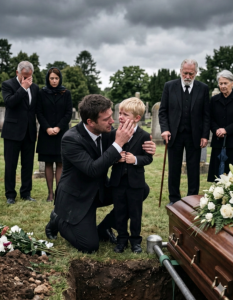
That afternoon, we gathered at Whispering Pines Cemetery for her funeral.
Family members cried.
Friends shared memories.
Lucas placed a small drawing inside the flowers covering his mother’s coffin.
It showed three people holding hands beneath a yellow sun.
He had written beneath it:
“Mommy, Daddy, and Me Forever.”
I nearly broke when I read those words.
After the ceremony, most of our relatives went home.
I stayed behind with Lucas.
That’s when he tugged my sleeve.
“Daddy?”
“Yes, sweetheart?”
“Mommy called my name.”
I knelt beside him.
“Lucas, I know you miss her. I miss her too.”
He shook his head.
“No, Daddy. I heard her.”
His eyes filled with tears.
“She said, ‘Lucas, come find me.’”
I gently pulled him into my arms.
“Sometimes when we love someone very much, we remember their voice so clearly that it feels like they’re right beside us.”
But Lucas pushed away.
“I’m not remembering, Daddy. I heard her today.”
Something about the way he said it made my skin crawl.
Then he whispered something else.
“Mommy told me not to let them leave her alone.”
I froze.
“What did you just say?”
Lucas pointed toward the grave.
“She said she’s scared.”
I immediately looked toward the funeral director, Mr. Thomas, who was gathering the remaining paperwork.
“Excuse me. Could you come here for a moment?”
He approached.
“Is everything all right, Brian?”
I explained what Lucas had told me.
The director listened patiently, then gave me a sympathetic look.
“Children sometimes experience grief in ways adults don’t understand. I’m sure he misses his mother terribly.”
I nodded, but something kept bothering me.
Earlier that morning, I had noticed something unusual.
When I briefly touched Rachel’s hand at the funeral home, it had felt warmer than I expected.
I’d mentioned it to the staff, but they explained that appearances and temperature could be affected by the preparation and environment.
I had accepted their explanation.
Now, standing beside my son’s trembling little body, I couldn’t stop thinking about it.
I turned toward Mr. Thomas.
“Can you tell me exactly what medical confirmation was received before the funeral?”
His expression became serious.
“Brian, everything was handled according to the documentation provided to us.”
“Then I want someone to review it again.”
He hesitated.
“Why?”
I looked down at Lucas.
“Because my son is absolutely convinced his mother is still calling him.”
I called the authorities and explained my concerns.
I didn’t know whether Lucas was experiencing grief, remembering something from the funeral, or reacting to something we had overlooked.
But I needed answers.
And I wasn’t leaving until the situation had been properly reviewed.
Twenty minutes later, two officers arrived.
They spoke with me, the funeral director, and several members of our family.
Then one of them asked an unexpected question.
“Mr. Cooper, did your wife have any unusual medical symptoms before her death?”
I shook my head.
“Not that I knew of.”
“Did she ever mention feeling unwell or experiencing memory problems?”
“No. Why?”
The officer exchanged a glance with his colleague.
“We’ve received a call from someone who claims to have information about your wife’s final hours.”
My stomach tightened.
“Who?”
The officer looked at his notes.
“A woman named Dr. Evelyn Carter.”
I had never heard that name.
But when Mr. Thomas heard it, his face suddenly changed.
He stepped backward.
Then he quietly said:
“That’s impossible. She’s the doctor who signed the original report.”
I stared at him.
“What do you mean?”
He didn’t answer.
Instead, he pulled out his phone and walked several feet away.
A moment later, he returned looking genuinely frightened.
“Brian, we need to stop everything and contact the medical examiner.”
“Why?”
He swallowed.
“Because Dr. Carter says there’s something wrong with the identification records.”
I felt the ground shift beneath me.
Then Lucas grabbed my hand again.
“Daddy?”
“What is it, buddy?”
He looked toward the cemetery entrance.
“That’s the lady Mommy told me about.”
I turned.
A woman in a dark coat was walking toward us.
And she was carrying a photograph of Rachel.
PART 2 — THE PHOTOGRAPH NOBODY WAS SUPPOSED TO SEE
The woman introduced herself as Dr. Evelyn Carter.
She was in her early fifties and looked as though she hadn’t slept in days.
She approached me carefully.
“Mr. Cooper, I’m sorry to meet you under these circumstances.”
I looked at the photograph in her hand.
“Why do you have a picture of my wife?”
She glanced toward the officers.
“Because I believe Rachel may have been connected to a medical investigation that was never properly completed.”
My throat tightened.
“What investigation?”
She took a breath.
“Before I explain, I need to ask you something. Did Rachel ever tell you that she had a twin sister?”
I stared at her.
“Rachel didn’t have a twin sister.”
Dr. Carter looked down.
“That’s what her official records say.”
“What does that mean?”
She opened a folder and showed me two photographs.
The first was Rachel.
The second showed a woman who looked almost exactly like her.
Same eyes.
Same smile.
Same small scar above the left eyebrow.
I felt sick.
“Who is that?”
“Her name was Rebecca.”
I shook my head.
“Was?”
Dr. Carter nodded.
“According to the records, Rebecca was Rachel’s biological twin. They were separated as infants after a complicated family situation.”
I couldn’t speak.
Rachel had never mentioned a sister.
Not once in eleven years.
“Why didn’t she tell me?”
Dr. Carter hesitated.
“Because she may not have known the entire truth herself.”
I looked toward the grave.
“Are you telling me the woman we buried wasn’t my wife?”
The doctor didn’t answer immediately.
Instead, she asked whether Rachel had any identifying medical records or previous hospital photographs.
I remembered an old folder at home containing her medical history.
But before I could respond, my phone rang.
It was Rachel’s younger brother, Kyle.
“Brian, where are you?”
“At the cemetery. What’s wrong?”
His voice sounded strange.
“Don’t let anyone take anything from the house.”
“What are you talking about?”
“Mom called me. She says someone has been asking questions about Rachel’s old records.”
I frowned.
“Why would anyone do that?”
Kyle went silent.
Then he said something that made my stomach drop.
“Because Rachel wasn’t the first person in our family to disappear under mysterious circumstances.”
I stared at the phone.
“What?”
Before he could explain, the call disconnected.
Dr. Carter watched my face.
“Mr. Cooper, I think you need to hear everything before making any assumptions.”
She explained that several years earlier, she had been involved in a confidential investigation concerning a hospital’s patient-identification procedures.
During that investigation, two women with remarkably similar medical histories had been confused in an archived record system.
One of those women was Rachel.
The other was Rebecca.
The original records had been corrected, but Dr. Carter had recently discovered a discrepancy involving the documents used to identify the woman who died three days earlier.
She couldn’t yet confirm whether it was an administrative mistake or something more serious.
I looked at her.
“Then why did you wait until now?”
Her eyes filled with tears.
“Because someone sent me a photograph yesterday.”
She handed me her phone.
It showed Rachel standing outside a hospital.
She was holding a little girl’s hand.
I recognized the date immediately.
It was taken just two weeks before her death.
But Rachel had told me she was visiting her mother that afternoon.
I zoomed in.
The little girl wasn’t Lucas.
And she wasn’t anyone I recognized.
“Who is that child?”
Dr. Carter lowered her voice.
“That’s Rebecca’s daughter.”
I felt dizzy.
“Why was my wife with her?”
The doctor looked toward Lucas.
“Because Rachel had been trying to find her sister for nearly a year.”
I turned toward my son.
He was quietly holding his mother’s drawing.
Then he said something I will never forget.
“Daddy, Mommy told me Aunt Rebecca was going to come get me.”
I looked at him.
“Did Mommy say anything else?”
He nodded.
“She said if she couldn’t come home, I should ask you to look inside her blue music box.”
I remembered the box immediately.
Rachel kept it on her dressing table.
It had belonged to her grandmother.
I had never opened it.
And suddenly, I understood that my wife might have left behind something far more important than a farewell message.
I turned toward Dr. Carter.
“I need to go home.”
She nodded.
“Then we should go together.”
But just as we started walking, an officer received a radio message.
He listened for several seconds.
Then his expression changed.
He turned toward me.
“Mr. Cooper, we’ve just received confirmation from the medical examiner.”
My heart began pounding.
“What confirmation?”
He looked at Dr. Carter.
“There’s a discrepancy between the identity documents and the original hospital records.”
Then he added:
“And your wife’s brother has just reported someone missing.”
PART 3 — THE SECRET INSIDE THE BLUE MUSIC BOX
We returned home with the police.
Lucas held my hand the entire way.
I couldn’t stop thinking about Rachel.
About the woman who had shared my bed, raised our son, and kissed me goodbye every morning.
How could I have known so little about her past?
When we entered the house, everything looked exactly as she had left it.
Her slippers were beside the sofa.
Her coffee mug was still on the kitchen counter.
And her favorite blue music box sat on the dressing table.
I picked it up.
My hands were shaking.
The little melody began playing as I opened the lid.
Inside was a photograph.
It showed two newborn babies wrapped in identical blankets.
On the back, Rachel had written:
“Rachel and Rebecca. Together from the beginning, separated by a secret.”
Beneath the photograph was a folded letter.
I opened it.
The handwriting was unmistakably Rachel’s.
My love,
If you’re reading this, something has happened that I couldn’t explain to you while I was alive.
There is something about my family I should have told you years ago.
Rebecca is my twin sister.
We were separated when we were babies. Our parents told everyone she had died, but she hadn’t.
I found her last year.
She has a daughter, and for the first time in my life, I understood what it meant to have someone who shared the same beginning as me.
I wanted you to meet her.
But there’s something else.
Rebecca and I discovered that our medical records had been mixed up when we were children. We tried to correct them, but the hospital never completed the investigation.
If anything happens to me, please don’t assume every document tells the whole story.
Look after Lucas.
And please, find my sister.
I love you.
I lowered the letter.
My eyes were full of tears.
For the first time, I understood why Lucas had mentioned his aunt.
Rachel had been preparing him for the possibility that something might happen.
But there was still one question.
Who had died?
And why were the records wrong?
Dr. Carter carefully examined the documents.
Then she called the medical examiner.
Several hours later, we received an update.
The authorities had identified a serious discrepancy in the original identification process.
The remains had not yet been conclusively identified, and the burial was being handled as a formal investigative matter.
A new examination was necessary.
I felt my knees weaken.
Then my phone rang.
An unknown number.
I answered.
“Hello?”
A woman’s voice came through.
“Brian?”
I stopped breathing.
I knew that voice.
I had heard it thousands of times.
It was Rachel.
“Rachel?”
There was a long silence.
Then the woman began crying.
“Brian, please don’t hang up.”
My hand started shaking.
“Where are you?”
“I can’t explain everything right now.”
“Are you alive?”
She began sobbing.
“Yes.”
I closed my eyes.
For three days, I had believed my wife was gone.
For three days, I had held our son while trying to explain why his mother would never come home.
And now I was hearing her voice.
“Rachel, where are you?”
“I’m at St. Mary’s Hospital.”
I immediately asked the officers to help verify the call.
Dr. Carter looked as though she couldn’t believe what she was hearing.
Within minutes, the authorities confirmed that the caller was being treated under a different identification record.
The woman was alive.
And she had been trying to contact us.
But when I asked why she hadn’t come home, her answer broke my heart.
“Brian, I woke up in the hospital after the accident. I couldn’t remember everything. They told me my family had been contacted, but nobody came.”
I looked at Lucas.
“Your son is here, Rachel. He’s been waiting for you.”
She began crying harder.
“Lucas?”
I placed the phone on speaker.
“Mommy?” Lucas whispered.
A soft sob came through the speaker.
“My baby…”
Lucas dropped his drawing and reached for the phone.
“Mommy! I knew you were calling me!”
I couldn’t hold back my tears.
But the story wasn’t over.
The medical examiner later confirmed that the woman buried in Rachel’s place was her twin sister, Rebecca.
The two sisters had been involved in a serious accident several days earlier, and the confusion surrounding their identities had resulted in a tragic series of mistakes.
Rebecca had not survived.
Rachel had been hospitalized under an incorrect identification, and the error had remained undiscovered until Dr. Carter recognized the discrepancy.
The authorities began a full investigation into how it happened.
Weeks later, Rachel finally came home.
Lucas ran into her arms and refused to let go.
I stood in the doorway, watching my wife hold our son again.
There were questions we still needed to answer.
There was grief for Rebecca, a woman I had never truly known but who had been part of Rachel’s life all along.
And there was a long road ahead of us.
But that evening, Rachel sat beside Lucas and opened the drawing he had placed at her grave.
Three people holding hands beneath a yellow sun.
She kissed his forehead.
“You knew I was coming back, didn’t you?”
Lucas smiled.
“I told Daddy you weren’t finished being my mommy.”
I held both of them close.
For three days, I had believed I had lost my entire world.
But my son had refused to give up on the sound of his mother’s voice.
And sometimes, the smallest person in a family notices the one thing everyone else has overlooked.
I thought I was teaching my son how to say goodbye. Instead, he was the one who taught me never to stop asking questions.
THE END.