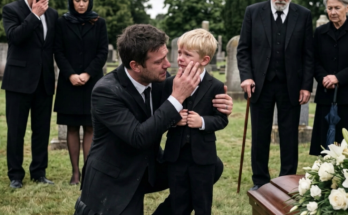
The moment my son’s best friend walked into the funeral chapel wearing a bright red dress, my husband stood up and whispered, “I’m going to make him leave.”
I grabbed his wrist.
“Daniel, please. Not today.”
But I couldn’t look away from the boy standing near the entrance.
His name was Theo. He was seventeen years old, and for nearly ten years, he had been as close to our son, Jack, as any brother could be.
Now Jack was gone.
And Theo had arrived at his funeral wearing a dress so red that people turned to stare.
Some relatives exchanged disapproving looks. Others whispered behind their hands. One of Jack’s classmates leaned toward her mother and murmured, “Why would he do something like that here?”
I wanted to ask the same question.
Not because I believed Theo owed anyone an explanation for his clothes, but because I was grieving, exhausted, and struggling to understand why the boy who had stood beside my son through every terrible moment was now doing something that seemed to invite even more attention.
I had no idea that, before the service ended, I would regret every suspicious thought that crossed my mind.
And I certainly wasn’t prepared for what Theo was carrying in the small black envelope hidden inside his dress.
To understand why his appearance shocked us so deeply, you need to know what Theo meant to our family.
He first came into our lives when he was seven.
His parents were going through a painful separation, and some evenings, he would sit on our front steps until Jack noticed him through the window.
“Mom, can Theo eat with us tonight?”
At first, it happened once or twice a week.
Then it became almost every day.
Eventually, I stopped asking whether Theo was staying for dinner and simply set another plate on the table.
He celebrated birthdays with us, spent Christmas mornings opening presents beside Jack, and learned to call my husband when he needed help with his homework.
We never officially adopted him.
We never needed to.
Our home was where he felt safe, and Jack was the person who made him feel that he belonged.
When the boys were twelve, Theo arrived at our house one rainy afternoon with a split lip and tears in his eyes. Some classmates had mocked him for being different and had made cruel jokes about the clothes he liked.
Jack didn’t laugh.
He didn’t ask Theo to explain himself.
He simply handed him a clean sweatshirt and said, “You don’t have to pretend to be someone else around me.”
I remembered that sentence years later, when Jack became sick.
The diagnosis came after months of unexplained exhaustion, hospital visits, and tests that seemed to lead nowhere.
Cancer.
Our boy was only sixteen.
For fourteen months, our lives became a cycle of hospital rooms, treatment appointments, frightening phone calls, and desperate prayers.
And through it all, Theo stayed.
He did his homework in the chair beside Jack’s bed. He brought his favorite snacks when the doctors allowed them. He watched terrible comedies with him at two in the morning because laughter was sometimes the only thing that made the pain bearable.
On days when Jack didn’t want visitors, Theo was the one person he still asked to see.
Even when my son became too weak to hold a conversation, Theo would sit beside him and talk about ordinary things—the school football game, a ridiculous video, the future they had once imagined sharing.
Sometimes, when I entered the room, I found them holding hands in silence.
I thought I understood their friendship.
I was wrong.
Three weeks before Jack died, Theo began visiting alone.
He would arrive, close the bedroom door, and stay with my son for hours.
Whenever I asked what they talked about, Jack would smile faintly.
“Just stuff, Mom.”
I didn’t press him.
I thought he was entitled to some privacy.
Then, on a Thursday evening, Jack asked me to bring him his sketchbook.
He flipped through several pages before tearing out one small drawing and placing it beneath his pillow.
“Can you promise me something?” he asked.
I sat on the edge of his bed.
“Anything, sweetheart.”
He looked at me with an expression I still struggle to remember without crying.
“If Theo does something that doesn’t make sense after I’m gone, please don’t assume the worst.”
My heart tightened.
“Why would you say that?”
“Just promise me.”
I took his hand.
“I promise.”
Jack closed his eyes, exhausted, and I thought the conversation was over.
Two days later, he asked Theo to come back after dinner.
I didn’t know that would be their final private conversation.
The following morning, Jack’s condition deteriorated. By evening, the doctors told us there was nothing more they could do.
I held my son’s hand as he took his last breath.
Theo arrived at the hospital shortly afterward. He stood in the doorway, stared at Jack’s empty bed, and collapsed against the wall.
He didn’t speak for several minutes.
Then he whispered, “I promised him.”
I asked what he meant.
But Theo only shook his head.
“I can’t tell you yet. I’m sorry.”
Now, standing in the funeral chapel, I watched that same boy walk toward the front row in his red dress.
My husband began to rise again.
Then the officiant approached the microphone.
“We’ll now hear a few words from Jack’s closest friend, Theo.”
Theo slowly made his way to the podium.
His hands trembled as he unfolded a piece of paper.
He looked at the coffin, then at the people staring at him.
“I know some of you think I’m disrespecting Jack today,” he began.
His voice cracked.
“Some of you probably think I came here to make his funeral about me.”
He took a shaky breath.
“But Jack knew I’d be wearing this. He asked me to.”
A murmur spread through the chapel.
My husband stopped moving.
I felt my fingers go cold.
Theo reached inside the small black envelope and removed a folded sheet of paper.
“Six months ago, Jack told me that if he couldn’t be here for this day, I had to do two things.”
He looked directly at me.
“The first was to wear something red.”
Then he lowered his eyes to the letter.
“The second was to tell his parents the truth about something he was too afraid to say while he was alive.”
He paused.
“And Mrs. Harris, I need you to know that your son didn’t keep this secret because he didn’t trust you.”
Theo’s eyes filled with tears.
“He kept it because he was afraid you’d blame yourself.”
My husband slowly sat down.
And I realized that the red dress wasn’t the real mystery.
The real mystery was what my son had been carrying alone—and why he had chosen his best friend to reveal it only after he was gone.
PART 2 — The Secret Jack Was Afraid to Tell His Parents
Theo unfolded the letter.
For several seconds, he simply stared at Jack’s handwriting.
Then he began to read.
“Mom and Dad,
If you’re hearing this, I’m probably somewhere you can’t reach me anymore. I’m sorry I didn’t tell you everything while I was still here.
Please don’t be angry with Theo.
He’s doing this because he loves me, and because I asked him to.
I need you to understand something about the last year of my life.
There were days when I wasn’t afraid of dying.
I was afraid of what would happen to the people I loved after I was gone.”
I pressed my hand over my mouth.
My husband reached for mine.
Theo stopped reading and wiped his eyes.
“Jack made me promise not to give you this letter until today,” he explained. “He said you needed time to get through the funeral before you heard the rest.”
He looked toward the coffin again.
“I didn’t want to wait. But I promised him.”
Then he continued.
“Mom, do you remember the afternoon you found me crying in the hospital bathroom?”
I remembered.
Jack had been admitted after a particularly difficult round of treatment. I’d walked down the corridor to find Theo sitting on the floor beside a vending machine, his face buried in his hands.
I’d sat beside him and asked what was wrong.
He’d told me he was scared.
I assumed he was frightened of losing his best friend.
I had no idea there was more.
Theo’s voice trembled as he read the next lines.
“That day, I told Theo something I hadn’t told anyone else. I was scared that after I died, everyone would forget the person I used to be.
I didn’t want every memory of me to become a hospital room, a diagnosis, or a photograph beside a coffin.
I wanted people to remember the boy who laughed too loudly at bad jokes, who burned pancakes, who wanted to travel across the country, and who once tried to build a treehouse that fell apart before we finished it.”
A few people laughed through their tears.
I remembered that treehouse.
Jack and Theo had spent an entire summer trying to build it in the backyard. It had leaned so badly that my husband finally had to dismantle it for safety.
Jack had called it an architectural masterpiece.
Theo had insisted it was ahead of its time.
I hadn’t thought about that summer in months.
Now I could barely breathe.
Theo continued.
“Then I told him about the red dress.
I had always wanted to wear something like it, but I was afraid of what people would say. Jack told me that if I spent my whole life waiting for everyone to approve of me, I would never get to live my own life.
He said that if I ever found the courage to be myself, I should remember that he was the first person who told me I didn’t have to hide.”
Theo looked up.
“I told Jack I wasn’t brave enough.”
He gave a small, broken smile.
“Jack said, ‘Then borrow some of my courage until you find your own.’”
The chapel was completely silent.
I stared at Theo’s red dress.
Suddenly, I understood why he had chosen it.
But I still didn’t understand why Jack had insisted that he wear it to the funeral.
Theo turned the page.
“Jack told me to wear red because he wanted one thing at his funeral that reminded people he was still alive in the ways that mattered.
Not because of the dress.
Because of what it meant.
He wanted everyone to remember that he spent his last months trying to help someone else live without fear.”
My husband lowered his head.
I could hear him crying.
Then Theo reached the final paragraph of the first letter.
“There’s one more thing I need you to know.
Theo didn’t just keep me company while I was sick.
He helped me make a plan.
A plan for someone who needed a place to belong.
Mom, Dad, please don’t be angry when you find out who.”
Theo stopped reading.
He looked toward the back of the chapel.
A woman was standing near the doorway, clutching a small cardboard box against her chest.
I recognized her immediately.
It was Theo’s older sister, Hannah.
She was twenty-two and had moved away years earlier after a painful family conflict. I knew little about what had happened, only that Theo rarely spoke about it.
Hannah stepped forward.
Her eyes were swollen from crying.
“I didn’t know Jack had written this,” she said softly. “Theo only asked me to bring something.”
She placed the box on the table beside the podium.
Inside were dozens of folded notes, drawings, photographs, and small keepsakes.
Jack had been collecting them throughout his treatment.
A ticket from the first movie the boys saw together.
A photograph of Theo asleep in a hospital chair.
A drawing of the crooked treehouse.
And, at the bottom, a sealed envelope with Hannah’s name on it.
Theo looked at her.
“Jack asked me to give you that too.”
Hannah opened the envelope with shaking fingers.
She read the first line, then covered her mouth.
“What’s wrong?” I whispered.
She looked at me, tears streaming down her face.
“He knew.”
“Who knew what?”
Hannah held the letter against her chest.
“He knew why I left home. He knew what happened between Theo and our father. And he wrote that he didn’t want Theo to spend the rest of his life believing he had to earn the right to be loved.”
My husband stood and moved toward her.
“Hannah, you don’t have to explain anything today.”
But she shook her head.
“No. Jack wanted this to be said.”
She took a breath.
“My father didn’t accept Theo. He spent years telling him that being different made him an embarrassment to the family. When Theo finally tried to tell him how he felt, my father told him to leave.”
Theo lowered his head.
“I should have gone with him,” Hannah whispered. “I was older. I should have protected him.”
Jack’s letter had apparently reached her in a way no one else could.
Hannah looked toward the coffin.
“He wrote that nobody should have to disappear from their own family just to be accepted.”
Then she turned toward Theo.
“And he wrote that he wanted you to have a home where you never had to apologize for being yourself.”
Theo began to cry openly.
I went to him and wrapped my arms around him.
For the first time that day, he let himself be held.
But as I hugged him, I noticed something else inside the box.
A small envelope with my name written across the front.
It was in Jack’s handwriting.
And beneath my name, he’d written six words that made my knees feel weak:
“Mom, this is the part I hid.”
PART 3 — The Final Gift My Son Left Behind
I took the envelope from the box.
My hands shook so badly that my husband had to help me open it.
Inside was a photograph of Jack and Theo sitting on the hospital floor, surrounded by colored paper, markers, and a pile of envelopes.
On the back, Jack had written:
The day we decided to make something good out of the time we had left.
Beneath the photograph was a letter.
“Mom,
I know you and Dad have spent every day trying to save me.
I know you’ve spoken to doctors, researched treatments, prayed, and searched for answers long after everyone else went to sleep.
I know you would trade places with me if you could.
But there’s something I need you to understand.
You didn’t fail me.
You didn’t fail because you couldn’t make me well.
You didn’t fail because you couldn’t stop this from happening.
You were my mother. You loved me. You stayed.
That was never a failure.
But while you were trying to save my life, I was thinking about what I could leave behind.
I couldn’t control how much time I had.
I could control what I did with it.”
I had to stop reading.
For fourteen months, I’d blamed myself for everything.
Every missed symptom.
Every delayed appointment.
Every night I wondered whether we should have sought another opinion sooner.
I had replayed conversations with doctors until I could barely sleep.
And my son, even while fighting for his life, had somehow noticed the guilt I was carrying.
He had written this letter to release me from it.
I continued reading.
“The first person I wanted to help was Theo.
He has spent so much of his life believing he has to become someone else to be accepted.
I wanted him to know that he already deserves love.
The second person was Hannah.
She left because she thought she had to choose between protecting herself and protecting her brother. I wanted her to know she can still come back.
The third person was you, Mom.
I wanted you to understand that love doesn’t end when someone dies.
Sometimes it becomes a responsibility we carry forward.”
I looked up at Hannah.
She was crying quietly beside Theo.
Jack had known that their family was fractured. He had listened to Theo talk about the pain he carried, and instead of judging him, he had tried to build a bridge between people who had hurt one another.
Then I reached the final page.
“Mom and Dad,
There’s a place near the community center where Theo and I used to sit after school.
We talked about what we’d do when we were older.
We said we’d travel, get jobs, buy ridiculous cars, and build a house with a room where our friends could always stay.
We were going to call it the Open Door House.
It was a stupid name, but we liked it.
I know I won’t be there to build it.
But maybe you can help Theo do something like it.
Not a huge building. Not a fancy charity.
Just a place where kids who feel unwanted can come and be safe.
A place where nobody has to explain why they’re different before someone offers them a chair.
If you do that, then something good will come from the worst thing that ever happened to us.
Please don’t do it because you feel sorry for me.
Do it because someone out there needs the kind of home you gave me.
I love you.
Jack.”
I folded the letter against my chest.
My husband was crying too hard to speak.
For a long time, neither of us moved.
Then Theo stepped toward us.
“I’m sorry I wore the dress without telling you,” he said. “I was afraid you’d think I was making a joke out of the funeral. But Jack asked me to wear it. He said he wanted me to walk into the room as myself, even if everyone stared.”
I held his face gently between my hands.
“Your friend knew us better than we knew ourselves.”
Theo shook his head.
“He knew you loved him. He just wanted you to understand that he loved me, too.”
Those words broke whatever remained of my composure.
I hugged him again, and my husband joined us.
For the first time since Jack’s death, the three of us cried without trying to hide it.
The funeral ended differently from how it had begun.
People who had whispered about Theo’s dress came to apologize. Some admitted they had judged him before they knew the story. Others simply hugged him and told him they were glad Jack had someone who loved him so faithfully.
No one asked him to change.
No one asked him to explain himself again.
The red dress became something else entirely.
It became a reminder of a boy who had spent his final months giving other people permission to live honestly.
But the most important part of Jack’s gift wasn’t the letter.
It was what happened afterward.
My husband and I decided to honor Jack’s wish.
We spoke with Hannah and Theo. We contacted the community center. We began looking for a small space where teenagers dealing with family rejection, grief, or loneliness could come without fear of being judged.
It took months of paperwork, fundraising, and hard conversations.
We named it Jack’s Open Door.
It wasn’t a grand building. It had a living room, a small kitchen, a study area, and a wall covered with photographs and handwritten messages.
The first message we hung came from Jack’s letter:
You don’t have to become someone else to deserve a place to belong.
Theo helped us paint the walls.
Hannah volunteered on weekends.
My husband built bookshelves, and I filled the kitchen cupboards with snacks, cereal, and everything else a teenager might need after a difficult day.
On opening day, Theo arrived wearing a simple red shirt.
He stood in the doorway for a long time, looking around the room.
“Do you think Jack would like it?” he asked.
I took his hand.
“I think he would have wanted to be here with you.”
Theo smiled through his tears.
Then he walked inside.
A year later, a teenager came to the center after being told by his family that he wasn’t welcome at home. He stood awkwardly near the entrance, clutching a backpack, and asked whether he could sit down for a while.
Theo was the first person to greet him.
“Of course,” he said, pulling out a chair. “You don’t have to explain anything first.”
I watched from the kitchen as the boy sat down.
And suddenly, I could almost hear Jack laughing in the next room, pleased that his ridiculous idea had become something real.
I still miss my son every day.
I miss his laugh, his terrible jokes, his messy bedroom, and the way he always stole food from my plate even when his own was full.
Nothing can replace him.
But his final gift taught me something I will carry for the rest of my life:
Sometimes, the people we lose leave behind more than memories.
They leave us a choice.
We can let grief close every door, or we can use the love they gave us to open one for somebody else.
At Jack’s funeral, people thought Theo’s red dress was a sign of disrespect.
They were wrong.
It was a promise kept.
And the boy in the red dress helped us discover that our son had left the world a little more kindness than he found in it.
If you were sitting in that chapel, would you have judged Theo before hearing his story—or would you have waited to understand?