My Daughter Was Told to Leave the School Orchestra Because Her Violin Was Falling Apart — Then the Visiting Conductor Saw the Name Hidden Inside It
PART 1 — THE VIOLIN NOBODY WANTED
My twelve-year-old daughter came home from school carrying her violin in a trash bag.
She placed it on the kitchen table, looked at me, and whispered, “Mom, I don’t think I’m allowed to play anymore.”
I immediately stopped washing the dishes.
“What happened, sweetheart?”
She wiped her eyes.
“Mr. Collins said my violin is embarrassing the orchestra.”
I looked at the instrument.
Its wooden body was scratched, one corner had been repaired with an old piece of dark wood, and the bow had several loose hairs.
But it was the most precious thing my daughter owned.
Her name was Sophie.
She had received that violin from her grandfather, Daniel, shortly before he died.
He had been a music teacher for nearly forty years.
He taught children from wealthy families, but he also gave free lessons to anyone whose parents couldn’t afford them.
When Sophie was six, he began teaching her in his living room.
He never cared whether she played perfectly.
He only told her one thing.
“Music isn’t about having the most expensive instrument, Sophie.”
“It’s about having something worth saying.”
After he passed away, Sophie refused to let anyone touch his violin.
She practiced every evening.
Sometimes the notes sounded beautiful.
Sometimes they sounded like a door struggling to open.
But she never gave up.
Three months earlier, she had earned a place in her school’s youth orchestra.
She was the youngest student in the group.
Her teacher, Mr. Collins, initially praised her talent.
Then the school announced that a professional conductor would visit to select students for a regional youth performance.
Suddenly, everything changed.
Mr. Collins began criticizing Sophie’s instrument.
He told her that the orchestra needed a more professional appearance.
He suggested that she borrow a violin from someone else.
When she explained that her grandfather’s violin was all she had, he told her she should consider leaving the group.
I held my daughter.
“You are not giving up music because someone doesn’t like your violin.”
She shook her head.
“He said everyone laughs when I play.”
My heart broke.
“Did you hear anyone laughing?”
She looked down.
“No.”
“Then don’t let one person’s opinion become the voice inside your head.”
The following morning, I went to the school.
Mr. Collins met me outside the music room.
He looked annoyed when I explained what had happened.
“Mrs. Parker, this is a competitive orchestra.”
“I understand.”
“Your daughter has potential, but her instrument is unsuitable.”
“She plays beautifully.”
“That isn’t the point.”
He folded his arms.
“We have standards.”
Before I could respond, a woman from the school office approached us.
“Mr. Collins, the visiting conductor has arrived.”
A tall older man entered the hallway carrying a leather music folder.
He introduced himself as Professor James Whitmore.
He had spent decades conducting orchestras around the country.
Mr. Collins immediately became polite.
“Professor, welcome. We’re ready to show you our strongest students.”
Then Sophie walked out of the music room.
She was holding her grandfather’s violin.
The conductor stopped.
He stared at the instrument.
Then he slowly approached her.
“Young lady, may I see that violin?”
Sophie looked at me.
I nodded.
She handed it to him carefully.
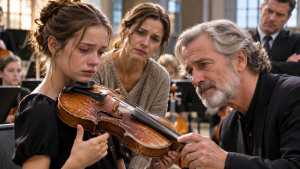
He examined the repaired corner.
Then he turned it over and looked beneath the chin rest.
His expression changed.
“Where did you get this?”
“My grandfather gave it to me.”
“What was his name?”
“Daniel Parker.”
The conductor’s fingers began trembling.
He looked at Sophie again.
Then he whispered:
“Your grandfather wasn’t supposed to have sold this violin.”
PART 2 — THE NAME INSIDE THE WOOD
Mr. Collins laughed nervously.
“Professor, perhaps we should continue with the audition.”
But Professor Whitmore didn’t move.
He asked Sophie to sit down.
Then he gently removed the chin rest.
Beneath it was a small inscription carved into the wood.
It was difficult to read because the letters had faded.
But the conductor recognized them.
E. WHITMORE — 1978.
He stepped backward.
I stared at him.
“Is that your name?”
He nodded.
“Not mine.”
“My father’s.”
He explained that his father, Edward Whitmore, had been a violin maker.
Edward had built instruments by hand and given several to talented young musicians who couldn’t afford them.
One of those musicians had been a teenage boy named Daniel Parker.
My father-in-law.
According to Professor Whitmore, Edward had given Daniel the violin after hearing him perform at a community music competition.
Daniel had promised to become a music teacher and help other children discover music.
He had kept that promise.
For decades, he taught students who had never touched an instrument before.
But there was something Professor Whitmore couldn’t understand.
“Why would Daniel tell everyone this violin was an ordinary family instrument?”
I looked at Sophie.
She was staring at the violin as if she had never seen it before.
Then Professor Whitmore opened his leather folder.
He removed an old photograph.
It showed a young Edward Whitmore standing beside a teenage Daniel.
The same violin was between them.
On the back of the photograph was a handwritten message.
“To Daniel, who reminded me why I build instruments.”
I began crying.
My father-in-law had never mentioned any of this.
He had simply told Sophie that the violin had been with the family for a long time.
Professor Whitmore looked toward the music room.
“Does she know how to play?”
“She’s been learning for six years,” I answered.
He turned to Sophie.
“Would you play something for me?”
She looked nervous.
“Even though my violin is old?”
He smiled.
“Especially because it is old.”
Sophie lifted the instrument.
Her first note trembled.
The second was steadier.
Then she began playing the melody her grandfather had taught her.
It was a simple piece.
Nothing complicated.
But as the music filled the hallway, Professor Whitmore closed his eyes.
When she finished, he didn’t speak immediately.
He looked at the instrument again.
Then he turned toward Mr. Collins.
“Why was this student removed from your orchestra?”
Mr. Collins cleared his throat.
“I was concerned about the quality of the instrument.”
Professor Whitmore nodded slowly.
“Then you were looking at the wrong thing.”
The hallway became silent.
He continued.
“A fine instrument can help a musician.”
“But it cannot give someone the patience to practice, the courage to perform, or the heart to make music.”
He looked at Sophie.
“Your grandfather understood that.”
Then he said something that changed everything.
“I would like Sophie to perform at the regional youth concert.”
Mr. Collins looked shocked.
“But we haven’t completed the auditions.”
Professor Whitmore answered calmly.
“Then perhaps you should complete them properly.”
But the biggest surprise was still waiting.
After school, Professor Whitmore asked me to meet him in the music room.
He explained that his father had left behind a collection of letters.
For years, he had been trying to locate the students who had received his instruments.
Daniel’s name was on the list.
So was a note about the violin.
Edward had written that the instrument should eventually be passed to another young musician who needed it.
I looked at the violin.
“Does that mean Sophie has to give it away?”
Professor Whitmore smiled.
“No.”
He reached into his folder.
“It means your father-in-law had already chosen someone.”
He handed me a letter.
It was written by Daniel.
And it was addressed to Sophie.
PART 3 — THE LAST LESSON
I recognized Daniel’s handwriting immediately.
My hands shook as I opened the letter.
“Dear Sophie,
If you are reading this, I hope you are still playing.
I know this violin looks old.
I know its scratches make it different from the instruments other children carry.
But I want you to understand something.
Every mark on this violin belongs to a moment when someone refused to give up.
The small crack was repaired by a man who believed music deserved another chance.
The faded finish came from years of hands holding it.
The worn bridge came from thousands of notes that were played, forgotten, and played again.
This violin was given to me when I was young.
I was poor, frightened, and convinced that I would never become a real musician.
Edward Whitmore gave it to me without asking for anything in return.
He only asked me to teach someone else when I had the chance.
I spent my life doing that.
Now I want you to continue.
You don’t have to become famous.
You don’t have to play in a grand concert hall.
Just remember the children who might never get the chance to hold an instrument.
If you ever meet one of them, help them.
That is how music survives.
I love you,
Grandpa.”
I couldn’t stop crying.
Sophie held the letter against her chest.
“He knew I would have this violin?”
I nodded.
“He hoped you would.”
Professor Whitmore then told us something else.
He had been planning to establish a small music scholarship in his father’s name.
After hearing Sophie’s story, he wanted to expand it.
The scholarship would provide refurbished instruments and free music lessons to children whose families couldn’t afford them.
He asked Sophie if she would like to help choose the first group of students.
She looked surprised.
“Me?”
“Yes,” he replied.
“Your grandfather spent his life helping children discover music.”
“I think he would be proud to see you do the same.”
Two weeks later, Sophie performed at the regional youth concert.
She wore a simple navy dress.
Her shoes were slightly too big because I had bought them one size larger, hoping she could wear them longer.
She stood backstage holding her grandfather’s violin.
I knelt beside her.
“Are you nervous?”
She nodded.
“Very.”
I smiled.
“Your grandfather would tell you to breathe.”
She laughed softly.
Then she walked onto the stage.
Professor Whitmore introduced her.
He told the audience about Edward’s violin, Daniel’s promise, and a young girl who refused to believe an old instrument made her less worthy of standing beside other musicians.
Sophie began playing.
The first few notes were gentle.
Then the melody grew stronger.
For a moment, I could almost imagine Daniel sitting beside me, smiling with his hands folded.
When Sophie finished, the audience stood.
She looked toward me.
I was crying.
But this time, they were happy tears.
After the concert, Mr. Collins approached us.
He looked uncomfortable.
“Sophie, I owe you an apology.”
She said nothing.
He continued.
“I judged your instrument before I truly listened to you.”
Sophie looked at her grandfather’s violin.
Then she answered quietly.
“I hope you listen to the other students too.”
Mr. Collins nodded.
“I will.”
Several months later, the school opened a small instrument lending program.
Students who couldn’t afford violins, cellos, or other instruments could borrow them without paying a fee.
Sophie helped Professor Whitmore organize the first collection.
She named the program:
The Second Note Project.
Its purpose was simple.
No child should lose the chance to make music because their family couldn’t afford an instrument.
At the opening ceremony, a little boy approached Sophie.
He was holding a battered violin with a missing string.
“Do you think I can still learn?” he asked.
Sophie smiled.
She remembered exactly how that question felt.
“Of course.”
She took him inside and helped him choose a repaired instrument.
Then she showed him how to hold the bow.
That evening, I found her sitting in her grandfather’s old chair.
She was polishing the violin carefully.
I sat beside her.
“Do you miss Grandpa?”
She nodded.
“Every day.”
Then she looked at the instrument.
“But I think he’s still teaching.”
I smiled.
“How?”
She placed the violin beneath her chin.
“Every time someone thinks they’re not good enough, I can tell them what he told me.”
She played one soft note.
Then another.
And I understood that her grandfather’s greatest gift had never been the violin.
It was the belief that every child deserved the chance to be heard.
THE END
Never judge someone’s potential by what they can afford to carry.
An old instrument can create beautiful music, and an overlooked child can become someone extraordinary when just one person believes in them.
Do you think Mr. Collins deserved forgiveness after apologizing, or should teachers be held more accountable for discouraging talented children?