My Son Told the School I Was Too Embarrassing to Attend His Daughter’s Play—Then the Little Girl Walked Onto the Stage and Signed Six Words That Made the Entire Auditorium Cry
PART 1 — THE GRANDFATHER WHO WASN’T INVITED
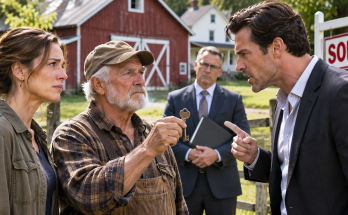
My son told me not to attend my granddaughter’s school play because he was afraid I would embarrass him.
I never imagined that six words from a little girl would eventually make an entire auditorium stand up.
My name is Walter, and I am sixty-eight years old.
For most of my life, I worked as a carpenter.
I built kitchen cabinets, repaired broken doors, and made furniture for families who wanted something that would last.
But the most important thing I ever built was a small wooden stage for my granddaughter, Emma.
She was five when she first told me she wanted to perform.
She stood on a chair in my workshop, raised a wooden spoon like a microphone, and announced that one day she would become an actress.
I laughed and promised to build her a real stage.
I kept that promise.
Every Saturday, Emma visited my house.
I helped her make costumes from old curtains, painted cardboard castles, and built little wooden animals for her imaginary stories.
There was only one difficulty.
I had been losing my hearing for several years.
At first, I could follow conversations by watching people’s faces.
Eventually, I struggled to understand even familiar voices.
I began using hearing aids, but crowded rooms remained difficult.
My daughter-in-law, Vanessa, seemed uncomfortable whenever I asked people to repeat themselves.
She often spoke louder instead of facing me.
My son, Michael, became increasingly impatient.
“Dad, you need to stop asking everyone to repeat everything,” he once said.
“I’m trying, son.”
“You make people uncomfortable.”
I didn’t argue.
I simply learned to smile more and speak less.
Then Emma’s school announced its annual theater performance.
She was playing the princess in a production called The Garden of Wishes.
For weeks, she practiced her lines in my workshop.
She also taught me a few simple signs because she had been learning sign language at school.
One afternoon, she placed both hands against her cheeks and signed that she loved me.
I signed it back.
She giggled.
“You’re getting better, Grandpa!”
I was happier than I had been in years.
Then I received a message from Michael.
He wrote that the school auditorium would be crowded and that I probably wouldn’t enjoy the performance.
I replied that I had already bought a ticket.
He called immediately.
“Dad, please don’t come.”
I thought I had misunderstood him.
“Why?”
“Because Emma has an important role, and we don’t need a distraction.”
“What distraction?”
He hesitated.
“People will notice your hearing aids. You’ll keep asking questions, and you might interrupt something.”
I sat quietly.
Then he said the sentence that hurt more than anything else.
“Please don’t make my daughter’s big night about you.”
I looked at the little wooden crown I had made for Emma.
“I understand,” I whispered.
But I didn’t understand.
I had never missed one of her performances.
I had built the stage where she practiced.
I had helped her memorize lines when she forgot them.
And now, the one person who had promised to support her wanted me to disappear.
The following afternoon, Emma called.
“Grandpa, are you coming?”
I looked at the ticket on my table.
“I don’t think so, sweetheart.”
She became quiet.
Then she asked, “Did Daddy tell you not to come?”
I didn’t answer.
She whispered, “But I saved you the best seat.”
Before I could respond, Vanessa took the phone.
“Emma needs to finish her homework.”
The call ended.
That night, I placed my ticket inside the drawer.
Then I noticed something unusual in my mailbox.
It was a small envelope from Emma’s teacher.
Inside was a handwritten note.
Mr. Walter, I hope you will attend Friday’s performance. Emma has been preparing something special for you.
I read it twice.
Then I looked at the date.
Friday was only two days away.
And I began to wonder what my granddaughter was planning.
PART 2 — THE SECRET BEHIND THE FINAL SCENE
On Friday afternoon, I decided to attend.
I didn’t tell Michael.
I wore my best gray suit, polished my shoes, and arrived thirty minutes before the performance.
The school auditorium was already filling.
Children ran between the seats while parents arranged cameras and flowers.
I found a seat near the back.
I wanted to avoid drawing attention.
A few minutes later, Emma’s teacher, Mrs. Collins, approached me.
“Mr. Walter, I’m so glad you came.”
“Thank you for inviting me.”
She sat beside me.
“Emma has told me a great deal about you.”
I smiled.
“She tells me you built her entire imaginary kingdom in your workshop.”
I laughed.
“Most of it was made from leftover wood.”
Mrs. Collins smiled.
Then she lowered her voice.
“There’s something I think you should know.”
She explained that Emma had been struggling with one part of the play.
The final scene required the princess to deliver a speech about the people who made her feel safe.
But Emma had refused to perform the original version.
“She said the words weren’t honest enough,” Mrs. Collins explained.
“What did she want to say?”
Mrs. Collins looked toward the stage.
“I think you’ll find out.”
Before I could ask anything else, Michael and Vanessa entered with their friends.
Michael noticed me immediately.
His expression changed.
He walked over.
“Dad, what are you doing here?”
“Emma invited me.”
“I told you not to come.”
“I bought a ticket.”
He glanced around.
“Can we talk outside?”
I stood.
But Mrs. Collins gently interrupted.
“Mr. Michael, your daughter has been asking whether her grandfather arrived. I believe he should stay.”
Michael looked embarrassed.
He returned to his seat without another word.
The lights dimmed.
The children walked onto the stage.
Emma appeared in a beautiful green dress with a paper crown.
She looked across the audience.
When she saw me, her face lit up.
She waved.
I waved back.
The play began.
The children performed their scenes beautifully.
Then came the final act.
Emma stepped forward.
She held a small wooden box.
Inside the story, the princess was supposed to place a wish inside the box before the garden disappeared.
But Emma didn’t follow the printed script.
She looked toward the audience and began speaking.
“My kingdom isn’t made of gold.”
“My kingdom is made of people who love me.”
She paused.
“Some people tell stories with their voices.”
“Some people tell stories with their hands.”
“Some people cannot hear every word, but they can still understand every feeling.”
My hands began to tremble.
Emma turned toward me.
Then she placed the wooden box on the stage.
And she began signing.
Slowly and clearly, she signed six words.
“Grandpa, you always heard my heart.”
The auditorium became silent.
I covered my mouth.
Emma continued signing.
“Thank you for listening when nobody else did.”
Then she spoke the same words aloud.
“I love you, Grandpa.”
I could barely see through my tears.
The audience began applauding.
But Emma wasn’t finished.
She reached into the wooden box and removed a folded piece of paper.
It was a drawing of a little girl standing beside a tall man in a workshop.
Above them, she had written:
My favorite person is my grandpa.
Then she looked at her parents.
“Mom and Dad said Grandpa might not understand my play.”
She paused.
“But Grandpa understands me better than anyone.”
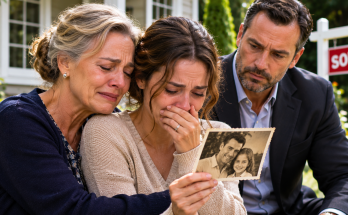
Michael lowered his head.
Vanessa stared at the stage.
And suddenly, I realized that Emma had not simply prepared a surprise for me.
She had prepared the truth for everyone.
PART 3 — THE MAN WHO FINALLY TOOK HIS SEAT
After the performance, the children ran into the auditorium to find their families.
Emma rushed toward me.
“Grandpa!”
I knelt and opened my arms.
She hugged me so tightly that my glasses nearly fell off.
“I saw you!” she shouted.
“I saw you too, princess.”
She pulled back and looked at my hearing aids.
“Did you hear my words?”
I smiled.
“I heard some of them.”
She touched my hands.
“Then I’ll sign the rest.”
And she did.
She signed that she loved me.
She signed that she wanted me at every performance.
And she signed that she never wanted me to feel ashamed of being different.
I held her hands.
“You never have to change how you speak for me, sweetheart.”
She smiled.
“Good. Because I have lots more stories.”
Behind her, Michael was standing near the auditorium doors.
He looked at me for a long time before approaching.
“Dad, can we talk?”
Emma stepped aside.
Michael sat beside me.
For the first time in years, he looked less like an impatient adult and more like the little boy who used to sit on my workshop floor.
“I’m sorry,” he said.
I waited.
“I was embarrassed about things I didn’t understand.”
He rubbed his hands together.
“When Emma started learning sign language, I thought it was just a school activity. I didn’t realize how much it meant to her.”
I looked at him.
“She wanted to communicate with me.”
“I know.”
He swallowed.
“I should never have asked you to stay away.”
I didn’t immediately forgive him.
Not because I wanted to punish him.
But because I needed him to understand that his words had consequences.
“You know what hurt the most?” I asked.
He shook his head.
“It wasn’t that you thought people might stare at me. It was that you thought I was something your daughter needed protection from.”
Michael’s eyes filled with tears.
“I know, Dad.”
I looked toward Emma.
She was showing another child how to sign the word for friendship.
“She doesn’t see my hearing aids as something embarrassing,” I said.
“She sees them as part of me.”
Michael nodded.
“I understand now.”
Then he did something I hadn’t expected.
He reached into his jacket and handed me a folded paper.
It was a printed photograph from the performance.
Someone had captured the exact moment Emma signed her message.
Beneath it, Michael had written:
The best seat in the auditorium belongs to the person who helped her find her voice.
I looked at him.
“Did you write this?”
He nodded.
“I wanted you to have it.”
I carefully folded the paper and placed it in my pocket.
Then Emma ran back toward us.
“Grandpa, can you come tomorrow?”
“Where?”
“My classroom. Mrs. Collins says we can show our families what we learned.”
I smiled.
“Of course.”
She grabbed my hand.
“And bring your little wooden animals. I want to teach them sign language.”
I laughed.
For the first time in a long while, I felt completely included.
A few weeks later, the school invited me to help with a new project.
Mrs. Collins wanted to create a small workshop where children could learn to build simple wooden props and explore ways to communicate with people who experience the world differently.
I volunteered every Thursday.
Michael began attending too.
At first, he struggled with the signs.
Emma patiently corrected him.
Sometimes she laughed.
Sometimes he got frustrated.
But he kept learning.
One afternoon, he came into my workshop and signed a sentence without looking at his phone.
“Dad, thank you for teaching me.”
My eyes filled with tears.
I signed back:
“I’m proud of you.”
On the wall above my workbench, I placed Emma’s drawing.
The little girl and the tall man stood together beneath a wooden sign.
It read:
EVERYONE DESERVES A PLACE IN THE STORY.
And underneath it, I placed the photograph from her school performance.
I had spent my entire life building things for other people.
But my granddaughter taught me that the strongest things we build aren’t made from wood.
They’re made from patience, understanding, and the simple decision to make room for someone.
I never missed another performance.
And whenever Emma walked onto a stage, she always looked for the same face in the audience.
Mine.
THE END
A little reminder: Never make someone feel small because the world communicates differently with them. Love isn’t measured by how loudly someone speaks, but by how deeply they listen.
What would you have done if your own child told you not to attend your grandchild’s special performance? Would you have stayed away, or would you have gone anyway?