My Son Laughed When I Applied to Become the Town’s Christmas Train Conductor—Then a Little Girl Stepped Onto the Platform Carrying a Photograph of the Man I Had Been Waiting 40 Years to Find
PART 1 — THE OLD MAN WITH ONE LAST DREAM
My son laughed when I told him I wanted to drive the town’s Christmas train.
“Dad, you’re seventy-two years old,” he said.
“You make it sound like I’m asking to fly to the moon.”
He shook his head.
“It’s a job for retired railway workers, not someone who spent his whole life repairing refrigerators.”
I looked down at the application form on my kitchen table.
He wasn’t entirely wrong.
I had never driven a train.
I had spent forty-three years repairing household appliances in a small workshop behind my house.
But every December, our town transformed an old railway line into a Christmas attraction.
The little red train carried families through the countryside, past decorated farms, frozen ponds, and thousands of glowing lights.
The conductor wore a dark green uniform and rang a brass bell whenever the train approached the station.
I had watched it every year.
And every year, I remembered my younger brother, Peter.
When we were children, Peter and I had dreamed of becoming railway engineers.
We used to sit beside the tracks and wave at passing trains.
He always insisted that one day we would operate one together.
But our childhood didn’t turn out the way we imagined.
When I was seventeen, our father died.
Our mother became ill shortly afterward, and I had to work to support the family.
Peter was only twelve.
One winter morning, he disappeared.
I searched everywhere.
The police eventually found his coat near the old railway station, but there was no sign of him.
Some people believed he had run away.
Others believed he had been taken by a passing freight crew.
No one ever discovered what happened.
For forty years, I kept his photograph inside my wallet.
It was the last picture taken of us together.
Two boys standing beside a railway signal, smiling at a future they believed would last forever.
My wife, Helen, knew how much I missed him.
Before she passed away, she used to tell me that I needed to stop living as though every December was a memorial.
“Do something that makes you feel alive again,” she would say.
So when I saw the Christmas train advertisement, I applied.
I wanted one last adventure.
I wanted to ring that brass bell.
And perhaps, in some small way, keep the promise I had made to my brother.
But my son, David, wasn’t supportive.
He had spent years encouraging me to sell my workshop and move into a retirement community.
He thought my old-fashioned hobbies were embarrassing.
“You should be enjoying your retirement,” he said.
“I am trying.”
“Then stop chasing childhood dreams.”
I folded the application.
But I didn’t throw it away.
The following morning, I visited the railway office.
The manager, a woman named Mrs. Bennett, looked through my application.
“Have you ever worked around trains?” she asked.
“No, ma’am. But I’ve repaired machinery my entire life.”
She smiled.
“That’s a useful beginning.”
She explained that the position involved training, safety procedures, and working with the regular railway crew.
I agreed to everything.
Three weeks later, I received a call.
I had been accepted as the Christmas train’s assistant conductor.
I was so excited that I called David.
He barely reacted.
“Just be careful,” he said.
Then he hung up.
I didn’t let it ruin my happiness.
On the first day of training, I arrived before sunrise.
The train stood on the platform, its red paint shining beneath the station lights.
I ran my hand along the brass bell.
For a moment, I could almost hear Peter laughing beside me.
Then I noticed a little girl standing near the ticket office.
She was holding an old photograph.
She looked about nine years old.
When she saw me, she approached slowly.
“Excuse me,” she said.
“Can you help me find someone?”
“Of course, sweetheart.”
She showed me the photograph.
My heart stopped.
It was a picture of two boys beside a railway signal.
One was me.
The other was Peter.
But there was something written on the back.
A message I had never seen before.
“If you ever find my brother, tell him I kept the promise.”
I looked at the girl.
“Where did you get this?”
She swallowed.
“My grandfather gave it to me.”
I stared at her.
“What is your grandfather’s name?”
She whispered a name that made my knees weaken.
“Peter.”
PART 2 — THE MESSAGE THAT CROSSED FOUR DECADES
I couldn’t speak.
For forty years, I had imagined a thousand possible explanations for Peter’s disappearance.
I had imagined that he had died.
I had imagined that he had forgotten us.
I had even imagined that he had built a new life somewhere and never wanted to return.
But I had never imagined that he might still be alive.
“Where is he?” I asked.
The little girl pointed toward the parking area.
“He’s waiting in the car.”
I walked outside with her.
An older man sat behind the steering wheel of a blue vehicle.
His hair was white.
His shoulders were bent.
But when he turned toward me, I recognized his eyes.
“Peter?”
He opened the door.
For several seconds, neither of us moved.
Then he stepped forward.
“Hello, Jack.”
I grabbed him.
We held each other in the parking lot, two old men crying like children.
I had imagined this moment for forty years.
But I had never imagined how much time would have passed before it finally arrived.
“Where have you been?” I asked.
Peter looked toward the ground.
“I’ve tried to find you.”
I shook my head.
“You disappeared.”
“I know.”
He explained that on the day he vanished, he had been trying to reach our aunt, who lived in another town.
He had heard our mother crying about unpaid bills and believed he was the reason she was struggling.
He thought leaving would make things easier for us.
He boarded the wrong train and ended up several hours away.
A railway worker found him alone and frightened.
The worker contacted the authorities.
Peter was eventually placed with a foster family.
But he had been too young to explain exactly where he came from.
His records were incomplete, and the surname he gave officials was misspelled.
He spent years trying to locate us.
By the time he became an adult, our mother had died.
He eventually discovered my name through an old newspaper photograph, but he couldn’t find a current address.
Then life kept moving.
He married.
He raised a daughter.
He worked in railway maintenance.
And he never stopped searching.
“Why didn’t you come back when you found me?” I asked.
Peter looked ashamed.
“I did come back once.”
“When?”
“Twenty-two years ago.”
He explained that he had visited our old house.
But the property had been sold, and a neighbor told him I had moved away.
He left a letter with the neighbor.
I never received it.
“Why didn’t you try again?” I asked.
“I did.”
His eyes filled with tears.
“But every time I thought I was close, something changed.”
He looked at the train behind me.
“I never stopped thinking about our promise.”
I couldn’t stop staring at him.
“What promise?”
He smiled.
“We said we would operate a train together.”
I laughed through my tears.
“You remembered that?”
“Every Christmas.”
Then Peter introduced his granddaughter, Lily.
She had discovered the photograph in an old family album.
When Peter told her about his brother, she insisted that they search for me.
She had found an old article about the Christmas train and recognized my face in a photograph of the volunteers.
That was how they found me.
I invited them to the training session.
Peter watched as I learned how to operate the bell and communicate with the driver.
He laughed when I struggled with the railway radio.
“You always were better with refrigerators,” he teased.
I laughed too.
For the first time in decades, I felt like a young man again.
But there was something else Peter wanted to tell me.
He reached into his coat and removed a small metal box.
Inside was a collection of old railway badges, a faded ticket, and a folded letter.
The letter was written by our mother.
I recognized her handwriting immediately.
Peter explained that he had received it from his foster mother shortly before she passed away.
She had kept it safe for him.
I opened it carefully.
My dear boys,
If life ever separates you, remember that being apart does not mean you have stopped belonging to one another.
Jack, please don’t carry the whole world on your shoulders.
Peter, please never believe that you were a burden.
I love you both more than you will ever understand.
I pressed the letter against my chest.
All those years, I had believed Peter had left because he wanted a different life.
He had believed I had never searched hard enough.
But neither of us had known the full truth.
We had both been children trying to survive a difficult world.
And we had both spent our lives missing the same family.
That evening, I called David.
I told him everything.
He was quiet.
Then he said, “Dad, are you sure it’s really Uncle Peter?”
I felt my happiness fade slightly.
“I’m sure.”
“People can pretend to be anyone.”
I looked at Peter sitting beside me.
“I know my own brother.”
David sighed.
“Just don’t get carried away.”
I ended the call.
Peter placed a hand on my shoulder.
“Don’t let this become another reason to lose your family.”
I nodded.
But I was beginning to realize that finding Peter was only the beginning.
I still had to learn how to let the people I loved back into my life.
PART 3 — THE BRASS BELL RANG TWICE
Christmas Eve arrived.
The little red train was decorated with garlands and warm white lights.
Families gathered along the platform.
Children wore knitted hats.
Parents held cameras.
The air smelled of hot chocolate and fresh pine.
I stood beside the locomotive wearing my new conductor’s uniform.
Peter was standing beside me.
Mrs. Bennett had made a special arrangement.
She had approved Peter to join the crew as a guest conductor for the evening, after completing the required safety briefing and training.
We were finally going to do it.
Together.
Just like we had promised when we were children.
Lily ran toward us.
“Grandpa! Uncle Jack!”
She held two small paper tickets.
“One for each of you!”
Peter laughed.
“Where did you get those?”
“I made them.”
She handed us the tickets.
They were decorated with tiny drawings of trains.
On the back, she had written:
For the brothers who found their way home.
I nearly cried again.
Just before departure, I noticed David standing near the station entrance.
He had arrived alone.
I walked toward him.
“What are you doing here?”
He looked uncomfortable.
“I wanted to see the train.”
I smiled.
“You came all this way just to see a train?”
He looked at Peter.
Then he looked back at me.
“I also wanted to apologize.”
I waited.
David explained that he had spent years worrying about me.
After his mother died, he became afraid that I would become lonely or get hurt.
He thought encouraging me to give up my workshop and hobbies was the responsible thing to do.
But somewhere along the way, he had confused protecting me with controlling me.
“I didn’t realize how much this mattered to you,” he said.
I looked at the train.
“It matters because I spent forty years thinking I would never have this moment.”
David nodded.
“I understand.”
Then he looked at Peter.
“I’m David.”
Peter smiled.
“I know. Your father has told me about you.”
David looked surprised.
“He has?”
“More than you might imagine.”
They shook hands.
It wasn’t a perfect beginning.
But it was a beginning.
A whistle sounded.
Mrs. Bennett called everyone to board.
I climbed into the conductor’s position.
Peter stood beside me.
The driver gave us a thumbs-up.
I lifted the brass bell.
And rang it once.
The sound echoed across the platform.
Peter laughed.
“Again!”
I rang it a second time.
And the train began moving.
Children waved from the windows.
Parents took photographs.
Lily stood near the front carriage, smiling so widely that her cheeks turned red.
As the train passed the first decorated farm, Peter leaned toward me.
“Do you remember what we used to say?”
I smiled.
“That one day we’d drive a train together.”
He nodded.
“And what did you say you’d do if we ever got the chance?”
I looked at him.
“I said I’d let you ring the bell first.”
Peter laughed.
“You always forget the important details.”
He reached for the bell.
I stepped aside.
He rang it.
The sound carried into the winter night.
For a moment, I was seventeen again.
My little brother was beside me.
Our mother was waiting at home.
And the future seemed full of possibilities.
After the ride, we gathered at the station for photographs.
David stood beside me.
Peter stood on my other side.
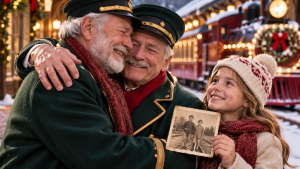
Lily held the old photograph of the two boys.
Mrs. Bennett took the picture.
Then she asked us to smile.
I looked at Peter.
He looked at me.
And we both smiled.
Not because forty years had disappeared.
But because they had finally stopped separating us.
The next morning, David visited my workshop.
He looked around at the old tools, unfinished furniture, and boxes of spare parts.
“I used to think this place was holding you back,” he said.
I put down my screwdriver.
“And now?”
He smiled.
“Now I think it’s where you kept part of yourself alive.”
He helped me build a small wooden train for Lily.
Peter joined us.
We spent the entire afternoon measuring, cutting, sanding, and laughing.
When the little train was finished, Lily placed it on the workshop table.
“Can I keep this forever?”
I nodded.
“That’s why we built it.”
She turned the wooden train over.
On the bottom, she found a small inscription Peter had carved.
It read:
“Some journeys take forty years, but brothers still know the way home.”
Lily hugged us both.
And I finally understood something my mother had tried to teach us long ago.
A family can be separated by distance, mistakes, fear, and time.
But love can survive all of them.
Sometimes, all it needs is one person brave enough to ring the bell and begin the journey home.
THE END
A little reminder: Never assume that someone who disappeared from your life stopped loving you. Sometimes people carry unfinished stories for decades, hoping for one more chance to come home.
If you were in my position, would you welcome a brother back after forty years without knowing what happened, or would you need time to forgive him?