PART 1 — THE THING BEHIND THE CLOSET
My name is Daniel Reed.
I had always been the uncle my nephew, Noah, ran toward.
He called me “Uncle Danny.”
Every holiday, he waited by the front window for my car.
So when I arrived at my sister Melissa’s house for Thanksgiving and Noah barely looked at me, I knew something was wrong.
He was six years old.
Usually, he talked nonstop.
That afternoon, he sat at the dining table without touching his food.
His shoulders were stiff.
His eyes kept moving toward the hallway.
Melissa noticed me watching him.
“He’s been difficult lately,” she said.
Her husband, Grant, laughed.
“Too much screen time.”
I smiled politely.
But I kept watching Noah.
The house was beautiful.
Warm lights.
A roaring fireplace.
A long dining table covered with food.
A huge Christmas tree stood in the corner even though Thanksgiving wasn’t over yet.
Everything looked perfect.
Except for the little boy sitting silently beneath it.
After dinner, I found myself alone in the hallway.
Then I heard a small voice behind me.
“Uncle Danny?”
I turned.
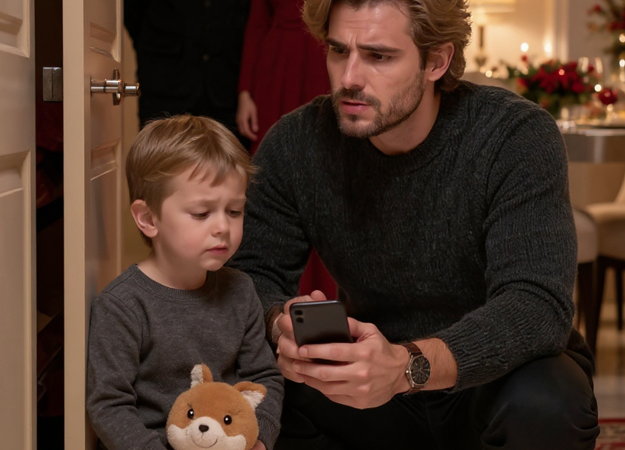
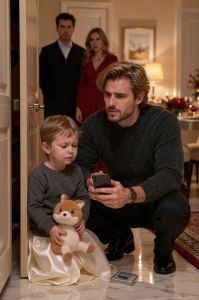
Noah stood there holding his stuffed fox.
“What’s wrong?”
He looked toward his parents.
Then whispered,
“The closet hurts.”
I frowned.
“What closet?”
He pointed toward the guest room.
I crouched down.
“Show me.”
He grabbed my hand.
We walked inside.
The closet door was closed.
Noah stopped several feet away.
“I don’t like that one.”
“Why?”
He swallowed.
Then he whispered,
“Because that’s where Daddy puts the box.”
“What box?”
He shook his head.
“I can’t tell.”
I heard footsteps behind us.
Melissa appeared in the doorway.
“Noah, what are you doing?”
He immediately stepped behind me.
“Nothing.”
Grant walked in.
He laughed.
“Don’t encourage him, Daniel.”
I looked at him.
“Encourage what?”
“These stories.”
Melissa rolled her eyes.
“He’s been making things up for weeks.”
Noah’s face tightened.
I didn’t argue.
I simply asked,
“What kind of stories?”
Grant answered too quickly.
“Monsters. Shadows. Someone following him.”
He laughed again.
“Kids his age imagine everything.”
Noah looked at me.
His eyes were wet.
Then he whispered,
“I’m not imagining it.”
My stomach tightened.
I waited until his parents returned downstairs.
Then I went back into the guest room.
The closet looked ordinary.
Winter coats.
Storage bins.
Shoes.
I checked behind the hanging clothes.
Nothing.
Then I noticed a box pushed against the back wall.
It was sealed with clear tape.
I photographed it.
I didn’t open it.
Instead, I called a pediatrician I knew through a friend and explained that Noah had been complaining of unexplained pain and fear.
The doctor asked me to bring him in the next morning.
Before we could leave, Noah whispered,
“Uncle Danny… there’s something under the box.”
I moved it carefully.
A small plastic pouch was taped to the floor.
Inside was a hospital bracelet.
Noah’s name was on it.
The date was eight months earlier.
I looked at him.
“Were you in the hospital?”
He shook his head.
“Mommy said I fell.”
I stared at the bracelet.
Something was wrong.
Very wrong.
I put the pouch in my pocket.
Then Noah grabbed my sleeve.
“Don’t tell Daddy.”
“Why?”
His voice dropped to almost nothing.
“Because he’ll make Mommy say I lied again.”
I felt a cold wave move through me.
I had spent years working in investigative journalism.
I knew the difference between a child’s imagination and genuine fear.
And Noah wasn’t playing.
That night, I didn’t sleep.
At 7:12 the next morning, I took Noah to the pediatric clinic.
The doctor examined him.
She asked him gentle questions.
She reviewed his medical records.
Then she stopped.
“What happened on this date?”
She pointed to the hospital bracelet.
Noah didn’t answer.
The doctor looked at me.
“This child had an emergency visit eight months ago.”
“I know.”
She shook her head.
“But the reason recorded here doesn’t match the injury pattern we’re seeing.”
My heart sank.
“What does that mean?”
She closed the file.
“It means someone may have given the hospital an incomplete explanation.”
Then she looked at Noah.
“Who brought you that night?”
Noah stared at the floor.
Finally, he whispered one name.
Not his father.
Not his mother.
Someone neither of us had expected.
And that was when I realized the box in the closet wasn’t the secret.
It was only the clue.
PART 2 — THE RECORD THAT WAS CHANGED
The name Noah whispered was Aunt Karen.
Melissa’s older sister.
Karen was the person everyone in the family trusted.
She organized holidays.
She babysat the children.
She volunteered at Noah’s school.
Whenever anyone needed help, Karen appeared first.
I couldn’t understand why Noah would be afraid of her.
The pediatrician recommended a formal child-safety evaluation.
I agreed.
Melissa arrived at the clinic less than an hour later.
She was furious.
“What are you doing with my son?”
I stood.
“He’s scared.”
“He’s six.”
“He’s also telling us something happened eight months ago.”
Grant stepped into the room behind her.
“This is ridiculous.”
The pediatrician remained calm.
“We need to review his medical history carefully.”
Karen arrived twenty minutes later.
She looked deeply concerned.
“What happened?”
Noah immediately looked away.
Karen noticed.
“What has he told you?”
I watched her carefully.
“About the hospital.”
Her expression changed.
Only for a second.
But I saw it.
She knew exactly what I meant.
She recovered quickly.
“Oh, that old thing.”
I frowned.
“You know about it?”
“Of course. Melissa called me that night.”
Noah suddenly spoke.
“You took me.”
The room went silent.
Karen’s smile disappeared.
“I only drove you to the hospital.”
“Why?”
“Because your mother was sick.”
Noah shook his head.
“No.”
His voice was trembling.
“Mommy wasn’t sick.”
Grant stepped forward.
“Enough.”
The pediatrician raised a hand.
“Please let him speak.”
Noah looked at me.
Then he pointed toward Karen.
“She told me not to tell Uncle Danny.”
Karen’s face went pale.
The doctor asked Noah what happened.
He didn’t describe everything.
He simply said that he had been frightened, someone had hurt him, and he had been told to say that he had fallen.
The room became silent.
The pediatrician immediately contacted the appropriate child-protection authorities and preserved the medical records.
That afternoon, investigators discovered something astonishing.
The original emergency report had been altered.
The first version stated that Noah had been brought in with injuries that required further investigation.
The final version simply said:
Accidental fall at home.
The signatures had been changed.
The time had been changed.
And the person listed as the accompanying adult was not Karen.
It was Melissa.
But Melissa hadn’t been at the hospital.
She had been working that night.
Someone had used her name.
Then investigators searched the family computer.
They found scanned copies of medical forms.
Drafts of explanations.
Messages discussing what Noah should say.
And one message from Karen:
He remembers more than we thought. Keep him away from Daniel.
My hands went cold.
“Why were they keeping him away from me?”
The investigator looked at me.
“Because you were asking questions.”
I remembered.
Three months earlier, I had casually asked Melissa why Noah had started waking up frightened.
She had told me I was imagining things.
Now I understood why.
The investigation expanded.
Doctors.
School staff.
Family members.
Everyone was interviewed.
Then the investigators discovered another hidden detail.
Noah’s teacher had reported concerns months earlier.
She had noticed the child becoming withdrawn and afraid whenever Karen came to school.
The report had never been forwarded.
Someone had removed it from the file.
The person who had access?
Karen.
She had been volunteering in the school office.
Then we found the box.
The one from the closet.
Inside were copies of old medical paperwork, photographs, and notes documenting every time Noah had been injured.
Someone had been keeping records.
Not to help him.
To keep track of what he might remember.
The most disturbing note was dated two months earlier:
If he talks, say Daniel caused the problems.
I stared at the page.
They had planned to blame me.
The person who had spent years protecting children in our family had been building a story that would make me look dangerous.
And then investigators discovered one final piece of evidence.
A security camera from a neighboring house.
It showed Karen arriving at Melissa’s home on the night of the original injury.
She was carrying a large storage box.
Two hours later, she left without it.
That box was the same one we had found in the closet.
Karen was arrested before she could remove anything else.
But the investigation revealed something even worse.
She hadn’t been acting alone.
And the person who had helped her was someone Noah still called “Mom.”
PART 3 — THE TRUTH NO ONE COULD HIDE
Melissa broke down when investigators showed her the evidence.
She admitted Karen had convinced her that protecting the family’s reputation mattered more than telling the truth.
Grant had known part of the story.
He had refused to ask questions.
Both had been afraid of what would happen if the truth became public.
But there was one thing Melissa insisted on.
“I never hurt my son.”
The investigators believed her.
But they also told her something she needed to hear.
“You don’t have to cause harm yourself to help hide it.”
Melissa cried.
For months, she had repeated the same explanations.
He fell.
He’s imagining things.
He’s seeking attention.
He gets nervous around strangers.
Anything except the truth.
Meanwhile, Noah had been carrying fear he couldn’t explain.
The evidence eventually established that Karen had been responsible for the earlier injuries and had pressured the family into hiding them.
The exact details were handled by investigators and medical professionals.
What mattered to Noah was finally being believed.
His teacher submitted her original concerns.
The hospital produced the first version of the medical report.
The security footage confirmed Karen’s presence.
The messages showed the effort to conceal what had happened.
The case was no longer a child’s word against an adult’s.
There was evidence everywhere.
Karen faced serious criminal charges.
Melissa entered treatment and counseling with Noah.
Grant was removed from decision-making about Noah’s care while the investigation continued.
And I became the uncle who never missed a school pickup.
Months passed.
Noah slowly changed.
He started laughing again.
He slept through the night.
He stopped staring at doors.
He even began carrying his stuffed fox everywhere again.
One afternoon, we sat together on a park bench.
He looked at me.
“Uncle Danny?”
“Yes?”
“Do you remember the closet?”
“Yes.”
“I’m not scared of it anymore.”
I smiled.
“Why?”
“Because the secret is gone.”
I looked at him.
He was still only six.
But he understood something many adults never learn.
Secrets grow powerful when everyone protects them.
Truth gets stronger every time someone tells it.
A year later, Noah returned to school.
His teacher gave him a little certificate for bravery.
He brought it home and showed me first.
“What do you think?”
I smiled.
“I think you’re pretty brave.”
He thought for a moment.
Then he said,
“I was only brave because you believed me.”
That sentence broke my heart.
Because children shouldn’t have to become brave just to convince adults that they’re hurting.
I eventually donated the stuffed fox he carried during those difficult months to a children’s support center.
But Noah kept one thing from that time.
The little hospital bracelet.
He had it in a memory box.
Not because he wanted to remember the pain.
Because he wanted to remember the day someone finally asked the right question.
Years later, I still think about the night he whispered,
“The closet hurts.”
At the time, it sounded like the strange sentence of a frightened child.
It turned out to be the beginning of the truth.
The adults in his life had spent months trying to make the story disappear.
But they had forgotten one thing.
Children notice what adults think they don’t.
They remember who came into the room.
They remember who told them to stay quiet.
They remember who believed them.
And sometimes, all it takes is one person willing to listen.
I didn’t save Noah by being a hero.
I saved him by refusing to dismiss him.
And that became the lesson I carried for the rest of my life:
When a child says something feels wrong, don’t rush to explain it away.
Listen. Ask. Look closer.
Because sometimes the smallest whisper in a quiet hallway is the first sound of a truth that can no longer be buried.
And that Thanksgiving, when my family thought I was simply visiting for dinner…
I had no idea I would leave with something much more important than a holiday memory.
I would leave knowing that one frightened little boy had trusted me with the truth.
And this time, someone finally listened.