
PART 1 — THE MARRIAGE I NEVER PLANNED
My name is Elena Brooks.
I was thirty-four when life cornered me into making the strangest decision of my life.
At the time, I wasn’t looking for romance.
I wasn’t looking for wealth.
I wasn’t even looking for a husband.
I was looking for a roof.
My daughter, Mia, was six.
Her father had disappeared from our lives two years earlier after leaving behind more debts than memories.
I worked as a receptionist at a private design firm.
The salary was barely enough.
Every month, I paid rent first, groceries second, and everything else whenever there was anything left.
Then Mia developed asthma.
Her medication became another expense I couldn’t afford.
One rainy Thursday evening, my landlord knocked on the door.
“You have thirty days.”
I stared at him.
“Please. I just need another month.”
He shook his head.
“I’ve already waited.”
That night, Mia asked me a question that broke my heart.
“Mommy, where will we sleep if we lose the apartment?”
I smiled.
“Somewhere nice.”
She believed me.
I barely believed myself.
The next morning, my supervisor called me into his office.
“We have a temporary opening at the Hawthorne estate.”
“The Hawthorne estate?”
“The owner needs a live-in personal assistant.”
The pay was nearly four times what I made.
I accepted immediately.
That’s how I met Malcolm Hawthorne.
He was seventy years old.
A retired architect.
A widower.
And unbelievably wealthy.
He lived in a sprawling stone estate surrounded by gardens, fountains, and acres of old oak trees.
But unlike the wealthy men I had met through my job, Malcolm wasn’t arrogant.
He was quiet.
Kind.
And strangely lonely.
He never asked about my daughter’s father.
He never judged me for bringing Mia to work occasionally.
In fact, he seemed to enjoy having her around.
He taught her chess.
He showed her how to grow tomatoes.
He even built her a tiny reading bench beneath the willow tree.
One afternoon, I found him sitting alone on the veranda.
“You look tired,” he said.
“I am.”
“Money trouble?”
I laughed awkwardly.
“Is it that obvious?”
“To someone who’s been poor before it isn’t.”
That surprised me.
“You were poor?”
“Very.”
We talked until sunset.
Over the following months, something changed.
Malcolm began trusting me.
I began caring about him.
Not because of his money.
Because underneath all that wealth was a man who ate dinner alone every night.
One evening, he finally said:
“Elena, I’m going to ask you something that may sound absurd.”
I smiled.
“That’s usually how serious conversations begin.”
He laughed.
Then he became serious.
“I’ve fallen in love with you.”
I froze.
He continued.
“I know the age difference is enormous.”
“It is.”
“I know people will assume you’re marrying me for my money.”
I lowered my eyes.
“They already assume that.”
“And maybe that’s why I’m asking you.”
I looked up.
He reached across the table.
“I can give Mia security. I can give you both a home. But I won’t ask you to pretend this is something it isn’t.”
My heart pounded.
“You want me to marry you?”
“Yes.”
I thought about the eviction notice.
Mia’s medicine.
The empty savings account.
The uncertainty that followed us everywhere.
I hated that his offer sounded like a rescue.
But I also knew something else.
Malcolm had never once treated me like I was beneath him.
He had never asked for my gratitude.
He had simply been kind.
I said yes.
We married quietly six months later.
No extravagant ceremony.
No magazine photographs.
Just a small garden wedding with Mia holding the flowers.
For five years, our little family was genuinely happy.
Malcolm became the father figure Mia never had.
He took her to school.
He attended every recital.
When she had pneumonia at nine years old, he stayed awake beside her bed all night.
And somehow, somewhere along the way, I stopped thinking of our marriage as a bargain.
I loved him.
Completely.
Then, one winter morning, Malcolm died peacefully in his sleep.
I was holding his hand.
Mia was beside me.
He was seventy-five.
I thought my world had ended.
The funeral was small.
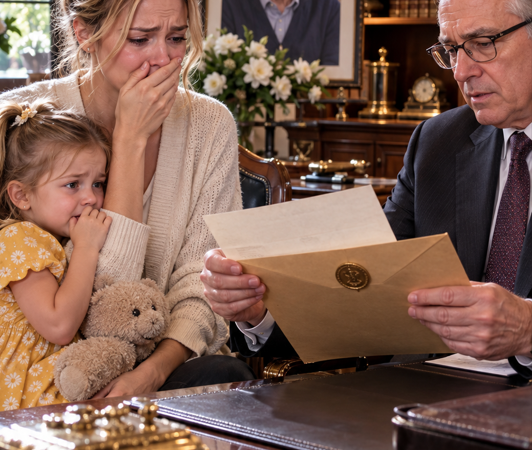
Three days later, his attorney, Charles Mercer, came to the estate.
He placed a thick folder on my desk.
I assumed it contained the inheritance documents.
Instead, he looked at me with an expression I couldn’t understand.
Then he said:
“Malcolm knew you’d fall for it.”
My heart stopped.
“Fall for what?”
“This marriage.”
I stared at him.
“What are you talking about?”
He slid a sealed envelope across the desk.
“The primary estate doesn’t go to you.”
I felt the room spin.
“What?”
“The house. The foundation. The majority of his assets. They’re not yours.”
I stared at the envelope.
“Then why did he marry me?”
Charles took a slow breath.
“Open it.”
I broke the seal.
Inside was a handwritten letter.
The first sentence made my hands tremble.
Elena, I never married you because you needed money.
I looked at Charles.
He said quietly,
“You need to read the rest before you decide whether he betrayed you.”
And what I read next made me realize…
I had never truly known the man I had married.
PART 2 — THE SECRET HE KEPT
The letter continued.
Five years ago, I realized someone in my family was trying to take everything I had built.
I read every line twice.
Malcolm explained that his younger brother’s son, Grant, had been pressuring him to change his will.
Grant believed he deserved control of the Hawthorne Foundation and the properties attached to it.
When Malcolm refused, Grant began manipulating business records.
At first, Malcolm handled it privately.
Then he discovered something much worse.
Grant had been quietly draining money from charitable accounts.
Millions.
Money intended for housing programs, children’s hospitals, and scholarship funds.
Malcolm had confronted him.
Grant denied everything.
Then he made a threat.
“If you change the will, your family will regret it.”
Malcolm wrote that he realized he couldn’t fight Grant alone.
He needed someone outside the family.
Someone Grant couldn’t control.
That person became me.
I lowered the letter.
“Why me?”
Charles answered.
“Because Malcolm trusted you.”
“But I knew nothing.”
“That was intentional.”
I continued reading.
I needed you to be close enough to see the truth, but far enough outside the family to remain independent.
I felt sick.
“So our marriage was part of a plan?”
Charles didn’t answer.
The letter did.
At first, yes.
I closed my eyes.
Then I read the next line.
But I fell in love with you long before I expected to.
Tears blurred the page.
He wrote about Mia.
About the first time he watched her fall asleep on the couch.
About the little reading bench beneath the willow tree.
About the night I sat beside him while he was sick.
Then came the part I hadn’t expected.
I left you almost nothing from the primary estate on purpose.
I stared at the sentence.
Why?
The answer came on the next page.
Because if I left you everything immediately, Grant would know you had access to the evidence.
I looked up.
“What evidence?”
Charles opened a second folder.
Inside were bank records.
Emails.
Property transfers.
And copies of contracts.
Grant had been stealing from Malcolm for years.
But the most disturbing documents were dated only months before Malcolm’s death.
They showed Grant had hired someone to search my apartment.
Someone had been looking for financial documents Malcolm had hidden with me.
I felt cold.
“They searched my home?”
Charles nodded.
“They believed you had the evidence.”
“Did Malcolm know?”
“Yes.”
“Then why didn’t he tell me?”
“Because he believed telling you would put you in more danger.”
I kept reading.
Malcolm had created a private trust.
But the trust had unusual conditions.
It would only activate after an independent investigation proved the financial fraud.
The primary estate would remain frozen until then.
I looked at Charles.
“So I get nothing?”
“You get something more important first.”
He placed another envelope in front of me.
Inside was a key.
“What’s this?”
“Malcolm’s private archive.”
“Where?”
Charles gave me an address.
An old theater on the edge of downtown.
I went there that night.
Inside was a hidden room behind the projection booth.
And on the wall were dozens of photographs.
Every photograph showed Grant meeting with different businessmen.
Every meeting connected to another hidden account.
Then I found a video recording.
Malcolm appeared on screen.
He looked tired.
But alert.
“Elena,” he said.
I covered my mouth.
“If you’re watching this, I’m probably gone.”
He smiled faintly.
“I know you’re angry.”
Tears filled my eyes.
“I would be too.”
He continued.
“But there is something I need you to understand.”
He paused.
“The man I was afraid of wasn’t Grant alone.”
I froze.
“There was someone inside my legal team.”
I looked at Charles.
His face had gone pale.
I turned back to the screen.
Malcolm said:
“Someone who has access to everything I’ve told my lawyers.”
The recording ended.
I slowly looked at Charles.
He shook his head.
“It’s not me.”
I wanted to believe him.
Then my phone buzzed.
A message from an unknown number.
Stop looking for the archive.
Another message appeared.
Malcolm is dead. His secrets should be too.
I stared at the screen.
Charles quietly stood.
“Elena…”
“What?”
“We need to leave.”
“Why?”
He pointed toward the window.
A black car was parked outside.
Someone was watching the building.
And suddenly, Malcolm’s final warning made sense.
The inheritance wasn’t the real secret.
The archive was.
Because whatever was inside it had the power to destroy far more than one man.
It could destroy an entire network.
PART 3 — WHAT MALCOLM REALLY LEFT ME
Charles took me to a secure office.
For the next several days, we worked with investigators to preserve Malcolm’s evidence.
The truth slowly came together.
Grant wasn’t the only person involved.
Several financial advisers had been helping him move money from Malcolm’s foundation.
One member of Malcolm’s legal team had been altering documents.
And the person who had been monitoring me had been paid to make sure I never discovered the archive.
But Malcolm had planned for this.
Before his death, he had secretly duplicated every important document.
One copy was in the archive.
One was with Charles.
And one was hidden somewhere else.
The final copy was inside the little reading bench he had built for Mia.
I remembered that afternoon.
Mia had once asked why Malcolm had made the bench hollow underneath.
He had smiled and said,
“Every good book needs a secret place.”
I thought he was joking.
He wasn’t.
We opened the hidden compartment.
Inside was a second flash drive.
The evidence on it was devastating.
Bank transfers.
Signed agreements.
Recorded conversations.
And one final audio file.
Grant’s voice.
He was speaking to Malcolm’s former attorney.
“If he marries her, she’ll have access to everything.”
The attorney replied:
“Then let him think she’s the reason.”
I listened in horror.
They had planned to blame me.
They intended to make Malcolm believe I was manipulating him.
The marriage hadn’t been their idea.
But they had been watching it.
Waiting for the right moment to turn it against me.
Then Grant said something that made my blood run cold.
“When Malcolm dies, the woman and the child can be removed from the estate.”
I shut off the recording.
Charles looked at me.
“Now you understand why Malcolm kept the trust complicated.”
He had never trusted the family to leave us alone.
He had built layers of protection around Mia and me.
Not because he thought I was weak.
Because he knew exactly what his family was capable of.
The investigation went public months later.
Grant was charged.
The corrupt attorney was charged.
The financial scheme was exposed.
The foundation’s stolen funds were recovered.
And Malcolm’s trust finally activated.
But the biggest surprise came at the end.
Charles handed me the final trust document.
“The estate is yours.”
I stared at him.
“You said it wasn’t.”
“It wasn’t supposed to transfer immediately.”
“Why?”
“Because Malcolm wanted you to have a choice.”
I looked confused.
Charles smiled.
“He didn’t want to buy your love.”
He continued:
“He wanted to know that after the truth was revealed, you’d stay because you chose to—not because a fortune forced you to.”
I sat in silence.
Five years earlier, I had married Malcolm because I needed a home.
But somewhere along the way, the marriage became something real.
He had become Mia’s family.
He had become mine.
And now I understood his final decision.
The money wasn’t the gift.
The choice was.
I kept the estate.
But I sold several of the properties and used the money to expand Malcolm’s foundation.
The foundation began funding housing for single parents and scholarships for children who had lost access to stable homes.
The very kind of people Malcolm had once helped quietly.
Mia grew up in that house.
She kept the little reading bench beneath the willow tree.
And she never forgot the man who taught her chess, fixed her bicycle, and always left the kitchen light on when she came home late.
Years later, I found Malcolm’s final letter again.
There was one sentence I had missed because I was too angry the first time.
It said:
I know one day you may wonder whether I rescued you, or whether you rescued me.
Underneath, he had written:
The truth is, Elena, we rescued each other.
I closed the letter.
For months, I had believed the lawyer’s words meant Malcolm had tricked me.
“He knew you’d fall for it.”
But now I understood.
He hadn’t meant that I had fallen for his money.
He meant I had fallen for the possibility of a safe life.
And instead of using that weakness against me, he had spent the rest of his life making sure no one else could.
The man I married because I needed a roof became the man who taught my daughter what a father could be.
The wealthy stranger I thought was offering me a lifeline became the person who trusted me with his final secret.
And the fortune I thought I had lost became the tool I used to build security for families like mine.
Sometimes, life doesn’t give you the person you expect.
Sometimes it gives you a person you don’t understand until they’re gone.
I married Malcolm because my daughter and I needed a home.
I stayed because I loved him.
And after his death, I finally learned what he had known from the beginning:
A person’s greatest inheritance isn’t money.
It’s knowing that, when the world had every reason to let you fall, someone chose to give you a place to stand.
That was what Malcolm really left us.
Not the mansion.
Not the accounts.
Not the fortune.
A future.
And for the first time in my life, my daughter and I weren’t waiting for someone to decide whether we belonged somewhere.
We finally knew we did.