
PART 1 — THE PAPERS ON THE TABLE
My name is Natalie Carter.
For nearly nine years, I believed my husband, Evan, and I were building a stable life.
We had two children, five-year-old twins, Lucas and Lily.
We weren’t rich.
We weren’t struggling.
We had a comfortable house, two cars, and enough money to take a family trip once a year.
Then Evan was promoted.
And slowly, everything changed.
He started coming home later.
He stopped asking about the children.
He became obsessed with appearances.
Our kitchen wasn’t stylish enough.
My clothes weren’t expensive enough.
Our children didn’t attend the private school his coworkers’ children attended.
One evening, he put a folder on the table.
“I want a divorce.”
I looked at him.
“What?”
“I’ve already filed.”
He opened the folder.
“And I’m requesting full custody.”
I stared at the papers.
“Why?”
He leaned back.
“Because the children need stability.”
I almost laughed.
“I’ve raised them every day.”
“You work from home.”
“I run a bookkeeping business.”
“You don’t have a traditional salary.”
My heart sank.
That was his argument.
He had spent years watching me build my business from our spare bedroom.
I paid part of the mortgage.
I paid the children’s expenses.
I managed the house.
But because my income wasn’t a weekly paycheck from a large company, Evan planned to portray me as financially dependent.
Then he said the sentence I’ll never forget.
“You’re going to make this easy for me.”
I looked at the custody petition.
He was asking for primary custody.
Child support.
Exclusive use of the family home.
And restrictions on my parenting time.
He had already built his case.
I could see it.
He had photographs of me looking exhausted.
Messages where I complained about work.
A note from a pediatrician about one of the children’s missed appointments.
Everything had been collected carefully.
I realized he wasn’t improvising.
He had been planning this for months.
So I did something he didn’t expect.
I signed.
His eyebrows rose.
“That’s it?”
“You asked for a divorce.”
“You’re not going to fight me?”
“No.”
He smiled.
For the first time in months, he looked relieved.
He believed he had won.
The next morning, I packed two suitcases.
I took the children to my friend Sophie’s house.
I had already opened a separate bank account three months earlier after noticing unusual transfers from our joint savings.
I had already saved copies of our tax returns.
Our mortgage records.
My business invoices.
The children’s medical records.
And something else.
Messages.
Lots of them.
Because while Evan was building a story about me, he had forgotten that I could keep records too.
Three days later, Sophie handed me a flash drive.
“I found something in your husband’s cloud account.”
I stared at her.
“How did you get this?”
“You gave me access months ago to back up the family photos.”
I opened the drive.
The first folder contained photographs of Evan with another woman.
The second contained text messages.
The third was labeled:
CUSTODY PLAN.
I opened it.
My hands went cold.
He had been discussing the divorce with his attorney six months earlier.
Before he ever mentioned leaving me.
Then I found an email to his assistant.
Need Natalie to look unstable. Keep documenting late work nights and missed appointments.
I read it twice.
Then Sophie pointed to another message.
Evan had also written:
Once I have the children full-time, everything becomes easier.
“Everything?” I whispered.
Sophie shook her head.
“There’s more.”
The next file contained financial transfers.
Large payments.
A private account.
And a second address.
An apartment across town.
The same address where the woman from the photographs lived.
Evan wasn’t simply leaving me.
He had already built another life.
And he planned to use our children as part of it.
But I still had no idea how far he would go.
Until Lily came into the room that night.
She climbed onto the couch and asked:
“Mommy?”
“Yes?”
“Are we going to have to lie in court?”
I froze.
“What?”
She looked down at her hands.
“Daddy said we have to say something.”
My heart stopped.
“What did Daddy tell you to say?”
Lily’s eyes filled with tears.
And the answer she whispered changed the entire case.
PART 2 — THE STORY HE TAUGHT OUR CHILDREN
Lily told me Evan had been rehearsing answers with both children.
He had told them what to say.
What not to say.
Who to blame.
And what would happen if they made a mistake.
Lucas had been told to say Mommy was “always tired.”
Lily had been told to say Mommy “gets angry.”
I felt sick.
“Did Daddy hurt you?”
“No.”
“Did he make you afraid?”
Lily nodded.
“Sometimes.”
“Why?”
She whispered:
“He said if we love him, we have to help him.”
That sentence broke something inside me.
I didn’t interrogate my children.
I didn’t coach them.
I didn’t tell them what to say in court.
Instead, I contacted my attorney.
She immediately arranged for the children to speak with a qualified child specialist.
Their statements would be documented properly.
At the same time, we gathered everything else.
My income records.
My business tax returns.
The mortgage payments I’d made.
The school records showing who attended parent meetings.
The medical records showing who had taken the children to appointments.
Then we found something unexpected.
The pediatrician’s office had surveillance footage.
Two months earlier, Evan had brought the children to an appointment.
He had told the receptionist I was “mentally exhausted.”
But the footage showed something very different.
He had arrived twenty minutes late.
He had forgotten the paperwork.
He had not known the children’s medication schedule.
And when the nurse asked about their allergies, he called me.
His custody argument was beginning to collapse.
Then came the financial discovery.
The private apartment wasn’t just a place for his affair.
Evan had been paying for it using money from our joint savings.
He had also transferred money from our children’s education account.
My attorney froze the remaining funds.
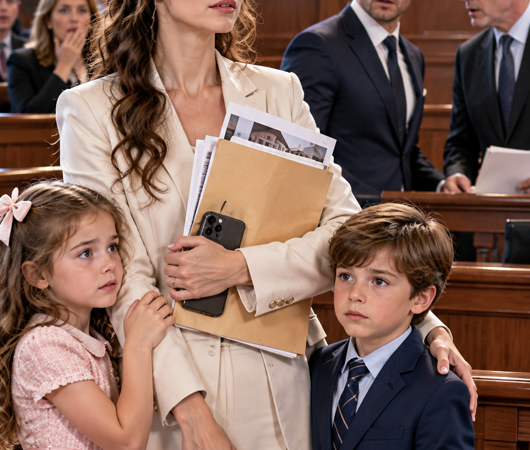
By the time we reached the custody hearing, Evan looked confident.
He wore a dark suit.
He brought his attorney.
He had prepared witnesses.
His mother testified that I was “emotionally inconsistent.”
His coworker said Evan had always been a “devoted father.”
Evan told the judge,
“I only want what’s best for my children.”
I sat quietly.
I didn’t interrupt.
I didn’t argue.
I waited.
Then the judge asked to hear from the children’s specialist.
The specialist explained that both children had independently described being coached.
She presented the recorded interviews.
Evan’s face changed.
He looked at me.
Then he looked at the judge.
But the worst was still coming.
The specialist said Lily had repeated one sentence several times.
“She said Daddy told her Mommy would lose us if she didn’t say the right thing.”
The courtroom became completely silent.
Evan’s attorney objected.
The judge denied the objection.
Then the judge looked directly at Evan.
“Mr. Carter, did you discuss this case with your children?”
Evan hesitated.
“I only reassured them.”
The judge asked again.
“Did you tell them what to say?”
“No.”
Then the audio played.
Evan’s voice was unmistakable.
“Lily, remember what we practiced.”
My stomach turned.
The recording continued.
“Tell the judge Mommy gets angry.”
Then Lily’s small voice:
“But that’s not true.”
The courtroom went silent.
Evan lowered his head.
But then something even more damaging came out.
The financial investigator had found that Evan had been moving money from our joint accounts for nearly a year.
His affair.
His second apartment.
His secret investments.
The money had all been hidden.
And suddenly, the man who claimed I was financially irresponsible was being questioned about where hundreds of thousands of dollars had gone.
The judge ordered an immediate review of the custody arrangement.
Evan’s lawyer whispered something to him.
Evan shook his head.
Then he looked at me.
“You did this.”
I stared at him.
“No.”
I pointed toward the evidence table.
“You did.”
He leaned forward.
“You’re destroying our family.”
I answered quietly:
“You started destroying it when you taught our children to lie.”
The judge called for a recess.
As everyone stood, Lily looked toward me.
Then she whispered six words.
The same six words that would finally break Evan’s story apart.
“Daddy told us what to say.”
PART 3 — THE TRUTH IN THE COURTROOM
The final hearing took place six weeks later.
By then, the evidence was overwhelming.
My financial records proved I had been supporting our children.
School records showed I had handled almost every appointment and parent meeting.
Medical records showed I was consistently involved in their care.
Bank statements showed Evan had diverted money.
Photographs and messages established his second relationship.
And the recordings showed he had coached the children.
But the most important evidence wasn’t any single document.
It was the pattern.
For months, Evan had been constructing a story.
He wanted everyone to believe I was unstable.
Dependent.
Unreliable.
He wanted the court to see him as the responsible parent.
But the truth was much simpler.
He had wanted control.
When the judge read the final findings, Evan sat motionless.
The court ordered a custody arrangement centered on the children’s best interests and prohibited him from discussing the case with them.
His financial claims were rejected.
The hidden accounts were investigated.
And the money he had moved from the children’s education fund had to be restored.
His affair wasn’t what ended our marriage.
The lies did.
After the hearing, I packed the last of our things from the old house.
Lily stood beside me holding a stuffed rabbit.
“Mommy?”
“Yes?”
“Are we okay now?”
I knelt beside her.
“Yes.”
“Do I still have to remember what Daddy said?”
I shook my head.
“No.”
“You don’t have to remember his story.”
I hugged her.
“You only have to tell the truth.”
That night, Lucas asked me another question.
“Can Dad still be our dad?”
I swallowed.
“Yes.”
Because no matter what had happened between Evan and me, the children deserved the chance to have a relationship with their father within safe boundaries.
I didn’t want revenge.
I wanted stability.
For the first time in months, our apartment was quiet.
No arguments.
No late-night phone calls.
No secret accounts.
No rehearsed answers.
Just the three of us.
A few months later, Lily started asking different questions.
She stopped asking whether she was supposed to choose a side.
She stopped worrying about what adults would think.
And one afternoon, she came running into the kitchen carrying a drawing.
It showed me, Lucas, Lily, and a small yellow house.
“What is this?”
“Our new home.”
I smiled.
“You drew us?”
She nodded.
“And you know what?”
“What?”
“You don’t look scared anymore.”
I hugged her.
She was right.
I wasn’t.
Looking back, I understand why Evan thought I would panic when he handed me those divorce papers.
He expected me to beg.
He expected tears.
He expected me to fight emotionally while he organized everything on paper.
Instead, I stayed quiet.
I gathered facts.
I protected my children.
And I let the truth speak for itself.
He believed the strongest weapon in a custody battle was a convincing story.
He was wrong.
Sometimes the strongest thing you can bring into a courtroom is patience…
a stack of evidence…
and children who finally feel safe enough to tell the truth.
Evan wanted full custody because he believed the children would become proof of his perfect life.
Instead, they became the reason the truth came out.
And the six words my daughter whispered in that courtroom stayed with me forever:
“Daddy told us what to say.”
Those six words didn’t destroy my family.
They ended the lie that had been destroying it.
And that taught me something I will never forget:
You don’t always win by fighting louder.
Sometimes you win by staying calm long enough for the truth to become impossible to hide.