Part 1 — The Photograph in the Attic
I found the photograph on a rainy Sunday afternoon.
I had been helping my grandmother clean out the attic of our old family home before it was sold.
The house had belonged to my great-grandparents, then my grandparents, and eventually my mother.
I had spent countless summers there as a child.
But I’d never been allowed into one particular corner of the attic.
My grandmother always kept several old trunks stacked against the far wall.
“Don’t bother with those,” she used to say.
So naturally, that was where I started.
I pulled the first trunk toward me.
It was covered in dust.
Inside were old blankets, handwritten letters, wedding invitations, and dozens of photographs.
Most showed relatives I didn’t recognize.
I began sorting them into piles.
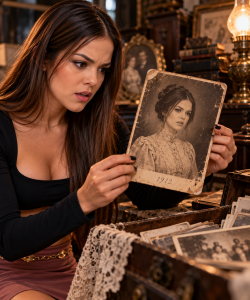
Then I found a photograph unlike the others.
It was larger than a normal family photograph.
The edges were worn and slightly curled.
A young woman stood in front of an old stone house.
She wore a high-necked lace dress with long sleeves.
Her dark hair was pinned up.
She was looking directly at the camera.
I stared at her.
Something about her face felt familiar.
Very familiar.
I held the photograph closer.
Her eyes.
Her nose.
The shape of her mouth.
Even the small mark near her left eyebrow.
I had the same mark.
I whispered,
“That looks like me.”
My grandmother was standing behind me.
The moment she saw the photograph, she dropped the box she was holding.
Photographs scattered across the floor.
“Where did you find that?”
I looked at her.
“In the trunk.”
She rushed over and took it from my hands.
Her face had gone pale.
“Who is she?”
My grandmother didn’t answer.
“Grandma?”
She turned the photograph over.
There was writing on the back.
Eleanor Whitmore — 1912.
Underneath, someone had written:
“Do not let her picture leave this house.”
I laughed nervously.
“Who was Eleanor?”
My grandmother sat down.
“I don’t know.”
“You do know.”
She stared at the photograph.
“She was your great-grandmother’s sister.”
I looked at the woman again.
“That can’t be right.”
“Why?”
“Because you said your great-grandmother was an only child.”
My grandmother’s expression changed.
“That is what I was told.”
I turned the photograph over again.
There was another line of handwriting beneath the warning.
I hadn’t noticed it before.
It said:
“She disappeared three days after this photograph was taken.”
I felt a chill.
“Disappeared?”
My grandmother nodded.
“No one ever found her.”
I looked at the photograph again.
Eleanor was wearing a small pendant around her neck.
I touched my own necklace.
It was almost identical.
Then my grandmother whispered something that made the room feel suddenly colder.
“Your mother looked exactly like her too.”
I stared at her.
“What?”
“Your mother found this photograph when she was your age.”
My heart started beating faster.
“What happened?”
“She became obsessed with finding out who Eleanor really was.”
My grandmother stood and walked toward another trunk.
She opened it.
Inside was a stack of letters tied with faded blue ribbon.
“These belonged to your mother.”
I picked up the first letter.
The handwriting was hers.
The date was seventeen years earlier.
The first sentence read:
“I finally found Eleanor’s diary.”
I looked at my grandmother.
“Where is it?”
She didn’t answer.
Then I heard something fall from the trunk.
A small brass key landed on the floor.
Attached to it was a handwritten label:
ROOM 1912.
Part 2 — Eleanor’s Diary
My grandmother didn’t want me to use the key.
That was the first thing she said.
“No.”
I stared at her.
“You know what it opens.”
She shook her head.
“I know where it leads.”
“Where?”
“The room your mother wasn’t supposed to find.”
I asked her what happened to my mother.
My grandmother looked away.
“She found the room.”
“And?”
“She never told me everything she saw.”
That answer terrified me more than anything else could have.
My mother had died when I was young.
I had always been told it was an accident.
A car crash on a rainy night.
There had never been any mystery.
At least, that’s what I believed.
I asked my grandmother:
“Did my mother know how Eleanor disappeared?”
“Yes.”
“Did she tell you?”
“No.”
“Why?”
“Because she was afraid.”
I looked at the key.
“What was she afraid of?”
My grandmother whispered:
“The photograph.”
That made no sense.
She explained that Eleanor’s photograph had been hidden in the attic for more than a century.
But my mother discovered it when she was twenty-eight.
She noticed something strange.
The photograph wasn’t simply a portrait.
There was a reflection in a window behind Eleanor.
My mother enlarged the photograph.
The reflection showed a man standing inside the house.
He wasn’t looking at Eleanor.
He was looking directly at the camera.
And according to family records, that man had died ten years before the photograph was taken.
My mother became obsessed with the mystery.
She searched old newspapers.
Property records.
Letters.
Church documents.
She eventually found Eleanor’s diary hidden behind a wall in the upstairs bedroom.
But she didn’t keep it at home.
She hid it somewhere else.
My grandmother handed me another letter.
It was my mother’s handwriting.
“If I ever disappear, don’t trust the family story.”
I stopped reading.
My hands were shaking.
“Mom wrote this?”
“Yes.”
“Why didn’t you tell me?”
“Because I promised her.”
I continued.
“Eleanor didn’t disappear voluntarily. She discovered something about our family. Something they have been hiding for generations.”
The rest of the page was missing.
I looked at the brass key.
“Where does this open?”
My grandmother finally pointed toward the hallway.
“There is a locked room behind the old library.”
We walked downstairs.
The library had been closed for years.
I inserted the key into a small brass lock hidden behind a painting.
It turned.
A section of wooden wall clicked.
Then slowly opened.
Behind it was a narrow staircase.
The air smelled like dust and old paper.
At the bottom was a small room.
There were shelves covering every wall.
Old boxes.
Photographs.
Newspapers.
Family records.
And in the center was a wooden desk.
On top of it sat a leather-bound diary.
I opened the cover.
The first page read:
Eleanor Whitmore — 1912
My heart raced.
The diary described the days leading up to her disappearance.
Eleanor had discovered that her father had been secretly transferring family property into another person’s name.
She confronted him.
He threatened her.
She planned to expose him.
Then came the final entry.
“Tomorrow I will leave this house. I have hidden proof of everything.”
The next page was blank.
But inside the back cover was a folded photograph.
I opened it.
It showed Eleanor standing beside another woman.
I recognized the other woman immediately.
It was my mother.
But the photograph had been taken decades before my mother was born.
I dropped it.
My grandmother gasped.
“No…”
We both stared at the photograph.
Then I noticed the date written on the back.
1912.
My mother was standing beside Eleanor.
Wearing the same necklace I was wearing now.
I turned toward my grandmother.
“What is this?”
She couldn’t answer.
Then the diary fell open by itself.
A loose page slid onto the floor.
I picked it up.
There was only one sentence:
“Eleanor was not the only one who disappeared.”
Underneath was a list of names.
The last name on the list was my mother’s.
Part 3 — The Secret Behind the Photograph
I couldn’t accept what I was seeing.
My mother had died in a car accident.
I had seen the photographs.
I had attended the funeral.
How could her name be written in a diary from 1912?
My grandmother finally told me what she had been hiding.
The family had discovered the hidden room generations ago.
Every generation had someone who tried to investigate Eleanor’s disappearance.
And every person who got too close to the truth was warned to stop.
Some left the family.
Some disappeared.
And some simply refused to talk about it.
My mother had been the last person to investigate.
But there was something my grandmother hadn’t known.
My mother had discovered that the diary wasn’t written entirely by Eleanor.
Several pages had been added decades later.
The handwriting changed.
The final pages were written by someone in the modern era.
Someone who knew about the family secret.
We compared the handwriting.
My grandmother immediately recognized it.
“It was your grandfather.”
I looked at her.
“Why would Grandpa add pages to Eleanor’s diary?”
We searched through his old documents.
Eventually, we found a letter.
It explained everything.
Eleanor had not disappeared in 1912.
She had escaped.
She had taken evidence of her father’s financial crimes and changed her identity.
She left the family home and built a new life.
But before leaving, she had hidden the original photograph and diary.
Her descendants remained connected to the family without revealing their identities.
That was why the woman in the photograph looked exactly like me.
Eleanor was my great-great-grandmother’s sister?
No.
The family tree had been deliberately altered.
Eleanor was actually my direct ancestor.
The family had erased her from the records because they wanted to hide the property and financial scandal surrounding her disappearance.
My grandmother looked at me.
“Your mother discovered the truth.”
“Then why did she die?”
My grandmother hesitated.
“She didn’t die in the accident.”
I felt the room spin.
“What?”
“She survived the crash.”
I stared at her.
My grandmother explained that my mother had been injured but alive.
Before she could tell authorities what had happened, someone visited her at the hospital.
After that, she disappeared.
The family had been told to call it an accident.
My grandmother had spent years believing my mother was dead.
But my grandfather had secretly continued searching.
The diary contained evidence that my mother had survived and left the country under another identity.
The photograph from 1912 wasn’t supernatural.
It was proof of a family connection that had been deliberately erased.
But one question remained.
Why did my mother look exactly like Eleanor?
Because she was Eleanor’s direct descendant.
And so was I.
The final page of my mother’s letter explained why she had hidden everything.
“If you’re reading this, you’re old enough to know the truth. Don’t spend your life chasing ghosts. Eleanor survived because she chose freedom. I want the same for you.”
I cried when I read those words.
For years, I had believed my mother had died in a tragic accident.
Now I understood that she had spent the final years of her life trying to uncover the truth about our family.
And she had left the evidence for me.
The original photograph.
The diary.
The letters.
The family records.
Everything.
I eventually took the documents to an attorney and had the family history properly investigated.
The property records were corrected.
Eleanor’s name was restored to the family tree.
And for the first time in more than a century, her photograph was no longer hidden.
I framed it.
I placed it in my living room.
People who visit always ask the same question.
“Who is that woman?”
I tell them the truth.
“She was my ancestor.”
Then they look at me again.
And usually, they become quiet.
Because the resemblance is impossible to ignore.
Same eyes.
Same face.
Same small mark above the eyebrow.
Sometimes I stand in front of the photograph alone.
I look at Eleanor.
And I wonder what she would think if she could see me now.
A century after her photograph was taken, her face finally came out of hiding.
But there is one thing I still can’t explain.
The day I brought the photograph home, I placed it on my desk.
That night, I woke up at 2:14 AM.
I walked into the living room.
The photograph was still there.
But someone had placed a handwritten note beneath it.
I hadn’t written it.
It said:
“Thank you for remembering me.”
And beneath the message was a signature.
Eleanor.