Part 1 — The Stranger at the Grocery Store
I almost walked past the old man.
It was raining heavily, and I was already late getting home.
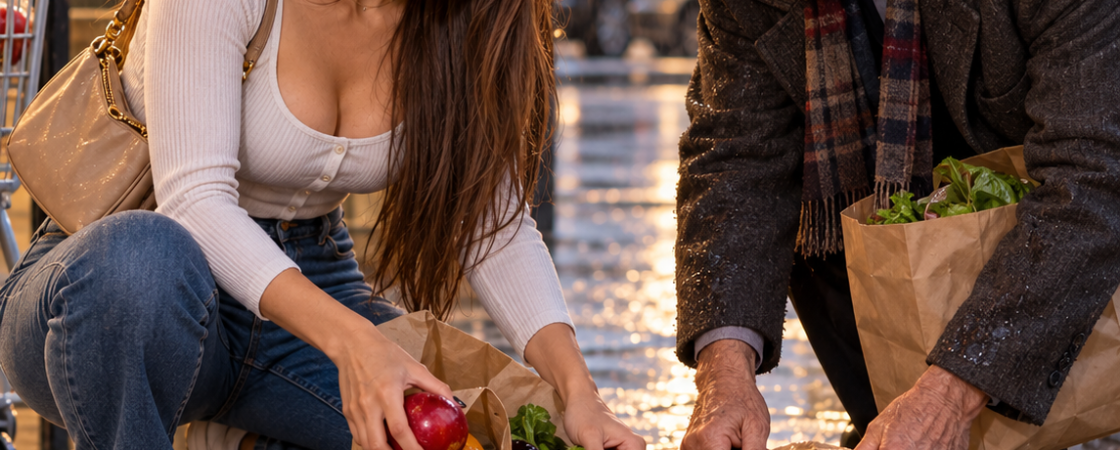
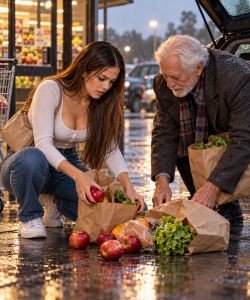
He was standing outside the grocery store with several paper bags at his feet.
One had broken open.
Apples were rolling across the wet sidewalk.
He tried to bend down, but his knees seemed too weak.
I stopped.
“Sir, let me help you.”
He looked embarrassed.
“I can manage.”
“You don’t have to.”
I picked up the apples and gathered the other bags.
He smiled.
“Thank you. My car is just over there.”
I carried everything to an old blue sedan.
He struggled to unlock the trunk.
I loaded the groceries inside.
Before I left, he looked at me carefully.
“You’re very kind.”
“It was nothing.”
He reached into his coat.
“I’d like to give you something.”
“No, really. You don’t need to.”
He smiled.
“Then at least tell me your name.”
I told him.
He repeated it quietly, as if memorizing it.
“My name is Arthur.”
We shook hands.
Then he said something strange.
“If anyone ever tells you that you don’t belong somewhere, remember that sometimes people don’t know what they’re talking about.”
I laughed politely.
“I’ll remember that.”
I walked home.
I forgot about Arthur almost immediately.
Until the next morning.
At exactly 9:15 AM, someone knocked on my front door.
When I opened it, a well-dressed man stood there holding a leather briefcase.
“Are you [my name]?”
“Yes.”
“My name is Daniel. I’m an attorney.”
My stomach tightened.
“Is something wrong?”
He shook his head.
“Actually, I’m here because of Arthur.”
I stared at him.
“The man from the grocery store?”
“Yes.”
Daniel took out a document.
“Mr. Arthur Whitmore passed away last night.”
I was stunned.
“What?”
“He had been seriously ill for some time.”
I suddenly remembered how tired Arthur had looked.
Daniel continued.
“Before his death, he gave me very specific instructions.”
“What kind of instructions?”
The attorney handed me an envelope.
It had my name written on it.
Arthur’s handwriting.
I opened it.
There was only one sentence:
“Tell him about the house on Maple Street.”
I looked at Daniel.
“What house?”
He studied my face.
“That’s what I came to explain.”
Part 2 — The House on Maple Street
Daniel invited me to sit down.
He explained that Arthur had owned several properties in the city.
One of them was an old house on Maple Street.
I knew the address.
It was the abandoned house near the park.
“Why are you telling me about it?”
“Because Arthur left it to you.”
I laughed.
“I barely knew the man.”
“That’s what makes this unusual.”
Daniel opened his briefcase.
Inside was a thick legal file.
Arthur had apparently spent years searching for someone.
Someone whose family had once lived in that house.
Daniel showed me an old photograph.
It showed a young couple standing outside the Maple Street property.
The woman looked familiar.
Very familiar.
I stared at the photograph.
“That woman looks like my grandmother.”
Daniel nodded.
“She was your grandmother.”
I couldn’t speak.
Arthur had known my grandmother.
They had grown up in the same neighborhood.
But there was more.
My grandmother had once owned the Maple Street house.
She lost it after a complicated legal dispute.
Arthur had spent decades trying to prove that the property had been taken from her family through fraudulent documents.
Before he died, he finally found the original records.
And according to those records, the house should have remained in my grandmother’s family.
I looked at Daniel.
“Why didn’t Arthur return it to my grandmother?”
“She passed away several years ago.”
“And he waited until now?”
“He was trying to find her descendants.”
Daniel showed me another document.
My name appeared at the top.
Arthur had specifically named me as the beneficiary.
But then Daniel said:
“There is something else.”
He opened a second folder.
Inside was a photograph of Arthur and my grandmother as teenagers.
They were standing outside the same house.
On the back was handwritten:
“Someday, this will belong to her family again.”
I felt overwhelmed.
“Why didn’t he tell me any of this yesterday?”
Daniel looked down.
“Because he didn’t know if you were the right person.”
“What do you mean?”
“Arthur had been watching the property for years. He wanted to find someone from your grandmother’s family who would help preserve it rather than sell it.”
I remembered Arthur asking my name.
He hadn’t been making conversation.
He had been confirming who I was.
Daniel handed me another envelope.
“This was his final instruction.”
I opened it.
Inside was a short letter.
“You helped an old stranger when you had absolutely no reason to. That told me everything I needed to know.”
My eyes filled with tears.
The letter continued:
“But the house isn’t the real inheritance.”
I looked at Daniel.
“What does that mean?”
He pointed toward the final page.
There was an address.
Not Maple Street.
A different location.
An old community center.
Daniel said:
“Arthur established a trust.”
“For what?”
“For the neighborhood where he grew up.”
He explained that Arthur wanted the money from his estate used to preserve the local community center, provide scholarships, and help elderly residents who couldn’t afford basic necessities.
But there was one condition.
The trust could only be activated by a descendant of Arthur’s childhood friend.
My grandmother.
And now, me.
Then Daniel said:
“There’s one final document you need to see.”
He placed it on the table.
I read the first line.
And my hands started shaking.
“Trust Agreement — Beneficiary: [my name].”
But beneath it was another name.
Someone else was listed as a beneficiary.
Someone I had never heard of.
Part 3 — Arthur’s Final Secret
I stared at the second name.
“Who is this?”
Daniel looked serious.
“That is Arthur’s only surviving relative.”
“Why would they be involved?”
“Because Arthur wanted you two to meet.”
I immediately became suspicious.
Daniel explained that Arthur’s relative had been fighting him for years over control of his estate.
Arthur didn’t trust them with the money.
Instead, he created the trust.
The house.
The community center.
And the remaining assets would be protected under one condition:
Neither beneficiary could sell or take control of the estate alone.
They had to agree.
I asked:
“Why would Arthur do that?”
Daniel smiled.
“Because he wanted to make sure the person who inherited his wealth couldn’t simply walk away with it.”
I met Arthur’s relative that afternoon.
His name was Michael.
He was angry.
He didn’t understand why Arthur had left so much responsibility to someone he barely knew.
Then I showed him the letter.
Arthur had written something to him too.
“You wanted my money. I wanted you to learn what it’s worth.”
Michael looked away.
The room became quiet.
Daniel explained Arthur’s final plan.
The Maple Street house would be restored.
The community center would remain open.
A scholarship fund would be created for local students.
And elderly residents in the neighborhood would receive assistance with groceries, utilities, and transportation.
Arthur hadn’t wanted his fortune to become another family argument.
He wanted it to become something useful.
Then I understood why he had stopped me outside the grocery store.
He wasn’t testing whether I would help him carry groceries for a reward.
He was looking for something money couldn’t buy.
Character.
Before leaving, Daniel handed me one final envelope.
Arthur’s final letter.
I opened it.
“When I first saw you help me, you didn’t know who I was.”
“That is exactly why I chose you.”
“People are often kind when they think someone important is watching.”
“You were kind when you thought nobody was.”
I cried as I read the final sentence.
“Never measure a person’s worth by what they can give you. Sometimes the greatest inheritance is the chance to give something to others.”
Months later, the Maple Street house was restored.
The community center reopened.
The scholarship fund began helping local students.
And every Saturday morning, I volunteered there.
One afternoon, an elderly man struggled to carry several grocery bags through the parking lot.
I walked over.
“Let me help you.”
He smiled.
“Are you sure?”
I picked up the bags.
“Of course.”
For a moment, I remembered Arthur.
The man looked at me and asked:
“Do I know you?”
I smiled.
“No.”
And I carried his groceries anyway.
Because I finally understood.
Arthur hadn’t changed my life because I helped him carry groceries.
He changed my life because that small act reminded me what kind of person I wanted to be.