Part 1 — The Empty Chair
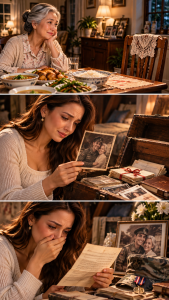
Every Sunday, my grandmother set the table for four people.
There was my grandmother.
My mother.
Me.
And one empty chair.
It was always the same chair.
A wooden chair beside the window.
My grandmother would place a clean plate in front of it, fold a napkin beside the plate, and put a glass of water on the table.
When I was little, I asked her about it.
“Grandma, who’s sitting there?”
She would smile.
“Someone who’s coming home.”
“Who?”
She never answered.
As I grew older, I stopped asking.
But the chair remained.
Even after my mother moved away.
Even when it was just my grandmother and me at Sunday dinner.
She still set four places.
Sometimes she would glance toward the empty chair while we ate.
Sometimes she would even say:
“He always liked the potatoes this way.”
I assumed she was talking about my grandfather.
He had died before I was born.
But one Sunday, when I was nineteen, I finally asked.
“Grandma, are you waiting for Grandpa?”
Her fork stopped.
“No.”
“Then who?”
She looked at me for a long moment.
“Someone who should have been here a very long time ago.”
I wanted to ask more.
But she changed the subject.
Years passed.
I moved to another city.
I got married.
I had children.
But whenever I visited my grandmother on Sundays, the fourth place was still there.
Then one winter morning, she died peacefully in her sleep.
At her funeral, I kept thinking about that empty chair.
After everyone left, my mother and I began cleaning her house.
In the dining room, I noticed something.
The chair was still there.
The plate was still on the table.
Even though she had been too weak to cook during her final weeks, she had continued setting the fourth place.
I pulled the chair away from the table.
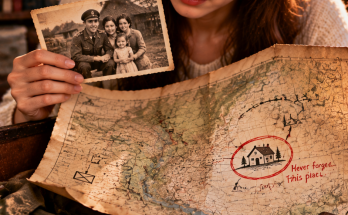
Underneath it was a small envelope taped to the floor.
My name was written on it.
I opened it.
Inside was a photograph.
It showed my grandmother as a young woman standing beside a man I didn’t recognize.
On the back, she had written:
“He never knew I kept waiting.”
Then I saw the date.
The photograph had been taken sixty-three years earlier.
I looked at my mother.
“Who is this?”
She became pale.
“I don’t know.”
But I knew she was lying.
Because she immediately started crying.
Part 2 — The Man in the Photograph
My mother finally told me the truth.
The man in the photograph wasn’t my grandfather.
His name was Daniel.
He and my grandmother had been engaged when they were young.
They planned to get married.
But one week before their wedding, Daniel disappeared.
My grandmother never knew why.
Everyone told her he had abandoned her.
She eventually married my grandfather.
But she never stopped wondering what had happened to Daniel.
“Why did she keep setting a place for him?” I asked.
My mother looked toward the empty chair.
“Because she believed he would come back someday.”
“After sixty years?”
“She never stopped hoping.”
I found another box in the attic.
Inside were dozens of letters.
All addressed to Daniel.
Most had never been sent.
My grandmother had written one every year.
Sometimes only a few sentences.
Sometimes several pages.
One letter said:
“I had another granddaughter this year. She has your eyes.”
Another:
“I still wonder where you are.”
Another:
“I don’t know if you’re alive, but I’ll keep one chair for you.”
I cried reading them.
Then I found a letter that changed everything.
It was dated only two years earlier.
My grandmother had written:
“I finally found you.”
I stared at the page.
She had found Daniel?
I searched the box.
There was an address.
A nursing home in another state.
I called.
The receptionist told me Daniel had been a resident there until six months earlier.
“He passed away,” she said.
My heart sank.
“Did he ever receive letters from a woman named Margaret?”
There was a pause.
“Yes.”
My grandmother had secretly contacted him.
They had spoken on the phone.
They had exchanged letters.
But they had never met again.
I asked why.
The receptionist said Daniel had been too sick to travel.
Then she said something that shocked me.
“He talked about your grandmother all the time.”
I sat down.
“He knew she waited for him?”
“Yes.”
“Why didn’t he come back?”
She hesitated.
“Because he thought she was happy.”
I couldn’t understand.
She explained that Daniel had disappeared all those years ago because he had been drafted into military service.
He had been sent overseas.
Before leaving, he wrote my grandmother a letter.
But the letter was never delivered.
He returned years later and learned she had married.
He believed she had moved on.
So he stayed away.
My grandmother believed he had abandoned her.
Daniel believed she had forgotten him.
Two people had spent more than sixty years carrying the same misunderstanding.
Then I found something inside the box.
An unopened letter.
It was addressed to my grandmother.
The envelope was faded.
The postmark was from 1961.
I opened it carefully.
Inside, Daniel had written:
“Margaret, I didn’t leave because I stopped loving you.”
I couldn’t continue reading for a moment.
Then:
“If I survive this, I will come home.”
The letter had never reached her.
At the bottom was one final sentence:
“Please leave a light on for me.”
I began crying.
My grandmother had waited her entire life.
And she had never known.
But there was something else in the box.
A final envelope.
This one had been written by Daniel.
And the date was only three months before he died.
Part 3 — The Empty Chair Wasn’t Empty
I opened Daniel’s letter.
It was addressed to my grandmother.
But she had died before it arrived.
“Margaret,
I know it has been more than sixty years.
I don’t know whether you still remember me.
But I remember everything.”
He described their last evening together.
The restaurant.
The rain.
The promise they made.
Then he wrote:
“I came back.”
My hands shook.
Daniel had returned to their hometown decades earlier.
He had secretly visited the neighborhood.
He had even stood outside my grandmother’s house.
But he saw her with my grandfather and believed she was happy.
So he walked away.
He never knew she had been waiting.
And my grandmother never knew he had come back.
At the end of the letter, he wrote:
“If there is one thing I regret, it is that I let silence speak for me.”
Then:
“I hope she forgives me.”
I put the letter down.
My mother was crying beside me.
“Did Grandma ever know he had returned?”
“No.”
I looked toward the dining room.
The empty chair suddenly felt completely different.
For decades, I had thought my grandmother was keeping a place for a man who had forgotten her.
But both of them had remembered.
They had simply spent their lives believing the other had moved on.
I decided to find out exactly where Daniel was buried.
A few weeks later, my mother and I traveled to his hometown.
We found his grave.
There was a small photograph attached to the headstone.
It was the same young man from my grandmother’s photograph.
I placed a white flower beside it.
Then I said:
“She never forgot you.”
For a moment, neither of us spoke.
Then my mother placed another flower beside mine.
“She waited every Sunday.”
We stood there quietly.
Before leaving, I noticed something tucked beneath the edge of the headstone.
It was a small envelope.
My name was written on it.
I opened it.
Inside was a note from Daniel’s daughter.
She had found my grandmother’s letters after her father’s death.
She wrote:
“My father kept every letter your grandmother ever sent him.”
I looked at my mother.
The letters my grandmother had written had somehow crossed the distance between them, even after both were gone.
There was one final sentence:
“He loved her until the end.”
When I returned home, I went into my grandmother’s dining room.
The fourth chair was still there.
I almost removed it.
Then I stopped.
Instead, I cleaned it.
I placed it beside the table.
Every Sunday afterward, I continued my grandmother’s tradition.
Not because I expected Daniel to return.
But because I finally understood what the chair represented.
It wasn’t an empty place.
It was a promise.
A reminder that someone could be absent from a room and still occupy an enormous place in someone’s heart.
Years later, my daughter asked me:
“Mom, why do you always put four plates on the table?”
I smiled.
“Because someone taught me that you should always leave room for the people you love.”
She looked at the empty chair.
“Who’s it for?”
I thought about my grandmother.
Daniel.
The letters.
The sixty years of waiting.
Then I answered:
“For someone who finally came home.”
And every Sunday, I still set that fourth place.
Not because I’m waiting for someone to walk through the door.
But because some promises deserve to be remembered.
My grandmother spent sixty years saving a seat for someone she thought had forgotten her.
In the end, she discovered he had been waiting too.