Part 1 — The Box She Left Behind
My mother packed my childhood room before she died.
At the time, I didn’t understand why.
She had been sick for months, but she never talked about dying.
Instead, she spent her final weeks quietly organizing my old bedroom.
She folded my childhood clothes.
Wrapped my school trophies in newspaper.
Placed my old stuffed animals into boxes.
Even my drawings from elementary school were carefully preserved.
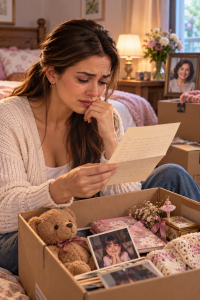
One afternoon, I walked into the room and found her sitting on the floor beside a cardboard box.
“Mom, what are you doing?”
She smiled.
“Cleaning up your past.”
I laughed.
“You’re making it sound dramatic.”
She looked at me for a long moment.
“Maybe it is.”
I sat beside her.
“Why are you packing everything?”
“Because someday you’ll want these.”
I didn’t understand.
“You can just give them to me now.”
She shook her head.
“Not this box.”
She placed a lid on a small wooden container.
“This one isn’t for now.”
“What does that mean?”
“You’ll know when the time is right.”
A few weeks later, my mother died.
I couldn’t bring myself to enter that bedroom for months.
Eventually, I moved away.
Years passed.
The house was eventually sold.
But before the sale, I returned to collect the last of my belongings.
Most of the room was empty.
Except for one box.
The same wooden box my mother had refused to let me open.
It was sitting on the closet shelf.
I carried it home.
For years, I left it unopened.
Then, on the tenth anniversary of my mother’s death, I finally decided to open it.
Inside were things I had forgotten existed.
My first pair of baby shoes.
A broken music box.
My childhood diary.
Photographs.
A dried flower from my elementary-school graduation.
And underneath everything was an envelope.
My name was written on it.
In my mother’s handwriting.
I immediately started crying.
The envelope was sealed.
On the front were five words:
“Open this when you’re ready.”
I opened it.
The letter began:
“My darling daughter,
If you’re reading this, then I’m no longer there to explain.”
I had to stop.
Then I continued.
“There is something about your childhood that I never told you.”
My hands began shaking.
Then I reached the final line of the first page:
“The reason I packed this room wasn’t because I wanted to preserve your memories.”
“I was trying to protect one of them.”
Part 2 — The Memory She Hid
I read the letter again.
My mother explained that when I was eight years old, something had happened that I had completely forgotten.
There had been a fire in our neighborhood.
Our house wasn’t damaged badly, but smoke had entered my bedroom.
I had been asleep.
My mother woke me and carried me outside.
But according to her letter, that wasn’t the whole story.
Someone had been inside the house before she reached my room.
Someone who had gone through my belongings.
She never told me because she didn’t want me to be afraid.
I kept reading.
“You probably remember the fire as an accident.”
It wasn’t.
My mother had discovered that someone had deliberately started it.
The person had been looking for something.
Something hidden inside our house.
She had never told the police what she knew because she was afraid of what would happen if the person returned.
Then I found a second envelope inside the box.
This one contained a photograph.
It showed my childhood bedroom.
But there was something strange.
The photograph had been taken before the fire.
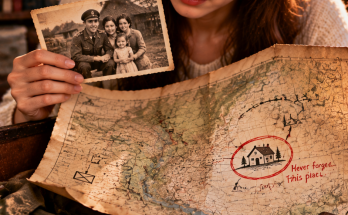
A small wooden box was visible beneath my bed.
I didn’t recognize it.
My mother had circled it in red.
Underneath, she had written:
“This is what they were looking for.”
I searched the rest of the box.
There was another letter.
“Your father gave me this box before he disappeared.”
I froze.
My father had left our family when I was six.
My mother had always said he had abandoned us.
But the letter told a different story.
My father had worked for a company involved in a legal dispute.
He had discovered documents showing that someone inside the company had been stealing money.
He copied the evidence.
Then he disappeared.
My mother believed he had left because he feared the people involved would hurt me.
The wooden box beneath my childhood bed had contained the original evidence.
My mother had hidden it after the fire.
But where was it now?
I searched the house.
Nothing.
Then I noticed something in the photograph.
The box wasn’t actually beneath my bed.
It was inside the wall behind the bed.
I looked at the old floor plan of the house.
There had been a narrow storage cavity behind the bedroom wall.
I contacted the current owner.
He agreed to let me inspect it.
The next weekend, I returned to my childhood home.
The room looked completely different.
But I knew exactly where my bed had been.
Behind the wall was an old wooden panel.
I removed it.
Inside was a metal container.
My mother’s handwriting was on the lid.
“If you’ve found this, you’re ready.”
Inside were documents.
Bank statements.
Photographs.
Legal papers.
And a letter from my father.
I opened it.
“My little girl,
If you ever find this, please know that I didn’t leave because I stopped loving you.”
I couldn’t breathe.
He explained that he had gone into hiding.
He had wanted to return.
But the people involved had threatened my mother and me.
Then he wrote:
“Your mother will probably tell you I abandoned you.”
“I asked her to.”
The final paragraph made my hands tremble.
“If I’m never able to come home, tell my daughter that every year I was away, I celebrated her birthday.”
I looked at the date.
The letter had been written twenty-nine years earlier.
But there was something else.
A recent photograph had been tucked inside.
A photograph of my father.
Alive.
Part 3 — The Last Box
I stared at the photograph.
My father looked older.
Gray hair.
Wrinkles.
But there was no doubt.
It was him.
On the back was an address.
I drove there the next morning.
It was a small apartment above a bookstore.
An elderly man opened the door.
He stared at me.
For several seconds, neither of us spoke.
Then he whispered:
“You have your mother’s eyes.”
I couldn’t move.
“Dad?”
He nodded.
I started crying.
So did he.
We sat together for hours.
He told me what had happened.
He had spent years moving between cities because he believed the people who threatened him were still searching for the evidence.
Eventually, the investigation had ended.
But by then, he had convinced himself that returning would only reopen old wounds.
He had secretly followed my life from a distance.
He knew when I graduated.
When I got married.
When I had my first child.
He had kept photographs of me too.
“I wanted to come home,” he said.
“Why didn’t you?”
He looked down.
“Your mother asked me not to.”
I was stunned.
“Why?”
“She believed you deserved a normal life.”
I thought about my mother’s final letter.
Then I understood why she had packed my childhood room.
She hadn’t been organizing old belongings.
She had been preserving a story.
A story she knew I would eventually need.
My father reached into a drawer.
He pulled out a small envelope.
“I was supposed to give this to your mother.”
He handed it to me.
Inside was a photograph of my parents when they were young.
On the back was written:
“Someday, we’ll tell her everything.”
I cried.
My mother had spent her final years preparing me for the truth.
My father had spent decades waiting for the right moment to return.
And I had spent most of my life believing they had simply chosen to keep secrets from me.
Before I left, my father gave me one final thing.
A small wooden music box.
I recognized it immediately.
It had been inside my mother’s box.
“Your mother sent this to me years ago,” he said.
“She wanted me to have it.”
“Then why did it end up with her?”
He smiled sadly.
“She changed her mind.”
I opened it.
A soft melody began playing.
The same melody my mother used to play when I was a child.
Inside the lid was a tiny handwritten message:
“Home is not always a place. Sometimes it is the people who never stopped waiting for you.”
I finally understood why my mother had packed my childhood room.
She wasn’t afraid I’d forget my childhood.
She was afraid I’d forget how deeply I had been loved.
Years later, I kept the wooden box in my own home.
Inside it are the same photographs.
The letters.
The music box.
And the little wooden shoes from when I was a baby.
Sometimes my daughter asks me:
“Why do you keep all that old stuff?”
I smile.
“Because one day, you might need to know where you came from.”
And every time I open that box, I think of my mother.
She knew she wouldn’t be there to explain everything.
So she left me the one thing she knew would survive her.
The truth.
And I finally realized:
She hadn’t packed away my childhood because she wanted to say goodbye.
She packed it because she wanted to make sure that, someday, I could find my way back home.