Part 1 — The Birthday She Never Celebrated
My mother never celebrated her birthday.
Not once.
Every year, when someone asked when her birthday was, she would smile and change the subject.
When I was a child, I thought she simply didn’t like birthdays.
But every year on the same date, I noticed something strange.
She would buy a small cake.
She would light one candle.
Then she would sit alone at the kitchen table for a few minutes.
I always assumed it was for herself.
One year, when I was twelve, I asked:
“Mom, why don’t we sing Happy Birthday?”
She smiled sadly.
“It’s not my birthday, sweetheart.”
I laughed.
“Of course it is.”
She shook her head.
“No. It’s someone else’s.”
“Whose?”
She didn’t answer.
Years passed.
I grew up, moved away, and eventually started my own family.
My mother continued the strange tradition.
Every year, she bought the same kind of cake.
Every year, she lit one candle.
Every year, she refused to explain.
Then she died unexpectedly.
After the funeral, I returned to her house to clean out her belongings.
In the kitchen cabinet, I found an old calendar.
One date had been circled every year.
The same date.
Beside it, my mother had written:
“Remember him.”
I stared at the words.
Him?
Who was she remembering?
I searched the house.
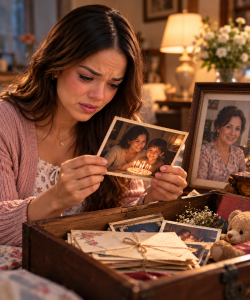
In an old wooden chest, I found photographs.
Most were ordinary family pictures.
But underneath them was a photograph I’d never seen before.
It showed my mother as a young woman.
She was holding a baby.
I turned it over.
On the back was a name.
Daniel.
And underneath:
“Born March 14.”
That was the date my mother had secretly celebrated every year.
I stared at the photograph.
The baby couldn’t have been me.
I was born in September.
I searched through the box again.
There were hospital papers.
A tiny knitted blanket.
A child’s hospital bracelet.
And one letter.
My mother’s handwriting covered the envelope.
It was addressed to me.
I opened it.
The first sentence made my hands tremble:
“My daughter, if you’re reading this, then you’ve finally discovered why I never celebrated my birthday.”
I kept reading.
“The date you thought was my birthday was actually the birthday of the son I lost before you were born.”
I couldn’t breathe.
My mother had never been celebrating herself.
She had been remembering someone I had never known.
But the letter continued:
“There is something else you need to know about Daniel.”
Part 2 — The Son I Never Knew Existed
I sat on the kitchen floor and read the letter again.
My mother explained that Daniel had been born several years before me.
He had been sick from birth.
He spent most of his short life in hospitals.
My mother and father had done everything they could.
But Daniel died when he was only three years old.
I had never known I had an older brother.
My mother said she couldn’t bear the thought of me growing up feeling like I was replacing him.
So she never talked about him.
She didn’t want me to carry her grief.
But there was something strange.
The letter said Daniel had died on the same day he was born.
His birthday and the anniversary of his death were the same date.
March 14.
That was why my mother bought a cake every year.
Not to celebrate death.
To remember that he had existed.
Then I found another envelope.
This one contained a photograph of Daniel sitting beside my mother.
He was smiling.
Behind the photograph was a note:
“He loved music.”
I found a small wooden music box.
When I opened it, a familiar melody played.
I recognized it immediately.
It was the song my mother used to hum whenever I was little.
I had always thought it was simply her favorite song.
It wasn’t.
It was Daniel’s favorite.
Then I found something even more surprising.
A birthday card.
It had been written by my mother when Daniel was still alive.
“Happy birthday, my little boy.
I promise I’ll always remember this day.”
I cried.
For decades, my mother had carried a memory she had never shared with me.
But then I found a second letter.
This one wasn’t from my mother.
It was from my father.
He had written it years before he died.
“Your mother thinks you don’t know about Daniel.”
“I do.”
“She believes keeping his story private protects you.”
“But one day, you may want to know who he was.”
My father had included an address.
It belonged to a small cemetery.
I went there the following morning.
Daniel’s grave was tiny.
There was no large monument.
Just a simple stone.
His name.
His birth date.
His death date.
And one sentence:
“Forever our little boy.”
I knelt beside it.
For the first time in my life, I said his name aloud.
“Daniel.”
Then I noticed something beneath the flowers.
A small envelope.
My mother’s handwriting.
She had apparently placed it there years earlier.
I opened it.
“If my daughter ever comes here, I want her to know something.”
I continued reading.
“You were never born to replace him.”
My tears fell onto the paper.
“You were born because I still had love left to give.”
Then came the final line:
“And I hope someday you understand that loving you never meant loving him less.”
I sat beside the grave for a long time.
But there was one question I couldn’t stop thinking about.
Why had my mother hidden Daniel’s existence from me for so many years?
The answer was inside the final page.
And it changed the entire story.
Part 3 — The Birthday Cake
My mother explained that after Daniel died, she became terrified of having another child.
She couldn’t imagine surviving another loss.
When she discovered she was pregnant with me, she was afraid.
She worried that loving another child would somehow betray Daniel.
But when I was born, everything changed.
She wrote:
“The first time I held you, I understood something.”
“Love doesn’t replace love.”
“It grows.”
She said she never told me about Daniel because she wanted my childhood to belong to me.
She didn’t want me growing up comparing myself to a brother I had never met.
She didn’t want me thinking I had somehow taken his place.
But she also couldn’t let his memory disappear.
So every March 14, she bought a small cake.
One candle.
No celebration.
No presents.
Just a quiet moment to remember her first child.
The cake wasn’t really a birthday party.
It was her way of saying:
“You existed. I remember you.”
I found one final photograph inside the wooden chest.
It showed my mother sitting at the kitchen table many years earlier.
There was a small cake in front of her.
One candle.
And beside the cake was a framed photograph of Daniel.
I turned the picture over.
My mother had written:
“One day, your sister will know you.”
I cried harder than I had since her funeral.
My mother had spent her life believing she needed to protect me from her grief.
But she had never stopped loving the child she lost.
And she had never loved me any less.
The following March 14, I went to the bakery my mother always used.
I ordered the same small cake.
I took it home.
I placed one candle in the center.
Then I put Daniel’s photograph beside it.
For the first time, I celebrated his birthday too.
My daughter watched me.
“Mom, who is that?”
I smiled.
“That’s your uncle.”
She looked surprised.
“You had an uncle?”
I nodded.
“Yes.”
I told her his name.
I told her he loved music.
I told her he had a mother who never forgot him.
Then I lit the candle.
Not because I wanted to live in the past.
But because someone had once been here.
Someone had mattered.
Someone had been loved.
And I finally understood my mother’s strange tradition.
She wasn’t refusing to celebrate her birthday.
She was giving the day to someone who never got the chance to grow older.
After blowing out the candle, I looked at Daniel’s photograph.
Then I whispered:
“Happy birthday, big brother.”
And for the first time, the date my mother had quietly carried for decades didn’t feel like a secret anymore.
It felt like a family memory that had finally come home.
My mother never forgot the child she lost.
And after she died, she taught me that remembering someone isn’t about holding on to sadness—it’s about making sure their life is never forgotten.