PART 1 — The Medal in the Drawer
My grandfather never talked about the war.
Not once.
Whenever someone asked about his military years, he would smile, change the subject, and say:
“Some things are better left in the past.”
I always assumed he was simply being modest.
Grandpa Daniel had been a quiet man.
He spent most of his life repairing watches, growing tomatoes, and sitting on the back porch with a cup of black coffee.
Then, at eighty-nine, he passed away peacefully in his sleep.
After the funeral, my mother asked me to help clean out his house.
We spent an entire Saturday going through closets, photographs, old tools, and boxes of paperwork.
Then I found a locked wooden drawer inside his bedroom desk.
I recognized the desk immediately.
Grandpa had owned it since before I was born.
“What’s in there?” Mom asked.
“I don’t know.”
I searched through his keys until I found one that fit.
The drawer opened with a soft click.
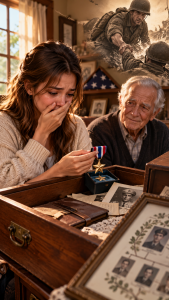
Inside was a small black velvet box.
I opened it.
My breath caught.
There was a military medal inside.
It was old, carefully polished, and attached to a faded ribbon.
Beside it was a yellowed photograph of Grandpa as a young man in uniform.
But the medal wasn’t what shocked me.
It was the paper underneath it.
A military citation.
I picked it up.
The first line read:
“For extraordinary courage while under enemy fire…”
I kept reading.
According to the citation, my grandfather had saved another soldier during a dangerous operation decades earlier.
The soldier’s name was clearly written.
Thomas Whitmore.
I froze.
I knew that name.
It was on our family tree.
Thomas Whitmore was my great-grandfather.
My grandfather’s father.
I stared at the paper.
That couldn’t be right.
According to our family history, Great-Grandpa Thomas had died overseas before Grandpa Daniel was born.
But if the citation was real…
Then Grandpa hadn’t simply saved a stranger.
He had saved his own father.
I immediately called my mother.
“Mom, do you know who Thomas Whitmore was?”
She paused.
“Of course. Your great-grandfather.”
“Did he serve in the military?”
Another pause.
“Yes.”
“Did Grandpa serve with him?”
Her voice became strangely quiet.
“I don’t know.”
I looked back at the medal.
There was something else inside the box.
A folded letter.
On the envelope, Grandpa had written:
“For my grandson. When you’re finally ready to know the truth.”
My hands started shaking.
I opened it.
The first sentence said:
“Your family has been telling the wrong story for seventy years.”
PART 2 — The Man Who Was Supposed to Be Dead
I read Grandpa’s letter three times.
It explained that Thomas Whitmore hadn’t died when our family thought he had.
He had survived.
But barely.
During a military operation, Thomas had become trapped after an explosion.
Grandpa Daniel, who was only nineteen at the time, had gone back for him.
The official citation described Grandpa crawling through burning debris, carrying Thomas to safety while the area was still under fire.
But the rescue wasn’t the strangest part.
Thomas had been seriously injured.
And afterward, something happened that changed the entire family.
Grandpa wrote:
“Your great-grandfather was told he would never walk normally again. He begged me not to tell your grandmother what had happened.”
I couldn’t understand.
Why would a man hide the fact that he survived?
Then I reached the next page.
Thomas had been involved in a classified operation.
He had witnessed something he wasn’t supposed to see.
Several men in his unit were accused of stealing military supplies and selling information.
Thomas had agreed to testify.
But someone threatened his family.
So the military created a new identity for him.
He couldn’t return home.
He couldn’t contact his wife.
And the family was told he had died.
Grandpa was the only person who knew the truth.
For decades, he secretly exchanged letters with Thomas.
I stared at the family tree hanging in the hallway.
Thomas was listed as:
“Killed in action — 1954.”
But according to Grandpa’s letter, that wasn’t true.
Thomas had lived for another thirty-seven years.
And Grandpa had visited him every few years.
Then I found a photograph tucked inside the letter.
Two elderly men were sitting beside a lake.
One was my grandfather.
The other was an old man I’d never seen before.
On the back, Grandpa had written:
“The last time I saw my father.”
I couldn’t stop crying.
My great-grandfather hadn’t died in 1954.
He had died in 1991.
And my grandfather had carried that secret for the rest of his life.
But there was one question I couldn’t answer.
Why had Grandpa waited until after his death to tell us?
I turned the letter over.
There was one final page.
It contained an address.
And one sentence:
“If you want to know why I never told your mother, go there.”
The address belonged to a small house in another state.
I drove there the next morning.
An elderly woman opened the door.
I showed her the photograph.
Her eyes immediately filled with tears.
“You’re Daniel’s grandson.”
I nodded.
She stepped aside.
“I’ve been waiting for you.”
Then she handed me a small envelope.
On it was written:
“Daniel never knew the whole truth.”
PART 3 — The Truth Behind the Medal
Inside the envelope was a letter written by Thomas.
It was dated only months before his death.
He explained everything.
The medal my grandfather received wasn’t just an award for bravery.
It was the reason Thomas survived.
But there was another secret.
Thomas had deliberately allowed the family to believe he was dead.
Not because he didn’t love them.
Because the people who had threatened him were still searching for him.
He believed that if his family knew he was alive, they would become targets.
So he disappeared.
For thirty-seven years.
He watched his family from a distance.
He knew when my grandfather got married.
He knew when my mother was born.
He even knew when I was born.
But he never came home.
At the bottom of the letter, Thomas had written:
“Daniel saved my life twice.”
The first time was on the battlefield.
The second time was when he agreed to keep my secret.
Then came the sentence that broke me.
“If my son ever tells his grandson about me, please tell him I never stopped loving this family.”
I sat there holding the letter for several minutes.
Then the elderly woman who had given it to me explained who she was.
She had been Thomas’s caretaker during his final years.
“He talked about your grandfather every day,” she said.
“He was proud of him.”
I looked down at the medal.
For years, I had thought it represented a war.
A battlefield.
A heroic moment.
But now I understood.
It represented a promise between a father and son.
My grandfather had carried that medal quietly for more than seventy years.
He never displayed it.
Never talked about it.
Never told anyone what it meant.
Because for him, the medal wasn’t about glory.
It was about the man he had rescued.
His father.
The man everyone else believed had died.
When I returned home, I took the old family tree off the wall.
I carefully removed the label beneath Thomas’s photograph.
It said:
“Killed in action — 1954.”
I replaced it with something simpler.
“Thomas Whitmore — Father, husband, and survivor.”
Then I placed Grandpa’s medal beneath the photograph.
My mother stood beside me.
She had tears in her eyes.
“I wish Dad had told me.”
“So do I.”
She touched the medal.
“Maybe he was waiting for us to be ready.”
I thought about Grandpa’s final letter.
The last line suddenly made sense.
He hadn’t wanted us to remember him as a decorated soldier.
He wanted us to remember the reason he became one.
I closed the drawer where the medal had been hidden for decades.
And for the first time, our family’s story didn’t feel like a mystery anymore.
It felt like an inheritance.
Not the medal.
Not the letters.
But the truth.
My grandfather didn’t spend his life hiding his military past. He spent it protecting the secret of the man he loved enough to save twice.