PART 1 — THE TABLE BY THE WINDOW
My name is Michael Dawson.
Three years after my wife died, I learned how quickly strangers could decide what kind of person you were based on your clothes.
I wasn’t dressed badly.
Just plainly.
Dark jeans.
Brown work boots.
A gray jacket that had seen better days.
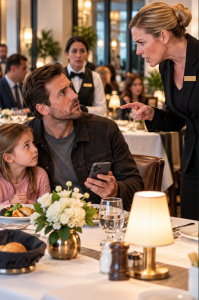
That evening, I took my nine-year-old daughter, Emma, to the Grand Meridian Hotel for dinner.
It was supposed to be a small celebration.
She had just won a school art competition.
She wanted spaghetti.
I wanted one quiet meal with my little girl.
We were seated near a large window overlooking the city.
Emma immediately started telling me about her painting.
“It has a rainbow over the mountain.”
“That sounds beautiful.”
“And I won second place.”
“Second?”
She smiled.
“There were thirty-two kids.”
I laughed.
“Then second is pretty impressive.”
A waiter brought our food.
For ten minutes, everything was perfect.
Then a woman approached our table.
She wore a black suit and a gold name badge.
Caroline Shaw — Hotel Director.
She looked at me.
Then at Emma.
Then at my boots.
“Sir, I need to speak with you.”
I looked up.
“Sure.”
“This dining room is currently reserved for hotel guests participating in a private event.”
I glanced around.
Half the tables were empty.
“We were told we could sit here.”
Caroline smiled.
“I understand.”
She didn’t sound as though she understood at all.
“But this section is being held for our premium guests.”
Emma stopped eating.
I looked at her.
Then back at Caroline.
“We already ordered.”
“You can finish elsewhere.”
I frowned.
“Why are you asking us to move?”
Caroline lowered her voice.
“We have standards.”
I looked around.
“What standard are we violating?”
Her eyes moved toward my jacket.
She didn’t answer.
Emma whispered:
“Daddy, are we doing something wrong?”
I immediately turned toward her.
“No, sweetheart.”
Caroline sighed.
“Sir, please don’t make this difficult.”
I stayed calm.
I had learned a long time ago that anger rarely fixes anything.
Especially when someone wants you to lose your temper.
So I picked up my phone.
Caroline smiled.
“I’ll have security assist you if necessary.”
I nodded.
Then I sent one text.
Come to Table 14. Bring the personnel file and tonight’s incident report.
The recipient was Victor Lang, chairman of the company’s board.
What Caroline didn’t know was that I wasn’t simply a guest.
Six weeks earlier, the Grand Meridian’s parent company had been acquired by an investment group I founded.
The purchase had not been publicly announced yet.
I had intentionally remained out of the spotlight during the transition.
My first task had been to evaluate the company’s customer-service culture.
I wasn’t looking for polished speeches.
I was looking for what happened when employees believed nobody important was watching.
Caroline had just given me my answer.
She didn’t know that.
She stepped closer.
“Security will be here shortly.”
Emma looked frightened.
I put my hand over hers.
“You’re safe.”
She nodded.
Then Caroline turned away.
A few minutes later, two security officers entered the dining room.
One approached our table.
“Sir, we’d like to ask you to come with us.”
Before I could respond, the restaurant manager hurried over.
“Wait.”
He looked past me.
Then toward the entrance.
His face changed.
Victor Lang had just walked in.
Behind him was the company’s chief operating officer.
And they were both walking directly toward our table.
Caroline smiled confidently.
“I was just handling the situation.”
Victor looked at her.
“What situation?”
“This guest refused to leave after I explained the private-section policy.”
Victor glanced at me.
Then at Emma.
Then back at Caroline.
His voice became very quiet.
“Caroline…”
“Yes?”
“Do you know who you’re speaking to?”
She smiled.
“No.”
Victor looked at me.
“Then I’d like to introduce you.”
He paused.
“This is Michael Dawson.”
Caroline’s expression didn’t change.
Not yet.
Victor continued:
“Yesterday, he became the controlling owner of this hotel.”
The room went silent.
Caroline’s face lost its color.
But I wasn’t finished.
Because I still had one question.
“Victor,” I said calmly, “show me the complaints from the last six months.”
Caroline’s eyes widened.
There had been more.
Much more.
And the names on those complaints were about to tell me exactly how long this had been happening.
PART 2 — THE REPORT THEY NEVER EXPECTED ME TO SEE
Victor brought the personnel file.
We moved into a private meeting room overlooking the restaurant.
Caroline sat across from me.
She looked completely different now.
No confident smile.
No dismissive tone.
Just silence.
I opened the report.
There were complaints from guests.
Dozens of them.
Families moved away from premium sections.
Parents told their children they couldn’t sit in certain areas.
Older customers ignored.
A couple dressed casually told a waiter they had to “prove” they were hotel guests before being allowed to order.
I looked at Caroline.
“Who trained your staff?”
She hesitated.
“I oversee the department.”
“So you knew?”
“I knew there had been isolated complaints.”
Victor interrupted.
“They weren’t isolated.”
He slid another folder across the table.
“Employee reports.”
I opened it.
Several employees had reported being instructed to prioritize guests based on how expensive they appeared.
One server had written:
I was told not to spend time with families who don’t order alcohol.
Another:
We were told certain customers make the dining room look less upscale.
I looked at Caroline.
“Did you say that?”
“No.”
“Did anyone in management?”
She hesitated.
Then:
“Not directly.”
I looked at Victor.
“Who?”
He opened another report.
A regional operations manager.
His name was Derek Miles.
He had sent internal messages praising managers who “protected the atmosphere” of premium spaces.
I read one message.
We can’t afford to have the wrong clientele taking over our best tables.
I felt my jaw tighten.
Emma was sitting beside me drawing quietly on a notepad.
She looked up.
“Daddy?”
“Yes?”
“Can we still have dessert?”
I smiled.
“Of course.”
Victor almost laughed.
“Absolutely.”
We returned to the restaurant.
Caroline stood.
“I apologize.”
I looked at her.
“To me?”
She nodded.
“And my daughter?”
She turned toward Emma.
“I’m sorry.”
Emma simply nodded.
But I wasn’t interested in an apology alone.
I wanted answers.
So I asked the staff a different question.
“Has anyone ever been told to treat customers differently based on clothing, appearance, or spending?”
Several employees looked at each other.
Then a young waitress raised her hand.
“Yes.”
Caroline’s face tightened.
“What?”
The waitress swallowed.
“We were told to do it.”
“By whom?”
“Derek.”
Another employee spoke.
“He told us premium guests don’t want to sit near families.”
A third employee nodded.
“He said children make the dining room look chaotic.”
I looked at Emma.
She was quietly coloring a rainbow.
I turned back.
“How long?”
“About a year.”
A year.
Not one incident.
Not one bad decision.
A culture.
Then Victor’s phone rang.
He answered.
His expression changed.
He handed me the phone.
It was our chief compliance officer.
“We found something else.”
“What?”
“Caroline approved the termination of three servers who complained about the policy.”
I looked at her.
“Is that true?”
She swallowed.
“They were insubordinate.”
“What did they do?”
“They refused to move a family.”
“Why?”
“Because they thought it was wrong.”
Silence.
I leaned back.
Then I asked:
“How much money has the company lost from customer complaints?”
The compliance officer answered:
“Almost $2.4 million in refunded stays, canceled memberships, and settlement payments.”
I looked at Caroline.
“This isn’t about one table.”
“No.”
“It’s about how people were treated.”
She lowered her eyes.
I had one more question.
“Where is Derek?”
Victor answered.
“On his way here.”
Twenty minutes later, Derek entered the room.
He looked confused.
Then he saw me.
“I was told the new owner wanted to meet me.”
“You’re looking at him.”
His face changed.
I placed the reports on the table.
“Did you instruct employees to judge guests by appearance?”
“No.”
I slid the internal messages toward him.
“Then explain these.”
He read them.
He had no answer.
Then Caroline spoke.
“He never explicitly said that.”
I looked at her.
“You defended the policy.”
She said nothing.
Derek stood.
“This is being blown out of proportion.”
I closed the folder.
“No.”
I looked toward Victor.
“We’re done here.”
Derek frowned.
“With what?”
“With pretending.”
He left the room.
I thought the evening was finally over.
But before I could return to Emma, one of the junior employees approached me.
“Mr. Dawson?”
“Yes?”
“There is something else you should know.”
“What?”
She lowered her voice.
“The policy wasn’t just about customers.”
She looked toward Caroline.
“It was also being used to decide which employees got promotions.”
I froze.
The discrimination wasn’t stopping at the dining room.
It had spread into the entire workplace.
And now I understood why nobody had been able to stop it.
People weren’t simply afraid of losing customers.
They were afraid of losing their jobs.
PART 3 — THE NIGHT THE HOTEL CHANGED
The investigation lasted several weeks.
We interviewed employees privately.
We reviewed complaints.
Audited promotions.
Examined termination records.
And tracked customer retention.
The pattern was undeniable.
Employees who questioned Caroline or Derek were sidelined.
Some were denied promotions.
Others were transferred.
A few resigned.
The company had built a culture where appearance mattered more than service.
And it had cost people their livelihoods.
Caroline eventually admitted that she had allowed the policy to continue.
She insisted she had never intended to discriminate.
But intent didn’t erase the results.
Derek was removed from his regional position pending the outcome of the investigation.
Caroline resigned after the internal review.
The company revised its guest-service standards.
Complaints were sent directly to an independent customer-relations team.
Employees were given a confidential reporting system.
And managers were retrained.
I also did something nobody expected.
I invited the three servers who had been fired back for interviews.
Two returned.
One had already found another job.
The two who returned were offered positions with higher responsibilities.
A month later, I went back to Grand Meridian with Emma.
We sat at the same table by the window.
The new restaurant manager recognized us.
“Welcome back, Mr. Dawson.”
I smiled.
“Just Michael.”
Emma looked at the menu.
“Can we get the spaghetti again?”
The manager laughed.
“Absolutely.”
Then she looked at Emma.
“And dessert is on us.”
Emma smiled.
But this time, nobody was watching our clothes.
Nobody was deciding whether we belonged.
Nobody was asking us to move.
Halfway through dinner, I noticed a framed photograph near the entrance.
It showed the entire restaurant staff.
Underneath it was a simple sentence:
Everyone belongs at the table.
I stared at it for a long time.
The night Caroline told me people like us didn’t belong, she thought she was protecting a certain image.
She thought wealth belonged at the best tables.
She thought appearances determined value.
She thought she could make people disappear by asking them to leave.
But she had forgotten something fundamental.
A business isn’t built by the clothes people wear.
It’s built by the people who show up every day and treat others with respect.
Years later, Emma still remembered that dinner.
She was older.
More confident.
And one evening, she asked me:
“Dad, why didn’t you get angry when that woman told us to leave?”
I smiled.
“Because I wanted you to learn something.”
“What?”
“That you don’t have to prove you belong somewhere.”
She looked at me.
“Even if someone says you don’t?”
“Especially then.”
She smiled.
Then she returned to her homework.
I looked around our house.
No expensive furniture.
No extravagant decorations.
Just a kitchen table where we ate together.
That was enough.
I still think about that night at the hotel.
I could have fired Caroline immediately.
I could have embarrassed her in front of the entire restaurant.
Instead, I investigated.
Because sometimes one person’s behavior is only the visible part of a much larger problem.
The real change came when we discovered how many employees had been afraid to speak.
And how many customers had quietly walked away.
That taught me something too.
Silence can make a bad culture look normal.
The person at the table may not have the loudest voice.
They may not have the most expensive clothes.
They may not look important.
But that doesn’t make them less deserving of respect.
And my daughter gave me the best ending of all.
A few months after the restaurant changed its policies, her school held an art show.
Her winning painting was displayed in the center of the room.
It showed a long table surrounded by people of different ages and backgrounds.
Above it, she’d written:
There is always room for one more.
I stood there staring at it.
Emma came beside me.
“Do you like it?”
I smiled.
“I love it.”
She looked at me.
“That’s what you taught me.”
I shook my head.
“No.”
I pointed at the painting.
“You taught me.”
Because the night a manager tried to make my daughter feel like she didn’t belong, my first instinct was to protect her.
But by the end of that night, I realized something bigger.
We weren’t just protecting one little girl from one humiliating moment.
We were changing a system where too many people had been quietly made to feel unwelcome.
And it all started with one simple question:
Who decided that someone wasn’t important enough to sit at the table?
The answer was never supposed to be based on a jacket, a pair of boots, or the size of a person’s wallet.
My daughter learned that.
So did I.
And the woman who thought she had the power to decide who belonged in that restaurant…
ended up teaching everyone in the building the lesson she had forgotten:
Respect is not something you earn by looking important.
It is something everyone deserves before they ever sit down at the table.