Part 1 — The mess from upstairs
My name is Laura Bennett.
I’d lived in my apartment for nearly nine years.
I liked quiet mornings.
I kept herbs on the balcony, read outside when the weather was nice, and treated the little space as my private escape from work.
Then the new tenant moved into the apartment directly above mine.
His name was Mason.
He seemed friendly enough at first.
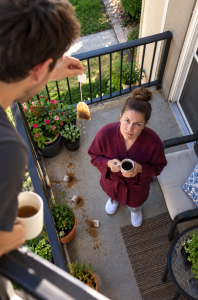
The first strange thing that landed on my balcony was a wet coffee filter.
I found it beside my rosemary pot one Saturday morning.
I assumed it had blown over the railing.
I threw it away.
The next day, another appeared.
Then another.
Soon, I started finding them several times a week.
Sometimes they landed on the concrete.
Sometimes on my outdoor chair.
Once, one landed directly on a stack of clean towels I’d left outside to dry.
I finally went upstairs.
Mason opened the door holding a mug.
“Do these belong to you?” I asked, holding up the soggy filter.
He looked embarrassed.
“Seriously?”
“I’ve found several.”
He laughed.
“Oh. I guess I toss them off the balcony without thinking.”
“Please don’t.”
“Sure.”
He apologized.
I went home.
The following morning, another filter appeared.
I waited a few days.
Then I found one in a flowerpot.
So I went upstairs again.
“Mason, this is still happening.”
He sighed.
“It’s coffee grounds, Laura.”
“They’re staining things.”
“You should probably move your stuff away from the railing.”
I stared at him.
“Or you could use your trash can.”
He gave a little shrug.
“It’s not a big deal.”
I walked away.
I didn’t want a feud.
I’d been in the building long enough to know how quickly neighbor disputes became everyone else’s entertainment.
So I tried one last polite request.
I left a note on his door.
Please keep the balcony clean. I’m not asking for much.
He never responded.
Three days later, another filter landed on my chair.
This time, something hard was inside it.
I picked it up.
It was a tiny brass screw.
I looked up toward Mason’s balcony.
Why would a coffee filter contain a screw?
The next morning, I found another.
This one held a small metal clip.
Then a third filter.
Inside was a narrow piece of blue plastic.
None of it made sense.
I called the building superintendent.
“Could the maintenance crew be doing something upstairs?”
“Not that I know of.”
“Could someone be throwing hardware out?”
“No.”
I thanked him.
Then I did something I’d never done before.
I bought a small motion-activated balcony camera.
I positioned it facing the railing.
I wasn’t trying to trap Mason.
I simply wanted proof that the items were coming from his apartment.
The first night produced nothing.
The second didn’t either.
Then, at 6:43 the next morning, my phone buzzed.
Motion detected.
I opened the recording.
Mason stepped onto his balcony holding a coffee filter.
He glanced left.
Then right.
Then dropped it over the railing.
I sighed.
At least now I knew.
I was about to close the recording when I noticed something.
Before throwing the filter, Mason had opened a small metal cabinet beside his balcony door.
Inside were dozens of identical filters.
Not coffee filters.
They were wrapped around tiny objects.
And one of those objects looked unmistakably like a key.
I replayed the video.
Then again.
Why was Mason wrapping keys in coffee filters and throwing them down onto my balcony?
The answer came the next morning.
Because this time, the object he dropped was caught perfectly on camera.
And when I zoomed in, my stomach tightened.
It wasn’t a key.
It was a building access card.
Part 2 — What he was throwing away
I contacted the building manager immediately.
Her name was Janet Cole.
I showed her the recording.
She stared at the screen.
“That’s not supposed to be in his apartment.”
“Why?”
“Those cards belong to residents.”
“How many?”
“I don’t know.”
We checked the building’s access system.
Three resident access cards had been reported missing in the previous month.
Janet had assumed people had simply lost them.
Then we checked the dates.
The first missing card was reported two days before Mason moved in.
The second disappeared the following week.
The third vanished four days later.
Janet looked at me.
“Are you saying he has them?”
“I don’t know.”
We watched another recording.
Mason appeared again.
Same routine.
Coffee filter.
Small object.
Over the railing.
This time, Janet recognized it immediately.
A garage fob.
She called building security.
The security supervisor came upstairs.
They checked the electronic logs.
The garage fob had been used at 2:14 a.m. the previous night.
Mason’s apartment wasn’t near the garage.
Someone had been using a resident’s access credentials after midnight.
Then we found something even stranger.
Several package lockers had been opened using missing cards.
Janet pulled the records.
“Someone has been accessing other residents’ deliveries.”
“What?”
“Small electronics. Prescription packages. Documents.”
My stomach turned.
The coffee filters weren’t random trash.
They were being used to discard access items after they had been used.
I felt sick.
We gave the evidence to the police and waited.
Later that evening, Mason knocked on my door.
I opened it only a few inches.
“You’ve been asking questions,” he said.
“About what?”
He smiled.
“The filters.”
My heart started pounding.
“You’ve been watching me?”
“I’ve noticed the camera.”
I froze.
“I don’t know what you’re talking about.”
He laughed.
“Laura, let’s not make this dramatic.”
Then he left.
I immediately called Janet.
The police were notified.
The next morning, investigators searched the building’s security records.
They discovered that Mason had been using temporary access cards belonging to short-term guests.
But the biggest surprise came when they checked his apartment’s lease.
The person listed as the tenant wasn’t Mason.
It was someone else.
Mason had rented the apartment under a false name.
Janet stared at the paperwork.
“So who is he?”
Police began tracing the identity.
They discovered he had been connected to a group that targeted apartment buildings with shared access systems.
He wasn’t simply stealing things.
He was testing which doors, lockers, garages, and common areas could be entered without attracting attention.
The coffee filters were his way of getting rid of the physical cards after copying or using them.
And my balcony had accidentally become the place where he discarded them.
I watched one more video.
This time, Mason stepped onto the balcony carrying a coffee filter.
He looked toward my camera.
Then he lifted the filter.
Something was written on a tiny slip of paper wrapped inside it.
Janet enlarged the image.
There was a list of apartment numbers.
My apartment number was on it.
I stared at the screen.
“Why is mine listed?”
The security supervisor answered quietly:
“Because your unit is directly below his.”
“What does that have to do with anything?”
He pointed to the rest of the list.
Every apartment on it belonged to residents whose packages had been accessed.
Mine was last.
And it appeared Mason hadn’t gotten to it yet.
Part 3 — The balcony that exposed everything
Police arrested Mason after collecting enough evidence to establish the connection between his apartment and the missing access devices.
Investigators recovered additional items connected to unauthorized building entries.
They also found records showing that the group had been targeting buildings with older access systems.
The coffee filters became one of the strangest pieces of evidence in the investigation.
Not because they were important by themselves.
Because they were what made me look up.
What started as a petty nuisance turned into a trail.
Every filter.
Every discarded access card.
Every tiny piece of hardware.
Every strange item I found on my balcony.
It had all been part of the same pattern.
After Mason was gone, the building felt completely different.
Residents started talking to one another again.
People compared notes.
Several discovered that they had reported unusual package problems without realizing they might be connected.
Janet arranged a security review.
The access system was upgraded.
Residents were given new cards.
And for the first time in months, I could sit on my balcony without looking over my shoulder.
A week later, Janet came to see me.
She handed me a small cardboard box.
Inside were the coffee filters I’d collected.
Dozens of them.
“What am I supposed to do with these?”
She smiled.
“Keep them.”
I laughed.
“Why?”
“Because without them, we might not have discovered what was happening.”
I looked at the pile.
Such ordinary objects.
Ugly.
Wet.
Annoying.
But they had become evidence.
I thought back to the first time I went upstairs.
Mason had laughed.
He told me:
“You live downstairs. You get what falls.”
He had been right about one thing.
Things do fall.
But sometimes, when they do, they reveal what someone is trying to hide.
Months later, I still kept the camera.
Not because I was afraid.
Because I had learned something.
You don’t always need to confront someone louder to solve a problem.
Sometimes you need to document it.
Stay calm.
Notice the pattern.
And let the facts speak for you.
One Saturday morning, I was watering my plants when a small object landed on my balcony.
I looked up.
Then laughed.
It was a single dry leaf.
Nothing suspicious.
Nothing wrapped in a coffee filter.
Just a leaf.
I picked it up and dropped it into my trash.
Then I sat in my chair with my coffee.
Peaceful.
Quiet.
Mine again.
My neighbor’s repeated little nuisance had seemed too insignificant to matter.
But the moment I stopped arguing and started paying attention, I discovered it wasn’t really about coffee at all.
It was about access.
Trust.
And a person who thought nobody was watching.
The building is safer now.
The residents know one another better.
And I have one simple rule whenever something strange keeps happening:
Don’t underestimate the small clue just because it looks ordinary.
Sometimes the thing landing on your balcony isn’t just trash.
Sometimes it’s the first piece of a much bigger story.
And in my case, a handful of soggy coffee filters ended up exposing a secret that dozens of people had never noticed.
What Mason thought he was throwing away was exactly what gave us the evidence to stop him.