My daughter was halfway down the aisle when I saw fear in her eyes instead of joy, but before I could reach her, my cardiologist wife stepped into the aisle and said, “Stop.” She pulled the bouquet from Harper’s trembling hands, and a sealed glass vial fell onto the marble floor. The groom went pale. Then a medical specialist in the third row stood up and explained why my daughter had been confused for weeks…
I spent thirty-four years as a structural engineer, which means I made a living noticing things other people were paid not to notice until later. A hairline crack over a doorway. A foundation settling half an inch more on one side than the other. The tiny bow in a steel beam that looks harmless until you understand exactly how much weight is resting above it.
You learn, after enough years, that catastrophic failures rarely begin with a dramatic sound. Most start quietly. Something shifts. Something strains. Something important stops behaving the way it should, and everyone keeps walking underneath it because the ceiling is still technically standing.
My name is Dean Whitaker. I was sixty-two the morning my only daughter, Harper, was supposed to marry Callum Dre at the Palmetto Grand in Charleston.
And for all my professional experience recognizing what was about to fail, I almost missed what was happening to my own child.
My wife, Marian, and I arrived shortly after nine that morning. The hotel sat a few blocks from the waterfront, with tall windows that caught the October light and poured it across the marble floors in long gold rectangles. Marian wore a slate-blue dress she had spent two weekends choosing, which for her was an extraordinary amount of indecision because my wife could make a difficult hospital decision faster than she could select formal shoes.
She had been a cardiologist for twenty-eight years. Marian had sat across from families and told them things that divided life into before and after, yet I had rarely seen her lose control of her voice.
That morning, she was too controlled.
I noticed it during the drive.
“You nervous?” I asked.
“No.”
“Thinking about the ceremony?”
“Yes.”
“That was a suspiciously short answer.”
Normally, she would have smiled.
She kept watching the road even though I was driving.
I let it go.
That decision would bother me later.
Callum’s father, Archer Dre, found us near the entrance to the ceremony hall. He was sixty-four, silver-haired, broad-shouldered, and polished in the way certain wealthy men become polished after enough years of people laughing at jokes that are only moderately funny. He ran Dre Capital Management in Atlanta, a private equity firm I had researched after Harper became engaged.
What I found looked respectable.
Profitable.
Established.
Complicated.
Archer shook my hand with both of his.
“Dean. Today’s the day.”
“So they tell me.”
He kissed Marian lightly on the cheek. “You two raised an extraordinary woman. Callum is the luckiest man alive.”
There was nothing wrong with the words.
That was part of what bothered me later.
They were perfect.
Too perfect, perhaps, though at the time I only thought Archer was one of those men who could deliver warmth like a prepared quarterly report.
After he moved on, I turned toward Marian.
“You’ve been somewhere else all morning.”
She looked at me for several seconds.
Then she shifted her clutch from one hand to the other.
“I need you to do something for me today.”
That got my attention.
“What?”
“Whatever happens in the next hour, I need you to stay calm.”
I stared at her.
“Marian—”
“No matter what you see.”
My mouth went dry.
“Do you know something?”
“I need you to promise me.”
There is an expression my wife gets when she already knows the result of a test but hasn’t told the patient yet. It isn’t coldness. It is concentration—the look of someone deciding how much truth another human being can absorb in one breath.
She had that expression.
“Promise me, Dean.”
I did.
Then I spent the next forty minutes regretting it.
The hall filled with nearly four hundred people. Callum’s side included business associates, old college friends, family from Georgia and North Carolina, and enough well-tailored men checking their phones to make the ceremony look briefly like a shareholders’ meeting with flowers.
Our side was quieter.
Harper had never liked spectacle, which made the size of the wedding somewhat ironic. She wanted a smaller celebration. Callum’s family wanted something “worthy of the occasion,” and somewhere during the planning process the occasion acquired a string quartet, six-foot floral arrangements, custom menus, and enough candles to concern any reasonable fire marshal.
I had teased Harper about it two months earlier.
“Your mother and I got married in a church basement with roast chicken.”
“You also had a sheet cake with plastic swans.”
“Those swans were classy.”
“They had glitter on their necks.”
“Classy glitter.”
She had laughed then.
That was the face I expected to see when she entered the hall.
Instead, when the music changed and Harper appeared at the far end of the aisle, I saw something that made every instinct I had developed in thirty-four years of engineering wake up at once.
My daughter was twenty-seven. I knew the difference between her nervous smile and her embarrassed smile, between the face she made when she was annoyed and the one she made when she was genuinely afraid.
She was wearing an ivory gown with her grandmother’s pearl earrings and little white flowers threaded through her hair. She looked beautiful.
She also looked unwell.
Her skin had the pale, flat color of old paper. Her steps were measured too carefully, almost as though she were giving herself instructions inside her head.
Left foot.
Right foot.
Keep going.
The bouquet of white gardenias in her hands trembled continuously.
Not bridal nerves.
Something physical.
Something wrong.
I turned toward Marian.
She was watching Harper with absolute focus.
That was when I understood that whatever my wife knew, it involved our daughter.
Harper reached our row.
I extended my hand toward her arm almost without thinking.
She turned her face toward mine.
Then she grabbed my hand.
Not held it.
Grabbed it.
Her fingers locked around mine hard enough that I felt every knuckle through her glove. Her eyes met mine for perhaps one second, and what I saw in them was not panic exactly.
It was a request.
Help me.
Then she released me and began walking again.
That grip changed the entire room.
I turned toward Marian.
She was already standing.
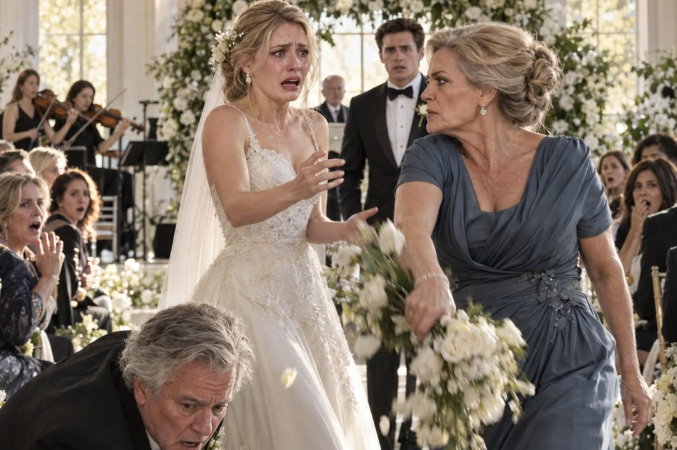
She stepped directly into the aisle.
“Stop.”
She didn’t shout.
She didn’t need to.
The quartet broke off awkwardly in the middle of a measure. Four hundred guests shifted at once, and at the altar Callum’s expression changed so quickly I almost convinced myself I had imagined it.
Surprise.
Alarm.
Then composure.
Marian walked straight to Harper.
“Mom?” Harper whispered.
Marian took the bouquet in both hands and pulled it downward.
Several gardenia petals scattered across the marble.
Something small dropped from inside the stems.
Glass struck stone.
A sealed vial, no larger than a perfume sample, rolled across the floor.
For half a second nobody moved.
Then I looked at Callum.
Every bit of color had disappeared from his face.
Marian nudged the vial gently sideways toward me with her shoe.
“Dean. Pick it up.”
I bent down.
“Do not let Callum touch it.”
I closed my hand around the glass.
The vial contained a clear liquid. The seal appeared intact, and there was a tiny printed label I couldn’t read from where I stood.
Callum stepped away from the altar.
“That belongs to the event team.”
Marian turned slowly.
“What?”
“It’s part of the ceremony. A fragrance element.”
“A what?”
“For the unity candle.”
A woman near the sound table spoke before Marian could.
“No, sir.”
She was Patricia Lowe, the Palmetto Grand’s senior event coordinator, a woman in her late forties who had been running around since seven that morning with a tablet and the expression of someone personally offended by crooked table linens.
She walked toward us.
“I approved every ceremonial item brought into this room. We do not place sealed vials inside bridal bouquets.”
A murmur moved through the guests.
Callum’s jaw tightened.
“There must have been a misunderstanding.”
“There wasn’t.”
The voice came from the third row.
A man I didn’t recognize stood.
He was around my age, smaller than me, wearing a plain dark suit. He introduced himself as Bernard Lusk, a clinical pharmacist with more than three decades of experience evaluating medications and laboratory samples.
“Four days ago,” he said, “Dr. Marian Whitaker asked me to review a sample connected to her daughter’s medical testing.”
I looked at Marian.
She didn’t look back.
Bernard continued.
“What I reviewed was a strong sedating compound capable of causing significant fatigue, confusion, slowed thinking, and impaired judgment.”
The room changed.
That is the only way I know how to describe it.
Four hundred people did not suddenly start yelling. They simply stopped believing they were attending a wedding.
I looked down at the vial in my hand.
Then at Harper.
Then at my wife.
“What is happening?”
Marian came to me.
“Three weeks ago, Harper came to my office.”
My daughter looked toward the floor.
“She had been having trouble concentrating. Fatigue. Confusion. Memory gaps.”
Harper swallowed.
“I thought it was stress.”
Marian nodded.
“She nearly convinced herself not to come.”
“What did you find?”
“I ordered extensive testing.”
She took a breath.
“Then I repeated it because I wanted to be absolutely certain.”
My stomach dropped.
“The results showed that something was affecting her system and likely contributing to the symptoms she had been experiencing.”
I put one hand on the back of a chair.
“How long?”
“Based on what Harper described? Several weeks.”
Harper’s voice came out small.
“I kept thinking I was failing.”
I looked at her.
She pressed her lips together.
“I couldn’t focus. I’d wake up exhausted. Callum would tell me we’d discussed things the night before, and I wouldn’t remember all of it. I kept thinking the wedding was too much, or I wasn’t sleeping, or I was becoming one of those brides who loses her mind over napkin colors.”
Nobody laughed.
Neither did Harper.
“He kept telling me I was overwhelmed,” she said. “That I needed to trust him.”
Callum finally spoke.
“This is insane.”
Marian looked at him.
“No. It is documented.”
He turned toward the guests.
“Harper has been under tremendous stress. Her mother is frightened and interpreting medical information through that fear.”
My wife did not react.
Instead, Patricia asked one of her assistants to bring up the corridor security footage from earlier that morning.
It took several minutes.
Those minutes lasted an hour.
Callum crossed his arms.
Archer Dre began moving slowly toward the back of the room, casually enough that most people probably didn’t notice.
I did.
Maybe I was finally looking properly.
The footage appeared on a monitor near the sound table.
The timestamp showed 6:52 a.m.
A figure came through the service corridor carrying a small bag. He knocked at a door.
Callum opened it.
Even from the grainy angle, there was no mistaking him.
He took the bag.
Eleven seconds later the other person disappeared toward the service stairs.
Archer spoke.
“My son receiving a personal item proves nothing.”
“Correct,” Marian said. “So let’s keep going.”
Patricia checked her tablet.
Every official delivery to the bridal suite had arrived later through the main hallway.
Flowers.
Breakfast.
Champagne.
Nothing was scheduled through the service stairs.
Then Marian reached inside her clutch and removed a folded report.
“Harper’s medical results.”
Callum’s expression finally lost its polish.
“This is absurd.”
Marian continued as though he hadn’t spoken.
“The findings were consistent with prolonged exposure to something that could explain the confusion, fatigue, and memory problems Harper had been experiencing.”
Harper raised one hand.
“I want to play something.”
Everyone turned toward her.
She reached inside the bodice of her dress and removed a slim black recording device.
My daughter had walked down the aisle carrying evidence against the man waiting to marry her.
Patricia connected the recorder to the sound system.
Harper looked at me.
“I recorded it eleven days ago.”
“What?”
“Mom asked me to.”
The audio began.
Restaurant noise first.
Silverware.
Conversation.
Then Callum’s voice.
“She’s easier to manage when she’s tired and second-guessing herself. The problem at the Henderson dinner was that she was too alert.”
My knees weakened.
Archer answered.
“You need her clear enough to sign. Not clear enough to start questioning every page.”
Callum said Sasha would make sure Harper stayed “calm” when necessary.
Then Archer spoke again.
“The Whitaker Trust closes on the fifteenth. Once it’s in the partnership structure, unwinding it will cost enough that it won’t matter.”
The recording ended.
I sat down.
I didn’t decide to.
My legs simply stopped participating.
The Whitaker Trust had been created by my father for Harper’s future and had grown over the years to assets worth roughly two million dollars. The principal was protected until she reached the required age, but certain marital and co-trustee arrangements could create interests that would be extraordinarily difficult and expensive to unwind once signed.
I looked at Marian.
She understood the question before I asked it.
“She found paperwork in Callum’s study.”
Harper stared toward the altar.
“A petition naming him co-trustee.”
My mouth went dry.
“My signature was already on it.”
“Did you sign it?”
Harper looked at me.
“I don’t remember.”
For the first time that morning, something like rage threatened to overpower the promise I had made Marian.
Then my daughter said something that stopped it cold.
“I kept making excuses for myself because the alternative was admitting what he was doing to me.”
A sound came from the left side of the room.
Harper’s maid of honor, Sasha Merrill, was standing near the staging area with both hands over her mouth.
She was crying.
Marian turned toward her.
“Sasha.”
She shook her head.
Marian’s voice softened.
“How long?”
Sasha backed against the wall.
Callum took one step toward her.
“Sasha.”
She looked at him.
Whatever she saw changed her.
“Eight weeks,” she whispered.
Harper went still.
Sasha began crying harder.
“He gave me something and told me it was harmless. He said it would help with the wedding stress. He told me Harper knew about it at first, and later he said she was embarrassed and didn’t want anybody discussing it.”
“You never asked me?” Harper said.
Sasha covered her face.
“I thought I was helping you.”
Harper’s voice cracked.
“For two months?”
Sasha slid one hand along the wall as if she needed it to remain upright.
Marian spoke with the terrifying calm of a physician who was now also a mother.
“You were helping him interfere with her health without her knowledge.”
Sasha began saying, “I’m sorry,” over and over.
Callum watched her.
Not with concern.
Not with grief.
He watched her the way I watched numbers during a structural failure analysis.
He was calculating what her confession cost him.
That was when I finally crossed the aisle.
I went to my daughter and wrapped both arms around her.
She held the back of my jacket.
“I’ve got you,” I said.
My voice broke.
I didn’t care.
“I’ve got you, sweetheart.”
And for the first time all morning, Harper stopped trying to look composed.

Chapter 2
The next hour barely resembled a wedding.
Two law-enforcement agents were already in the hotel. Marian, Bernard, and our family attorney, Phyllis Crane, had contacted the appropriate authorities before the ceremony because they wanted the medical evidence, the suspicious delivery, and Callum’s behavior properly documented rather than turning everything into a private family accusation he could later dismiss.
That was the part Marian had hidden from me.
Callum remained near the altar while one agent spoke with him. Archer immediately requested counsel, apparently believing that saying the word attorney in an expensive suit still caused rooms to reorganize around him. It did not.
Sasha sat near the entrance and talked to the second agent.
Once she started, she did not seem able to stop. From where I stood, I could see her crying and answering every question, her shoulders folding inward as the full meaning of what she had participated in finally reached her.
Harper watched for less than a minute.
Then she turned away.
I wanted to ask Marian why she had let our daughter walk into that ceremony at all, but before the anger could form properly, I remembered the recorder.
“You knew for three weeks.”
“Yes.”
“And you didn’t tell me.”
“I couldn’t.”
“Couldn’t?”
“If you had known, Archer would have known that you knew.”
I stared at her.
She took my hand.
“Dean, you cannot hide anger. You think you can. You cannot.”
Under almost any other circumstances, I might have been offended.
Unfortunately, after thirty-one years of marriage, she had supporting evidence.
“The rehearsal dinner,” she continued. “If you had looked at Callum or Archer knowing what we knew, one of them would have changed course. Harper needed proof tying their manipulation to the trust documents, and the authorities needed more than our suspicions.”
I looked across the hall.
Harper was still standing in her wedding dress near the window.
“You asked her to make the recording?”
Marian nodded.
“She wanted to.”
“She had been confused for weeks.”
“She was also your daughter.”
That stopped me.
Marian squeezed my hand.
“Do not confuse what they did to her with weakness.”
I looked again.
Harper’s shoulders were straight.
Her mascara had run slightly, but her chin was level.
For weeks she had believed her own mind was failing her.
Then, once she learned it wasn’t, she had walked back toward the people responsible and collected the evidence needed to stop them.
I had never been more proud of her.
Or more ashamed that I hadn’t seen what was happening.
Chapter 3
Charges followed within days.
Callum pleaded not guilty. Archer retained separate counsel, which told me more about the Dre family’s internal loyalty than any public statement they issued afterward. The case moved slowly, as serious cases do, despite the fact that television has convinced half the country justice happens between commercial breaks.
Sasha cooperated fully.
Because she admitted her role, provided information about Callum’s instructions, and turned over messages supporting her statement, she avoided the harshest consequences she might otherwise have faced.
Harper never spoke to her again.
People sometimes asked whether she forgave Sasha.
I learned not to answer for her.
There are betrayals that produce anger, and then there are betrayals that create an empty place where a person used to be. Sasha had been Harper’s closest friend for four years. Whatever Callum had told her, she had repeatedly helped him interfere with Harper’s health without ever speaking honestly to the woman she called her best friend.
Harper did not need to hate her.
She simply stopped opening that door.
The petition giving Callum control over the trust was invalidated. The Whitaker Trust remained protected in Harper’s name, untouched by the partnership structure Callum and Archer had been trying to create.
That mattered legally.
Emotionally, it mattered much less than I expected.
For months afterward, Harper was more disturbed by the fact that she had doubted herself.
“I thought I was becoming stupid,” she told me one Sunday.
We were sitting on our back porch with coffee.
“You weren’t.”
“I know that now.”
She watched a squirrel make a spectacularly bad attempt to jump between two branches.
“I apologized to Callum for forgetting conversations he had probably invented.”
I didn’t know what to say.
So I stopped trying to say the perfect thing.
“I’m sorry.”
She looked at me.
“For what?”
“For not noticing.”
Her expression softened.
“Dad, I didn’t notice either.”
“But I’m supposed to.”
“No. You’re supposed to love me.”
That sentence stayed with me.
Maybe because I had spent my career believing attention was part of love.
Maybe because she was right that love cannot make us omniscient.
Maybe both things were true.
Final chapter
Six months after the wedding that never happened, Harper called me on a Tuesday and asked whether I could meet her on King Street.
She had been doing freelance textile design since graduate school, mostly from the corner of her apartment. Before Callum, she had talked constantly about opening a studio. During the engagement, that dream had somehow become something she would “get back to later.”
Later had finally arrived.
The space was modest.
Two rooms.
High ceilings.
Old wood floors.
A wide front window facing the street.
Harper stood outside with her hands in the pockets of her coat and looked through the glass.
“What do you think?”
I inspected the building automatically.
“The masonry looks sound.”
She laughed.
“I meant as a studio.”
“I know.”
“You’re impossible.”
“Professionally cautious.”
“You inspected the ceiling before you looked at the windows.”
“The ceiling is what stops the upstairs neighbors from becoming downstairs neighbors.”
That earned me the eye roll I had missed for months.
She signed the lease the following week.
By April, the front window had a painted sign:
Whitaker Textile Studio.
Marian and I helped her move in. I carried boxes and pretended not to notice that my wife, who had spent her career telling patients not to overexert themselves, was personally dragging a drafting table twice her size across the floor because apparently medical advice only applies to other people.
At some point Harper stood in front of the window with sunlight behind her.
Marian took a photograph.
The three of us together.
There is a copy on the windowsill in my office now.
Harper is smiling.
Not the careful smile from those last weeks with Callum. Not the polite one she wore in engagement photographs while something inside her was becoming quieter every day.
Her real smile.
I know that smile.
It starts in her eyes.
Sometimes I look at that photograph and think about the morning of the wedding.
The trembling bouquet.
Her grip around my hand.
The tiny vial rolling over white marble.
For years, I believed being a good father meant building enough around my daughter that nothing could reach her.
A stable home.
Education.
Savings.
A trust from her grandfather.
People she could rely on.
What I eventually understood was that danger does not always climb over the walls you build.
Sometimes you invite it to dinner.
Sometimes it remembers your wife’s birthday.
Sometimes it shakes your hand, compliments your daughter, and slowly teaches her not to trust her own judgment.
That realization could make a person suspicious of everyone.
I refuse to let it.
Fear is not attention.
Control is not protection.
Those were Callum’s mistakes.
What I learned instead was to look carefully without assuming I already know what I am seeing.
On the drive home after helping Harper settle into the studio, Marian sat beside me with her shoes off, scrolling through something on her phone.
After several quiet miles she lowered it.
“You never asked again.”
“About what?”
“Why I was so quiet on the way to the hotel.”
I smiled faintly.
“You told me when I needed to know.”
She watched me.
“That didn’t bother you?”
“It bothered me tremendously.”
She laughed.
“But I trusted you.”
Marian looked out the window for a moment.
Then she reached across the console.
“That’s why I married you.”
I took her hand.
Three decades earlier, when we first met, I thought she was the calmest person in every room because nothing frightened her.
I know better now.
Courage is not calm because nothing is wrong.
Sometimes it is calm because something is terribly wrong and somebody still has to think clearly.
Harper inherited that from her mother.
Maybe she inherited something from me too.
Buildings tell you when they are under strain if you know where to look.
So do people.
The signs are not always obvious. Sometimes it is simply a daughter walking more carefully than usual. A hand gripping yours too tightly. A person apologizing more than they used to. A woman saying she is exhausted for the sixth week in a row.
I still wish I had seen it sooner.
That is the part I am learning to forgive in myself.
But the story does not end with what I missed.
It ends with what my daughter did after she understood the truth.
She trusted herself again.
She stood in front of four hundred people and refused to let someone else define what had happened to her.
Then she built something that belonged entirely to her.
Every so often, Harper sends me a photograph from the studio.
Fabric samples across a table.
A new pattern pinned to the wall.
Coffee beside her sketchbook.
Nothing dramatic.
I treasure every one.
Because ordinary life, once someone has tried to take it from you, becomes a remarkable thing.
And somewhere in my office, beside engineering plans and old photographs, there is a picture of my daughter smiling beneath her own name.
When I look at it, I no longer see the bride who almost reached the altar.
I see the woman who stopped walking toward the wrong future.
And started building her own.