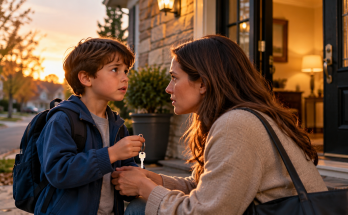
PART 1: The Secret Beneath Her Sleeves
My name is Margaret Wilson. I’m sixty-two years old, and I thought I knew everything about the son I raised.
I was wrong.
The truth began on a rainy Thursday afternoon when my son, Daniel, arrived at my house carrying his four-year-old daughter, Lily.
He looked as though he hadn’t slept in days.
“Mom, can you watch Lily for a few hours?” he asked, setting her little pink backpack beside my front door. “I have something important to take care of.”
“Of course,” I replied. “But is everything all right?”
He nodded too quickly.
“Everything’s fine. Just don’t let her take off her sweater. She’s been complaining about being cold.”
I glanced at Lily.
She stood silently beside him, her tiny hands gripping the hem of her yellow sweater. Unlike most children her age, she didn’t rush into my arms or ask for cookies.
Instead, she stared at the floor.
“Sweetheart, Grandma has your favorite strawberry cake,” I said gently.
She looked up for half a second.
Then she whispered, “Will Mommy be angry?”
Daniel’s expression changed.
“Lily, stop that.”
The little girl immediately fell silent.
I felt a strange knot tighten in my stomach.
Daniel kissed her forehead, grabbed his car keys, and hurried out without another word.
Through the window, I watched him sit in his car for nearly a minute before driving away.
Something was wrong.
I just didn’t know how wrong.
For the first twenty minutes, Lily sat on the living room sofa without touching her toys. When I brought her a plate of cake, she carefully broke off a tiny piece but refused to eat it.
“Are you feeling sick, darling?”
She shook her head.
“Does your tummy hurt?”
Another shake.
I knelt beside her.
“Grandma won’t be upset with you. You can tell me anything.”
Her lower lip trembled.
“Can I have water?”
“Of course.”
When I returned from the kitchen, she was trying to pull her sweater sleeves over her hands.
That was when I noticed the dark mark near her wrist.
“Lily, sweetheart, what happened to your arm?”
She jerked away.
“Nothing!”
Her voice was so frightened that I stopped moving.
I sat down beside her and waited.
After a few seconds, she whispered, “I bumped into something.”
“Does it hurt?”
She nodded.
“Can Grandma take a look?”
She hesitated before slowly pushing up her sleeve.
My breath caught.
There were several bruises on her small arm, some fading yellow and others dark purple.
I had raised children. I knew that little ones fell while playing.
But these marks made my hands go cold.
“Did you fall at school?”
Lily shook her head.
“Did somebody hurt you?”
Her eyes filled with tears.
Before she could answer, my phone rang.
It was Daniel.
“Mom,” he said, his voice sharp with panic. “Has Lily taken off her sweater?”
I stared at the little girl beside me.
“Why are you so worried about her sweater, Daniel?”
He didn’t answer my question.
“Listen carefully. Put her clothes back the way they were and wait for me. Don’t call anyone.”
My heart began pounding.
“Daniel, I can see bruises on her arm.”
Silence.
Then he whispered, “Mom, please. You don’t understand what’s happening.”
“Then explain it to me!”
“I can’t.”
The call ended.
I looked at Lily, who had begun crying silently.
I reached for her hand.
“Sweetheart, I’m taking you to the doctor.”
She suddenly grabbed my wrist with surprising strength.
“No, Grandma! Please!”
“Why not?”
She looked toward the front door.
Then she said six words that would haunt me for the rest of my life.
“Mommy said doctors take children away.”
I didn’t wait another second.
I wrapped Lily in her coat, picked up her backpack, and drove straight to the nearest children’s hospital.
At the emergency department, a nurse noticed the bruises almost immediately.
Within minutes, Lily was examined by a pediatrician. Another nurse brought her a stuffed rabbit, and a social worker quietly joined us.
The doctor asked me to wait outside for a moment while she spoke with Lily privately.
I sat in the corridor, clutching that little pink backpack.
Then my phone vibrated.
A message from Daniel appeared.
“Mom, please bring Lily home. Whatever she tells you, don’t believe everything.”
I stared at the screen in disbelief.
Before I could respond, the pediatrician returned.
Her expression was serious.
“Mrs. Wilson, we’ve found several injuries that need further examination. We’re also concerned about how frightened Lily appears.”
My knees weakened.
“What are you saying?”
“We aren’t making assumptions yet,” she replied carefully. “But we need to make sure she is safe.”
Just then, a police officer entered the corridor.
He approached me, introduced himself, and asked whether I was Lily’s grandmother.
When I nodded, he glanced at the pink backpack beside my chair.
“Did this bag come with the child?”
“Yes. Why?”
He exchanged a look with the doctor.
“Because,” he said quietly, “we’ve received information that may explain why someone was so desperate to keep her away from medical attention.”
He opened the backpack.
Inside were a spare dress, a coloring book, a small bottle of children’s medicine, and a folded sheet of paper.
The officer unfolded it.
His face changed.
At the top was a handwritten date.
Below it were several entries describing Lily’s injuries.
And at the bottom, in handwriting I recognized immediately, were the words:
“If anyone asks, she fell again.”
It was signed by my daughter-in-law, Vanessa.
I couldn’t breathe.
Because Vanessa had been calling me every week, smiling over video chats, telling me what a wonderful mother she was.
And now her handwriting was sitting in a police officer’s hands.
But the worst discovery was still waiting for us.
When the doctor returned, she asked me to sit down.
“Mrs. Wilson, Lily has told our specialist something important about the person she is afraid of.”
I gripped the edge of my chair.
“Who?”
The doctor paused.
“Your granddaughter didn’t identify her mother as the person who frightened her most.”
My heart pounded.
“Then who did she name?”
The doctor looked toward the examination room.
“Your son, Daniel.”
PART 2: The Voice Behind the Bedroom Door
I couldn’t make sense of what I had just heard.
Daniel had always been the gentle one.
When he was a child, he cried if he accidentally stepped on an insect. When his younger sister broke her arm, he stayed beside her hospital bed until midnight, holding her hand.
How could that same boy be the reason his daughter was terrified?
“No,” I whispered. “There must be some mistake.”
The doctor didn’t argue.
“Children sometimes struggle to explain frightening experiences clearly. We’re allowing trained professionals to speak with Lily, and we’re working with the appropriate authorities to understand what happened.”
I nodded, but my thoughts were racing.
Then the officer asked me whether I had noticed anything unusual during previous visits.
Suddenly, memories began returning.
Vanessa insisting that Lily was too difficult for me to babysit.
Daniel canceling family dinners at the last minute.
The little girl arriving at Christmas wearing long sleeves, even beside a warm fireplace.
And three months earlier, when Lily had dropped a glass at my house, Daniel had grabbed her arm so quickly that she stumbled.
I had told myself he was stressed.
I had told myself every family had difficult days.
Now I wondered how many warning signs I had explained away.
An hour later, the social worker invited me into a quiet room.
Lily sat at a small table with her stuffed rabbit tucked beneath one arm.
When she saw me, she hurried into my lap.
“Grandma, are you taking me home?”
I hugged her gently.
“Not until the doctors say you’re safe, sweetheart.”
She began to cry.
“Daddy said I ruined everything.”
My throat tightened.
“What did you ruin, darling?”
“The surprise.”
I exchanged a glance with the social worker.
“What surprise?”
Lily looked at the floor.
“Mommy told Daddy not to let me tell anyone. She said if I told, our family would be broken.”
I brushed her hair away from her face.
“You are not responsible for keeping grown-up secrets.”
She looked at me with frightened eyes.
“Even if Daddy gets angry?”
“Even then.”
She pressed her face against my shoulder.
Then she began telling the story in small pieces.
She spoke about loud arguments at night. About being told to stay in her bedroom. About being frightened when adults shouted.
She described an incident in which Daniel had grabbed her arm during an argument and she had fallen against a wooden bed frame.
She also described times when Vanessa had seen her crying and told her to say nothing.
The details were painful, but I listened without interrupting or suggesting answers.
When the social worker asked Lily whether she felt safe returning home, the little girl shook her head.
That answer changed everything.
The hospital arranged for her to remain in a safe setting while the authorities investigated.
I was allowed to sit beside her until she fell asleep.
For the first time that evening, her face relaxed.
Then a nurse entered and told me Daniel had arrived.
He was standing outside the room, his hair wet from the rain and his eyes red.
“Mom,” he whispered, “please let me see my daughter.”
I stepped into the corridor and closed the door behind me.
“What happened to her?”
He covered his face.
“I lost control.”
The words landed like a blow.
“Did you hurt Lily?”
He stared at the floor.
“Yes.”
I felt something inside me break.
“Why?”
“Everything was falling apart. Vanessa and I were fighting constantly. I lost my job, the bills piled up, and I couldn’t sleep.” He swallowed hard. “That doesn’t excuse what I did. I know that.”
“And Vanessa?”
He looked away.
“She knew things were bad.”
“Did she know Lily was being hurt?”
He didn’t answer immediately.
That silence told me more than I wanted to know.
Finally, he said, “She was afraid I would leave her. She thought if anyone found out, we’d lose our daughter.”
“So you both decided to hide what happened?”
Daniel began crying.
“I thought I could fix it before anyone knew.”
I looked at the man I had raised and struggled to recognize him.
“You don’t get to decide whether your daughter is safe,” I said. “You don’t get to hide her injuries because you’re afraid of the consequences.”
He reached for my hand.
“Mom, please. Help me.”
I pulled away.
“I will help Lily. You need to tell the truth and accept whatever comes next.”
A second officer approached him.
Daniel didn’t resist when they asked him to accompany them for questioning.
But as he walked away, he turned back.
“Mom, there’s something else you need to know.”
I stared at him.
“What?”
He lowered his voice.
“Vanessa wasn’t the one who first told me to keep Lily’s injuries hidden.”
My stomach twisted.
“Who was?”
He looked toward the hospital entrance.
“Her older brother, Michael.”
I remembered Michael well: charming, successful, always ready with expensive gifts for Lily.
Daniel continued.
“He was at our house the night it happened. He said he could make everything disappear if I kept quiet.”
“Why would he care?”
Daniel hesitated.
“Because Lily saw something she wasn’t supposed to see.”
Before I could ask another question, the officer led him away.
I returned to Lily’s room, my mind spinning.
A few minutes later, the social worker brought me a sealed envelope that had been found inside the lining of the pink backpack.
It contained a small drawing.
Lily had drawn a house, three stick figures, and a black car parked beside the garage.
Above the car, in a child’s uneven handwriting, she had written:
“UNCLE MICHAEL SAID WE MUST NEVER TALK ABOUT THE NIGHT IN THE GARAGE.”
I stared at the words.
Then my phone rang again.
An unfamiliar number.
A man’s voice spoke before I could say hello.
“Mrs. Wilson, my name is Michael Reed. I’m Lily’s uncle.”
I said nothing.
He continued, his tone suddenly cold.
“I hear you’re making a very serious mistake. Bring the child home, and we can settle this as a family.”
I gripped the phone.
“You have no right to tell me what to do.”
He laughed softly.
“You don’t understand what Lily saw. If you keep asking questions, you’ll discover that Daniel isn’t the only person who has something to lose.”
The call ended.
And for the first time, I realized that protecting my granddaughter might mean confronting more than one person I had trusted.
PART 3: The Truth No One Could Bury
By sunrise, the hospital corridor had become a place I never wanted to remember.
Lily was resting under the supervision of her medical team. A child-protection specialist had been assigned to her case, and the police were gathering statements from everyone who had been present at the house.
I stayed beside her bed.
Every time she stirred, I reached for her hand.
“Grandma?”
“I’m here, sweetheart.”
“Am I in trouble?”
My eyes filled with tears.
“No. You have done nothing wrong.”
“Will Daddy come back?”
I took a slow breath.
“I don’t know when you’ll see him again. But the grown-ups are going to work on making sure you’re safe.”
She considered that for a moment, then tucked her stuffed rabbit beneath her chin.
“I want my purple pajamas.”
I smiled sadly.
“I’ll bring them.”
It was such a small request, so ordinary, that it nearly broke me.
She wasn’t asking for a perfect family.
She was asking for pajamas, a safe bed, and a grandmother who would come back when she promised.
I could do that.
Later that morning, a detective named Harris asked to speak with me.
He explained that the investigation had uncovered a series of messages between Daniel and Vanessa. They showed that both adults had discussed Lily’s injuries and had tried to prevent others from asking questions.
The messages did not establish everything that had happened, but they gave investigators a reason to examine the timeline more closely.
Then Detective Harris mentioned Michael.
“He has told us he wasn’t at the house that evening,” the detective said. “However, another witness places his car near the property.”
I remembered the drawing.
“What happened in the garage?”
“We’re investigating. We don’t want to put words into Lily’s mouth, and we won’t pressure her to provide details.”
I appreciated that.
Whatever the truth was, Lily deserved to be heard without being frightened into saying anything.
That afternoon, the detective returned with news.
A neighbor had provided security footage showing Michael arriving at Daniel’s house on the evening Lily described. The footage didn’t reveal what had happened inside, but it contradicted his claim that he had never been there.
Investigators also found messages in which Michael had urged Daniel to keep family matters private and warned him against contacting the authorities.
Then came the discovery that changed the direction of the investigation.
The police found an old phone belonging to Vanessa.
It contained a voice message recorded weeks earlier.
The detective played it for me only after explaining that it was relevant to the investigation.
Vanessa’s voice came through the speaker, trembling and exhausted.
“Michael, I can’t keep doing this. Lily is scared of Daniel. She cries every time he walks into the room. Something has to change.”
A man’s voice answered.
“You think telling someone will help? They’ll take her away, and you’ll lose everything.”
Vanessa whispered, “She’s already suffering.”
“Then make Daniel calm down. Keep the neighbors out of it. And stop writing things down.”
The recording ended.
I sat motionless.
The message suggested that Vanessa had recognized the danger long before Lily arrived at my house.
It did not excuse her silence.
But it revealed how deeply fear and secrecy had become part of that household.
Detective Harris explained that investigators would continue examining the recording and the surrounding evidence. Michael would be questioned about his involvement, and Daniel and Vanessa would each be held accountable for their own actions.
I asked whether Lily could stay with me.
The detective said the child-protection team would assess my home and determine the safest arrangement.
“I don’t care how long the process takes,” I told him. “I’ll do whatever is required.”
For the next several days, I answered questions, attended meetings, and prepared a bedroom for Lily.
I painted the walls a soft lavender.
I bought night-lights shaped like stars.
I placed her stuffed animals on a shelf where she could reach them herself.
And I made one promise to myself: no matter what the investigation uncovered, I would never again confuse keeping a family together with keeping a child silent.
Two weeks later, Lily came to stay with me under an approved temporary safety arrangement.
The first night, she woke screaming from a nightmare.
I hurried to her room and found her curled against the headboard.
“Grandma, don’t let him come in!”
I sat on the floor several feet away so she wouldn’t feel trapped.
“It’s just me, sweetheart. You’re safe here.”
She stared at the door.
“Can you leave the light on?”
“Of course.”
I stayed until she fell asleep again.
Healing didn’t happen overnight.
Some days she laughed and played in the garden. Other days she became frightened by a raised voice or hid when a door slammed.
We worked with professionals who helped her feel safe again. I learned to ask gentle questions, respect her boundaries, and let her decide when she wanted a hug.
Meanwhile, the investigation continued.
Daniel admitted to hurting Lily and concealing her injuries. Vanessa acknowledged that she had known Lily was afraid and had failed to protect her. Michael’s messages and the security footage became part of the evidence examined by investigators.
Their legal situations were handled separately, based on the evidence against each of them.
I didn’t celebrate any of it.
There was no victory in watching my family fall apart.
The only thing that mattered was that Lily was no longer being asked to pretend she was fine.
Months later, on a bright Saturday morning, she came into the kitchen wearing a yellow dress.
“Grandma, can we plant flowers?”
I looked up from my coffee.
“What kind?”
“Sunflowers!”
We spent the morning digging in the garden. Lily got dirt on her knees, laughed when a worm appeared, and insisted on watering every seed twice.
When we finished, she sat beside me on the back steps.
“Grandma?”
“Yes, sweetheart?”
“Did I break my family?”
I set my coffee aside and turned toward her.
“No, Lily. You didn’t break your family.”
She looked down at her muddy hands.
“But everybody was crying.”
“Sometimes grown-ups make choices that hurt people. It is never a child’s job to hide those choices or fix them.”
She was quiet for a long time.
Then she leaned against me.
“I’m glad you took me to the doctor.”
I held her close.
“So am I.”
That evening, after she had gone to bed, I stood in the doorway of her room and watched her sleep.
I thought about the day Daniel had dropped her at my house.
His warning had sounded like a simple request from a tired father.
Don’t take her sweater off.
For a moment, I had almost obeyed without question.
I wondered how many people had noticed something wrong and convinced themselves it wasn’t their place to interfere.
How many had heard a child go quiet and mistaken that silence for good behavior.
How many had seen a bruise and accepted an easy explanation because the truth would be too painful.
I couldn’t change what Lily had endured.
But I could make sure she never had to face it alone again.
The next morning, she ran into the kitchen and wrapped her arms around my waist.
“Grandma, look! The sunflowers are going to grow!”
I knelt and kissed her forehead.
“Yes, sweetheart. They are.”
And as I watched her smile, I finally understood something I wished I had learned sooner.
Sometimes the bravest thing a grandmother can do isn’t to defend her family. It’s to protect the child her family has failed.