PART 1 — THE MILLIONAIRE’S SHOCKING ANNOUNCEMENT
At twenty-eight, I had convinced myself that working hard was something other people did.
I had tried several jobs, but none lasted long. The hours were exhausting, the salaries were disappointing, and I hated answering to managers who earned less than I believed I deserved.
Whenever my mother asked what I planned to do with my life, I gave her the same answer.
“Someday, I’ll marry a wealthy man. Then I’ll never have to struggle again.”
She always shook her head, but I never took her warnings seriously.
I believed beauty could open doors that hard work never would.
Then I met Richard Whitmore.
He was seventy-eight years old, a retired real estate magnate who had built an empire of luxury hotels, office towers, and private estates. His name appeared regularly in business magazines, and people whispered that his wealth exceeded $400 million.
I first encountered him at an exclusive restaurant in Manhattan.
He sat alone near the windows, wearing a charcoal suit and an elegant silver watch. Even the restaurant manager approached him with unusual respect.
When Richard struggled to pick up his walking cane after it slipped beside his chair, I hurried over to help him.
He thanked me warmly.
“You have a kind face,” he said.
I smiled, unaware that this simple encounter would change my life.
Over the following weeks, Richard began sending flowers to my apartment. He invited me to expensive restaurants, bought me jewelry, and listened patiently whenever I complained about my disappointing career.
Unlike younger men, he never seemed interested in playing games.
Three months later, he proposed.
The ring was breathtaking.
My mother nearly dropped her teacup when I showed it to her.
“Richard is old enough to be your grandfather,” she whispered. “Tell me honestly, sweetheart. Do you love him?”
I looked at the diamond sparkling on my finger.
“I love the way he treats me,” I answered.
It was not a lie, exactly. I enjoyed his attention, his generosity, and the security I believed he could provide.
But if I was honest with myself, I loved the future I imagined even more.
Richard owned a magnificent mansion outside New York, complete with marble staircases, landscaped gardens, and a private swimming pool. He promised that after our wedding, I would move in and help him enjoy the years he had left.
I imagined designer clothes, international vacations, and never checking the price of anything again.
Then, strangely, the money began disappearing from view.
Richard’s chauffeur was suddenly unavailable. He started driving an ordinary sedan instead of his Bentley. He told me several investments were undergoing restructuring, and the mansion, he explained, was temporarily inaccessible because of a legal dispute.
I became nervous.
One evening, I finally asked him the question that had been troubling me.
“Richard, are you still as wealthy as everyone says?”
He studied me for a long moment.
Then he smiled.
“Does it matter?”
“Of course not,” I replied too quickly.
He reached across the table and gently held my hand.
“Good. Because I have something important to discover before we marry.”
I wanted to ask what he meant, but he changed the subject.
A week before the wedding, he even asked me to cover a small expense related to the ceremony.
I was furious inside, but I swallowed my frustration.
I had come too far to walk away.
Finally, our wedding day arrived.
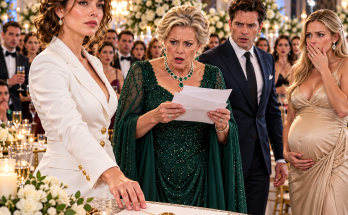
The ceremony took place in a grand hotel ballroom decorated with white roses, golden candles, and towering crystal chandeliers. Business associates, distant relatives, and wealthy acquaintances filled the room.
I wore an elegant ivory gown and a diamond necklace Richard had given me.
Standing beside him, I felt certain that my life was about to become everything I had dreamed of.
The officiant invited us to exchange our vows.
Richard spoke first.
His voice trembled slightly as he promised to cherish me, respect me, and stand beside me for whatever time remained in his life.
Then it was my turn.
I recited the words I had practiced, smiling as the guests watched.
But just as the officiant prepared to pronounce us husband and wife, Richard gently raised his hand.
“Please,” he said. “There is something I must tell everyone before this ceremony continues.”
The music stopped.
Richard took the microphone from the officiant.
“My beautiful bride believes she knows everything about me,” he began. “She knows my age, my reputation, and what the world believes I own.”
My smile stiffened.
He turned toward me.
“But there is one very important thing she still doesn’t know.”
The guests exchanged curious glances.
Richard paused long enough for the silence to become uncomfortable.
“For the past six months, I have been conducting a private experiment. I needed to understand whether the woman standing beside me wanted a husband—or simply wanted his fortune.”
My heart pounded.
A few guests looked directly at me.
Richard continued.
“Because the truth about my wealth is very different from what you have been told.”
He reached into his jacket and removed a sealed envelope.
Then he looked at me with an expression I had never seen before.
“Before we finish these vows, my dear, I want you to answer one question.”
My mouth went dry.
“What question?” I whispered.
Richard held the envelope between us.
“If I told you that you would never inherit a single dollar from me, would you still marry me today?”
Every eye in the ballroom turned toward me.
And for the first time in my life, I had no answer prepared.
PART 2 — THE SECRET INSIDE THE ENVELOPE
I could hear the guests whispering.
My father sat near the back of the ballroom, staring at me with a look that seemed to say he had warned me this would happen.
I forced a laugh.
“Richard, darling, this isn’t the time for jokes.”
“I’m not joking,” he replied.
He handed the envelope to his attorney, who had been sitting quietly in the front row.
The attorney opened it and removed several documents.
Richard turned toward the audience.
“For months, people have assumed that my wealth is sitting safely in bank accounts waiting for someone to inherit it. That assumption is incorrect.”
My hands began to shake.
He explained that most of his former business holdings had been transferred into a charitable trust several years earlier. His remaining assets were subject to obligations, and the mansion I had dreamed of owning was involved in a legal arrangement that prevented him from simply giving it away.
I stared at him.
“What are you saying?”
Richard looked at me sadly.
“I am saying that the fortune you imagined marrying is not something you can claim simply by becoming my wife.”
A wave of embarrassment swept over me.
I wanted to leave, but hundreds of people were watching.
Then his attorney placed another document on the table.
Richard explained that he had arranged a financial review of his affairs before the wedding. He had also asked his legal team to prepare a fair prenuptial agreement that would protect both of us.
Nothing in the documents required me to surrender my independence, but they made one thing unmistakable: marriage would not automatically make me the owner of his estate.
I had never read the final agreement carefully.
I had been too busy imagining the life waiting for me.
“Why didn’t you tell me this earlier?” I demanded.
“Because whenever I tried to discuss money, you told me it didn’t matter.”
His answer struck harder than I expected.
I remembered every time I had dismissed his questions, every time I had changed the subject when he spoke about love, companionship, or growing old together.
I remembered asking about his properties more often than I had asked about his health.
For a moment, I hated him for exposing me.
Then I hated myself for giving him the evidence.
But Richard was not finished.
He turned toward the guests and revealed that he had spent months quietly supporting a community program that provided housing and vocational training for young people who had aged out of foster care.
He had hoped that, if we married, I might help him expand it.
“I wanted a partner who would share my remaining years,” he said. “Someone who would understand that a person’s value cannot be measured by the size of their bank account.”
I looked at the floor.
I could have apologized. I could have admitted that I had been selfish.
Instead, fear took control of me.
“So what happens now?” I asked. “Are you canceling the wedding?”
Richard studied me.
“That depends on what you want.”
I glanced toward the ballroom doors.
Leaving would mean facing my parents, my friends, and the hundreds of guests who now suspected the truth about me.
Staying would mean accepting a marriage without the fortune I had expected.
For several seconds, I said nothing.
Then I did something that surprised everyone.
I removed the diamond ring from my finger and placed it in Richard’s hand.
“I can’t answer your question honestly while everyone is watching me,” I said. “I need time to understand why I came here.”
Richard’s expression softened.
“That is the first honest thing you have said today.”
He instructed the officiant to end the ceremony before the vows were completed.
There was no shouting. No dramatic argument. Just the quiet sound of guests rising from their seats.
I walked out of the ballroom alone.
In the hotel corridor, I found my mother waiting.
She did not say, “I told you so.”
She simply put her arms around me.
And for the first time that day, I began to cry.
But the most painful revelation was still waiting for me.
The following morning, Richard’s attorney called.
He explained that Richard had left something behind for me—not money, not jewelry, and not a promise of inheritance.
It was a letter.
And the final paragraph contained a truth that changed the way I understood the entire wedding.
PART 3 — THE LETTER THAT CHANGED EVERYTHING
I met Richard at a quiet café three days later.
He looked older than he had at the wedding. His hands trembled as he lifted his coffee cup, and for the first time, I noticed how carefully he moved.
I had spent two nights thinking about everything that had happened.
At first, I was angry. I believed he had humiliated me deliberately.
But as the hours passed, I began remembering our conversations.
He had asked me what made me happy.
I had spoken about expensive clothes.
He had asked what kind of future I wanted.
I had described a mansion.
He had asked whether I would care for someone who became ill.
I had laughed and told him we could always hire help.
I had never truly listened to him.
When Richard arrived at the café, he placed a folded letter on the table.
“I wrote this before the wedding,” he said. “I wasn’t certain I would give it to you.”
I opened it.
The letter explained that Richard had once been married to a woman named Eleanor. They had loved each other deeply, but during the final years of her life, his business had consumed nearly every waking hour.
He had provided her with beautiful homes, expensive gifts, and everything money could buy.
But when she became seriously ill, she told him that she had never needed another diamond.
She had needed him to sit beside her.
Richard had been devastated when she died.
He had spent years building businesses and giving money to worthy causes, but he had never forgotten the lesson she left him.
He wanted his final years to mean something beyond his bank balance.
The letter ended with a sentence I read three times.
I can survive losing my fortune, but I don’t want to spend the rest of my life wondering whether anyone would choose me if I had nothing left to give.
I lowered the paper.
For the first time, I understood that Richard’s secret was not simply about money.
He was frightened of being valued only for what he owned.
And I had walked into his life carrying precisely that intention.
“I don’t know how to apologize for this,” I whispered.
“You don’t need to find the perfect words,” he replied. “You need to decide what kind of person you want to become.”
I asked him whether he had ever truly intended to marry me.
He nodded.
“Yes. I cared for you. I hoped we could build something honest together. But I couldn’t ignore the questions I had about why you wanted to be with me.”
I looked at him through tears.
“Did you ever love me?”
Richard took a long breath.
“I loved the possibility of who you might become. But love cannot survive on possibility alone.”
Those words stayed with me long after we parted.
I returned the jewelry he had purchased for me and began searching for work. My first job was at a small event-planning company, where I spent long days answering calls, arranging schedules, and carrying boxes.
The salary was modest.
The work was exhausting.
But for the first time, I earned money without pretending I was destined for something greater.
Months later, I volunteered at the community program Richard had told me about. I helped organize donated clothing, prepare meals, and assist young adults who were trying to find their first jobs.
I never told anyone I had once nearly married the millionaire who funded the program.
I didn’t want admiration.
I wanted to learn how to contribute without expecting a reward.
Nearly a year after the interrupted wedding, I received a handwritten invitation from Richard.
It was for the opening of a new training center.
I attended quietly and found him standing near the entrance, greeting visitors.
When he saw me, he smiled.
“You look different,” he said.
“I feel different.”
We walked through the building together. Young people were learning practical skills, meeting potential employers, and preparing for independent lives.
Richard explained that the center had helped dozens of people find stable employment.
I told him I was proud of what he had built.
He looked at me for a long moment.
“Do you still dream about marrying a wealthy man?”
I laughed softly.
“No. I dream about becoming someone who doesn’t need to pretend.”
He smiled, and for the first time, there was no test between us.
We did not get married.
We did not suddenly fall into a perfect romance.
Instead, we became friends, and I learned that some relationships are meant to change your life rather than remain in it forever.
Richard passed away several years later, surrounded by people who cared about him.
I did not inherit his fortune.
I received something more difficult to earn: a lesson I had spent most of my twenties refusing to learn.
Money can make life comfortable, but it cannot make you worthy of love.
And the day I stood beside a seventy-eight-year-old millionaire in a ballroom, convinced I was about to secure my future, was the day I discovered how little I understood about happiness.
Sometimes, the greatest fortune is not what someone leaves you when they die. It is the person you become after they show you the truth about yourself.