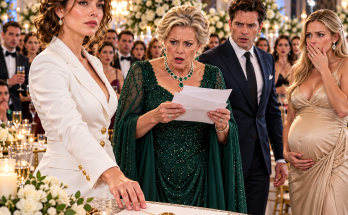
PART 1 — THE LETTER HE NEVER WANTED ANYONE TO FIND
After sixty-seven years of marriage, my husband left me nothing in his will.
Not a dollar.
Not a house.
Not even the wedding ring he had placed on my finger when we were barely old enough to understand what forever meant.
Then, after our children left the lawyer’s office, his attorney locked the door, looked directly at me, and whispered, “Margaret, your husband made me promise to tell you something only after everyone else was gone.”
He reached into his briefcase and placed a small brown envelope on the desk.
My name was written across the front.
I recognized the handwriting immediately.
It belonged to Robert, the man I had loved for sixty-seven years.
My hands began shaking before I even opened it.
The first sentence read:
“My darling Margaret, if you are reading this, then the people I feared have finally begun to believe that I died without leaving you anything.”
I stopped breathing.
What people?
And why had my husband, who had never kept secrets about money, suddenly become someone I didn’t recognize?
To understand what happened next, you need to understand the life Robert and I had built together.
We met in a little college library in 1957. I was nineteen, studying literature, and Robert was twenty-one, an engineering student who always carried more books than he could possibly read.
He accidentally knocked a stack of my books off a table.
Instead of apologizing properly, he offered to buy me a cup of coffee.
That coffee turned into dinner.
Dinner turned into a courtship.
And two years later, we married in a small church with only our closest friends and family present.
We weren’t wealthy.
Our first apartment had peeling wallpaper, a kitchen faucet that leaked every night, and a heater that stopped working whenever the temperature dropped below freezing.
But we were happy.
Robert worked long hours at an engineering firm while I took a job at a local school. We saved every penny we could, raised three wonderful children, and slowly built a comfortable life.
Over the decades, we bought a house, traveled when we could afford it, and welcomed five grandchildren.
Our life wasn’t perfect.
We argued about bills, disagreed about our children’s choices, and sometimes went to bed angry.
But every morning, Robert made my coffee before leaving for work.
Every evening, he kissed my forehead before going to sleep.
And whenever I worried about the future, he would squeeze my hand and say, “Margaret, whatever happens, we’ll face it together.”
I believed him.
Even during his final year, when his health began to decline, I never imagined he was hiding anything significant from me.
I cared for him at home as long as possible.
I helped him dress, organized his medication, and sat beside him when the nights became too difficult for him to sleep.
Sometimes he would look at me for a long time without speaking.
“What is it, Robert?” I’d ask.
He would smile sadly.
“Nothing, sweetheart. I’m just grateful you’re here.”
I thought he was reflecting on our life together.
Now, I wonder whether he was trying to tell me something he didn’t know how to say.
Three weeks after his funeral, his attorney summoned our family to read the will.
Our eldest son, Daniel, sat beside his wife.
Our daughter, Susan, kept wiping her eyes with a tissue.
Our youngest, Michael, stared at his phone until the lawyer asked him to put it away.
Robert’s younger sister, Patricia, sat at the opposite end of the table, wearing a black dress and an expression I couldn’t quite understand.
She and Robert had always been close, although their relationship had grown strangely tense during the last few months of his life.
The lawyer began reading.
Robert left money to several charities.
He divided his investments among our children.
He left his collection of antique watches to Daniel and his favorite fishing boat to Michael.
Susan received the jewelry Robert had inherited from our mother.
Then the lawyer turned to the final page.
His voice became formal.
“To my wife, Margaret, I leave no financial assets under this will.”
I stared at him.
“I’m sorry,” I whispered. “Could you read that again?”
He did.
The same words.
No financial assets.
No explanation.
Daniel looked at me with concern.
Susan covered her mouth.
Michael finally put down his phone.
Patricia, however, leaned back in her chair and released a quiet breath.
It was almost a sigh of relief.
I noticed it.
I would remember it later.
The lawyer explained that the estate would be distributed according to the document Robert had signed several months earlier.
I barely heard him.
Sixty-seven years.
I had shared every important moment of my life with that man.
I had held him through grief, celebrated his victories, and cared for him when he could barely stand.
And now, according to his final wishes, I was apparently the one person he had chosen not to provide for.
After the meeting, Patricia approached me.
“I’m sure Robert had his reasons,” she said, adjusting the strap of her handbag. “Perhaps you should simply accept his decision.”
Her words were gentle.
Her smile wasn’t.
Before I could respond, she walked away.
I remained seated until the room emptied.
Then I gathered my purse and slowly stood.
“Mrs. Hayes?”
The lawyer, Mr. Bennett, was watching me.
“Would you mind staying a few minutes?”
When the door closed behind the last person, he walked to his desk and removed the brown envelope.
“Your husband instructed me to give you this privately,” he said. “He also left specific instructions about what I should tell you afterward.”
My heart began pounding.
“Why privately?”
Mr. Bennett hesitated.
“Because he believed someone in your family might try to stop you from discovering the truth.”
I opened the envelope.
The letter began with the words I had already read.
“My darling Margaret, if you are reading this, then the people I feared have finally begun to believe that I died without leaving you anything.”
Below that, Robert had written:
“I need you to remember one thing. I never stopped protecting you, even when you believed I had turned my back on you.”
I wiped my eyes.
Then I read the next paragraph.
“There is a blue folder hidden inside the old sewing cabinet in our bedroom. Do not tell our children about it. Do not tell Patricia. And whatever you do, do not sign any document she brings you.”
I looked up at the lawyer.
“Patricia? Why would my husband’s sister bring me a document?”
Mr. Bennett folded his hands.
“Because, Margaret, your husband believed she would come to you soon after the will was read.”
My stomach tightened.
He handed me a second sheet of paper.
It contained an address, a date, and a name I had never seen before.
At the bottom, Robert had written one final sentence.
“If you want to know why I left you nothing, go to this address tomorrow morning at nine. The woman waiting there knows what happened thirty years ago.”
Thirty years ago?
I tried to remember what had happened in our lives around that time.
Our children were growing up.
Robert was working constantly.
We had recently bought our second home.
Nothing extraordinary came to mind.
But when I looked at the unfamiliar name on the paper, I felt a chill travel down my spine.
Because beneath the woman’s name, Robert had written three words.
She is our daughter.
I read the sentence again.
Then a third time.
We had three children.
Daniel.
Susan.
Michael.
There had never been another child.
At least, not one I knew about.
And suddenly, the life I thought I understood began to unravel.
PART 2 — THE WOMAN WHO KNEW MY HUSBAND’S SECRET
I barely slept that night.
Robert’s side of the bed remained untouched.
His reading glasses were still on the bedside table, and his favorite blue sweater hung over the chair near the window.
I kept looking at those familiar things, trying to reconcile them with the letter hidden inside my handbag.
She is our daughter.
How could Robert have written those words?
Had he betrayed me?
Had he fathered a child with another woman?
Or was there another explanation?
At six the next morning, I went downstairs and opened the old sewing cabinet.
Robert had bought it for me on our tenth anniversary. It was a beautiful wooden piece with small drawers and a narrow compartment beneath the sewing machine.
I had used it for decades.
I had never known there was a hidden panel behind the bottom drawer.
Inside it lay a blue folder.
My fingers trembled as I opened it.
The first document was a photograph of a young woman holding a baby.
The woman had dark hair, a delicate nose, and Robert’s unmistakable smile.
On the back of the photograph, he had written:
“Elise and Anna. October 1995.”
Beneath the photograph were hospital records, letters, and a document from a family court.
I sat down because my knees had begun to weaken.
The papers told a story I had never heard.
Thirty years earlier, Robert had discovered that his sister Patricia had been involved in a serious financial dispute with a business partner.
Patricia had been struggling with debt. She had asked Robert for money, claiming that someone was threatening to take her home.
Robert had helped her.
He paid several bills and agreed to keep the matter private.
But there was something else.
In 1995, a young woman named Elise had given birth to a little girl named Anna.
Elise had been Robert’s biological daughter from a relationship before he met me.
He had learned about Elise only after she contacted him as an adult, searching for information about her father.
Robert had kept the discovery quiet because Elise was afraid of disturbing his family.
He had begun helping her financially, not as a secret lover, but as a father trying to make up for decades he could never recover.
Then, several years later, Elise died unexpectedly.
Her daughter, Anna, was left in the care of relatives who struggled to support her.
Robert stepped in.
He arranged for Anna’s education, paid her medical expenses, and helped her build an independent life.
He had apparently never told me because he feared I would see his actions as a betrayal of our marriage.
But that wasn’t the part that frightened me most.
The folder contained copies of financial transfers.
Large ones.
For years, Robert had been moving money into a private trust.
The trust was established for Anna’s future.
And the final documents revealed something astonishing: the trust wasn’t funded with our family savings.
It had been funded by shares Robert had received decades earlier from a small engineering company he had helped build.
Those shares had grown into a substantial fortune.
I sat motionless.
Robert had never mentioned that investment.
We had always lived comfortably, but modestly. I had assumed the company shares were worth very little after he retired.
Apparently, I had been wrong.
The blue folder also contained a letter from a bank explaining that the trust was worth considerably more than the house we lived in.
But why would Robert hide it from me?
I turned to the last page.
It was a handwritten note.
“Margaret, I know you will feel hurt that I kept Elise and Anna’s story from you. I was wrong to let fear make that decision for me. But there is a reason I placed these papers where you would find them.”
The next sentence made me sit upright.
“Patricia knows about Anna. She has known for years. And she has been trying to get control of the trust.”
Suddenly, Patricia’s reaction at the lawyer’s office made sense.
But I still didn’t understand why Robert had left me nothing in his will.
I looked at the address again.
At nine o’clock, I arrived at a small office building on the other side of town.
A woman in her early thirties stood outside, holding a leather folder.
She had dark hair, warm brown eyes, and a small silver necklace around her neck.
When she saw me, she stepped forward.
“Mrs. Hayes?”
“Yes.”
“My name is Anna.”
For several seconds, neither of us spoke.
Then she said something that broke my heart.
“My grandfather talked about you all the time.”
I felt tears gathering in my eyes.
“He did?”
She nodded.
“He told me you were the kindest person he’d ever known. He said he was afraid you’d think he had betrayed you.”
I couldn’t answer.
Anna led me inside and placed several documents on the table.
“Your husband helped me finish university,” she explained. “He paid for my education and made sure I had a safe place to live. He never asked me to call him Dad, but I did anyway.”
She smiled sadly.
“I think he liked hearing it.”
I pressed my hand against my chest.
“Why didn’t he tell me?”
“Because he was afraid of losing you.”
She paused.
“But that’s not why he left you out of the will.”
My eyes lifted to hers.
“What do you mean?”
Anna opened her folder.
Inside was a copy of a legal agreement signed six months before Robert died.
It concerned a property company owned by Patricia.
Apparently, Patricia had borrowed money against several properties and used Robert’s private investment shares as collateral without his permission.
When Robert discovered what she had done, he confronted her.
She insisted it was temporary.
She promised to repay everything.
But the documents showed that she had continued making financial commitments she couldn’t afford.
Robert had become concerned that Patricia might attempt to involve our family home and personal savings in her financial troubles.
He had spent months working with Mr. Bennett to separate his investments, protect our home, and establish the trust for Anna.
The will I had heard read aloud was only one part of a much larger legal arrangement.
“Your husband didn’t want you exposed to Patricia’s debts,” Anna said. “He wanted to make sure you could keep your home, no matter what happened.”
I stared at her.
“But the will says I inherit nothing.”
“Under that will, yes. But there’s another document.”
She slid a folded paper across the table.
It was a signed agreement establishing my right to remain in our home for the rest of my life, along with access to a separate account Robert had funded before his death.
The account wasn’t mentioned in the will because it had been legally arranged outside his estate.
I began to cry.
Robert hadn’t abandoned me.
He had tried to protect me.
But there was still one unanswered question.
Why had he told me not to trust Patricia?
Anna looked toward the window.
“Because she recently found out about the trust,” she said. “And yesterday, she called me.”
My tears stopped.
“What did she want?”
Anna’s expression hardened.
“She wanted me to sign away my inheritance. She told me that if I refused, she would make sure the entire family believed I had manipulated your husband.”
I felt a cold anger rise inside me.
Patricia had sat beside me at the lawyer’s office while I struggled to understand why my husband had apparently left me nothing.
She had watched my humiliation.
And she had known there was more to the story.
I stood.
“I need to speak to her.”
Anna reached for my hand.
“Before you do, Mrs. Hayes, you should know something else.”
I turned back.
She opened the folder to reveal a final document.
It was a letter Robert had written to Patricia.
The letter was dated just two days before his final hospitalization.
At the top, he had written:
“If you attempt to take what belongs to Anna or Margaret, I will make the truth public.”
Below it was a list of financial transactions and a copy of a police report.
I felt the room begin to spin.
Robert hadn’t simply discovered that his sister was struggling financially.
He had discovered that she had used his trust to conceal something much worse.
And the final page of the report contained a name I recognized immediately.
My son, Michael.
PART 3 — THE TRUTH THAT CHANGED OUR FAMILY FOREVER
I drove home with Robert’s letter resting on the passenger seat.
For the first time since his death, I wasn’t thinking about how much I missed him.
I was thinking about how much he had carried alone.
The documents revealed that Patricia had persuaded Michael to help her transfer money between several accounts.
Michael believed he was helping his aunt manage a temporary business problem.
He had not understood that some of the transactions involved money that did not belong to her.
When Robert discovered what was happening, he confronted them both.
He ordered the transfers stopped and contacted his attorney.
Michael cooperated with the investigation and provided the records he had.
Patricia, however, refused to accept responsibility.
She insisted Robert had promised to help her indefinitely.
When he declined to give her more money, she threatened to challenge his financial arrangements after his death.
That was when Robert made his final decision.
He asked Mr. Bennett to prepare the will in a way that would prevent Patricia from identifying or reaching certain assets through the estate.
He arranged for my home and living expenses to be protected separately.
He established clear legal safeguards for Anna.
And he wrote the letter I had received.
It wasn’t a perfect plan.
It left me confused and heartbroken.
He could have trusted me with the truth.
He should have.
But now I understood why he had acted as he did.
Robert had tried to protect everyone at once, and in doing so, he had left me alone with questions I never should have had to ask.
That afternoon, I called Daniel, Susan, and Michael.
I asked them to come to the house.
Patricia arrived with Michael.
She entered the living room wearing the same composed expression she had worn at the lawyer’s office.
“Margaret,” she said, “I hope you’ve had time to accept Robert’s decision.”
I placed the blue folder on the coffee table.
Her expression changed.
Only slightly.
But I saw it.
“What’s that?” she asked.
“The truth,” I replied.
I opened the folder and showed her the financial documents.
Then I placed Robert’s letter beside them.
Patricia stared at the papers.
For a moment, she looked genuinely frightened.
“You had no right to go through his private things,” she said.
“They were left for me.”
“Robert was confused near the end. He wasn’t thinking clearly.”
“Then why did he specifically warn me about you?”
Nobody moved.
Michael looked at his aunt.
“Aunt Patricia,” he said slowly, “what exactly happened with the money?”
She turned toward him.
“Don’t you dare question me. I was trying to save the family business.”
“Your business,” Daniel corrected.
Patricia’s face reddened.
I took a deep breath.
“For sixty-seven years, I believed Robert and I shared everything important. Now I know he kept a terrible secret from me. That hurt me more than you can imagine.”
I looked directly at her.
“But I will not allow you to use his death to take advantage of the people he loved.”
She stood abruptly.
“You think you’ve uncovered some great conspiracy? Robert owed me. I was his sister.”
“He helped you,” I said. “That doesn’t mean he owed you everything he had.”
She glanced at the documents again.
Then she made a mistake.
She reached for the trust agreement.
I pulled it away.
“Don’t touch that.”
Her expression turned cold.
“You have no idea what you’re doing, Margaret. You could lose everything by interfering.”
“No,” I replied quietly. “For the first time, I understand exactly what I’m protecting.”
Mr. Bennett had already arranged a meeting with the appropriate financial authorities to review the disputed transactions. The documents would be examined, and anyone responsible would have to answer for their actions.
I wasn’t going to make accusations I couldn’t prove.
I wasn’t going to seek revenge.
I simply wanted the truth established and the legal arrangements Robert had made respected.
Patricia left without another word.
The room remained silent long after the door closed.
Then Michael began to cry.
“Mom, I’m sorry,” he whispered. “I thought I was helping her. Dad told me to stop, and I didn’t listen soon enough.”
I crossed the room and held him.
“Your father knew you made a mistake,” I said. “What matters now is that you tell the truth and make things right.”
Over the following months, the financial investigation continued.
Some of Patricia’s claims were challenged, and the disputed transactions were reviewed through the proper legal process. She eventually agreed to cooperate with the investigation and stopped trying to claim the assets Robert had placed beyond her reach.
Michael provided the remaining records he had.
Our family began to heal, slowly and imperfectly.
And Anna became part of our lives.
The first time she came to dinner, she stood nervously at the doorway, holding a small box.
“I thought you might like this,” she said.
Inside was a silver picture frame containing a photograph of Robert sitting on a park bench beside a little girl.
Anna was perhaps six years old.
Robert had his arm around her shoulders, and both of them were laughing.
I had never seen the photograph before.
On the back, in his familiar handwriting, were the words:
“Family is not measured by the years we have together, but by the love we choose to give.”
I held the photograph against my chest.
For a moment, I could almost hear his voice.
Anna sat beside me.
“He always said you were the heart of his family,” she whispered. “He wanted me to know you, but he didn’t know how to explain everything.”
I looked at her.
“You don’t have to apologize for existing, sweetheart.”
Her eyes filled with tears.
Then I took her hand.
“You were his granddaughter. That makes you part of our family.”
That evening, we ate together around the same dining table where Robert and I had celebrated birthdays, holidays, and countless ordinary meals.
There was an empty chair at the head of the table.
I looked at it several times.
I wished Robert were there.
I wished he could see that the secret he had carried for so long had finally brought us together instead of tearing us apart.
Months later, Mr. Bennett delivered one final envelope.
This one had been scheduled to reach me after the financial review was complete.
I opened it alone in the garden.
Robert’s handwriting covered three pages.
The letter began:
“My darling Margaret, I am sorry that my choices caused you pain. You deserved the truth from me long before I became too frightened to speak it.”
I paused, wiping my eyes.
He explained that he had spent years trying to find the right moment to tell me about Elise and Anna.
Each time, he worried that the revelation would hurt me.
Each time, he promised himself he would tell me later.
Eventually, later became something he could no longer guarantee.
He wrote that he had made mistakes, that fear had guided too many of his decisions, and that he wished he had trusted me enough to face the truth together.
Then came the final paragraph.
“You may have believed that I left you nothing, Margaret. But I hope you now understand that the most important things I left you were not written in a will. I left you a home filled with memories, children who can learn from our mistakes, and one more person who will love you because you loved me. I am sorry I waited so long to tell you. If I could have one more day, I would spend it sitting beside you, drinking your coffee, and telling you everything.”
I folded the letter carefully.
For a long time, I sat beneath the old apple tree where Robert and I had taken family photographs for decades.
I had spent weeks believing that sixty-seven years of love had ended with a sentence in a lawyer’s office.
I was wrong.
Our marriage had not been perfect.
Robert had hidden things from me.
He had made decisions without my knowledge.
And I would never have the chance to ask him all the questions I still carried.
But I finally understood that his final act had not been about leaving me with nothing.
It had been an imperfect attempt to protect the people he loved while making peace with the truth he had hidden.
I still missed him every morning.
I still reached for his hand sometimes before remembering that he was gone.
But I no longer looked at his empty chair and wondered whether our life together had meant less to him than it had to me.
Because the truth was more complicated than that.
And sometimes, love does not mean that someone never makes mistakes.
Sometimes, it means learning the truth, facing the hurt, and deciding what to do with the years that remain.
I placed Robert’s letter inside the silver frame beside Anna’s photograph.
Then I whispered the words I wished I had said to him while he was still alive.
“I forgive you, Robert. But I wish you had trusted me enough to tell me.”
The wind moved gently through the apple tree.
For the first time in weeks, I smiled through my tears.
I had lost my husband.
But I had not lost the life we built.
And I had not been left with nothing.
THE END.