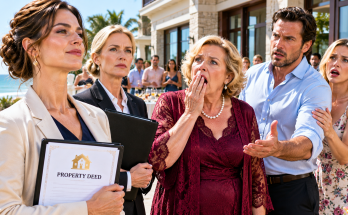
Three Weeks After My Husband Died, My Son-in-Law Changed the Locks on My House—Then My Granddaughter Handed Me a Key and Whispered, “Grandpa Told Me What He Hid Before He Died”
Part 1: The Day My Own Family Locked Me Out
Three weeks after my husband died, I returned home from the cemetery and discovered that my front-door key no longer worked.
I tried it once.
Then twice.
On the third attempt, I noticed a new brass lock shining beneath the porch light.
Before I could knock, my son-in-law, Brandon, opened the door.
He stood there wearing my husband’s favorite cashmere sweater, holding a cup of coffee as though he owned the place.
“Eleanor,” he said coldly, “you need to stop coming here.”
I stared at him.
“Coming where? This is my house.”
He smiled without warmth.
“Not anymore.”
My name is Eleanor Hayes. I was sixty-six years old, and I had spent forty years building a life with my husband, Robert.
We had raised two children, paid off our mortgage, and saved carefully for retirement. Our home was modest, but every corner held a memory: the height marks on the kitchen doorway, the rose bushes Robert planted for our anniversary, and the old wooden bench where we sat every Sunday morning.
Robert had been gone for twenty-one days.
Now Brandon was telling me I had no right to enter my own home.
“Where is my daughter?” I demanded.
“Victoria is busy.”
“Then tell her to come outside.”
He took a sip of coffee.
“Victoria agrees with me. You need somewhere smaller to live. We think it’s time you stopped making decisions for everyone.”
I couldn’t believe what I was hearing.
My daughter had always been close to me. Or at least, I thought she had.
After Robert’s funeral, Victoria began visiting more frequently. She offered to help with paperwork and bills, saying she wanted to make sure I wasn’t overwhelmed by grief.
Brandon came with her, carrying folders and asking questions about the house.
I had trusted them.
Now I wondered whether they had been waiting for Robert to die before showing me who they really were.
“I want my belongings,” I said.
“Your belongings are being packed.”
He began closing the door.
I put my hand against it.
“Brandon, you cannot throw me out of my own home.”
His expression hardened.
“Take it up with a lawyer.”
Then he shut the door.
I stood on the porch, staring at the brass lock.
The house behind it had been my entire adult life.
I had nowhere to go that night except my sister’s small apartment across town.
I sat at her kitchen table until dawn, trying to understand how a family could turn against someone so quickly.
At 8:15 the next morning, I received a message from Victoria.
Mom, please don’t make this difficult. Brandon is handling everything. You should accept that things have changed.
I called her immediately.
She didn’t answer.
I sent another message.
Your father would never have allowed this.
This time, she replied.
Dad isn’t here anymore.
I put the phone down.
Those five words hurt more than Brandon’s threats.
Robert had always been careful with our affairs. He kept important documents in a small locked cabinet in his study and insisted that every major decision be written down.
He had once told me, “Eleanor, if anything ever happens to me, don’t sign anything you haven’t read.”
At the time, I thought he was simply being cautious.
Now I wished I had asked more questions.
That afternoon, while I was sitting in my sister’s living room, someone knocked on the door.
It was my eleven-year-old granddaughter, Lily.
She was standing alone on the doorstep, clutching a small brass key.
“Grandma,” she whispered, “I need to tell you something.”
I pulled her inside and checked the hallway.
“Where is your mother?”
“She thinks I’m at a friend’s house.”
My stomach tightened.
“Lily, you shouldn’t be walking around alone. What’s happening?”
She placed the key in my palm.
“Grandpa gave me this before he died.”
I stared at it.
“What does it open?”
Lily’s eyes filled with tears.
“He told me that if anyone tried to make you leave your house, I should find you and give you this.”
My hands began to shake.
“Why would Grandpa say that?”
She looked down.
“Because he knew Uncle Brandon was planning something.”
I sat beside her.
“Sweetheart, tell me exactly what your grandfather said.”
Lily took a trembling breath.
“He said there was a secret in his study. He said the truth was hidden where Brandon would never think to look.”
I looked at the brass key.
Robert had spent his final months growing weaker, but his mind had remained sharp. He had known something was wrong.
Perhaps he had even known who was responsible.
“Did Grandpa tell you anything else?”
Lily nodded.
“He said you must never let Mom sign the blue papers.”
I felt a chill travel down my spine.
“What blue papers?”
“I don’t know. But the night before Grandpa died, I heard Mom and Brandon arguing with him. Brandon said they needed his signature before the lawyer came.”
I closed my eyes.
Robert had died unexpectedly after a short illness. The family had told me he was too weak to discuss his affairs, and I had accepted their explanation.
Now, for the first time, I wondered whether I had been kept away from something important.
Lily squeezed my hand.
“Grandma, Grandpa said you would understand when you found the letter.”
I looked at the key again.
Then I made a decision.
I would not confront Brandon. I would not beg Victoria to believe me.
I would find the truth.
And if Robert had left something behind to protect me, I would discover exactly what it was.
Part 2: The Letter Behind the Locked Cabinet
The next morning, I contacted my husband’s longtime attorney, Samuel Brooks.
Samuel had handled our wills, property documents, and retirement planning for more than twenty years. When I told him Brandon had changed the locks on my house, he became very quiet.
“Eleanor,” he said, “did you sign any documents after Robert’s death?”
“No. Victoria brought some papers, but I refused to sign them without reading everything.”
“Good. Don’t sign anything until we meet.”
I told him about the brass key and Lily’s warning.
He asked me to bring the key to his office.
When I arrived, he examined it carefully.
“I recognize this design,” he said. “Robert used an old cabinet in his study to store original documents.”
“Can we open it?”
“We can, provided we have lawful access to the property. I’ll contact the appropriate parties and arrange an inventory with your authorization.”
Samuel then explained something I had not known.
Robert had recently updated his estate plan. The changes had been properly documented, but he had asked Samuel to keep certain records separate because he was concerned about a dispute involving our house.
“What kind of dispute?” I asked.
Samuel opened a folder.
“Several months ago, Robert discovered that someone had been trying to use a copy of an old property document to claim an interest in your home.”
My heart began pounding.
“Who?”
“We don’t know yet. Robert asked me to investigate, but he became ill before we finished.”
I thought about Brandon’s sudden confidence and Victoria’s strange messages.
“Do you think they were involved?”
“I won’t accuse anyone without evidence,” Samuel replied. “But we need to determine what happened.”
He arranged for a formal review of the property’s title and the documents connected to Robert’s estate.
The initial records showed that the house had been purchased jointly by Robert and me decades earlier. Nothing in the public record suggested that Brandon had any ownership interest.
Yet someone had recently submitted paperwork claiming that Robert had transferred his share to a company connected to Brandon.
The filing was under review because several details appeared inconsistent.
Samuel looked at me.
“If the document was unauthorized or fraudulent, it could explain why Brandon is acting as though he controls the property.”
I felt sick.
Had my son-in-law been trying to take our house while Robert was still alive?
Later that afternoon, Samuel arranged a supervised visit to the property so I could collect essential belongings and identify the cabinet Robert had mentioned.
Brandon was furious when we arrived.
“You can’t just walk in here,” he said.
Samuel calmly showed him the relevant documents and explained the purpose of the visit.
Brandon stepped aside, but his eyes followed us through the hallway.
Robert’s study was exactly as I remembered it.
His reading glasses still lay beside the lamp. A framed photograph of our wedding sat on the bookshelf. His favorite fountain pen rested in a drawer.
I felt tears gathering in my eyes.
Then I remembered why we had come.
The cabinet stood behind a row of old books.
The brass key fit.
Inside were property records, bank statements, a sealed envelope, and a small notebook in Robert’s handwriting.
Samuel photographed and catalogued the contents before we removed anything.
The envelope was addressed to me.
I opened it with trembling hands.
My dearest Eleanor,
If you are reading this, something may have happened that prevents me from explaining matters myself. I want you to know that I have taken steps to protect our home and the future we planned together.
I discovered that someone was attempting to use a document bearing my name to transfer an interest in our property. I did not authorize that transfer.
Samuel has copies of the original records. Please trust him to help you establish the truth.
There is one more thing you must know. I believe Victoria is being pressured, and I fear she may have signed documents without understanding their consequences.
Do not assume that everyone who has hurt you fully understands what they are doing. But do not let anyone use your love for our family to take away what is rightfully yours.
I love you always.
Robert.
I pressed the letter against my chest.
Robert had known that something was wrong.
But he had also believed our daughter might be caught in the middle.
Samuel examined the notebook.
It contained dates, notes about conversations, and references to meetings with a company Brandon had established shortly before Robert’s death.
There were also several entries mentioning a blue folder.
The same blue papers Lily had warned me about.
Samuel copied the relevant pages and arranged for the originals to be preserved.
Then we discovered a second document: a signed declaration confirming that Robert had never authorized the disputed transfer.
It did not, by itself, prove who had submitted the questionable paperwork, but it gave the investigators a clear starting point.
As we left the house, Brandon followed us to the porch.
“You’re making a terrible mistake, Eleanor.”
I turned toward him.
“No, Brandon. I think I finally stopped making one.”
His face darkened.
“You’ll regret this.”
Samuel stepped between us.
“Any further communication should go through legal counsel.”
We drove away.
For the first time since Robert died, I felt as though I had a chance to fight back.
But that evening, Victoria called.
Her voice was shaking.
“Mom, I need to see you. I think Brandon has done something terrible.”
“Where are you?”
“At home. But I can’t stay here much longer.”
I asked her to meet me at Samuel’s office the following morning.
Before ending the call, she whispered one sentence.
“Mom, the blue papers weren’t just about the house. Brandon wanted Dad’s entire estate.”
Part 3: The Truth My Husband Left Behind
Victoria arrived at Samuel’s office the next morning carrying a folder.
She looked exhausted and frightened.
“I didn’t know what he was doing,” she said before sitting down. “At least, not at first.”
I wanted to believe her, but I needed to hear the truth.
“Tell us everything.”
Victoria explained that Brandon had convinced her our family finances were in danger. He claimed Robert had made several bad investments and that creditors might seize the house.
He told her that if she signed certain documents, she could protect the family.
She had signed some papers without seeking independent legal advice.
Later, she discovered that the documents authorized Brandon’s company to act in ways she had never intended.
When she questioned him, he told her it was too late to change anything.
“Why didn’t you come to me?” I asked.
Victoria began crying.
“Because I was ashamed. I thought you would hate me. And Brandon told me that if I admitted what I’d signed, I could lose custody of Lily.”
I stared at my daughter.
“You let him lock me out of my own home.”
“I know.”
“You ignored my calls.”
“I know, Mom.”
She covered her face.
“I thought I could fix everything before you found out. Then Brandon changed the locks and told me the house was already his.”
Samuel listened carefully.
He explained that the legal effect of the documents would need to be examined and that Victoria’s account alone could not settle the matter. But her willingness to provide the papers and cooperate with the review was important.
We handed the folder to him.
Inside were copies of the disputed transfer document, correspondence from Brandon’s company, and a draft agreement requiring me to leave the house permanently.
One page included a signature that appeared to be Robert’s.
But the date was troubling.
The document was dated after Robert had become too ill to manage his affairs independently.
Samuel immediately arranged for the signature and the document’s origin to be examined.
The investigators also requested financial records from Brandon’s company.
Within days, the review uncovered a series of transactions involving money from Robert’s estate. Some transfers appeared to have been made without the necessary authorization, and the company had recorded the house as an asset despite the unresolved ownership dispute.
Brandon claimed everything had been done legally.
But the documents did not support all of his explanations.
The authorities began examining whether the paperwork had been altered and whether estate funds had been misused.
Then Lily provided one more important detail.
She remembered seeing Brandon take a folder from Robert’s study shortly before Robert died. She also remembered hearing him tell Victoria that the house would soon belong to them.
Lily’s account was documented carefully, and investigators considered it alongside the other evidence.
No one pressured her to confront Brandon or repeat anything she was uncomfortable discussing.
Her safety came first.
As the investigation progressed, Samuel filed the necessary legal requests to protect the house and prevent further transfers while the ownership dispute was resolved.
The court reviewed the evidence and issued temporary restrictions on transactions involving the property.
Brandon could no longer act as though the house was his to sell.
His business partners began asking questions. The company that had been listed on the disputed paperwork paused its plans, and financial institutions requested clarification of the estate’s records.
For the first time, Brandon faced consequences he could not dismiss with a threat.
But I was still worried about Victoria.
She had made serious mistakes, and she needed to take responsibility for them. Yet she was also beginning to understand how thoroughly Brandon had manipulated her fears.
We started meeting with a family counselor.
I told her that forgiveness would not mean pretending nothing had happened.
“You hurt me,” I said. “You let him shut me out of my own home. I can’t simply forget that.”
Victoria nodded through her tears.
“I understand.”
“But if you are willing to be honest and do the work to repair our relationship, I am willing to try.”
She reached across the table and took my hand.
For the first time in months, I saw my daughter rather than the frightened person Brandon had turned her into.
The legal proceedings continued.
The examination confirmed serious problems with the disputed transfer documents, and the authorities pursued the evidence concerning the questionable filings and estate transactions. Brandon’s explanations were tested against the records, and the case moved through the proper legal process.
Eventually, the court confirmed that the attempted transfer had not established ownership of my home. The house remained mine under the original property records, and the disputed estate transactions were addressed through the legal proceedings.
Brandon was held accountable for the misconduct established by the evidence.
I did not celebrate his humiliation.
I celebrated being able to turn my key in my front door again.
Several months later, Victoria and Lily came to visit.
I had changed the locks, repaired the garden gate, and planted new roses beside the porch.
Lily ran into my arms.
“Grandma, is this your house again?”
I smiled.
“It always was, sweetheart.”
She handed me a small drawing. It showed a house with three people standing in front of it, holding hands.
Above them, she had written:
Home is where people tell the truth.
I hung the drawing beside Robert’s photograph.
That evening, Victoria and I sat at the kitchen table, drinking tea as Lily played in the garden.
“I wish Dad were here,” Victoria said quietly.
“So do I.”
“He tried to protect us.”
I looked toward the study, where Robert’s letter was safely stored.
“Yes,” I replied. “But he also trusted us to finish what he started.”
Before they left, Victoria hugged me.
“I know I can’t undo what happened. But I want to be a better daughter.”
I held her for a long moment.
“Then start with the truth. Every day.”
After they left, I walked into Robert’s study and sat in his old chair.
For months, I had believed that losing him meant losing the security of the life we had built together.
But he had left behind more than documents and legal instructions.
He had left me a reminder that love should never require blindness, and loyalty should never mean surrendering your judgment.
Brandon had believed he could use grief, family pressure, and complicated paperwork to take a home that was never his.
He had underestimated a quiet woman who finally decided to ask questions.
And he had forgotten that the smallest voice in a family can sometimes reveal the biggest truth.
My granddaughter had carried a key because her grandfather trusted her to protect a secret.
But the real key was courage.
Courage to speak.
Courage to admit mistakes.
And courage to rebuild a family without pretending the past never happened.
Because a home is more than a building, and an inheritance is more than money. The greatest thing we can leave our children is the strength to recognize the truth—and the wisdom never to trade their conscience for someone else’s approval.