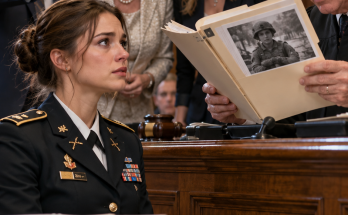
PART 1: THE MAN WHO RETURNED AFTER 52 YEARS
When I was 18, I married the boy who promised he would love me until his final breath. Three weeks later, he left for the war, carrying a photograph of me inside his uniform.
I waited for him for four years.
Then a military officer arrived at my parents’ house and told me my husband was dead.
I cried until I could barely breathe. My father buried the only photograph I had of us, my mother begged me to move on, and my older sister told me I was destroying my life by remaining faithful to a ghost.
But I never remarried.
Fifty-two years later, on a rainy Thursday evening, someone knocked on my front door.
When I opened it, I nearly collapsed.
Standing on my porch was a thin, gray-haired man leaning on a wooden cane. His face was older, his shoulders were bent, and deep wrinkles surrounded his eyes.
But I recognized those eyes immediately.
“Margaret,” he whispered.
The teacup slipped from my hand and shattered on the floor.
“Daniel?”
He nodded, tears rolling down his cheeks.
For several seconds, neither of us moved. I wanted to run into his arms, but I was terrified that if I touched him, he would disappear like every dream I had experienced over the past five decades.
Finally, he reached into his coat pocket and pulled out something small.
Two inexpensive silver-colored rings lay in his palm.
I covered my mouth.
Those rings.
We had bought them from a little machine outside a grocery store because neither of us had enough money for proper wedding bands. We exchanged them beneath an old oak tree behind the church where my grandmother used to pray.
Daniel had promised that even if the world separated us, those rings would always belong to us.
I had buried mine with my wedding photograph.
He still had his.
“I thought you were dead,” I whispered.
“I know.”
“Where have you been?”
His expression changed.
The sadness in his eyes became something darker.
“Before I tell you, Margaret, I need you to promise me something.”
“What?”
“Don’t call your sister. Don’t tell her I’m here. And whatever she says tomorrow, don’t believe her.”
My heart began to pound.
My older sister, Helen, was the only family I had left. She had comforted me after Daniel’s supposed death. She had held my hand at his memorial service. She had even helped me pack away his belongings when I could no longer bear looking at them.
“Why would you say something like that?” I asked.
Daniel lowered himself into the chair beside the fireplace.
“Because Helen is the reason I never came home.”
I stared at him.
“That’s impossible. Helen cried when we received the telegram.”
“She knew I was alive.”
The room seemed to tilt around me.
Daniel told me that his unit had been attacked overseas. He had been seriously wounded and taken to a military hospital. For months, he could barely speak or recognize the people around him.
Eventually, he recovered enough to write letters.
He wrote to me every week.
He told me he was alive. He told me he was coming home. He told me he dreamed about our little house, our future children, and the life we had promised each other.
But none of those letters ever reached me.
“How do you know?” I asked.
“Because I kept copies. And because, three years ago, I found the letters you supposedly sent me.”
My breath caught.
“What letters?”
He reached into an old leather bag and placed a thick bundle of envelopes on the table.
Every envelope bore my name.
Every one contained handwriting that looked exactly like mine.
And every letter told Daniel the same heartbreaking story: I had fallen in love with another man, married someone else, and begged him never to return.
“I never wrote these,” I whispered.
“I know that now.”
He opened one envelope and showed me the signature.
My name was written at the bottom.
But the final sentence made my blood run cold.
Please forget me, Daniel. I never loved you enough to wait.
I shook my head.
“That isn’t my handwriting.”
Daniel looked at me.
“Your sister copied it from your school notebooks.”
I felt sick.
Helen had always been jealous of the attention Daniel gave me. When we were teenagers, she used to joke that I had stolen the only decent boy in town.
But jealousy was one thing.
Destroying two lives was another.
“Why didn’t you come looking for me sooner?” I demanded, my voice breaking.
“I tried.”
He explained that after recovering, he had been transferred between military facilities and later hospitalized for years. When he finally returned to the United States, he went straight to my parents’ address.
The house had been sold.
My parents were gone.
And a letter awaited him at the post office, supposedly written by me, telling him I had moved away and wanted nothing more to do with him.
He had searched for me for years, but my surname had changed in several records, and he had been given false information about where I lived.
Then, three years ago, he discovered an old photograph of me in a local newspaper.
That was when his search began again.
“Why did you wait until now to come?” I asked.
Daniel looked down at his cane.
“Because I had surgery last year. The doctors told me I might not have much time left. I couldn’t die without knowing whether you had truly forgotten me.”
Tears streamed down my face.
I reached for his hand.
For the first time in fifty-two years, I was holding the hand of the man I had never stopped loving.
Then he said something that made me pull away.
“Margaret, there’s something else. Your sister didn’t do this alone.”
I stared at him.
“What do you mean?”
He took a deep breath.
“Your father helped her.”
I felt the blood drain from my face.
“My father?”
Daniel nodded.
“He was the one who arranged for the officer to tell your family I had died. And he was the one who paid someone to make sure my letters never reached you.”
I could barely speak.
“Why would my father do that?”
Daniel looked directly into my eyes.
“Because your father knew something about my family. Something he was willing to destroy our entire future to keep hidden.”
Before I could ask another question, a car pulled into my driveway.
Headlights swept across the living room.
Daniel stood abruptly, gripping his cane.
“No,” he whispered. “It can’t be.”
A moment later, someone knocked on the door.
I opened it.
Helen stood outside, holding a bouquet of white roses.
She smiled when she saw me.
Then she looked past my shoulder and saw Daniel.
The flowers fell from her hands.
Her face turned completely white.
“Daniel,” she whispered.
He stared at her.
“Hello, Helen. I see you still remember me.”
My sister took one trembling step backward.
Then she looked at me and said six words I will never forget.
“Margaret, you must not marry him.”
I had been married to Daniel for fifty-two years already.
And suddenly, I understood that my sister was about to reveal a secret far more terrible than stolen letters.
PART 2: THE SECRET MY FAMILY BURIED
Helen stood in my doorway, staring at Daniel as if she had seen a dead man rise from his grave.
In a way, she had.
I had never seen my sister look frightened before. She was the kind of woman who could silence an entire room with a single glance. Even in her seventies, she carried herself with the confidence of someone who had spent a lifetime believing she was always right.
But now her hands were shaking.
“Margaret,” she said, forcing a smile, “please ask him to leave. You don’t understand what he’s trying to do.”
Daniel laughed bitterly.
“After fifty-two years, that’s still your favorite sentence.”
I stepped between them.
“Both of you sit down. Nobody is leaving until I know the truth.”
Helen refused at first. She claimed Daniel was confused, that his injuries had damaged his memory, and that I was allowing an old man to manipulate me.
Then Daniel opened his leather bag again.
He pulled out a photograph.
It showed my father standing outside a military hospital beside a younger man wearing a uniform. On the back, someone had written a date and a short message.
The problem has been handled. She will never know.
I recognized my father’s handwriting.
Helen sank into a chair.
For a long time, she said nothing.
Finally, I asked the question that had haunted me since Daniel returned.
“Why?”
My sister began to cry.
She told me that our father had never approved of Daniel. His family was poor, and Daniel had no wealthy relatives, no important connections, and no promising career waiting for him.
My father had arranged for me to marry the son of a prosperous local businessman.
I had refused.
When Daniel was drafted, my father saw an opportunity to separate us permanently.
He intercepted our letters, convinced Helen to imitate my handwriting, and arranged for the false death report to reach our family.
Helen had helped him because she wanted Daniel for herself.
I stared at her in disbelief.
“You loved him?”
She shook her head quickly.
“Not the way you think. I wanted what you had. Everyone loved you, Margaret. Mother praised you. Father protected you. Daniel looked at you as if you were the only woman in the world.”
Her voice cracked.
“I wanted you to lose something for once.”
I felt as though I had been punched.
“You let me mourn my husband for fifty-two years because you were jealous?”
Helen covered her face.
“I thought you’d eventually marry someone else. I thought you’d forget him.”
“But I didn’t!”
“I know!”
Her cry echoed through the room.
For the first time in my life, I saw the truth about my sister. She had spent decades pretending to be my protector while secretly knowing that she had helped destroy the happiest part of my life.
But Daniel wasn’t finished.
He placed another document on the table.
“This is why your father went to such lengths,” he said quietly.
The document was a copy of a legal agreement signed shortly before Daniel left for the war.
My father had promised Daniel’s father that if Daniel survived, he would receive a share of a property inheritance belonging to his family.
The inheritance wasn’t enormous, but it included a valuable piece of land that had been in Daniel’s family for generations.
My father had wanted that land for a business venture.
Daniel’s father had refused to sell it.
After Daniel disappeared, my father convinced the family that the young soldier had died and used forged documents to claim that Daniel had abandoned his inheritance.
Years later, the land was sold.
My father received the money.
Helen had known about the arrangement and had helped hide the paperwork.
I looked at my sister.
“Did you know he was alive?”
She nodded, tears running down her face.
“Not at first. Father told me several years later. By then, he said it was too late to undo everything.”
“And you said nothing?”
“I was afraid.”
“You were afraid?” I repeated. “What about me? What about the life I lost?”
Helen lowered her head.
I wanted to scream. I wanted to throw her out of my house and never see her again.
Instead, I asked Daniel the question that mattered most.
“Can any of this be proved?”
He nodded.
“Three years ago, I hired a lawyer. We found military hospital records, copies of the original letters, and documents connected to the land sale. Your father’s signature appears on several of them.”
He paused.
“There’s enough evidence to show what happened. But there’s something else I haven’t told you.”
He removed a final envelope from his bag.
It was old, yellowed, and sealed with brittle glue.
The handwriting on the front belonged to my mother.
My hands began to tremble.
I had never seen the envelope before.
Daniel explained that he had received it only two months earlier. It had been discovered among the belongings of a retired attorney who had represented my father.
Inside was a letter from my mother, written shortly before she died.
I opened it carefully.
My darling Margaret,
If you are reading this, then perhaps the truth has finally found its way home.
I knew your father had interfered with your marriage. I discovered the letters he had hidden in his study, and I confronted him. He told me he had done it for your own good.
I was a coward. I was afraid of losing my home, my family, and everything I depended on. I convinced myself that silence would prevent further suffering.
But there is one thing I must tell you.
Daniel did not disappear by accident.
Your father knew the date Daniel would be transferred to a different unit. He used his connections to ensure Daniel was sent into a dangerous operation, hoping the boy would never return.
I stopped reading.
Daniel’s eyes filled with tears.
My mother had suspected the truth, but she had never managed to gather enough evidence to prove the details.
The letter continued.
Helen helped your father because she believed that if Daniel disappeared, you would finally accept the marriage he had arranged for you.
I cannot undo what I allowed to happen. I can only beg you to forgive me for being too frightened to protect you.
There is one more thing.
Your father did not keep all the money from the sale of Daniel’s family land. Some of it was placed in an account under Helen’s name.
I looked up.
Helen had stopped crying.
Her expression had changed completely.
“That letter is a lie,” she said.
Daniel shook his head.
“The account records are included in the evidence.”
Helen rose from the chair.
“You have no right to destroy my life!”
I stared at her.
“You destroyed mine first.”
She looked at me with an expression I had never seen before: pure hatred.
Then she turned toward Daniel.
“If you expose everything, you’ll lose Margaret all over again.”
Daniel stepped closer to me.
“No. I lost her once because I trusted your family. I won’t lose her again because you threaten me.”
Helen grabbed her handbag and rushed out of the house.
I watched her car disappear into the rain.
For the first time in fifty-two years, I understood why I had never been able to forget Daniel.
Somewhere inside me, I had always known that our story had never truly ended.
That night, Daniel stayed in my guest room.
We talked until sunrise. He told me about the hospitals, the years of searching, the loneliness, and the small moments of hope that had kept him alive.
I told him about the birthdays I spent alone, the holidays when I imagined him sitting beside me, and the little ring I had kept in a wooden box.
He took my hand.
“We can’t get those years back,” he whispered.
“No,” I said. “But we can stop them from stealing the rest of our lives.”
The following morning, we contacted his lawyer.
We planned to release the evidence, correct the false records, and demand an accounting of the money taken from his family.
But before the lawyer could begin, an unfamiliar number appeared on my phone.
I answered.
A man’s voice spoke quietly.
“Mrs. Margaret, my name is Robert Ellis. I worked for your father many years ago. I’ve been trying to find you.”
My heart began to race.
“What do you want?”
“I have the original documents proving what your father did. But you need to know something before you confront your sister.”
“What?”
He hesitated.
“Your sister wasn’t the only person who benefited from Daniel’s disappearance.”
Then he gave me a name.
The name of the man I had nearly married after Daniel was declared dead.
The man who had become one of the wealthiest businessmen in our town.
And the man who, according to Robert, had been paying Helen to keep the entire secret buried.
PART 3: THE FINAL LETTER AND THE PRICE OF BETRAYAL
I spent the next hour sitting at my kitchen table, staring at the telephone.
The name Robert Ellis had given me belonged to Richard Whitmore.
Richard had been my father’s preferred son-in-law. When Daniel was declared missing, Richard began visiting our home regularly. He brought flowers for my mother, gifts for my father, and expensive jewelry for me.
I had refused his proposal twice.
The third time, I had told him that I would never marry a man while my heart belonged to someone else.
He stopped visiting soon afterward.
Within ten years, Richard had become a prominent property developer. His company acquired land throughout the region, including the land that had once belonged to Daniel’s family.
I had always assumed it was a coincidence.
Now I wondered how many parts of my life had been arranged without my knowledge.
Daniel listened as I explained the phone call.
Then he closed his eyes.
“I remember that name,” he said. “Your father mentioned him in one of the letters I received overseas.”
“What did he say?”
“That Richard wanted to marry you. Your father believed I was standing in the way of a business arrangement.”
I felt a chill run through me.
“So Richard knew?”
“We need to find out.”
That afternoon, Daniel’s lawyer arranged a meeting with Robert Ellis.
He was an elderly man with a stooped back and a nervous habit of twisting his wedding ring. He had worked as an accountant for my father’s business decades earlier.
He brought a folder containing copies of financial records, correspondence, and a handwritten statement.
The records showed that money from the sale of Daniel’s family’s land had been transferred through several accounts. Some went to my father. Some went to a company controlled by Richard Whitmore.
And a portion had been deposited into an account belonging to Helen.
The evidence also suggested that Richard had paid Helen for years to prevent her from revealing what she knew.
I looked at Robert.
“Why are you telling us now?”
He lowered his eyes.
“Because I helped move the money. I told myself I was only following instructions. But after your father died, I realized that the people who suffered were the only ones who had done nothing wrong.”
He slid another document across the table.
It was a letter from Richard to my father.
The letter was dated shortly before Daniel’s supposed death was announced.
Once the boy is out of the picture, Margaret will have no reason to refuse me. We can settle the land question afterward.
My hands shook as I read the words.
Richard had not simply hoped to marry me.
He had seen Daniel as an obstacle to be removed.
Daniel placed a hand over mine.
“Margaret, we don’t have to do this if it’s too much for you.”
I looked at him.
For fifty-two years, I had believed I was powerless. I had accepted a terrible loss because people I trusted had told me there was nothing else I could do.
But the truth had finally arrived.
And I refused to bury it again.
“We’re going to finish this,” I said.
Over the following weeks, the lawyer gathered the surviving records and contacted the relevant authorities. He also sent formal requests for financial documentation relating to the disputed property.
Richard Whitmore was still alive, though he was now in his eighties and living in a large estate outside town.
When he received notice that the old transactions were being investigated, he requested a private meeting.
I agreed to meet him.
Daniel came with me.
Richard greeted us in a grand sitting room filled with expensive furniture and family photographs.
He looked frail, but his eyes were sharp.
“Margaret,” he said, “you have no idea how much I regret what happened.”
I remained standing.
“Then explain it.”
He glanced at Daniel.
“I never intended for things to go this far.”
Daniel’s voice was cold.
“You knew I was alive.”
Richard said nothing.
“You knew she was waiting for me,” Daniel continued. “You knew the letters were fake. You knew her father was lying.”
Richard finally lowered his head.
“Yes.”
The single word seemed to drain all the air from the room.
He admitted that he had known about the forged letters and the false reports. He had helped conceal the financial arrangements because he wanted access to the property and believed Margaret would eventually marry him.
But when I continued refusing him, he stopped pursuing me.
He told himself that what had happened was no longer his responsibility.
I listened in silence.
Then I asked him the question that had followed me for more than half a century.
“Did you ever think about what you did to me?”
Richard looked at me.
“I did.”
“And?”
He struggled to answer.
“I convinced myself that you would be happier eventually.”
I laughed, but there was no humor in it.
“You stole fifty-two years of my life and called it happiness?”
His eyes filled with tears.
“I was young. I was ambitious. I wanted money and influence, and I was willing to look away when other people suffered.”
Daniel leaned forward.
“Did you know my father was threatened into signing the final property agreement?”
Richard nodded.
“Your father-in-law made it clear that the family would lose everything if they challenged him.”
Daniel’s face hardened.
“My father died believing I had abandoned him.”
Richard began to cry.
“I know.”
“No,” Daniel said. “You know the words. You don’t know what it feels like to spend your entire life believing the people you love have forgotten you.”
For a moment, I thought Daniel might strike him.
Instead, he stood and walked toward the window.
When he turned around, his eyes were wet.
“We’re not here to beg you for an apology,” he said. “We’re here to make sure the truth is recorded.”
Richard signed a statement acknowledging his role in the scheme. His lawyers later cooperated with the investigation, and the financial records became part of the official proceedings.
The process was slow. Some claims were complicated by the passage of time, and not every loss could be recovered. But the evidence was preserved, the false story about Daniel’s death was corrected, and the surviving family members learned what had really happened.
Helen eventually contacted me.
She came to my house alone.
For a long time, we sat across from each other without speaking.
Finally, she said, “I know you may never forgive me.”
I looked at her tired face.
“You’re right.”
She nodded as if she had expected nothing else.
“But I want you to understand something,” I continued. “Forgiveness isn’t the same as pretending it never happened. And loving you because you’re my sister doesn’t mean I have to trust you again.”
She began to cry.
“I was jealous of you. I thought you had everything. I didn’t understand what I was taking away.”
“You understood enough to keep doing it.”
She had no answer.
I did not embrace her. I did not tell her everything was all right.
Instead, I gave her a copy of our mother’s letter.
“Keep this,” I said. “And remember what silence cost us.”
She left quietly.
I never learned whether she truly changed.
But I finally stopped making her choices the center of my life.
Months passed.
Daniel and I began building the life we should have shared when we were nineteen. We took slow walks through the park. We drank tea beside the fireplace. We looked through old photographs and laughed at how young and foolish we had once been.
One afternoon, I found the small wooden box where I had kept my wedding ring.
I brought it downstairs and placed it beside Daniel’s ring on the table.
He smiled.
“You kept it all this time.”
“I promised I would.”
He held my hand.
“I wish I could give you those years back.”
I shook my head.
“Neither of us can change the past. But we can decide what the rest of our lives will look like.”
A week later, Daniel asked me to marry him again.
We held a small ceremony beneath an oak tree in the garden of an old church. There were no expensive flowers, no grand reception, and no elaborate wedding rings.
Just two elderly people who had finally found each other again.
Daniel placed his old ring on my finger.
I placed mine on his.
And when he kissed me, I cried harder than I had at our first wedding.
Not because I was sad.
Because, after fifty-two years of believing I had lost the only person who had ever truly known my heart, I finally understood that our love had survived something far more powerful than distance or time.
It had survived betrayal.
That evening, Daniel and I sat together on the porch, watching the sun disappear behind the trees.
“Do you regret waiting for me?” he asked.
I thought about the years alone, the birthdays, the holidays, the nights when I had wondered whether I had made a terrible mistake.
Then I looked at him.
“I regret the years they stole from us,” I said. “I regret the lies. I regret believing that everyone who claimed to love me was telling the truth.”
I squeezed his hand.
“But I don’t regret loving you.”
Daniel kissed my forehead.
Inside the house, the two little rings rested in a glass dish beside our wedding photograph.
They were still inexpensive pieces of metal.
They had never been valuable to anyone else.
But to me, they represented the one thing my family, the war, and fifty-two years of lies had never managed to destroy.
A promise.
And as I sat beside the man I had loved since I was eighteen, I finally understood something I wished I had known all those years ago:
Sometimes, the greatest betrayal comes from the people who claim to protect you. But the truth has a way of finding its way home—even when it takes an entire lifetime.