My grandma called the police because I closed my bedroom door after she barged in for the third time that morning, and my mom told me to apologize because “she worries.” I was 22, paying rent, working from that room, and tired of being treated like a runaway teenager. Then one officer asked Grandma a simple question in our front hallway, and for the first time, nobody in my family could pretend her behavior was normal…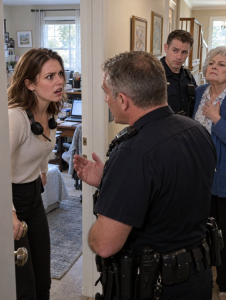
When I moved into my grandmother’s house at twenty-two, I thought the arrangement was going to save both of us money and maybe keep her from eating canned soup over the sink four nights a week. What I did not realize was that Grandma Evelyn believed a bedroom door was less an architectural feature than a personal insult.
She lived in the same two-story house outside Dayton, Ohio, where my mother and Aunt Laura had grown up, a beige colonial with green shutters, a basketball hoop nobody had used since 2004, and a dining room Grandma still referred to as “the good room” despite the fact that its most recent formal event had been storing seventeen cases of bottled water during a plumbing repair. Grandpa had died three years earlier, and although Grandma insisted she loved having the house to herself, she also called my mother whenever the furnace made a sound she didn’t recognize and once called me because a squirrel had “looked aggressive” from the bird feeder.
My lease with two college friends had ended that spring, and one of them was moving in with her boyfriend while the other had accepted a job in Indianapolis. I had just started working remotely for a health-insurance company, mostly handling claims documentation and customer escalations, and apartment prices had risen enough that my mother suggested Grandma’s spare bedroom while I saved.
Grandma offered before I could ask.
“You’d be helping me,” she said. “Three hundred and fifty a month, chip in for groceries, and I won’t have to wonder whether I’ve died and nobody noticed.”
“Grandma.”
“I’m kidding.”
She paused.
“Mostly.”
At first, it worked surprisingly well. I paid rent on the first of every month, bought groceries every other week, took the trash cans to the curb, changed light bulbs she claimed were “too high for seventy-four-year-old knees,” and learned that my grandmother could somehow use six spoons to prepare scrambled eggs.
She packed leftovers for me even though I worked fifteen feet from the refrigerator. I drove her to church when the roads were icy, and on Sunday nights we watched old game shows while she shouted answers at contestants who had filmed the episode before I was born.
The first problem was knocking.
Grandma did knock, technically. She simply treated knocking as an announcement that the door was about to open rather than a request to enter.
Tap-tap.
Door.
“Claire, have you seen my reading glasses?”
Tap-tap.
Door.
“Do you want half a banana before it gets too ripe?”
Tap-tap.
Door.
“Was that the mail truck?”
The reading glasses were usually on her head, I never understood why a banana needed witnesses, and yes, the mail truck was generally the vehicle placing mail in our mailbox.
The first few times, I laughed.
Then she walked in during a work call.
I had my headset on and was discussing a complicated claim with a supervisor when Grandma appeared behind me carrying a laundry basket.
“Claire, are these black pants yours?”
I muted myself.
“Grandma, I’m working.”
“I know. Are they yours?”
“Yes.”
“You left them in the dryer.”
“Okay.”
“They’ll wrinkle.”
“Grandma.”
She glanced at my computer. “You don’t have to snap.”
When I brought it up that evening, she looked genuinely puzzled.
“I knocked.”
“You knocked while opening the door.”
“Well, yes. Otherwise I’d just be standing in the hallway.”
“That is usually what happens while you wait for someone to say come in.”
She stared at me as though I had recently joined a cult.
“This isn’t a hotel, Claire.”
“I know. Hotels have little signs.”
That joke did not land.
I tried explaining that my job involved private customer information and that I sometimes had video meetings. Grandma nodded solemnly, then interrupted another call two days later because the dishwasher had made “a click.”
My mother thought the whole thing was funny.
“She’s lonely,” Mom said when I complained. “Your grandfather was always in and out of rooms. She’s used to people being around.”
“I am around. Constantly. That’s the issue.”
“Just humor her.”
In my family, “humor her” had the same practical meaning as “whatever Grandma wants is now your responsibility.”
Grandma’s need to know what I was doing gradually spread beyond the door. If I went out after work, she wanted to know where. If I said dinner with my friend Rachel, she wanted to know which restaurant, who else was going, whether Rachel was still dating “that boy with the earrings,” and what time I expected to be home.
I reminded her that I was twenty-two.
She reminded me that twenty-two-year-olds could still get murdered.
This was difficult to argue with because technically she was correct, although statistically I suspected my chances of being murdered between Olive Garden and her driveway were lower than she imagined.
The door became the symbol for all of it.
If I closed it while reading, Grandma opened it because she thought I was sleeping too much.
If I closed it while changing clothes, she would call through the wood, “Why is this shut?”
There are questions that should not require answers.
I started locking it during work calls.
The first time she discovered that, she rattled the knob.
“Claire?”
“I’m on a call.”
“Why is this locked?”
“Because I’m on a call.”
“You can be on a call with the door unlocked.”
I stared at my computer screen while my coworker Rachel tried very hard not to laugh through my headset.
“Is someone trying to get in?” she whispered.
“My grandmother.”
“Should I call security?”
“She is security.”
That evening Grandma was waiting at the kitchen table with her arms folded.
“You locked me out of a room in my own house.”
“I locked my bedroom while I was working.”
“My house.”
“My bedroom.”
“My door.”
That was technically difficult to dispute.
So I tried another approach.
“I pay you rent.”
Her mouth tightened.
“I’m not your landlord.”
“Then what am I paying rent for?”
“Don’t get smart.”
That ended the conversation in the traditional Evelyn Parker manner: not with an answer, but with a declaration that the question itself was disrespectful.
Mom called twenty minutes later.
I knew Grandma had contacted her because Mom opened with, “Can you please not turn this into a whole thing?”
“I didn’t call you.”
“Grandma’s upset.”
“She’s upset because I closed a door.”
“She feels like you’re shutting her out.”
“I am shutting her out. Temporarily. That’s what doors do.”
Mom sighed.
“Claire.”
There was a particular way my mother said my name when she wanted me to become easier.
I had heard it my entire life.
“Just leave the door cracked when you can.”
So I did, because I was trying to be reasonable.
For about two weeks, I closed it only during meetings, calls and changing clothes. The rest of the time I left it halfway open, even though every footstep in the hallway made my shoulders tighten because I knew there was a decent chance Grandma would appear with a question about weather, leftovers, stamps or the moral decline represented by ripped jeans.
Then came Thursday.
I had an annual performance review at ten that morning. It was my first one at the company, and I was nervous because my manager had mentioned that they were considering moving me into a senior claims role with better pay.
At 9:55, I made coffee, put on a decent blouse over sweatpants, checked my camera and closed the bedroom door.
I locked it.
At 10:07, while my manager was telling me that my customer-resolution scores were among the highest on our team, someone tried the knob.
Once.
Twice.
Then harder.
I muted myself.
“Grandma, I’m in my review.”
“I need you for a minute.”
“After eleven.”
“It’ll take ten seconds.”
“I can’t.”
Silence.
I unmuted.
My manager smiled awkwardly. “Everything okay?”
“Yep. Sorry.”
We continued.
Thirty seconds later came three loud knocks.
“Claire?”
I muted again.
“Grandma.”
“The chicken.”
“What chicken?”
“The chicken for dinner. I need to know if you’re eating.”
I closed my eyes.
“Please give me forty minutes.”
“I just need yes or no.”
“Yes.”
“You don’t have to be rude.”
My manager was now looking at something offscreen with the intense concentration of a woman heroically pretending she had heard none of this.
I finished the review at 10:43.
I got the promotion.
I barely had time to feel happy before I opened my door and found Grandma standing at the end of the hallway.
“You embarrassed me.”
I actually looked behind myself.
“You interrupted my performance review to ask about chicken.”
“I knocked politely.”
“You shook the doorknob.”
“Because you locked it.”
“That is what locks are for.”
Her face changed.
It was not rage exactly. Grandma rarely yelled. She became wounded instead, which was much more effective in our family.
“I open my home to you, and you barricade yourself upstairs like I’m some stranger.”
“I pay rent, Grandma.”
“There it is again. Money.”
“Yes. Because rent is money.”
“You think three hundred and fifty dollars buys you the right to disrespect me?”
“No. Being an adult buys me the right to close a bedroom door.”
She stared at me.
Then she said, “Not in my house.”
I should probably tell you that I did not handle my next sentence with the diplomacy of the United Nations.
“Then maybe you shouldn’t rent rooms to adults.”
Grandma went white around the mouth.
I went back inside.
And I closed the door.
Not slammed.
Closed.
Then, because my hands were shaking and because I had another call at eleven, I locked it.
For the next half hour, nothing happened.
That should have worried me.
Grandma was not a woman who surrendered arguments quietly. Once, after disagreeing with Aunt Laura about whether cranberry sauce counted as a side dish, she mailed her a magazine article three weeks later.
At 11:26, I heard a car pull into the driveway.
Then another.
I assumed Mom had been summoned.
I was wrong.
Someone knocked downstairs.
Voices followed.
A man.
Then another.
I took off my headset.
Footsteps came up the stairs.
There was a firm knock on my door.
“Claire?”
Not Grandma.
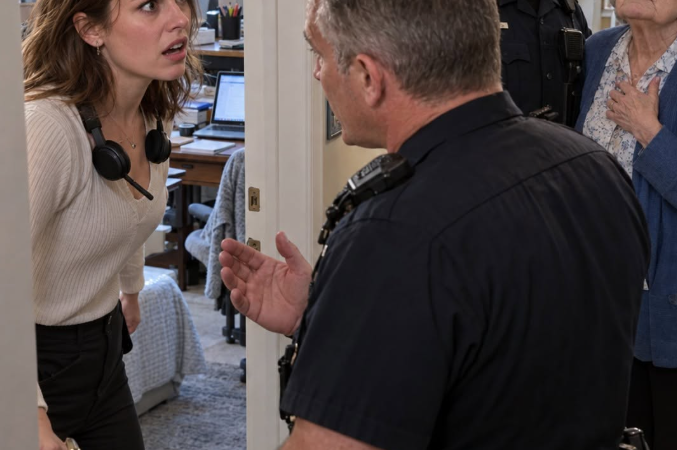
“Claire Bennett? Dayton Police. Can we speak with you?”
For a second, I honestly believed I had misunderstood the sentence.
I opened the door.
Two uniformed officers stood in the hallway. Grandma hovered behind them in her blue cardigan with one hand pressed dramatically to her chest.
The older officer looked me over.
“Are you okay?”
“Yes?”
“Your grandmother called because she was concerned about your welfare.”
I looked at Grandma.
She lifted her chin.
“I didn’t know what else to do.”
“You called the police?”
“You locked yourself in here.”
“I was working.”
“You wouldn’t open the door.”
“Because I was working.”
The younger officer glanced toward the desk behind me, where my laptop was still open beside a coffee mug and a stack of insurance manuals.
“Were you threatening to hurt yourself?” the older officer asked.
“No.”
“Anyone else?”
“No.”
“Were you in some kind of medical distress?”
“No.”
He looked back at Grandma.
She answered before he could ask.
“She was angry.”
The officer waited.
Grandma continued.
“She shut the door in my face.”
I could see the exact second he realized what kind of call he had been dispatched to.
His shoulders dropped about half an inch.
“Ma’am, did she threaten you?”
“No, but she was extremely disrespectful.”
I pressed my lips together.
The younger officer suddenly became fascinated by a framed watercolor hanging beside him.
The older officer tried again.
“Did she damage anything?”
“No.”
“Did she threaten herself?”
“No.”
“Did she threaten anyone else?”
“No.”
“Then what exactly were you asking us to do?”
Grandma looked offended by the question.
“I want her to understand that she cannot lock me out of rooms in my own house.”
The younger officer coughed.
I am still not convinced it was a cough.
The older man looked at me.
“How old are you?”
“Twenty-two.”
“Do you live here?”
“Yes.”
Grandma cut in. “Temporarily.”
He nodded. “Do you pay rent?”
The hallway went quiet.
Grandma’s lips tightened.
“A little.”
I almost laughed.
Three hundred and fifty dollars had apparently been downgraded from rent to a charitable donation now that a uniform was present.
The officer looked from her to me.
Then he asked the question nobody in my family had ever asked Grandma when she decided a boundary was an insult.
“If she’s an adult resident paying you rent, why are you asking the police to make her keep her bedroom door open?”
Grandma blinked.
No answer came.
For once, neither did Mom’s familiar explanation that she was lonely, worried, old-fashioned, grieving, anxious or “just like that.”
There was only my grandmother, two police officers, one closed bedroom door, and a silence big enough for the truth to finally fit inside.

Chapter 2
Grandma recovered before anyone else did.
“It is still my house,” she said, with the steady dignity of a woman who had apparently expected municipal law enforcement to endorse an open-door policy. The older officer agreed that it was her property, then explained just as calmly that they were not there to settle ordinary household rules and that if there was no threat, violence or emergency, there was nothing for them to enforce.
Before leaving, he looked at me and asked whether I felt safe remaining in the house. I said yes, although Grandma’s expression suggested my continued survival might now depend on whether I touched her good towels.
Mom arrived seven minutes after the police left.
She came through the front door carrying her purse under one arm and anxiety across her entire face.
“What happened?”
Grandma pointed upstairs.
“She humiliated me in front of the police.”
I came down halfway.
“You called them.”
“That is not the point.”
“It feels adjacent to the point.”
Mom closed her eyes briefly. “Claire, please.”
There it was.
My name in that voice.
Grandma told the story as though she had discovered me barricaded inside a meth lab rather than answering insurance emails beside a scented candle. She emphasized that I had “refused access,” “locked her out” and “become hostile,” while skipping over the performance review, the rent and the fact that her emergency had begun with poultry.
Mom listened, then looked up at me.
“Can you just apologize so everybody can calm down?”
Something in me changed.
Maybe it was seeing police lights reflected in Grandma’s china cabinet because I had used a lock built into a door. Maybe it was the fact that I had spent months making myself smaller and quieter, and the reward had been two officers standing outside my bedroom.
“No.”
Mom stared at me.
Grandma actually whispered, “Excuse me?”
“I’m not apologizing for closing my door.”
“You made me feel unsafe in my own home,” Grandma said.
“You called armed strangers to my bedroom because I wanted forty minutes alone.”
Mom flinched at the wording.
I went upstairs, opened my laptop and transferred money into savings. Then I texted Rachel.
Any chance your spare room is still empty for two weeks?
She responded almost instantly.
Did the chicken call the cops?
Despite everything, I laughed.
That was the first thing I packed.
By dinner, Grandma had established new terms. If I stayed under her roof, the bedroom door remained unlocked unless I was changing clothes, and she expected “basic courtesy,” which apparently included informing her when I left the house and answering when she called through the door.
I nodded.
“Okay.”
She relaxed.
Then I added, “I’ll be out Saturday.”
Grandma stared at me.
Mom said, “Claire, nobody told you to leave.”
“Yes, she did. She just used more words.”
For the first time all day, Grandma looked uncertain rather than angry.
“You’re going to throw away family over a door?”
“No. I’m moving because apparently a door is enough for you to call the police.”
Nobody had much to say after that.
I packed over the next day and a half. Rachel and her boyfriend helped Saturday morning, and Grandma followed us from room to room offering commentary about what technically belonged to her because it had “always been in that room.”
This included a lamp I had bought at Target.
I showed her the receipt.
She frowned.
“You save receipts for lamps?”
“Apparently I was preparing for this moment.”
Rachel had to walk outside.
Final chapter
Living on Rachel’s futon for two weeks was not glamorous. Her cat slept on my chest like a tiny landlord collecting rent through respiratory restriction, and her boyfriend made smoothies at six every morning with a blender that sounded capable of processing landscaping gravel.
But the bedroom had a door.
Nobody opened it without asking.
Three weeks later, I signed a lease on a one-bedroom apartment ten minutes from work and twenty-five minutes from Grandma. It was small enough that I could stand in the kitchen and reach my couch without fully committing to the trip, but it was mine.
Mom came over the first Sunday.
She brought a box of dishes and spent ten minutes rearranging my silverware before finally sitting at the little kitchen table.
“Grandma hasn’t stopped talking about what happened.”
“I’m stunned.”
“She thinks you made her look crazy.”
“I didn’t make her call the police.”
Mom looked down.
“I know.”
That was new.
She turned her coffee mug slowly between both hands. “Your grandmother took my bedroom door off when I was sixteen.”
I stared at her.
“What?”
“She said I was hiding things. Laura had started dating and Grandma was convinced I was going to do the same, so one Saturday I came home and my door was in the garage.”
“And you’ve spent months telling me to humor her?”
Mom’s face tightened.
“I learned that apologizing was easier.”
“For who?”
She did not answer immediately.
“For me, I guess.”
I leaned back.
“But it wasn’t easier for me.”
“No.”
The word came quietly.
Mom told me Grandma had always confused access with closeness. Grandpa had pushed back when he was alive, sometimes gently, sometimes not, and after he died there was nobody in the house reminding her that concern did not give her ownership of other people.
It explained something.
It did not excuse it.
“I wish you had told me,” I said.
“I wish I had realized it mattered.”
A month passed before Grandma called.
I almost let it go to voicemail.
Instead, I answered.
“Hello?”
“I have your mail.”
“Okay.”
“Three pieces.”
“You can leave them with Mom.”
A long pause.
Then Grandma said, “I didn’t call the police because I wanted to scare you.”
“Why did you?”
“I thought something was wrong.”
“You knew I was working.”
“You were angry.”
“People are allowed to be angry without becoming emergencies.”
She was quiet.
Finally she said, “When you closed that door, it felt like everybody leaves.”
There it was.
Not an apology.
But something more honest than “my house.”
Grandpa had died. Mom and Laura had grown up and moved away. Her grandchildren visited instead of living down the hallway, and an empty house had apparently taught Grandma to treat every closed door like another departure.
I softened, but I did not surrender.
“Then tell me you’re lonely, Grandma. Tell me you miss having people around. Ask me to have dinner with you. Don’t call the police because I close a bedroom door.”
She made a small sound.
“I suppose that was excessive.”
From Grandma Evelyn, this was approximately equivalent to a televised confession.
“Yes,” I said. “It was.”
We did not return to normal because I no longer wanted the old normal.
I visited twice a month. I called on Sundays. If Grandma criticized my apartment, my clothes, my friends or the amount of money I spent on coffee, I ended the conversation instead of proving my case like an attorney who had accidentally wandered into family court.
The first few times, she was furious.
Then something strange happened.
She adjusted.
Not completely. Grandma was still Grandma. She once left me a voicemail saying, “I’m not interfering, but that Rachel girl puts too many vacation photos online,” which remains one of the finest examples of a sentence defeating itself I have ever heard.
At Thanksgiving, I went back to the house.
Mom was carving turkey because Grandma had finally admitted that her hands hurt too much to wrestle a twenty-pound bird, Aunt Laura brought cranberry sauce and announced at the table that it absolutely counted as a side dish, apparently reopening a conflict I had not known survived the Obama administration.
Halfway through dessert, Laura asked about my apartment.
“I like it.”
“Good neighbors?”
“Mostly. The guy upstairs vacuums at midnight.”
Grandma frowned. “You should tell the landlord.”
“I can handle it.”
She opened her mouth.
Then closed it.
Mom saw.
So did I.
Nobody congratulated her. We were not going to give a seventy-four-year-old woman a medal for resisting one piece of unsolicited advice.
But I noticed.
A few weeks before Christmas, Grandma asked to see my apartment.
I hesitated before agreeing.
When she arrived, I watched her walk down the hallway carrying a tin of sugar cookies, taking in the framed prints I had hung myself and the little Christmas tree beside the window.
She stopped outside my bedroom.
The door was closed.
For one strange second, we both looked at it.
Then Grandma raised her hand.
She knocked.
And waited.
I almost laughed because the gesture was so ordinary that nobody else in the world would have understood why it mattered.
“Come in.”
She opened the door and looked around.
“You need curtains.”
“Grandma.”
“I’m only saying.”
“I know.”
She sat on the edge of the bed.
After a moment, she touched the quilt.
“This is nice.”
“Thank you.”
“You’re doing all right?”
“I am.”
She nodded slowly.
Then she looked toward the door.
“I hated that you left.”
“I know.”
“I thought if I gave you enough rules, I could keep things from changing.”
I sat beside her.
“That’s not how people stay.”
“No.”
It was the closest thing to an apology I ever received.
Maybe that sounds unsatisfying. For a long time, I thought healing required somebody who hurt you to finally deliver the exact speech you had rehearsed for them in the shower.
Real families are usually less cooperative.
Grandma never became a different person. Mom never stopped instinctively trying to smooth conflict before asking who caused it. I did not become endlessly patient and emotionally enlightened at twenty-two.
What changed was simpler.
I stopped confusing peace with obedience.
The morning Grandma called the police, I thought the argument was about whether I had the right to close one bedroom door.
It wasn’t.
It was about whether loving somebody meant they were entitled to unlimited access to me, my time, my explanations and eventually my silence.
I still close my bedroom door.
Sometimes because I am working.
Sometimes because I am changing.
Sometimes because I want to lie on my bed in sweatpants and watch a terrible baking show without anybody asking whether I have considered freezing leftover chicken.
And sometimes I close it simply because I can.
The people who love me are still on the other side when I open it again.
That turned out to be the lesson Grandma and I both needed.
A closed door is not abandonment.
A boundary is not punishment.
And if someone has to call the police because you finally said no, the problem probably was never the door.