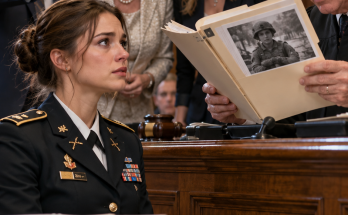
PART 1 — THE FAMILY THAT WANTED ME DESTROYED
At 4:47 in the morning, my older brother kicked open my apartment door, my mother screamed that I had ruined the family, and my father stood behind them holding a folder full of documents that would soon be used to destroy my military career.
“Sign the papers, Natalie,” my father ordered. “Or you can forget that you ever had a family.”
I was thirty-two years old, a Staff Sergeant in the United States Army, and I had spent twelve years learning how to stay calm under pressure. I had coordinated supply convoys, managed emergency shipments, and worked through nights when one mistake could put hundreds of soldiers at risk.
Yet nothing in the Army had prepared me for the people standing inside my home.
My brother, Ryan, was thirty-five and had never held a job for longer than eight months. My mother, Diane, had perfected the art of turning every disaster in his life into my responsibility. And my father, Robert, believed that being the head of our family gave him the right to control every dollar I earned.
For seven years, I had sent them money.
It began with a few hundred dollars to cover a late mortgage payment. Then came the electricity bill, Ryan’s truck repairs, his failed business, and the mysterious emergencies that always appeared whenever I tried to save something for myself.
By the time I finally stopped, I had transferred nearly $74,000 to my parents.
I had skipped vacations, delayed replacing my broken laptop, and lived in a tiny apartment while my family enjoyed a house with a swimming pool and a new kitchen.
I told myself it was temporary.
I told myself family meant sacrifice.
Then, three weeks before that terrible morning, I discovered the truth.
My mother had accidentally forwarded me an email containing the final documents for my parents’ estate.
The house was being transferred into a trust.
The savings accounts were included.
The investment property my father had inherited from my grandfather was included, too.
Every asset was being left to Ryan.
My name appeared only once, in a handwritten note attached to the documents.
“Natalie has a stable government career. She doesn’t need anything from us.”
I read that sentence until the words blurred.
I wasn’t angry because I wanted their house. I was angry because I had spent years helping them protect it, believing I was saving something that belonged to all of us.
They had never considered me part of their future.
I was simply the person who paid for it.
That afternoon, I canceled every automatic transfer.
Two days later, my mother called crying.
The mortgage company had rejected a payment. Ryan’s truck had been repossessed. My father claimed the family was on the verge of losing everything.
I told her I was sorry, but I wouldn’t send another dollar.
She stopped crying.
“You think you’re better than us because you wear a uniform?”
“No,” I answered. “I think I deserve to stop paying for people who have already decided I don’t matter.”
She hung up.
I thought that would be the end of it.
I was wrong.
At 4:47 that morning, someone slammed a fist against my door.
“Natalie! Open up!”
My father.
I looked through the peephole and saw all three of them. Ryan was carrying a backpack. My mother was clutching her purse. My father looked as though he had rehearsed the confrontation in the car.
I opened the door only as far as the security chain allowed.
“What do you want?”
“Your bank card,” Dad said.
I stared at him. “Excuse me?”
“You’re going to transfer enough money to cover the mortgage. Then you’re going to sign these documents.”
He pushed the folder toward the opening.
The papers would make me a guarantor on a loan for Ryan’s new business. The amount was $180,000.
“You have lost your mind,” I whispered.
Ryan laughed. “Don’t make this dramatic. You make good money. The bank just needs someone reliable.”
“Then let the bank ask someone who wants to take that risk.”
My father shoved the door.
The chain snapped.
I stumbled backward as the door struck the wall, and he marched into my apartment as if he owned it.
My mother followed him. Ryan went straight toward my desk, where my wallet and military laptop were sitting.
“Don’t touch anything,” I warned.
Ryan ignored me and reached for my wallet.
I caught his wrist.
He twisted free and shoved me into the bookshelf. A framed photograph fell and shattered beside my feet.
My mother immediately began shouting that I was attacking her son.
My father grabbed my shoulder.
“Sign the papers!”
I pulled away and reached for my phone.
“I’m calling the police.”
That finally made him pause.
Then he smiled.
“Go ahead. I’ll call your commanding officer afterward. I’ll explain that you’ve been having mental problems. I’ll tell them you can’t control your temper.”
“You broke into my apartment.”
“And who’s going to believe you over your own family?”
I dialed emergency services and gave the dispatcher my address. While I spoke, Ryan suddenly snatched a small envelope from the desk drawer.
I recognized it immediately.
It contained copies of my personal financial records and several receipts documenting the money I had sent my parents.
“Put that down!” I shouted.
Ryan shoved it into his backpack.
My father dragged my chair away from the desk while my mother screamed that I was destroying their lives.
When the sirens sounded outside, they finally backed toward the door.
Dad stopped on the threshold.
“You have until Friday,” he said. “Sign the loan documents, or you’ll regret the day you were born.”
Then he looked at Ryan and nodded.
It was a tiny gesture, but I noticed it.
So did the officer who arrived thirty seconds later.
He asked why my brother was carrying my envelope. Ryan claimed it was his property. My father insisted they had come only to discuss a family disagreement.
The officers separated us, photographed the damage, and took statements.
Before leaving, one officer quietly advised me to change my locks and preserve any security footage.
I did both.
For the next two days, I barely slept. I replaced the broken chain, sent a written account of the incident to my command, and saved copies of every threatening message my family sent.
On Thursday evening, I received a text from my mother.
You could have prevented all of this. Remember that when people start asking questions about you.
I took a screenshot.
At 6:12 the following morning, someone knocked on my door.
This time, it wasn’t my family.
Two police officers stood in the hallway beside an investigator from military law enforcement.
The older officer held up a warrant.
“Staff Sergeant Natalie Hayes, we need to search your apartment. Your parents and brother have accused you of threatening to shoot them during your last visit.”
“I never threatened anyone.”
“They’ve provided sworn statements.”
My stomach tightened.
Then the investigator looked toward my living room.
“We also have reason to believe there may be a firearm hidden in your apartment.”
I had never owned a gun.
The officers entered and searched the rooms.
One walked behind the sofa and crouched.
A moment later, he reached beneath the cushion and pulled out a black handgun wrapped in a towel.
I couldn’t breathe.
The officer turned toward me.
“Is this yours?”
“No.”
He looked at the other officer.
“Secure the weapon.”
As they placed me in handcuffs, my mind returned to Ryan’s backpack, my missing envelope, and that small nod my father had given him at the door.
Then the investigator said something that made my blood run cold.
“Your brother claims you told him exactly where you planned to hide the gun.”
I had never said those words.
But someone had planted the weapon, and my own family had prepared the story before the police ever arrived.
What they didn’t know was that my apartment had recorded something they had forgotten to hide.
And the person who would uncover it wasn’t my lawyer.
It was the one officer my father had spent years insulting.
PART 2 — THE EVIDENCE THEY NEVER KNEW EXISTED
The first night in custody was the longest night of my life.
I kept thinking about my uniform hanging inside the bedroom closet, my unfinished reports on my desk, and the soldiers who depended on me to do my job correctly.
I had spent twelve years earning the rank on my chest.
Now, a handgun I had never touched threatened to erase everything.
The investigator, Special Agent Daniel Mercer, interviewed me the following morning.
He was a quiet man in his late forties with tired eyes and a habit of listening without interrupting.
“Your father says you became violent when he asked you to help the family financially,” he explained.
“He broke into my apartment because I refused to guarantee a loan for my brother.”
“And the firearm?”
“I’ve never owned one.”
He studied me for a moment.
“Your brother says you showed him the weapon two weeks ago.”
“That is impossible.”
“Your mother says she saw you place it beneath the sofa.”
I leaned forward.
“Then ask them what color towel it was wrapped in.”
His pen stopped.
“I never told you it was wrapped in a towel,” I continued. “If my family gave you that detail, they may know more about the weapon than they should.”
For the first time, Agent Mercer looked genuinely interested.
He ended the interview and left the room.
Hours later, Captain Elena Brooks, my company commander, arrived.
I had expected anger. Instead, she looked exhausted.
“Natalie, I need you to understand how serious this is. A weapons allegation can affect your security clearance, your assignment, and your future in the Army.”
“I understand, ma’am.”
“Did you put that gun in your apartment?”
“No.”
She held my gaze.
“Then we will establish the facts. But I need you to be completely honest with me about everything involving your family.”
So I told her everything.
The money. The trust documents. The loan agreement. The threats. The envelope Ryan had stolen.
When I finished, she asked a question I hadn’t considered.
“Do you have any proof your family planned this?”
I thought about my phone.
The dispatcher had remained on the line while my father threatened my career. My device had also automatically uploaded its audio recording to a secure cloud account.
But there was something else.
For months, I had used a small indoor security camera near my apartment entrance. I had installed it after a package disappeared from my doorstep. The camera recorded continuously, and the files were stored remotely.
I had forgotten about it during the confrontation.
Captain Brooks immediately contacted Agent Mercer.
By late afternoon, investigators had recovered the recording.
The footage was grainy, but the audio was unmistakable.
My father could be heard shouting, “Sign the papers!”
Then Ryan’s voice:
“What about the other thing?”
My father answered, “Not here. Wait until we’re outside.”
A few seconds later, my mother said, “You promised this would scare her, not ruin everything.”
There was a long silence.
Then Ryan asked, “And if she calls the police?”
My father’s response made the room go still.
“By then, she’ll have something to explain.”
The recording ended shortly afterward.
It wasn’t enough to establish who had planted the gun, but it destroyed their claim that the confrontation had been peaceful.
Investigators began checking the timeline.
The building’s security system showed Ryan entering the apartment complex twice during the forty-eight hours before the search warrant was executed.
He had no legitimate reason to be there.
My apartment manager remembered seeing him carrying a large black backpack.
Then came the discovery that changed everything.
The gun’s serial number had been partially filed away, but forensic specialists recovered enough information to trace its previous owner.
It belonged to a man named Victor Hale, who had reported the firearm stolen from his locked vehicle three weeks earlier.
Victor was Ryan’s former business partner.
The two men had fallen out after Ryan allegedly borrowed money he never repaid.
When investigators contacted Victor, he immediately recognized Ryan’s photograph.
“He told me he needed the gun to scare someone,” Victor said. “I thought he was bluffing. I never gave him permission to take it.”
A search of Ryan’s vehicle uncovered a pair of work gloves and a receipt from a hardware store near my apartment.
The purchase had been made the evening before the handgun was discovered.
Still, my parents refused to change their stories.
They insisted I had threatened them.
They said the camera recording was misleading.
My father even told a local reporter that I had become unstable because the military had damaged my mental health.
The article spread through my hometown before I could respond.
Strangers called me dangerous. Former classmates posted cruel comments. Someone sent an anonymous complaint to my command.
For the first time in my career, I wondered whether the truth would matter if enough people repeated a lie.
Then Agent Mercer called me into his office.
“We found your missing financial envelope,” he said.
“Where?”
“In your brother’s backpack.”
I felt a wave of relief.
“Does it prove he planted the gun?”
“Not directly. But we found something else inside the envelope.”
He placed a printed page on the table.
It was a draft email recovered from Ryan’s laptop.
The message had been addressed to my father’s attorney.
Its subject line read: NATALIE’S CAPACITY AND FINANCIAL RESPONSIBILITY.
The email discussed a plan to have me declared financially unreliable so that my parents could argue I was unfit to manage my own affairs.
It also mentioned the $180,000 loan.
Ryan had written that if I refused to sign, the family would need to “create leverage before the bank deadline.”
The email had been drafted two days before my father broke into my apartment.
My hands trembled as I read the final sentence.
If she loses her clearance, she’ll have no choice but to come back home and help us.
They hadn’t merely wanted my money.
They wanted to make me dependent on them.
They believed that if they destroyed my career, they could force me back into the role I had occupied since childhood: the responsible daughter who sacrificed everything while her brother received everything.
Agent Mercer closed the folder.
“Your family has a problem,” he said.
“What problem?”
“Your father believed his reputation would protect him. Your brother believed the weapon would make you look guilty. And your mother believed nobody would question a grieving parent.”
He paused.
“But none of them expected the forensic evidence to contradict their statements.”
That evening, Captain Brooks called.
“Your administrative suspension remains in place while the investigation continues,” she said. “But your command is not treating the accusations as established fact. We have the recording, the stolen-property evidence, and the conflicting statements.”
I closed my eyes.
For the first time in days, I could breathe.
Then she added, “There is one more development. Your father’s attorney has requested a meeting with the prosecutor.”
“Why?”
“He wants the accusations withdrawn before formal charges are considered.”
I almost laughed.
My father had spent years teaching me that family loyalty meant protecting him from consequences.
Now he wanted to negotiate his way out of the very lie he had sworn was true.
But the prosecutor refused to make the case disappear.
Instead, investigators served additional warrants and obtained the original trust documents, the loan application, and Ryan’s electronic messages.
The case was moving beyond a family dispute.
It was becoming a criminal investigation.
And the final piece of evidence arrived the next morning.
A laboratory report showed that the towel wrapped around the handgun contained trace material consistent with fibers from a jacket recovered during the search of Ryan’s car.
But Agent Mercer wasn’t finished.
He placed another document in front of me.
It was a bank statement showing a transfer of $12,000 from my parents’ account to Ryan’s account on the same day the firearm had been reported stolen.
The description attached to the transfer read:
EMERGENCY FAMILY SECURITY.
I stared at the words.
My family had not only planned to destroy me.
They had used money I had spent years giving them to finance the machinery of my own downfall.
Agent Mercer took the statement back.
“Your parents have been summoned to testify about these transactions.”
“When?”
“Monday morning.”
I nodded slowly.
For seven years, I had paid their bills, covered their emergencies, and believed that love meant never keeping score.
On Monday, my family would have to answer questions under oath.
And for the first time in my life, I wasn’t going to rescue them.
I was going to let them face the truth.
PART 3 — THE DAUGHTER THEY UNDERESTIMATED
The hearing began at nine o’clock on Monday morning.
My father arrived wearing his best navy suit. My mother held a tissue in one hand and Ryan’s arm in the other.
They looked like a family preparing to defend an innocent son.
I sat beside my attorney, Michael Bennett, with my hands folded in my lap.
For months, my family had controlled the story.
They had told relatives I was selfish. They had told neighbors I was unstable. They had told investigators I was dangerous.
Now, every claim had to survive questions.
The prosecutor began with the financial records.
“Mr. Hayes, did your daughter send you money every month for seven years?”
“Yes,” my father answered.
“How much?”
“I don’t recall the exact amount.”
The prosecutor displayed the bank statements.
“Would $74,000 be approximately correct?”
My father shifted in his seat.
“Over that length of time, perhaps.”
“And despite receiving those funds, you removed your daughter from your estate plan?”
“That was a private family decision.”
“Did you tell her she would receive nothing?”
“I don’t remember.”
The prosecutor presented the email containing the trust amendment.
My father’s handwriting appeared beside my name.
Natalie is independent and has already built her own life.
The room became silent.
The prosecutor let the statement sit on the screen.
“Mr. Hayes, was your daughter independent when you needed help paying your mortgage?”
My father stared at the table.
“Was she independent when your son needed money to start a business?”
No answer.
“Was she independent when you demanded that she guarantee a $180,000 loan?”
My father’s attorney objected, but the judge allowed the question.
My father finally answered.
“We were trying to keep the family together.”
The prosecutor nodded.
“Then why did you tell your son, on a recording, that your daughter would have something to explain by the time she contacted the police?”
My father’s face changed.
For the first time, he looked afraid.
The recording played.
His voice filled the courtroom.
By then, she’ll have something to explain.
My mother began crying.
Ryan stared at the floor.
Then came the evidence concerning the firearm.
Victor Hale testified that Ryan had taken his handgun without permission. Investigators presented the recovered serial-number records, the laboratory report, and the photographs from the search of Ryan’s vehicle.
Ryan’s attorney argued that the evidence was circumstantial.
But the prosecutor had one final exhibit.
It was a message recovered from Ryan’s phone and sent to my father the night before the search.
It’s under the left cushion. Nobody will check until they have a reason.
My father read the message on the courtroom screen.
His shoulders collapsed.
The prosecutor turned toward him.
“Mr. Hayes, what did your son mean?”
“I don’t know.”
“Did you know a firearm had been placed in your daughter’s apartment?”
“No.”
The prosecutor displayed the message again.
“Then why did you respond, ‘Make sure the story matches’?”
My father opened his mouth.
Nothing came out.
My mother suddenly stood.
“This is ridiculous!” she shouted. “Natalie has always wanted to make us look bad!”
The judge ordered her to sit down.
She began sobbing, but nobody rushed to comfort her.
Not even Ryan.
For years, I had imagined that one day my parents would apologize. I had pictured my father admitting that he had treated me unfairly, and my mother finally recognizing how much I had sacrificed.
Instead, I watched them become strangers beneath the weight of their own words.
The hearing did not end with a dramatic confession.
It ended with evidence, sworn testimony, and decisions made by people who had no emotional attachment to my family.
Ryan faced charges arising from the firearm and the alleged planting of evidence. My parents were investigated for their alleged roles in the false accusations and related conduct. The exact outcomes would depend on the court proceedings that followed.
But the case against me began to collapse.
The prosecutor withdrew the request for continued restrictions based on the weapon allegation, and my attorney moved to correct the record.
My command received the investigative findings.
Two weeks later, Captain Brooks called me into her office.
She stood when I entered.
“Staff Sergeant Hayes, the evidence does not support the allegations against you. Your administrative suspension is being lifted, subject to the remaining routine personnel procedures.”
I tried to answer, but my voice failed.
She came around the desk.
“You have spent years proving that you can be trusted with responsibility. Don’t let this family convince you that their actions define your character.”
I nodded, blinking back tears.
When I returned to my unit, nobody applauded. Nobody made a speech.
My soldiers simply welcomed me back.
One of them had left a cup of coffee beside my desk with a note.
Glad you’re home, Sergeant.
I sat down and cried.
Not because I was defeated.
Because I was finally allowed to stop fighting for the people who had tried to destroy me.
Three months later, the legal proceedings reached their next major milestone.
Ryan entered a plea agreement addressing his role in the firearm incident and related conduct. My parents faced their own legal scrutiny over the false reports and evidence uncovered during the investigation. The civil dispute over the loan and my financial contributions proceeded separately.
I recovered my missing records, and my attorney helped me challenge the fraudulent loan application.
The bank removed my name from the proposed guarantee.
I also closed every account through which my family could access my money, changed my emergency contacts, and instructed my attorney to direct all future communication through legal channels.
My parents sent letters.
My mother wrote that she had made mistakes.
My father wrote that I had misunderstood his intentions.
Ryan wrote that he had been under pressure.
None of them began with the words I had waited my entire life to hear.
We were wrong.
I didn’t answer.
For the first time, silence wasn’t a punishment I feared.
It was a boundary I had chosen.
I sold the apartment where the gun had been planted and moved to a quieter neighborhood. I started saving for a house of my own, not because I needed to prove anything to my family, but because I wanted a place where peace didn’t come with a price tag.
On the anniversary of the morning my father broke through my door, I received one final message from him.
After everything we’ve been through, are you really going to abandon your own parents?
I read it twice.
Then I typed my response.
I didn’t abandon this family. I stopped financing the people who were willing to frame me for a crime.
I blocked his number.
That evening, I sat on my new balcony and watched the sun disappear behind the trees.
I thought about the young woman I had been at twenty-five, sending money home after exhausting days, believing that if she sacrificed enough, her family would finally be proud of her.
I wished I could tell her something.
You do not have to purchase love.
You do not have to destroy yourself to prove that you are loyal.
And being related to someone does not give them permission to ruin your life.
My father had believed that my uniform would make his accusations more powerful.
My brother had believed that a hidden gun would make me helpless.
My mother had believed that tears would make everyone overlook the truth.
They had all underestimated one thing.
I had spent twelve years learning to document facts, preserve evidence, and remain calm when people tried to make me panic.
They thought my greatest weakness was that I would always protect my family.
They never realized that my greatest strength was knowing when the evidence spoke for itself.
I never celebrated their humiliation. I didn’t need revenge in the form of their suffering.
I wanted my career back, my freedom back, and the chance to build a life that belonged to me.
I got those things.
And when I finally stood in my own home, surrounded by nothing but the quiet I had earned, I understood the final lesson my family had taught me.
Sometimes the most powerful revenge isn’t making the people who hurt you pay.
It’s making sure they never get the chance to hurt you again.
THE END.