PART 1 — THE NIGHT THE DOCTOR LOCKED THE DOOR
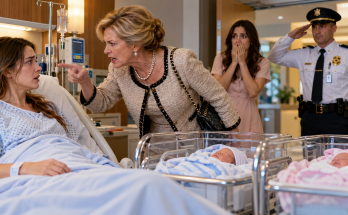
The night my stepfather brought my twin sister and me to the emergency room, he told the doctors we had fallen down the stairs.
My mother stood beside him, nodding as if she had rehearsed the lie a thousand times.
But Dr. Adrian Cole looked at the matching bruises on our bodies, then at the man gripping my sister’s wrist.
“Sir, I need you to step outside.”
My stepfather laughed.
“I’m their father. You don’t give me orders.”
The doctor didn’t argue. He quietly turned toward the hospital security guard.
“Lock the doors to this treatment area. Call the police. And make sure nobody removes those girls from these beds.”
For the first time in seventeen years, I watched fear appear on my stepfather’s face.
My name is Emily Bennett. My twin sister is Emma.
We were seventeen, identical in appearance, and different in almost every other way. Emma cried when she was frightened. I became quiet. She tried to reason with people. I watched them, memorizing every word.
Our stepfather, Richard Hale, had learned to exploit both of us.
He had married our mother, Patricia, six years earlier, after our biological father died in a construction accident. At least, that was the story we had been told.
Richard entered our lives pretending to be the kind of man every widow needed: dependable, generous, patient.
He helped with our homework. He repaired the broken fence. He attended school meetings and remembered our birthdays.
Our neighbors adored him.
Then, slowly, the rules began.
We weren’t allowed to close our bedroom doors. We couldn’t call our father’s relatives without permission. Richard checked our phones every night and accused us of lying whenever we disagreed with him.
Eventually, he began hurting us.
He never did it in front of witnesses.
He always made sure our mother was nearby, but never close enough to be blamed.
And after every incident, he forced us to apologize.
“You girls make me do things I don’t want to do,” he would say.
Our mother repeated the same sentence until we began to wonder whether it was true.
The worst part wasn’t the pain.
It was knowing that the woman who had once held us when we were frightened now stood in the doorway, pretending she couldn’t hear us.
One evening, Emma tried to leave the house and call our maternal grandmother.
Richard caught her at the front door.
I still remember the sound of Emma’s shoes scraping against the floor as she tried to pull away.
“Let her go!” I screamed.
Richard turned toward me.
“Which one of you wants to be first?”
Emma stepped between us.
That was the last thing I remembered before everything went dark.
When I woke, we were in the hospital.
My head throbbed. My arms were covered in bruises. Emma lay on the bed beside mine, barely moving.
Richard stood near the curtain, calmly explaining our injuries to a nurse.
“They’re clumsy,” he said. “Always have been.”
Our mother added, “They fell down the stairs.”
Dr. Cole examined us separately. He asked Emma questions, checked our injuries, and returned to my bed with an expression I couldn’t understand.
“Emily, can you tell me what happened tonight?”
I looked toward the doorway.
Richard was watching.
I lowered my eyes.
“I fell.”
The doctor remained silent for a moment.
Then he asked, “Did your sister fall in exactly the same way?”
I didn’t answer.
He gently pulled the blanket over my injured arm.
“You don’t have to tell me everything right now,” he said. “But I need you to understand something. What happened to you is not your fault.”
Those words nearly broke me.
Nobody had ever said that to us.
A few minutes later, Dr. Cole stepped into the hallway. Through the narrow opening in the curtain, I saw him speak to a security guard.
Then I heard the words that changed everything.
“Call the police. Now.”
Richard immediately demanded to know what was happening.
“This is ridiculous,” he snapped. “My wife and I have legal custody. You’re keeping our children against our will.”
The doctor faced him.
“I’m protecting two patients while we investigate serious concerns about their safety.”
Richard’s expression hardened.
“You’ll regret this.”
Then Emma moved.
Her eyes opened slowly, and she reached across the gap between our beds until her fingers found mine.
“Emily,” she whispered.
“I’m here.”
She swallowed painfully.
“Did you keep it?”
My heart began racing.
Three months earlier, Emma and I had discovered an old metal box hidden beneath the loose floorboard in our father’s former study. Inside were a small digital recorder, several envelopes, and a photograph of our father standing beside a woman neither of us recognized.
The envelopes were addressed to us.
None had been opened.
We had taken the recorder and hidden it inside an old schoolbag, terrified Richard would discover it.
A week later, we found out why.
The recorder contained a conversation between Richard and our mother.
They were discussing our father’s death.
Richard’s voice was unmistakable.
“He never changed the beneficiaries. Once the girls turn eighteen, the money transfers automatically. We have to make sure they never get control of it.”
Our mother’s voice trembled.
“What if they find out?”
“They won’t. And if they do, nobody will believe two unstable girls over us.”
We had listened to the recording only once.
Then we made three copies and hid them in separate places.
Richard knew nothing about the third copy.
I squeezed Emma’s hand.
“Yes,” I whispered. “I kept it.”
She closed her eyes.
Then, with a strength I hadn’t heard in her voice for years, she turned toward Richard.
“You should have checked the schoolbag.”
His face went completely still.
At that moment, the emergency room doors opened.
Two police officers entered.
And behind them walked a silver-haired woman carrying a leather briefcase.
Richard stared at her.
Our mother dropped her purse.
I had never met the woman before, but I recognized her from the photograph in our father’s box.
She looked directly at Richard and said five words.
“It’s time to explain Thomas’s death.”
PART 2 — THE SECRET OUR MOTHER BURIED
The silver-haired woman introduced herself as Eleanor Price, an attorney who had represented our father for nearly twenty years.
She had been trying to locate us for months.
According to her, our father had left detailed instructions concerning his estate, our education, and the people he believed might try to interfere with our inheritance.
Richard immediately denied everything.
“This is a family matter,” he said. “You have no right to be here.”
Eleanor opened her briefcase.
“Actually, Mr. Hale, I have every right to be here. Your stepdaughters are named beneficiaries in a trust you have been attempting to access illegally.”
The police officers exchanged a glance.
Richard’s confidence began to crumble.
Our father had been a financial investigator who uncovered fraud involving several construction companies. Before his death, he had discovered that someone was moving money through accounts connected to a company owned by Richard.
The investigation had never been completed.
Then our father died.
The official report described his death as an accident on a rainy highway. His car had left the road, struck a barrier, and caught fire.
For six years, we had believed it was a terrible coincidence.
Eleanor explained that our father had been preparing to submit additional evidence shortly before the crash. Several documents disappeared after his death, and the case was eventually closed for lack of sufficient evidence.
Richard had later married our mother.
He had moved into our father’s house.
And he had spent years convincing everyone that our father’s relatives were dangerous, untrustworthy people who wanted to steal us away.
But the most devastating revelation came next.
Eleanor placed a document on the small table beside my hospital bed.
It was a letter written by our father three weeks before he died.
My precious girls,
If you are reading this, something has happened that I was unable to prevent. Never believe that the people who claim to love you are automatically safe. Love does not demand your silence. Love does not make you afraid.
The trust I created belongs to you. No one has the right to use it as a weapon against you.
If Richard Hale ever becomes part of your lives, please contact Eleanor Price.
And if your mother asks you to forgive something that hurts you, remember that forgiveness is not the same as allowing someone to hurt you again.
I couldn’t finish reading.
Emma began to cry.
For years, we had wondered why our father had left us with a man who treated us so cruelly. Now we understood that he had never intended Richard to become our guardian.
Eleanor explained that our father had arranged for his brother, Daniel Bennett, to become our legal guardian if anything happened to him. But the documents establishing that arrangement had disappeared after the accident.
Richard had told everyone that Daniel had abandoned us.
In reality, Daniel had spent years trying to contact us.
Every letter he sent was returned.
Every phone call was blocked.
Every attempt to visit the house ended with our mother telling him we wanted nothing to do with him.
Our mother finally spoke.
“I was trying to protect the girls.”
Emma turned toward her.
“From whom?”
Patricia’s lips trembled.
“Richard said your father had debts. He said if I cooperated, we could keep the house. He promised he would take care of you.”
“You let him hurt us,” I said.
She covered her face.
“I was afraid.”
I had imagined this conversation a thousand times. I had imagined shouting, demanding explanations, forcing her to admit what she had done.
But when the moment finally arrived, I felt strangely empty.
“You were afraid of him,” I whispered. “And you made us live with that fear every day.”
She began sobbing.
Richard interrupted her.
“Enough! They’re manipulating everyone. They’re disturbed girls who have been listening to lies.”
One of the officers stepped forward.
“Mr. Hale, we need you to come with us.”
He resisted, insisting that he had done nothing wrong. The officers eventually escorted him into the hallway while hospital staff continued documenting our injuries.
But before he disappeared through the doors, he turned toward us.
“You think you’ve won?” he shouted. “You have no idea what you’re getting yourselves into.”
For the first time, I didn’t look away.
“We know exactly what we’re getting out of,” I answered.
He was arrested that night on suspicion of assault and child abuse. The investigation would take months, and we knew his arrest wasn’t the same as justice.
Still, it was the first night in six years when we slept without listening for his footsteps.
Eleanor arranged for us to stay with our aunt until our eighteenth birthday. A hospital social worker helped coordinate our care, and the police began collecting evidence.
The recorder was found exactly where we had hidden it: inside a hollow compartment in an old schoolbag at our aunt’s request.
The recordings contained more than the conversation about the trust.
They revealed Richard threatening our mother, discussing the missing financial documents, and admitting that he had deliberately isolated us from our father’s family.
The evidence didn’t prove that he had caused our father’s death, but it gave investigators a reason to reopen parts of the financial investigation surrounding the crash.
Then Eleanor found something else.
A bank statement showed that thousands of dollars had been transferred from our father’s estate into an account controlled by Richard. The transactions had begun shortly after the funeral and continued for years.
Our mother had signed some of the documents.
When questioned, she claimed Richard had forced her to do it.
The authorities would have to determine what she knew, what she had done willingly, and what had been done under coercion.
We didn’t know whether we could ever forgive her.
Two weeks later, Emma and I turned eighteen.
We received access to the trust, along with copies of the documents our father had left behind.
For the first time, we could make decisions about our own lives.
I thought that would be the end of our story.
Then Eleanor called us into her office.
She placed a photograph on the desk.
It showed our father standing beside Richard outside a courthouse, months before the accident.
On the back, someone had written a date and a sentence.
The person who knows what happened is still alive.
Eleanor looked at us carefully.
“There is one more witness,” she said. “Someone who was supposed to testify against Richard six years ago.”
“Who?” Emma asked.
Eleanor slid a sealed envelope across the desk.
Inside was a name.
Daniel Bennett.
Our uncle.
And beneath it was a handwritten message from our father.
If anything happens to me, Daniel knows the truth about the highway.
PART 3 — THE DAY WE FINALLY TOLD THE TRUTH
We found our uncle living in a small coastal town several hours away.
When he opened the door and saw us standing together, he simply stared.
Then he began to cry.
“Your father told me you’d be eighteen before I could safely explain everything,” he said.
Emma stepped forward.
“Why didn’t you come and get us?”
Daniel lowered his head.
“I tried. Every time I came close, your mother told me you didn’t want to see me. Later, Richard threatened to accuse me of kidnapping if I approached you again. I should have fought harder. I should have found another way.”
He didn’t ask us to forgive him.
That mattered.
Instead, he invited us inside and showed us a box of documents he had kept for six years.
Inside were copies of financial records, letters from our father, and a statement Daniel had given to investigators shortly after the crash.
Our father had discovered that Richard was using a construction business to conceal stolen funds. He had gathered evidence and planned to testify.
Daniel had been helping him.
The night before the crash, our father called Daniel and told him he believed someone had been following him.
He also said that if anything happened, Daniel should make sure we were protected.
The next morning, our father died.
Daniel suspected foul play, but he had no proof. He gave investigators everything he had, yet the financial records were incomplete and the witnesses refused to cooperate.
Then Richard married our mother and gained access to the house.
The original evidence disappeared.
Daniel spent years believing that the truth had died with his brother.
Until Eleanor contacted him.
“Did Richard cause the accident?” I asked.
Daniel looked at me for a long time.
“I don’t know. I won’t tell you something I cannot prove. But I know your father was frightened, and I know Richard had a reason to silence him.”
For once, someone was willing to admit what they knew without pretending to know everything.
We returned to the investigators with Daniel’s documents and the recordings from the old phone.
The new investigation uncovered additional financial transactions and inconsistencies in Richard’s statements. Investigators interviewed former business associates, examined archived records, and reopened questions surrounding our father’s final days.
Months passed.
Richard remained in custody while prosecutors prepared the case involving our abuse. Our mother was investigated separately for her role in the financial transfers and for failing to protect us.
Eventually, Richard pleaded guilty to several counts of assault and financial fraud after prosecutors presented the evidence against him. He was sentenced to prison.
The investigation into our father’s death remained unresolved. There was insufficient evidence to prove that Richard had caused the crash, and we refused to let suspicion become a substitute for facts.
But we had achieved something Richard had spent years trying to prevent.
People finally knew what he had done.
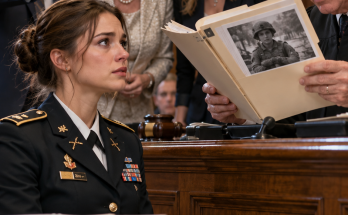
At the sentencing hearing, the judge asked whether either of us wanted to speak.
Emma stood first.
She held a piece of paper in trembling hands, but after a few sentences, she lowered it.
“You made us believe that being afraid was our fault,” she said. “You taught us to apologize for your cruelty. You convinced us that nobody would believe us because you were charming when other people were watching.”
Richard stared at the table.
“You didn’t just hurt us,” Emma continued. “You stole years we can never get back. But you don’t get to steal the rest of our lives.”
Then she sat down.
I stood beside her.
“For years, I thought surviving meant staying quiet,” I said. “I thought if I endured enough, you might eventually leave us alone. I understand now that silence protected you, not us.”
I looked directly at him.
“You wanted two frightened girls who would never tell anyone what happened behind closed doors.”
My voice steadied.
“But we’re not those girls anymore.”
The courtroom was silent.
When the hearing ended, Emma and I walked outside together.
The sun was shining, and the air smelled like rain.
For a long time, neither of us spoke.
Then Emma slipped her hand into mine.
“Do you think Dad would be proud of us?”
I thought about the letter he had left behind. I thought about the recorder hidden in the schoolbag, the doctor who had listened, the attorney who had kept searching, and the uncle who had finally helped us recover the truth.
“I think he would be proud that we survived,” I said. “But I think he’d be even prouder that we stopped blaming ourselves.”
We moved into a small apartment near the college we both wanted to attend. Emma studied nursing because she wanted to help people who were frightened and alone. I studied forensic accounting, determined to understand the kind of financial deception that had helped destroy our family.
We kept our father’s photograph on the living room shelf.
Our mother wrote to us several times.
Her letters were full of apologies, explanations, and promises that she had changed. We didn’t answer immediately. Eventually, we agreed to meet with a counselor present, but we made no promises about reconciliation.
Forgiveness, we learned, was not an obligation.
It was a choice we could make in our own time, or not make at all.
One year after the night at the hospital, Emma and I returned to Dr. Cole’s office to thank him.
He remembered us immediately.
“I was only doing my job,” he said.
“No,” Emma replied gently. “You were doing what everyone else should have done.”
He looked uncomfortable with the praise, but he smiled when we told him about college.
As we left the hospital, I paused beside the entrance.
A year earlier, we had been carried through those doors unconscious, terrified, and convinced nobody would ever believe us.
Now we walked out together, holding our own keys, carrying our own documents, and deciding our own future.
Richard had spent six years trying to convince us that we belonged to him.
He was wrong.
We belonged to ourselves.
And the most important thing we learned was not that every villain eventually gets punished, or that every mystery finds a satisfying answer.
It was that the truth does not become less true simply because someone powerful denies it.
Sometimes justice begins with a doctor who refuses to look away.
Sometimes it begins with a recording hidden beneath a floorboard.
And sometimes it begins with two frightened sisters reaching for each other’s hands and deciding that, whatever happens next, neither of them will ever have to face the darkness alone again.