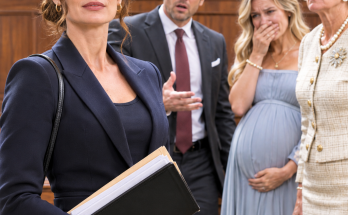
PART 1 — HE GAVE MY MOTHER’S DIAMONDS TO HIS MISTRESS
My husband put my dead mother’s diamond necklace around his mistress’s neck, then served me divorce papers in front of 400 guests at our twelfth-anniversary gala.
He expected me to cry.
He expected me to beg.
Most importantly, he expected me to sign away everything my family had built before midnight.
But he made one terrible mistake.
He let me read the red handwriting in the margins of the divorce agreement.
And by the time the sun rose the next morning, the woman he had spent twelve years underestimating would become the one person capable of bringing his entire empire to its knees.
My name is Vivienne Ashford, and until that evening, I believed the worst thing a husband could do was fall out of love with his wife.
I was wrong.
The worst thing he could do was pretend to love her while secretly preparing to destroy her.
The anniversary gala was held at the magnificent Sterling Grand Hotel in Manhattan. Crystal chandeliers illuminated the ballroom, golden lights reflected off polished marble floors, and hundreds of white roses decorated the tables.
Four hundred guests had gathered to celebrate what the newspapers called one of New York’s most successful marriages.
My husband, Adrian Ashford, was the chairman of Ashford Crown Holdings, a hospitality empire that owned luxury hotels, private resorts, and commercial properties across the country.
To the public, he was a self-made billionaire with impeccable manners.
To our friends, he was a devoted husband.
To me, he had once been the man who sat beside my hospital bed all night when I lost our first pregnancy.
I had spent twelve years believing that the man who held my hand through that tragedy would never deliberately break my heart.
Then I saw him walk into the ballroom with Vanessa Reed.
Vanessa was thirty-one, breathtakingly beautiful, and dressed in a champagne-colored gown that shimmered beneath the chandeliers.
But it wasn’t her dress that made my stomach tighten.
It was the necklace around her throat.
Twenty-one diamonds surrounded a rare emerald, set in platinum with a tiny engraved flower beneath the clasp.
My mother had worn that necklace on the day she married my father.
Before she died, she had clasped it around my neck and whispered, “One day, you’ll understand that the things worth protecting are rarely the things people can see.”
She left it to me in her will.
I had kept it inside a locked jewelry vault in our penthouse.
Adrian knew exactly what it meant to me.
Yet there it was, resting against Vanessa’s skin as if it had always belonged to her.
I rose from my chair.
“Where did you get that necklace?”
Vanessa touched the emerald and gave me a sympathetic smile.
“Adrian gave it to me. Isn’t it beautiful?”
The surrounding conversations began to fade.
Adrian approached us with a cream-colored envelope in his hand. His expression was calm, almost bored, as if he were discussing an overdue business invoice.
“Vivienne, we need to settle something tonight.”
He placed the envelope in front of me.
Inside were divorce papers, a property settlement, and a document requiring me to surrender any claim against his companies.
The agreement gave me a small monthly allowance and temporary access to our Manhattan apartment.
In exchange, I would waive my rights to several properties, accept responsibility for certain household debts, and agree never to challenge the financial arrangements of Ashford Crown Holdings.
I had seventy-two hours to leave every property connected to the company.
Seventy-two hours to disappear from the life I had helped build.
And one hour to sign the agreement before Adrian’s lawyers would supposedly withdraw their offer.
I stared at him.
“You’re divorcing me at our anniversary party?”
He adjusted his cuff links.
“I tried to handle this privately. You kept avoiding the conversation.”
“Which conversation? The one where you explain why your mistress is wearing my mother’s necklace?”
Vanessa lowered her eyes, but the corners of her mouth betrayed her.
Adrian’s expression hardened.
“Don’t embarrass yourself, Vivienne. Vanessa has nothing to do with our marriage.”
“Then why is she wearing my property?”
“It’s jewelry, not a national treasure.”
I felt something inside me go very still.
For twelve years, I had protected Adrian’s reputation. I had smiled through his business dinners, excused his unexplained absences, and remained silent whenever rumors about his relationships reached me.
I had done it because I loved him.
Or perhaps because I loved the man I remembered.
Adrian pushed the papers closer.
“Sign tonight, and you’ll leave with enough money to live comfortably. Refuse, and my lawyers will make this extremely unpleasant.”
I opened the settlement again.
That was when I noticed the red handwriting.
Someone had written several notes in the margins.
“She will sign if the photographers are watching.”
Another note appeared beside the section concerning family properties.
“Keep Hawthorne Estate out of the disclosure schedule.”
Farther down, beside the clause requiring me to surrender future financial claims, someone had written:
“Do not allow independent review. The trust transfer must remain undiscovered.”
My fingers tightened around the pages.
Hawthorne Estate was my mother’s ancestral property in Connecticut. Adrian had told me it was sold eleven years ago to settle a business debt.
I had mourned its loss because it was the last place where my mother and I had lived together.
Why would anyone insist on keeping a supposedly sold property out of a divorce agreement?
And what trust transfer were they talking about?
I turned to the final page.
A signature appeared beneath the red notes.
Not Adrian’s.
Not his attorney’s.
It belonged to Vanessa Reed.
She had been involved in preparing my divorce settlement.
I looked up slowly.
“Vanessa, did you write these notes?”
Her smile disappeared for a fraction of a second.
Adrian immediately took the document from my hands.
“Enough. You’re tired, emotional, and making accusations you can’t support.”
I watched him fold the papers.
Then I noticed something else.
His right hand was trembling.
Adrian never trembled. Not during hostile takeovers, not when a hotel project lost millions, and not even when his father died.
Yet the sight of those red notes had frightened him.
That was when I realized this divorce was not simply about replacing me with another woman.
They needed something from me.
Something they couldn’t take without my signature.
I reached into my evening bag and removed the business card of the attorney sitting three tables away.
His name was Nathaniel Cross, a former legal adviser to my father’s estate and one of the few people Adrian had never managed to intimidate.
Adrian glanced at the card.
“Why is he here?”
“Because I invited him.”
Nathaniel had been helping me investigate several unexplained transactions involving my inheritance. I had discovered that money from a family trust was moving through companies I had never heard of.
I hadn’t yet understood where it was going.
But now I knew someone desperately wanted me to stop asking questions.
I handed Nathaniel the settlement.
“Please read the red notes.”
He studied the pages, and the expression on his face changed.
“Mr. Ashford,” he said quietly, “I strongly advise you not to ask your wife to sign anything else tonight.”
Adrian laughed.
“You’re attending an anniversary party, Cross. Don’t pretend you’re in a courtroom.”
Nathaniel closed the folder.
“Then you shouldn’t have presented evidence of a potentially concealed asset in front of four hundred witnesses.”
Silence spread across the nearest tables.
Vanessa reached for Adrian’s arm.
He ignored her.
For the first time that evening, my husband looked at me without pretending to love me or pity me.
He looked at me with fear.
I stood, gathered my handbag, and removed my wedding ring.
I placed it directly on top of the divorce papers.
“You gave me seventy-two hours to leave your life,” I said. “I’ll need less than that to decide what happens next.”
Adrian leaned toward me.
“You have no idea what you’ve just started.”
I met his eyes.
“Then perhaps you should have been more careful about what you put in writing.”
I walked out of the ballroom with Nathaniel beside me.
Behind us, the music stopped.
And somewhere inside that glittering room, four hundred guests began asking the same question.
What had Adrian Ashford done?
Nathaniel waited until we reached the private elevator before speaking.
“Vivienne, there’s something I need to ask you.”
“What?”
“Did your mother ever tell you that Hawthorne Estate was placed in a family trust?”
I shook my head.
He closed his eyes briefly.
“Then your husband has been lying to you for much longer than you realize.”
He took the settlement from his briefcase and pointed to the red note about the trust transfer.
“Because if this document means what I think it means, your mother may have left you something far more valuable than a house.”
He paused.
“She may have left you the company your husband believes he owns.”
PART 2 — THE HOUSE HE CLAIMED WAS SOLD
At 8:17 the following morning, Nathaniel called me with news that changed everything.
“Hawthorne Estate was never sold.”
I sat motionless in my temporary hotel suite, staring at the rain running down the windows.
“What do you mean?”
“I mean the property is still registered to a family trust established by your grandfather. The records show that the trust was amended shortly after your mother’s death.”
“Who amended it?”
“Your husband attempted to.”
I gripped my phone.
“Attempted?”
“The transfer was never properly completed. There are missing approvals, questionable signatures, and several payments to a company connected to Vanessa Reed.”
I remembered the red handwriting.
Keep Hawthorne Estate out of the disclosure schedule.
“What does Vanessa have to do with my mother’s property?”
“That’s what we’re going to find out.”
Nathaniel arrived an hour later carrying three thick folders and a small black box.
Inside the box lay a silver key.
My mother had given it to me when I was twenty-two.
She had told me to keep it safe and never let anyone borrow it.
I had assumed it belonged to an old desk.
Nathaniel placed it beside a photograph of Hawthorne Estate.
“Your mother left instructions with her estate attorney. The key was supposed to be delivered to you if anyone tried to transfer the estate without your consent.”
I stared at him.
“She knew someone might try?”
“Apparently, she was concerned about your father’s business partners. But she also left a sealed letter.”
He handed it to me.
My mother’s handwriting appeared across the envelope.
For Vivienne, when the truth can no longer be hidden.
My hands shook as I opened it.
Inside was a single page.
My darling girl,
If you are reading this, someone has tried to take what belongs to you. Do not trust the person who insists that signing a document will make everything easier. Some people will use love to enter your home, then use your silence to take it apart.
The key opens the cabinet in the old library. What you find there will explain why I refused to sell Hawthorne Estate, even when the people around me said it was worth more as cash.
Remember this: ownership is not the same as possession.
All my love,
Mother.
I read the letter three times.
Adrian had spent twelve years telling me that my inheritance was insignificant compared with his business empire.
He had called Hawthorne Estate an expensive memory.
He had insisted that my mother’s investments had disappeared during a difficult financial period.
I had believed him because I trusted him more than I trusted myself.
Now I wondered whether our entire marriage had been built around a secret.
That afternoon, Nathaniel drove me to Hawthorne Estate.
The house stood behind iron gates at the end of a long, tree-lined driveway. Its white stone walls were weathered, and ivy climbed around the windows, but the property was unmistakably beautiful.
I had not visited in nine years.
Adrian had told me the new owners refused visitors.
The gatekeeper recognized me immediately.
“Mrs. Ashford,” he said, correcting himself a moment later. “Miss Vale. I’m sorry. Your mother always said you’d come back.”
My heart tightened.
“Who owns the property now?”
He looked confused.
“The Vale Family Trust, of course.”
Inside the library, I found the cabinet behind a row of leather-bound books.
The silver key fit perfectly.
There were old contracts, property deeds, bank statements, and a sealed document bearing the signature of my grandfather.
Nathaniel examined the papers while I stood beside the window.
Then he stopped turning pages.
“Vivienne, you need to sit down.”
I approached the desk.
“What is it?”
He pointed to a corporate ownership agreement.
My grandfather had established a holding company decades earlier. The company had acquired hotels, commercial buildings, and land long before Adrian entered the hospitality industry.
After my grandfather died, my mother inherited the controlling interest.
When she died, the controlling interest passed into a protected trust for me.
The company was called Vale Meridian Group.
And according to the documents, it owned a significant portion of the properties operated by Ashford Crown Holdings.
I stared at the page.
“How much?”
Nathaniel checked the latest ownership records.
“Enough to challenge the foundation of Adrian’s business empire.”
My husband had not built his company entirely from nothing.
He had expanded using property leases, financing arrangements, and guarantees connected to assets he had claimed were his own.
Some of those guarantees depended on agreements with Vale Meridian Group.
Agreements I had never seen.
Agreements Adrian had repeatedly assured me were routine paperwork.
But the worst discovery was still waiting.
Nathaniel opened another folder containing records of transfers made over the previous eleven years.
Millions of dollars had moved from accounts associated with my inheritance into companies controlled by Vanessa’s relatives.
The transfers were described as consulting fees, management charges, and property-development expenses.
Several had been approved using documents bearing my name.
I had never signed them.
“Is this forgery?” I whispered.
“It may be. We’ll need forensic examination and the original records before drawing a final conclusion.”
He showed me one more document.
It was a draft agreement between Adrian and Vanessa.
The date was three years earlier.
The document described a plan to restructure Ashford Crown Holdings after my inheritance was transferred into a new company.
A handwritten sentence appeared near the bottom.
“Once Vivienne signs the marital release, there will be no remaining obstacle.”
I felt sick.
The affair had not begun because Adrian fell in love with someone younger.
At least, that was not the whole story.
Vanessa had been involved in the financial restructuring long before I discovered their relationship.
The necklace, the divorce papers, the public humiliation—all of it had been designed to push me into signing away my rights before I could investigate the money.
And the seventy-two-hour deadline was not generosity.
It was a trap.
My phone began vibrating.
Adrian.
I answered.
“Where are you?” he demanded.
“Somewhere you told me no longer belonged to me.”
A long silence followed.
“Hawthorne Estate?”
“Funny how you knew exactly where to look.”
“Vivienne, listen to me. Whatever Nathaniel told you, he’s twisting things. You’re making a terrible mistake.”
“Then explain why your company tried to transfer assets from my family trust.”
His breathing changed.
“Those transactions were business arrangements.”
“Then you won’t mind explaining them to a judge.”
He lowered his voice.
“You don’t understand what happens if Ashford Crown collapses. Thousands of employees could lose their jobs. Suppliers, investors, families. You would be responsible for destroying everything.”
There it was.
The final weapon of a man who had run out of excuses.
Guilt.
For twelve years, he had used my loyalty to protect himself.
Now he wanted to use the livelihoods of innocent people to keep me quiet.
“I’m not trying to destroy your company, Adrian,” I said. “I’m trying to discover who actually owns what.”
“You need to stop this investigation.”
“No.”
His voice turned cold.
“If you continue, I’ll make sure you never see a dollar from me.”
I looked at the documents on the desk.
For the first time, the threat sounded ridiculous.
“That’s all right,” I replied. “I’ve started looking for the money you took from me.”
I ended the call.
Nathaniel watched me carefully.
“He’s going to react badly.”
“Then we’d better make sure every document is protected.”
We spent the next several hours securing copies of the trust records and contacting independent forensic accountants.
Before sunset, Nathaniel received a message from an unknown number.
It contained a single photograph.
Vanessa stood inside Adrian’s private office, holding a thick envelope.
Behind her was a wall safe, its door hanging open.
Nathaniel enlarged the photograph.
On the desk sat a document labeled Original Beneficial Ownership Register.
The message beneath the image read:
Ask Vanessa what happened to the original signatures.
I looked at Nathaniel.
“Who sent this?”
“We don’t know.”
Then another message arrived.
You have forty-eight hours before Adrian moves the remaining assets.
I felt the room grow colder.
Adrian knew we had found Hawthorne Estate.
He knew we had uncovered the trust.
And someone inside his organization was frightened enough to risk exposing him.
I looked at my mother’s letter one final time.
Ownership is not the same as possession.
Suddenly, I understood why she had chosen those words.
Adrian had spent years possessing the things my family owned.
He had mistaken access for ownership, silence for consent, and my love for weakness.
But the original ownership register could prove exactly what he had done.
If we found it, the case would become much stronger.
If he destroyed it first, he might escape accountability for the transfers.
Nathaniel closed the folders.
“We need to find Vanessa.”
I looked toward the darkening windows.
“No,” I said. “We need to make her come to us.”
And for the first time since the gala, I smiled.
Because I had finally discovered something Adrian had never understood.
A person who has spent twelve years being underestimated knows exactly how careless the powerful can become.
PART 3 — THE WOMAN WHO OWNED HIS EMPIRE
Vanessa called me at 10:42 the next morning.
Her voice was barely recognizable.
“Vivienne, I need to speak with you.”
“About what?”
“Adrian.”
I glanced at Nathaniel, who was sitting across the table.
“Then speak.”
“Not on the phone.”
She gave me the name of a private restaurant near Central Park and asked me to come alone.
Nathaniel advised against meeting her without legal safeguards. We arranged for him to remain nearby, and I agreed to meet Vanessa in a public place.
When she arrived, she wore no jewelry.
Not even the necklace.
She looked exhausted.
For a moment, I remembered the confident woman who had stood beside Adrian at our anniversary gala, smiling while he handed me divorce papers.
That woman was gone.
“I took the necklace off,” she said before sitting down. “It’s in a safe place. I wanted to return it.”
“Why should I believe anything you say?”
“You shouldn’t. Not yet.”
She placed a small flash drive on the table.
“This contains copies of the original ownership records, payment instructions, and emails between Adrian and his financial advisers.”
I did not touch it.
“Why are you giving me this?”
“Because Adrian intends to blame everything on me.”
Her eyes filled with tears, but I refused to confuse fear with innocence.
“You helped prepare my divorce settlement.”
“Yes.”
“You wore my mother’s necklace.”
“Yes.”
“You knew about the transfers.”
She looked down.
“Yes.”
Each admission landed harder than the last.
“Then why should I help you?”
Vanessa swallowed.
“Because I was stupid enough to believe Adrian would marry me after the divorce. I thought he loved me. I thought the company restructuring was legal, and I thought you were simply refusing to let go of a marriage that had already ended.”
“And now?”
“Now I know he never intended to give me anything.”
She explained that Adrian had promised her a senior executive position and a substantial ownership interest in a new hospitality company.
In return, she had helped prepare documents, coordinate transfers, and persuade certain advisers that the restructuring was legitimate.
She claimed she had not understood that some signatures were disputed until an internal auditor questioned the records.
When she confronted Adrian, he told her the documents were none of her business.
Then she discovered that the proposed divorce settlement named her as a witness to transactions she had never personally verified.
If the investigation began, she could face serious legal consequences.
“So you want protection,” I said.
“I want the truth to come out before he makes me the only person responsible.”
I studied her face.
“Did you know the necklace belonged to my mother?”
She closed her eyes.
“He told me it was a family heirloom he had purchased years ago.”
“You never asked why he gave you something so personal on the night he intended to destroy his marriage?”
“I didn’t think about it.”
“No,” I said quietly. “You didn’t think about me.”
She had no answer.
I took the flash drive and stood.
“Give everything to Nathaniel. Tell him the complete truth. He will decide what can be used and how to preserve it.”
“Will you forgive me?”
I looked at the woman who had helped my husband humiliate me in front of four hundred people.
“No. Not today.”
Then I walked away.
That afternoon, Nathaniel delivered the evidence to independent investigators and notified the relevant parties through the appropriate legal channels.
The forensic accountants began examining the disputed transactions. Our legal team sought to protect the family trust’s assets and challenge the settlement Adrian had presented.
We did not announce our findings to the press.
We did not threaten Adrian with public humiliation.
We simply stopped giving him opportunities to hide what he had done.
He responded by filing an emergency motion accusing me of interfering with his business.
His lawyers argued that I was a vindictive wife attempting to destroy a successful company because my husband wanted a divorce.
For years, that story might have worked.
But this time, we had the documents.
The ownership records showed that the trust had retained its controlling interest in Vale Meridian Group. The financial records raised serious questions about transfers involving properties connected to Ashford Crown Holdings.
And the disputed signatures required an independent examination.
Adrian’s lawyers could no longer dismiss the matter as a private marital disagreement.
Three weeks later, a court hearing was scheduled to address the disputed settlement and preserve the assets while the ownership questions were investigated.
Adrian arrived wearing a charcoal suit and the same confident expression he had worn at our anniversary gala.
Vanessa sat behind his legal team.
She looked at the floor.
When the hearing began, Adrian’s attorney argued that I had voluntarily accepted financial arrangements during our marriage and was now attempting to rewrite history.
Nathaniel responded by presenting the red-ink notes from the divorce settlement.
The judge examined the document.
“Who prepared these handwritten instructions?”
Adrian’s attorney said the matter was under investigation.
“Then why,” the judge asked, “does the proposed settlement specifically instruct the parties to exclude a property held by a trust connected to the claimant?”
No one answered immediately.
Nathaniel presented the Hawthorne Estate records.
Then he introduced the ownership documents showing Vale Meridian Group’s relationship to properties operated by Ashford Crown Holdings.
Finally, he presented the disputed transfer records and requested that the court preserve the relevant assets while the evidence was examined.
The judge granted temporary protections and ordered the preservation of specified financial records.
It was not a final ruling on ownership or wrongdoing.
But it was enough to stop Adrian from rushing through the settlement as if nothing had happened.
Outside the courtroom, reporters crowded the steps.
Adrian pushed past them and approached me.
“You’ve ruined everything,” he hissed.
I looked at him.
“No, Adrian. I stopped pretending everything was fine.”
He glanced at Nathaniel.
“You think you can take my company?”
Nathaniel answered before I could.
“The question is whether you ever owned everything you claimed to own.”
Adrian’s face changed.
For the first time, he had no polished response.
Over the following months, the investigation uncovered additional discrepancies in the financial records. Some transactions had been improperly documented, and several approvals were disputed. The company faced intense scrutiny from its lenders, investors, and business partners.
Adrian stepped aside from certain executive responsibilities while the investigation continued.
Vanessa cooperated with investigators and provided records that helped establish the timeline of the disputed transactions. Her cooperation did not erase her own decisions, and she still faced questions about her involvement.
I did not celebrate her downfall.
I did not need to.
My mother had taught me that justice was not the same as revenge.
The necklace was returned to me after its ownership was documented.
When I held it again, I remembered my mother’s hands fastening the clasp around my neck. For the first time in years, I felt that I had recovered something more important than jewelry.
I had recovered my right to decide what happened to my own life.
The divorce was eventually resolved through a separate legal process. The financial and ownership disputes took longer, and the final outcomes depended on the evidence and the applicable law.
I returned to Hawthorne Estate.
The gardens were overgrown, and the library smelled of dust and old paper. I spent the first evening sitting beside the window where my mother used to read to me.
Then I made a decision.
I would restore the estate and establish a foundation there to support women rebuilding their lives after financial abuse, coercive relationships, and sudden family crises.
I wanted it to become a place where a woman could receive legal guidance, learn how to protect her finances, and discover that losing a marriage did not mean losing her future.
Six months after the gala, I attended the reopening of the estate’s restored library.
There were no photographers waiting for me.
No reporters asking whether I had won.
No powerful man standing beside me, explaining what I was allowed to own.
Only a small group of guests, a table of white roses, and a framed photograph of my mother.
Nathaniel approached me with a final envelope.
Inside was a copy of the original trust document, now preserved with the other legal records.
Beneath it was a note from my mother’s estate attorney.
Your mother always believed you would eventually find the strength to protect what she left you. She only hoped you would discover that strength before someone forced you to.
I folded the note carefully.
Across the room, sunlight fell over the old wooden shelves.
For twelve years, Adrian had believed that my greatest weakness was my desire to keep our marriage private.
He thought I would tolerate anything to avoid a scandal.
He believed I would surrender my inheritance rather than confront him.
He believed the woman he married would always be too frightened to challenge the man he had become.
He was wrong.
I had not destroyed his empire.
I had simply refused to sign away the truth.
And sometimes, that is enough to change everything.
As I placed my mother’s necklace inside its restored velvet case, I remembered the last words she had written in her letter.
Ownership is not the same as possession.
Now I finally understood.
A man can possess your home without owning your future.
He can take your jewelry without taking your memories.
He can betray your trust without destroying your worth.
And he can hand you divorce papers in front of four hundred people, believing that the entire world is watching you fall apart.
But he cannot control what happens when you finally stand up, open the documents, and read the truth for yourself.
THE END.