PART 1 — THE WEDDING THAT CHANGED EVERYTHING
At 73, I never imagined I would wear a wedding dress again.
But when my first love, Daniel Whitmore, lay dying in a hospital bed, I made a promise that would change the rest of my life.
I would marry him.
Even though I had spent more than fifty years believing our love story had ended forever.
Daniel and I met when we were seventeen. He was the boy who waited outside my school with wildflowers in his hands, who walked me home in the rain, and who promised that one day we would grow old together.
We truly believed we had forever.
Until life got in the way.
I received a scholarship to study nursing in another state. Daniel wanted me to stay in our hometown and help him build the family business his father had left behind.
We argued for weeks.
On the night before I left, he stood outside my house, his eyes red from crying.
“If you get on that train tomorrow, Eleanor, don’t expect me to wait for you forever,” he whispered.
I was young, stubborn, and convinced that following my dreams was the only choice I had.
“I love you, Daniel,” I told him. “But I can’t give up my future.”
He looked at me for a long moment.
“Then I suppose we’ll have to find out what our future looks like without each other.”
I boarded that train the next morning.
Neither of us knew those would be the last words we exchanged for more than five decades.
I never married. I came close once, but the relationship ended before the wedding. After that, I devoted myself to nursing, caring for patients who had families waiting beside their beds and others who had nobody at all.
I told myself I was happy.
And most days, I was.
But every year, on my birthday, I wondered whether Daniel had found someone else.
Whether he had children.
Whether he still remembered the girl who had broken his heart.
I never asked anyone about him. Pride can be a cruel companion, especially when you grow old.
Then, six months ago, I returned to my hometown after retiring. My pension barely covered my expenses, so I accepted a part-time nursing position at a small hospital.
On my third day, I was assigned to a new patient.
I opened his medical chart.
Daniel Whitmore. Age 73. Advanced cancer.
My fingers went cold.
I walked into his room, expecting a stranger who happened to share my first love’s name.
Instead, I saw a thin, silver-haired man lying beneath a white blanket, oxygen tubing resting beneath his nose.
He turned his head.
For several seconds, neither of us spoke.
Then he smiled.
“Eleanor?”
My knees nearly gave way.
“Daniel?”
His eyes filled with tears.
“After all these years,” he whispered, “you finally came home.”
I wanted to ask a thousand questions. Why hadn’t he married? Had he ever looked for me? Had he hated me all those years?
Instead, I pulled a chair beside his bed and took his trembling hand.
We talked until my shift ended.
The next day, I returned to his room.
And the day after that.
Soon, our conversations became the brightest part of both our days. We spoke about our childhood, the dreams we had abandoned, and the lives we had built without each other.
One afternoon, Daniel reached beneath his pillow and showed me an old photograph.
It was a picture of us at seventeen, standing beside the river behind our high school.
“You kept that?” I asked, stunned.
“Every day of my life.”
I pressed my hand against my mouth.
“Daniel, why didn’t you ever marry?”
He looked toward the window.
“Because the only woman I ever wanted to marry was too busy building a life that didn’t include me.”
His words hurt, but I understood the pain beneath them.
“I’m sorry,” I whispered.
He squeezed my hand.
“So am I.”
For the first time in fifty-six years, I leaned forward and kissed his forehead.
Neither of us wanted to let go.
Two days later, Daniel asked me to come closer.
“Eleanor, I need to ask you something, and I need you to answer honestly.”
“Anything.”
“The doctors say I don’t have much time left.”
My throat tightened.
“Please don’t talk like that.”
“I have to. There’s something I’ve wanted since we were seventeen, and I don’t want to die without asking you.”
He took a shaky breath.
“Will you marry me?”
I stared at him.
He gave a faint, embarrassed laugh.
“I know it’s ridiculous. We’re seventy-three. I can barely stand without help. But I want to call you my wife, even if it’s only for a few weeks.”
Tears slipped down my cheeks.
“Daniel…”
“Please,” he whispered. “Let me have this one thing before I go.”
I looked at the boy I had loved, the man I had lost, and the dying stranger who somehow still felt like home.
Then I nodded.
“Yes. I’ll marry you.”
Three days later, we were married in his hospital room.
I wore a simple ivory dress. Daniel wore a clean blue shirt, and a nurse placed a tiny bouquet of white roses beside his bed.
Two nurses witnessed the ceremony. A hospital chaplain spoke a few gentle words.
When Daniel slipped a gold ring onto my finger, his hands shook so badly that I had to help him.
He looked at me with tears shining in his eyes.
“Fifty-six years late,” he whispered.
I laughed through my tears.
“But we’re here now.”
He kissed my hand.
For the first time in decades, I felt as though a missing piece of my heart had finally returned.
We spent the following weeks talking, holding hands, and remembering the life we might have shared.
Then, one quiet morning, Daniel passed away.
I was holding his hand when his breathing stopped.
His final words were barely audible.
“Don’t let them fool you, Ellie.”
I leaned closer.
“Who, darling?”
But his eyes had already closed.
I cried for three days.
I thought I had lost him twice in one lifetime, and this time there would be no reunion.
The morning after his funeral, someone knocked on my front door.
A tall man in a charcoal suit stood outside, holding a leather briefcase.
“Mrs. Whitmore?” he asked.
I nodded, confused by the unfamiliar title.
“My name is Richard Hayes. I was Daniel’s attorney for nearly thirty years.”
I invited him inside.
He didn’t sit down.
Instead, he studied me with an expression I couldn’t understand.
“Your husband left very specific instructions concerning you.”
I wiped my eyes.
“Did he leave me a letter?”
Richard slowly shook his head.
“More than a letter.”
He placed a small wooden box on my coffee table.
Then he said something that made my blood run cold.
“Mrs. Whitmore, Daniel warned me that you would agree to marry him. He said you would believe you were granting a dying man’s final wish.”
I stared at him.
“What are you talking about?”
Richard opened his briefcase and removed a sealed envelope bearing Daniel’s handwriting.
Then he looked directly into my eyes.
“Daniel told me to say this to you after his funeral: ‘Eleanor walked straight into my trap.’ ”
My hands began to shake.
“His trap? What trap?”
The lawyer pushed the wooden box toward me.
“Before I explain, you need to see what’s inside.”
I lifted the lid.
And the moment I saw the contents, I screamed.
Because beneath the velvet lining lay an old photograph of Daniel and me at seventeen, a key I had not seen in fifty-six years, and a folded document with my full name printed across the top.
But it was the handwritten sentence beneath my name that made my heart stop.
“To my wife, Eleanor Whitmore: the truth about the night you left is finally yours to discover.”
And suddenly, I remembered Daniel’s final words.
Don’t let them fool you, Ellie.
To be continued…
PART 2 — THE SECRET HE KEPT FOR FIFTY-SIX YEARS
Richard sat across from me while I unfolded the document.
It wasn’t a will.
It was a property deed.
The address belonged to the old Whitmore family mansion, the house where Daniel had grown up and where we had spent countless afternoons dreaming about our future.
But the deed listed me as the sole beneficiary.
I looked up in disbelief.
“Why would Daniel leave me his childhood home?”
Richard folded his hands.
“Because that house was supposed to become yours fifty-six years ago.”
I stared at him.
“What?”
He opened the envelope and removed a letter written in Daniel’s familiar handwriting.
“Eleanor,” it began, “if you’re reading this, then I have finally done something I should have done a lifetime ago. I have given you the truth.”
The letter explained that the night before I left for college, Daniel had discovered a secret about my family.
My father had been accused of stealing money from the company where he worked. The accusation had destroyed his reputation, and our family had been struggling financially.
Daniel’s father had offered to help.
But there had been a condition.
He wanted Daniel to marry the daughter of a wealthy business partner instead of me.
Daniel had refused.
His father threatened to cut him off and told him that I would eventually abandon him once I learned how little money he had.
Then came the revelation that changed everything.
Daniel had discovered documents proving that my father had not stolen anything. The missing money had been diverted by a senior executive who had framed him.
Daniel intended to tell me the truth.
But before he could, someone delivered a letter to his house claiming that I had accepted a proposal from another man and planned to leave town without saying goodbye.
The letter was supposedly written by me.
It wasn’t.
And Daniel believed it.
I lowered the paper, unable to breathe.
“I never wrote that letter.”
“I know,” Richard said quietly. “Daniel eventually discovered that, too.”
I pressed my trembling hands against my face.
“Then why didn’t he come looking for me?”
Richard hesitated.
“Because by the time he learned the truth, you had already left. He tried to contact you, but his father intercepted his letters. Years later, when Daniel finally confronted him, his father admitted what he had done.”
I felt as though the room were spinning.
Fifty-six years.
Fifty-six years of wondering whether Daniel had forgotten me.
Fifty-six years of believing we had simply chosen different lives.
And all that time, someone had deliberately torn us apart.
I looked at the key inside the box.
“What does this open?”
Richard’s expression grew serious.
“The safe in the old mansion. Daniel left something there that he insisted you must see with your own eyes.”
He paused.
“There’s one more thing you should know. Daniel didn’t marry you merely because he was dying.”
My stomach tightened.
“What do you mean?”
“Your marriage made you the legal recipient of certain property rights that his father had placed in trust decades ago. Daniel spent years trying to correct the arrangement. He never wanted you to inherit a problem without knowing its history.”
I gripped the key.
“What problem?”
Richard stood and buttoned his jacket.
“That is what the safe will explain.”
He handed me a second envelope.
“Please read this before you go to the mansion.”
After he left, I opened it.
Inside was a single photograph of a woman standing beside Daniel outside the old family house.
On the back, Daniel had written six words:
“The woman who destroyed us is alive.”
I stared at the photograph.
I knew that woman.
She was Margaret Whitmore, Daniel’s younger sister.
The same woman who had attended our wedding in the hospital and hugged me afterward.
The same woman who had cried at Daniel’s funeral.
And the same woman who had whispered into my ear that her brother had never truly recovered from losing me.
My hands went numb.
What had Margaret been hiding?
And why had Daniel waited until his death to expose it?
I barely slept that night.
At sunrise, I drove to the old Whitmore mansion with the key in my pocket and Daniel’s letter on the passenger seat.
The house stood behind an iron gate, its windows dark and its garden overgrown.
I unlocked the front door.
Inside, dust covered the furniture, but everything had been preserved as though Daniel had expected to return someday.
I found the study at the end of the hallway.
Behind a row of old books sat a steel safe.
The key turned.
Inside lay a thick folder, a small cassette recorder, and dozens of letters tied together with a faded blue ribbon.
Every letter was addressed to me.
Every letter was written by Daniel.
Some were dated the year I left. Others had been written five, ten, even twenty years later.
I picked up the first one.
My dearest Eleanor,
I don’t know whether you will ever read this. I only know that I cannot let you spend your life believing I stopped loving you.
My eyes filled with tears.
I reached for the next letter.
Then I noticed something tucked beneath the folder.
A bank statement.
And a document showing that someone had transferred a large amount of money from Daniel’s family trust just two weeks before our wedding.
The signature belonged to Margaret.
I stood frozen in the silent room.
Then the cassette recorder clicked on.
Daniel’s voice filled the room.
“Eleanor, if you’ve found this, then my sister has already begun telling people that I was confused, that my illness made me imagine things, and that you married me for my money.”
I sank into the chair.
“But there’s something she doesn’t know,” Daniel continued.
“The money she stole wasn’t mine alone.”
He paused.
“It belonged to the woman she spent fifty-six years trying to destroy.”
Then he said my name.
“Eleanor, the fortune you believe I’ve left you is only the beginning. The real secret is hidden in the final letter.”
I reached for the last envelope.
It was sealed with red wax.
On the front, Daniel had written:
“Open only when you are ready to learn what happened to your father.”
My father had died believing himself disgraced.
I had spent my entire adult life believing that nothing could ever repair the damage.
But Daniel had just revealed that the truth had been hidden from me all along.
I broke the seal.
Inside was a photograph of my father shaking hands with Daniel’s father.
And behind it was a signed confession.
The first line read:
“I, Charles Whitmore, admit that I deliberately framed Eleanor’s father to keep our families apart.”
I covered my mouth.
But the confession didn’t end there.
The final paragraph named the person who had helped him.
It was Margaret.
And beneath her name was a second signature.
One I recognized immediately.
My own father’s.
To be continued…
PART 3 — THE TRAP WAS NEVER ABOUT MONEY
I read the confession three times before I could accept what it said.
My father had not been innocent of every accusation.
Years earlier, he had signed a false statement under pressure, believing it would protect my family from financial ruin. He had later tried to correct the record, but the company buried the evidence and allowed the scandal to follow him for the rest of his life.
Daniel’s father had orchestrated the cover-up.
Margaret had helped him.
And when Daniel discovered what had happened, they had both worked to keep us apart.
I sank into the chair, weeping for the young woman I had been and the father who had carried a secret to his grave.
Then I remembered the cassette.
I pressed play again.
Daniel’s voice was softer now.
“Eleanor, I owe you an apology. I spent too many years angry with you when I should have been fighting harder to find you. I let pride make decisions that love should have made.”
He took a shaky breath.
“I can’t give you back the years we lost. But I can make sure you never have to wonder why.”
I wiped my cheeks.
“There’s another reason I asked you to marry me,” he continued.
“And this is the part that may make you angry.”
I leaned toward the recorder.
“When my doctors told me I was dying, I learned that Margaret had been quietly selling pieces of the family estate. She intended to empty the trust and leave the remaining debts to the people she believed would never fight back.”
He paused.
“I knew she would challenge anything I left to you. She would tell the court that you were a stranger, that our marriage was a desperate mistake, that I wasn’t thinking clearly.”
My heart pounded.
“So I asked Richard to make sure every decision was documented. I made my wishes clear while I was still capable of understanding them. I wanted the truth recorded, the property secured, and the stolen money traced.”
Daniel’s final words made me shiver.
“I called it a trap because Margaret has spent her entire life believing she was the cleverest person in the room. She never imagined that the woman she helped drive away would one day become the person who could expose her.”
I stopped the recording.
For a long time, I sat in the quiet study, surrounded by letters from the man I had loved my entire life.
Then my phone rang.
It was Richard.
“Eleanor, have you opened the safe?”
“Yes.”
“Then you know about Margaret.”
“I know enough.”
“There’s something else. Margaret has filed a petition challenging the validity of your marriage and Daniel’s final estate documents. She claims he wasn’t mentally competent when he married you.”
My stomach tightened.
“That’s a lie.”
“I know. We have the hospital records, the witnesses, and the independent evaluations Daniel arranged. But we need the original documents from the safe.”
I looked down at the folder.
“They’re here.”
“Good. Don’t let anyone take them from you. I’ll meet you at my office this afternoon.”
For the first time since Daniel died, I felt something stronger than grief.
I felt determined.
The court hearing took place three weeks later.
Margaret arrived in an elegant black suit, carrying herself like a woman who had never been told no.
When she saw me, she offered a small, pitying smile.
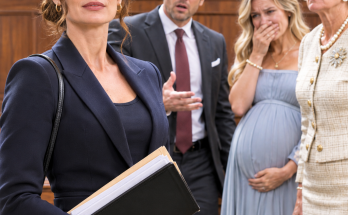
“Eleanor,” she said, “you really should have stayed away. My brother was sick. You can’t possibly believe that a hospital wedding makes you part of this family.”
I looked at her calmly.
“Your brother believed otherwise.”
Her smile disappeared.
Inside the courtroom, her attorney argued that Daniel had been too ill to understand his decisions and that I had manipulated his affection to gain access to his property.
I sat silently while he spoke.
Then Richard presented the medical records, the marriage documents, the witness statements, and the recordings Daniel had made with his attorney.
Finally, he submitted the letters and the confession from the safe.
Margaret’s expression changed as each document was read aloud.
When the judge asked whether she recognized her signature on the trust transfers, she hesitated.
“I don’t remember signing that.”
Richard placed the original documents before her.
“Would you like to examine them more closely?”
She said nothing.
Then Richard played the final recording.
Daniel’s voice filled the courtroom.
“Margaret, if you’re hearing this, then you’ve chosen to challenge my wife’s rights. I hope you’ll reconsider. You have taken enough from Eleanor already.”
Margaret’s face went pale.
Daniel continued.
“You told me years ago that she would never come back. You were wrong. She came back because life brought her home, and I married her because I loved her. Not because she asked for my money. Not because she wanted my house. Because after fifty-six years, I still loved the same girl who once stood beside the river and promised she would never forget me.”
My eyes filled with tears.
“And if you still believe this was a trap, Margaret, you’re right. But it wasn’t a trap for Eleanor.”
Daniel paused.
“It was a chance for you to tell the truth.”
The recording ended.
The courtroom was silent.
The judge rejected Margaret’s challenge to the marriage and ordered a full accounting of the trust transfers. The estate documents were upheld, and the disputed assets were placed under independent supervision while the financial investigation continued.
Margaret left the courtroom without looking at me.
I never celebrated her humiliation.
I had already lost too much time to anger.
What mattered was that Daniel’s final wishes had been respected, and the truth about my father was finally part of the public record.
Months later, I returned to the Whitmore mansion.
I restored the garden, repaired the old windows, and turned the unused rooms into a small residence for retired nurses who needed affordable housing.
I kept Daniel’s letters in a wooden chest beside the fireplace.
Every evening, I read one.
Some made me laugh. Others broke my heart.
In the final letter, Daniel had written:
My darling Eleanor,
People will tell you that our story ended when you boarded that train. They’ll say we wasted our lives loving someone we could not have.
But I don’t believe that.
You became a nurse. You helped strangers through their darkest hours. I built a business, made mistakes, and spent too long believing that pride was stronger than forgiveness.
We lived the lives we were given.
Then, when we had almost run out of time, we found each other again.
If you remember nothing else, remember this: I never married you to own you, trap you, or buy your love.
I married you because I wanted the world to know that you were my wife.
And I left you the truth because you deserved it.
Forever yours,
Daniel.
I folded the letter and held it against my heart.
At seventy-three, I had become a bride for only a few precious weeks.
But those weeks gave me something I had never expected to find again: the truth, the chance to forgive, and the knowledge that I had never been forgotten.
Sometimes, I still visit the river where Daniel and I took that old photograph.
I sit on the same wooden bench and watch the water move beneath the bridge.
And when the evening light touches the trees, I imagine him beside me, smiling that familiar smile.
I used to believe our love story was a tragedy because we lost fifty-six years.
Now I understand something different.
The cruelest trap wasn’t the one Daniel planned for his sister. It was the lie that made us believe we had stopped loving each other.
And the greatest gift he left me wasn’t the mansion, the money, or the family name.
It was the truth.
Because sometimes, even after a lifetime apart, love finds its way home.
THE END.