MY FAMILY CALLED ME A DISGRACED NAVY FAILURE FOR TEN YEARS—THEN I WALKED INTO FEDERAL COURT IN UNIFORM TO TESTIFY AGAINST MY BROTHER
PART 1 — THE DAUGHTER THEY WERE ASHAMED OF
For ten years, my family told everyone I had failed in the Navy.
They said I had been discharged in disgrace, embarrassed my parents, and disappeared because I couldn’t face my own mistakes.
My brother, Daniel, made sure the story never changed.
My parents believed him.
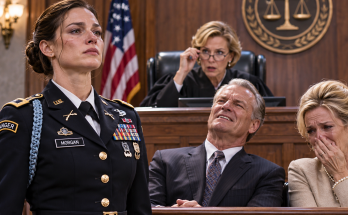
Then, one Tuesday morning, I walked into a federal courtroom wearing the uniform they had once accused me of disgracing.
And when my mother saw the medals on my chest, she dropped her handbag.
My name is Rebecca Hayes. I was twenty-nine years old when I finally learned how dangerous a lie could become when the people telling it had access to your identity, your finances, and your family name.
I joined the Navy at nineteen.
My father, Robert Hayes, never supported the decision.
“You’re too sensitive for that life,” he told me. “You’ll come home before your first year is over.”
I wanted to prove him wrong, but I wasn’t prepared for what proving him wrong would cost me.
I completed my training, earned my qualifications, and accepted assignments that demanded discipline and courage. I missed holidays, birthdays, and family celebrations. I learned to function on little sleep and to keep moving even when I was exhausted.
My older brother Daniel took a different path.
He was charming, ambitious, and obsessed with being the most successful person in our family. He had a talent for making ordinary achievements sound extraordinary, and our parents loved introducing him as the son who would one day build an empire.
For a while, I didn’t mind.
I thought there was room for both of us to succeed.
I was wrong.
The trouble began when our grandfather died and left behind a valuable stretch of waterfront property. Daniel wanted to sell it to finance a private security company. I objected because our grandfather had specifically asked us to preserve the land for our family.
Daniel never forgave me for standing in his way.
A few months later, I returned home during leave and found my father waiting at the dining-room table.
A stack of papers sat in front of him.
“Explain this,” he demanded.
The papers appeared to show that I had failed military evaluations and received a dishonorable discharge.
I stared at them in disbelief.
“They’re fake.”
Daniel sat beside our mother, looking disappointed.
“Rebecca, please stop. We know what happened.”
“Nothing happened! I’m still serving.”
My father slammed his hand on the table.
“Then why does this document say otherwise?”
“Because someone fabricated it!”
I asked him to contact my commanding officer. I offered to provide official records. I even showed him my military identification.
He barely looked at it.
My mother shook her head.
“You have always been stubborn, Rebecca. At least admit your mistakes.”
I turned toward Daniel.
He wouldn’t meet my eyes.
That was when I understood he had something to do with it.
I left that house without another word.
Over the next ten years, Daniel told relatives that I had been discharged. He said I was too ashamed to come home. He told our parents I had financial problems and had probably changed my number to avoid them.
Whenever I tried to correct the story, he claimed I was lying.
Eventually, I stopped trying.
I continued my career. I earned promotions, received commendations, and built a life I was proud of.
My family never asked about any of it.
Then, one morning, an investigator contacted me about a company called Northstar Defense Solutions.
The company had submitted bids for several federal emergency-response contracts. Its paperwork claimed that it qualified for a veteran-owned business preference.
My name appeared in the supporting records.
So did a military service history I had never submitted.
Someone had used my identity to make the company appear eligible for benefits it might not have qualified for.
And the company’s principal owner was my brother.
Daniel Hayes.
The investigator explained that the case involved disputed records, financial transactions, and questions about whether government officials had been misled. The investigation was ongoing, and they needed my help establishing which documents were genuine.
I agreed to cooperate.
Not because I wanted revenge.
Because my service was real, my identity belonged to me, and I would not let anyone use either one to deceive the government.
A few weeks later, I learned Daniel had been indicted on federal charges related to the contract scheme.
My parents were furious.
They called him a victim of jealous competitors and insisted that the government had misunderstood his business.
They still had no idea I was involved.
On the morning of the hearing, I stood outside the courtroom in my ceremonial uniform.
I adjusted my ribbons and took a steady breath.
Inside, Daniel sat beside his attorneys. My mother held my father’s arm while he whispered that everything would be fine.
They believed they were about to defend the family’s successful son.
Then the courtroom deputy announced my name.
The doors opened.
I stepped inside.
My mother turned first.
Her face drained of color.
My father slowly rose from his seat.
And Daniel, the brother who had spent ten years calling me a failure, stared at my uniform as though he had seen a ghost.
The prosecutor approached me.
“Commander Hayes, are you ready to testify?”
I nodded.
Daniel suddenly leaned toward his attorney and whispered something urgently.
His attorney stopped writing.
Then he looked directly at Daniel and asked a question that made my brother’s face turn white.
“Did you tell your parents whose name was on those original contracts?”
PART 2 — THE DOCUMENT THAT EXPOSED MY BROTHER
The courtroom fell silent.
Daniel shook his head at his attorney, but the damage was already done.
My father turned toward him.
“What does that mean?”
Daniel said nothing.
The judge instructed everyone to remain quiet while the proceedings continued.
I took my place near the witness stand.
For the first time in ten years, my family had to hear the truth from someone other than Daniel.
The prosecutor began with simple questions.
My name.
My rank.
My years of service.
My official record.
I answered each question clearly.
Then she displayed the military documents that Daniel’s company had submitted.
One page claimed I had received a dishonorable discharge. Another described me as a former service member who had supposedly authorized Northstar Defense Solutions to use my service history in its applications.
Neither document was authentic.
I explained that I had never signed the authorization, had never worked for Daniel’s company, and had never given him permission to use my personal records.
The prosecutor then presented verified records establishing my actual service history.
My mother covered her mouth.
My father stared at the pages.
Daniel’s attorney objected to several questions, and the judge ruled on each objection before the testimony continued. The court was not there to settle our family history. It was there to determine the facts relevant to the criminal case.
Still, those facts were beginning to dismantle the story Daniel had told for a decade.
Then the prosecutor introduced financial records.
Investigators had traced payments connected to Northstar’s contract applications. Some funds had moved through accounts associated with companies Daniel controlled. Other transactions were still under review.
One document was particularly troubling.
It showed that a family investment account had been used to guarantee a loan connected to Northstar.
My parents had signed the guarantee.
My father leaned toward Daniel.
“You told us that money was for the property development.”
Daniel whispered back, “Not now.”
But my father had finally started asking questions.
The prosecutor then displayed an email recovered during the investigation.
It contained a discussion about a veteran-owned business application and the need to establish a qualifying service history.
My name appeared in the conversation.
Daniel’s attorney immediately requested a recess.
The judge granted it.
As the courtroom emptied, my mother approached me in the hallway.
“Rebecca,” she whispered, “why didn’t you tell us you were still in the Navy?”
I looked at her.
“I did.”
She blinked.
“I showed Dad my records. I told you both the documents were fake. I asked you to listen.”
Her eyes filled with tears.
“We thought you were ashamed.”
“You thought Daniel was telling the truth. You never asked me what happened.”
My father came toward us, his expression hardening as he struggled to understand everything he had heard.
“Are you doing this to destroy your brother?”
I shook my head.
“No. I’m here because someone used my identity. What happens next depends on the evidence.”
He opened his mouth, but no words came.
For once, I didn’t try to fill the silence.
When proceedings resumed, the prosecutor introduced another set of records involving our grandfather’s waterfront property.
Investigators had discovered that documents used in a proposed sale included a disputed authorization bearing my name. The property transaction was not itself the central criminal charge, but it helped explain why my identity had been useful to Daniel.
If he could convince our family that I was disgraced, he could make it easier to dismiss any objection I raised.
The prosecutor turned toward the judge.
“The government expects additional evidence to clarify the relationship between the defendant’s business representations and the disputed personal records.”
Daniel’s face tightened.
My mother looked from him to me.
And then she noticed something else.
The prosecutor was holding an envelope marked with Daniel’s company name.
My brother recognized it immediately.
He stood so abruptly that his chair scraped against the floor.
“That’s private company correspondence!”
His attorney grabbed his sleeve and pulled him back down.
The judge warned Daniel to remain seated.
I watched my brother carefully.
For ten years, he had been comfortable lying about me because he believed I had no power to challenge him.
Now the evidence was speaking for itself.
During the recess that followed, Samantha Cole, an investigator assigned to the case, approached me.
“Commander Hayes, we found a second set of records. They may explain how your brother obtained the original documents.”
I lowered my voice.
“What did you find?”
She glanced toward the courtroom doors.
“A former company administrator has agreed to provide information. And she says your brother wasn’t the only person who knew your service history was being used.”
My stomach tightened.
“Who else knew?”
Samantha handed me a note with one name written on it.
My mother’s.
PART 3 — THE TRUTH MY MOTHER HAD BEEN AFRAID TO FACE
I read the name twice.
Judith Hayes.
My mother.
For a moment, the courthouse hallway seemed to tilt beneath my feet.
I had expected Daniel to lie. I had expected my father to defend him. But I had never imagined that my mother might have known more than she had admitted.
Samantha quickly explained that the administrator’s statement was only an investigative lead. It did not prove that my mother had committed a crime or knowingly participated in anything unlawful.
Still, I couldn’t stop thinking about the years I had spent believing she simply didn’t care enough to listen.
When my mother approached me again, I asked her directly.
“Did you know Daniel was using my name?”
She looked toward my father.
He stared at her, waiting.
My mother’s hands began to shake.
“I knew he had asked questions about your military records,” she admitted. “He told me you had authorized him to use them for a business application.”
“Did you see the authorization?”
“No.”
“Did you ask me?”
Her eyes filled with tears.
“No.”
I swallowed hard.
“Why?”
She looked down.
“Because Daniel told us that you were in trouble. He said you had embarrassed the family and that he was trying to repair the damage. I wanted to believe him.”
“You wanted to believe him more than you wanted to hear me.”
She began to cry.
“I know.”
My father turned away.
For the first time, neither of them had an excuse that could make the past disappear.
The legal proceedings continued over the following weeks. Investigators examined the disputed records, financial transactions, and statements made in connection with the government contracts. Daniel denied intentionally misleading anyone, and his attorneys challenged the evidence presented against him.
The court would have to decide the criminal allegations based on admissible evidence, not on my family’s anger or my own pain.
I understood that.
I had spent years in the Navy learning the difference between what I felt and what I could prove.
I wasn’t there to punish my brother for being jealous.
I was there to tell the truth.
Eventually, the case reached a major turning point. Additional records and testimony supported the government’s allegations concerning false business representations and the misuse of my identity. Daniel’s legal team faced mounting evidence, and the financial arrangements surrounding Northstar came under intense scrutiny.
My parents learned that the family assets they had pledged were exposed to financial consequences from the agreements they had signed. Their belief that Daniel was protecting their future had placed that future at risk.
The son they had defended without question had not protected the family from my supposed disgrace.
He had used that story to keep them from questioning him.
After one hearing, my father waited for me outside the courthouse.
He looked older than I remembered.
“Rebecca, I don’t know how to fix this,” he said.
I studied his face.
For years, I had imagined what it would feel like to hear him admit he was wrong. I had pictured an apology that would erase the hurt, a moment when everything returned to the way it had been before Daniel’s lies.
But standing there, I realized that no apology could give me back those ten years.
“You start by telling the truth,” I said. “Not just to me. To everyone you told I was a failure.”
He nodded slowly.
“And your mother?”
“She has to make her own choices. I can’t do that for her.”
My father looked down at the courthouse steps.
“I should have believed you.”
“Yes,” I replied. “You should have.”
I didn’t hug him. I wasn’t ready.
A few months later, I received a letter from my mother. She wrote that she had begun correcting the story she had told relatives and friends. She acknowledged that she had failed me by accepting Daniel’s claims without asking for proof.
Her letter did not ask me to forgive her immediately.
That mattered.
I continued my service and focused on the life I had built. I kept in contact with the investigators when needed, and I allowed the legal process to proceed without turning every hearing into a personal confrontation.
My relationship with my parents remained complicated. Trust had to be rebuilt through consistent actions, not promises made in a courthouse hallway.
As for Daniel, he could no longer control the story simply by repeating it louder than I could speak.
The truth had entered the record.
One evening, after a long day, I took my uniform from its hanger and carefully placed it back in the closet. My medals caught the light from the window.
I thought about the nineteen-year-old girl who had left home determined to prove she was strong enough.
She had been wrong about one thing.
She hadn’t needed to prove her worth to her father, her mother, or her brother.
She had possessed that worth all along.