PART 1: The Night My World Fell Apart
At 12:17 a.m., my phone rang.
I was sitting alone in my study when the hospital number appeared on the screen. Something about the timing made my heart sink before I even answered.
“Are you Mr. Daniel Hayes?” a woman asked urgently.
“Yes. What happened?”
“Your wife, Victoria, has been admitted to the intensive care unit. She’s in critical condition. You need to come immediately.”
I dropped everything and drove through the empty streets.
Victoria was seven months pregnant. When I had left home that afternoon, she had kissed me goodbye and reminded me to pick up the little yellow blanket we had chosen for our baby girl.
She had smiled when she said it.
That was the last time I saw her standing on her own two feet.
When I reached the hospital, a nurse hurried me toward the ICU. Through the glass, I saw a woman lying motionless beneath the bright lights, surrounded by machines.
It took me several seconds to recognize my own wife.
Her face was swollen. Her arms were covered in bruises, and bandages wrapped around her injured body. An oxygen tube rested beneath her nose while monitors beeped beside her bed.
I grabbed the doorframe to keep myself standing.
“What happened to her?” I asked the doctor.
He led me into a quiet corner.
“Your wife suffered multiple traumatic injuries. She has several broken ribs, a fractured shoulder, and serious internal bleeding. Our team managed to stabilize her, but she’s still in critical condition.”
I swallowed hard.
“And my daughter?”
The doctor lowered his eyes.
“I’m deeply sorry. We couldn’t save the baby.”
For a moment, the world stopped.
I had spent thirty-two years in the military. I had commanded thousands of personnel, survived dangerous operations, and stood beside men who never made it home.
I had learned to remain calm when everyone around me was panicking.
But no training could prepare a father to learn that his unborn child was gone before he had ever held her.
I entered Victoria’s room and gently took her hand.
“I’m here, sweetheart,” I whispered. “You don’t have to fight alone anymore.”
Her fingers didn’t move.
Then I noticed a small tear sliding from the corner of her eye.
She was unconscious, but somehow, I wondered whether she could hear me.
I leaned closer.
“Who did this to you?”
A nurse standing nearby hesitated before answering.
“Your wife managed to say a few words before she lost consciousness. She mentioned her father and her brothers.”
My blood ran cold.
Victoria’s father, Richard, had never approved of our marriage. He believed his daughter deserved a wealthy businessman, not a quiet man who wore plain clothes and rarely discussed his work.
He and her eight brothers had mocked me at family gatherings for years.
They called me weak. They called me insignificant.
They had no idea what I did for a living.
To them, I was simply Daniel Hayes, an ordinary government employee who left home early and returned late.
They didn’t know I was a three-star general who had spent decades commanding military operations.
Victoria had asked me to keep my position private because she wanted a marriage built on love, not power. I had respected her wishes.
Until that night, I had never regretted it.
Then a hospital security guard approached me.
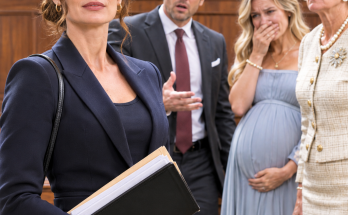
“Sir, there’s a group of men outside the ICU. They say they’re your wife’s family.”
I walked into the hallway.
There they were.
Richard stood in the middle, surrounded by his eight sons. One of them was laughing while another held a paper cup of coffee.
When Richard saw me, he smiled.
“Look who’s finally arrived.”
I stared at him.
“What did you do to my wife?”
He shrugged.
“She needed to learn that she can’t turn her back on her own family.”
One of his sons laughed.
“She should have listened when Dad warned her.”
I looked at their faces, searching for even the smallest sign of remorse.
There was none.
Then Richard stepped closer and whispered, “And don’t think you can do anything about it. You’re nobody.”
I reached into my pocket and took out my phone.
For the first time that night, my hands stopped shaking.
I dialed a number I had memorized years ago.
When the call connected, I spoke in a voice that had once brought entire command centers to attention.
“This is General Daniel Hayes. I need immediate assistance at St. Catherine’s Hospital. We have a suspected group assault involving nine individuals. Preserve all surveillance footage, identify every witness, and notify the appropriate law enforcement authorities.”
I paused and looked directly at Richard.
“Make sure nobody has the opportunity to destroy evidence.”
The smile slowly disappeared from his face.
He had just made the biggest mistake of his life.
He had mistaken my silence for weakness.
And before sunrise, he would discover the difference.
PART 2: The Man They Thought Was Nobody
For several seconds, nobody spoke.
Richard stared at me as though I had suddenly begun speaking a foreign language.
Then he burst out laughing.
“General?” he scoffed. “Did you hear that? My son-in-law thinks he’s a general!”
His eldest son stepped forward and shoved a finger toward my chest.
“Stop pretending to be someone important. You’re embarrassing yourself.”
I didn’t move.
I had faced armed men in hostile territory. I wasn’t going to lose control in a hospital hallway.
Instead, I looked toward the security desk.
“Please ensure the hospital’s recordings are preserved. I want every available camera angle from the entrance, the parking area, and this corridor secured according to the investigation protocol.”
The security supervisor nodded and immediately began making calls.
That was when the elevator doors opened.
Two senior officers stepped out, followed by several investigators. A moment later, members of my military staff arrived after being notified of the emergency.
One of the officers approached me and stood at attention.
“General Hayes, we’ve been briefed on the situation. Local investigators are on their way to take statements and secure the scene.”
Richard’s face changed.
He looked at the officer, then at me.
“Wait,” he muttered. “You’re actually a general?”
I didn’t answer his question.
I was looking through the ICU window at Victoria.
“Has anyone interviewed these men?” I asked the officer.
“Not yet, sir.”
“Then let the investigators do their work. No threats, no intimidation, and no special treatment. I want this handled properly.”
Richard suddenly found his voice.
“This is a family matter! You can’t drag us into some criminal investigation just because my daughter is upset!”
One of his sons nodded quickly.
“She fell. That’s all. Nobody attacked her.”
Another added, “We were barely even near her.”
Their stories began falling apart before the questioning had properly started.
A nurse approached the investigators with a statement. She had seen the men arrive earlier that evening, heard shouting near the emergency entrance, and watched them leave while Victoria was being taken inside.
A security guard provided additional information.
Then investigators reviewed footage from the hospital’s exterior cameras.
The men had arrived together.
Several hours later, they had returned together.
And when Victoria was brought through the emergency entrance, Richard had stood nearby arguing with staff instead of asking whether his daughter would survive.
But the most important evidence had not yet been examined.
An investigator approached me quietly.
“General, we found a witness who says your wife was attacked at her father’s property. We’re arranging a formal interview.”
I closed my eyes for a moment.
Victoria had gone there that afternoon because Richard had insisted on discussing something important about her inheritance.
She had told me she would be home before dinner.
Instead, our daughter was gone.
And my wife was fighting for her life.
Richard noticed the investigators separating his sons for individual interviews.
His confidence began to crumble.
“You can’t do this!” he shouted. “Do you know who I am?”
One investigator answered calmly.
“We know who you are, sir. Right now, we’re interested in what happened to your daughter.”
For the first time, Richard had nothing to say.
Then my phone vibrated.
It was a message from the hospital’s attending physician.
Your wife has regained consciousness briefly. She is asking for you.
I hurried into the ICU.
Victoria’s eyes were barely open. Her breathing was shallow, and every movement seemed to cause her pain.
I sat beside her and held her hand.
“I’m here, sweetheart.”
Her lips trembled.
“Daniel…”
“Don’t try to speak too much. The doctors are taking care of you.”
She shook her head weakly.
“Our baby?”
My throat tightened.
I pressed her hand gently against my cheek.
“I’m so sorry.”
Tears slipped down her face.
For a long moment, neither of us spoke.
Then she struggled to whisper something.
“They said… nobody would believe me.”
I leaned closer.
“Who said that?”
“My father.”
She closed her eyes, exhausted.
“They wanted me to sign something. I refused. Then my brothers…”
Her voice broke.
I felt an unbearable mixture of grief and anger rise inside me, but I forced myself to remain calm.
“You don’t have to explain everything tonight. The investigators will listen to you when you’re ready.”
Victoria opened her eyes again.
“Please don’t let them hurt anyone else.”
I kissed her forehead.
“I won’t. Everything will be handled through the law.”
When I returned to the hallway, Richard was sitting in a chair with his head in his hands.
His sons were being interviewed separately.
One had already contradicted another’s account of the evening.
And investigators had requested access to a recording from a security camera at the family property.
Richard looked up as I approached.
“You’re going to destroy this family,” he whispered.
I stopped in front of him.
“No, Richard. Your choices did that.”
He stared at me, and for the first time in all the years I had known him, he looked afraid.
But I knew something he didn’t.
The investigation was only beginning.
And the evidence they had spent so much time dismissing was about to tell a story none of them could control.
PART 3: The Evidence That Ended Their Lies
By the following morning, the hospital hallway had become the center of a criminal investigation.
Investigators had collected witness statements, secured available surveillance recordings, and begun examining the circumstances surrounding Victoria’s injuries.
Richard and his eight sons were no longer laughing.
They were asking for lawyers.
They were demanding to know why the police were treating the incident so seriously.
And they were blaming one another.
I sat outside the ICU with a cup of untouched coffee in my hands.
For the first time in decades, I had no mission I could personally complete to bring back what I had lost.
No order could restore my daughter’s heartbeat.
No rank could erase the pain in Victoria’s eyes.
All I could do was make sure the truth was heard.
Late that morning, the lead investigator approached me.
“General Hayes, we’ve obtained additional evidence that supports the account of a serious assault. We’re still verifying individual roles, but several statements conflict with the physical evidence.”
I nodded.
“Please follow the evidence wherever it leads.”
He paused before adding, “Your wife’s testimony will be important when her medical condition allows it. We won’t pressure her to give a statement before she’s ready.”
“Thank you.”
A few minutes later, Richard asked to speak with me.
I found him sitting alone in a small interview room, his expensive jacket wrinkled and his face pale.
When I entered, he stood.
“Daniel, please. We need to talk.”
I remained by the door.
“You’ve had years to talk to your daughter.”
He swallowed.
“I never thought things would go this far.”
“You knew she was pregnant.”
His eyes dropped.
“She was being disrespectful. She refused to listen to me.”
“She was your daughter.”
He rubbed his forehead.
“I lost my temper.”
I looked at him for a long moment.
“You didn’t lose your temper once. Nine people were involved in an incident that left your daughter in intensive care and her child dead. Now you’re trying to make it sound like an ordinary family argument.”
He began to cry.
Perhaps he was frightened.
Perhaps he was finally beginning to understand what he had done.
But his tears could not change the facts.
“I can make this right,” he whispered. “I’ll pay for everything. I’ll buy you a house. I’ll make sure Victoria never wants for anything.”
I shook my head.
“You still think this is about money.”
He stared at me.
“I want my wife to survive. I want the truth established. And I want the law to decide what happens next.”
When I left the room, I felt no satisfaction.
There was only grief.
Three days later, Victoria’s condition improved enough for doctors to move her out of intensive care. She was weak, frightened, and devastated by the loss of our daughter.
I brought the little yellow blanket from home.
When I placed it beside her, she began to cry.
“I was going to wrap her in that,” she whispered.
I sat beside her.
“Me too.”
We held each other and cried for the child we would never bring home.
The investigation continued for weeks. Authorities examined the available physical evidence, reviewed the witness accounts, and assessed the role of each family member.
Eventually, prosecutors filed charges against those they believed were responsible, based on the evidence gathered.
The case moved through the legal system, where the defendants had the opportunity to respond to the allegations and receive legal representation.
I never asked anyone to punish them because of my rank.
I never ordered soldiers to frighten them.
And I never tried to interfere with the investigators.
I wanted a case strong enough to stand on its own.
Months later, Victoria and I stood together at our daughter’s grave.
She placed a small white flower on the stone.
“What should we have named her?” she asked softly.
I took her hand.
“Emily,” I said. “You always loved that name.”
Victoria nodded, tears shining in her eyes.
“Emily Hayes.”
We stood there until the wind grew cold.
I had spent most of my life believing that strength meant giving orders, protecting others, and never allowing pain to interfere with duty.
But standing beside my wife, I finally understood something different.
Strength was helping her survive the days when she wished she hadn’t.
Strength was listening when she needed to talk about our daughter.
Strength was refusing to let hatred turn me into the kind of man I had spent my life trying not to become.
Richard had once looked me in the eyes and called me nobody.
He had believed that a quiet man without visible wealth or status had no power to challenge him.
He was wrong.
But my greatest victory was never that he discovered I was a general.
It was that I refused to use my position for revenge.
Because the uniform I wore had taught me a lesson more important than rank:
Power means nothing without restraint, and justice means nothing if the truth is sacrificed for revenge.
My daughter would never grow up to see the world.
But I would spend the rest of my life making sure that what happened to her mother was never buried beneath someone else’s money, influence, or pride.
And every night, before Victoria fell asleep, I reminded her of one thing.
“You are not alone. Not anymore.”
Because they had taken so much from us.
But they would never take away our right to tell the truth.