Part 1: The Nine Calls They Never Answered
The ninth time I called my parents from my hospital bed, my mother finally sent me a text.
“Miranda, please stop calling. We’re busy helping your sister. You’re in the hospital, not dying.”
I read those words three times.
Then I looked at the heart monitor beside my bed, watched the numbers flicker across its screen, and wondered how a mother could be so certain her daughter would survive without her.
My name is Claire Bennett. I was thirty-four years old, and less than twenty-four hours earlier, a drunk driver had smashed into the side of my car while I was driving home from work.
The collision left me with three broken ribs, a fractured leg, a concussion, and internal injuries that required emergency surgery. My doctor had told me that the next two days would be critical.
I wasn’t asking my parents to save my life.
I just wanted someone from my family to sit beside me while I tried to understand whether I would ever walk normally again.
But my younger sister, Vanessa, had other plans for them.
She had just purchased a beautiful four-bedroom house in an expensive suburban neighborhood. The closing had happened that morning, and she had decided that moving day was the perfect occasion for our parents to prove which daughter mattered most.
Vanessa had always been their favorite.
When we were children, she received the newest toys while I wore hand-me-downs. When she went to college, our parents paid her tuition. When I received a scholarship, they told me I should be grateful I wouldn’t cost them anything.
After graduation, I worked two jobs, built a small technology company, and eventually sold it for more money than my parents could imagine.
Suddenly, they were proud of me.
Or, at least, proud to tell their friends about me.
They never asked how exhausting it had been to build my company. They never asked why I worked through holidays or why I spent my birthdays alone in hotel rooms.
They only wanted to know whether I could help Vanessa with her latest expense.
I had helped her with a car payment, a failed business, and even the down payment on her first apartment. Every time, my parents promised she would repay me.
She never did.
Still, when the hospital admitted me, I called my mother first.
She answered on the second ring.
“Claire? What’s wrong?”
“I’ve been in an accident, Mom. I’m at St. Mary’s. They operated on me last night.”
There was a pause.
Then she asked, “Oh, sweetheart. Is it serious?”
“The doctor says I need someone here. I don’t want to be alone.”
I heard my father talking in the background. Then Vanessa called out, asking where they had put the boxes labeled kitchen.
My mother’s voice changed.
“Claire, we’re right in the middle of helping Vanessa move. Your father and I promised her we’d stay all day.”
“Mom, I can’t even get out of bed by myself.”
“We’ll come tomorrow, okay? Try to rest.”
She hung up.
I called my father.
He declined the call.
I tried again an hour later.
Voicemail.
By late afternoon, I had called them nine times.
Then, while a nurse was checking my blood pressure, my phone lit up with a notification.
Vanessa had uploaded a video to social media.
In it, she stood in her new kitchen, smiling while my mother unpacked expensive dishes and my father assembled a dining table.
The caption read:
“Nothing feels better than having parents who always show up when you need them. Couldn’t do this without you two!”
I watched the video until the screen went dark.
For the first time in my life, I stopped making excuses for them.
I stopped telling myself that my parents loved me in their own way.
I stopped wondering what I could do to earn the same consideration they gave my sister.
Instead, I asked the nurse to retrieve the business card in my handbag.
It belonged to my attorney, Daniel Reeves.
Daniel had handled the sale of my company, managed my estate documents, and helped me establish a private investment trust. He knew more about my finances than anyone in my family.
When he answered, I didn’t cry.
“Daniel, I need you at the hospital tonight.”
“Claire? What happened? Are you all right?”
“I survived an accident. That’s not why I’m calling.”
I took a breath.
“I want to change my will, revoke every financial authorization I’ve given my family, and review the trust documents. I want everything done legally and properly.”
He was silent for a moment.
“Did something happen with your parents?”
I glanced at my phone.
“No. Something finally became clear.”
He arrived forty minutes later with a briefcase and a folder of documents.
For the next two hours, we reviewed everything.
My parents were named beneficiaries in an older version of my estate plan. Vanessa was scheduled to receive a substantial inheritance, including a fund intended to help her children someday.
I had also allowed my parents to access a limited account that paid certain family expenses.
Daniel explained which changes could be completed immediately, which required additional formalities, and which decisions deserved a second review after I recovered.
I listened carefully.
Then I signed the documents that could lawfully be completed that evening.
At 9:17 p.m., my phone rang.
Mom.
I answered.
“Claire, why is your lawyer calling us?” she demanded. “Your father says something about the accounts has changed. What’s going on?”
I looked at Daniel, who was quietly organizing the signed papers.
“Where are you, Mom?”
“At Vanessa’s house. We’re finally sitting down to eat.”
“That’s nice.”
“Don’t use that tone with me. Your father says you changed something important.”
“I did.”
“Claire, we’re your parents! You can’t make decisions like this because you’re upset.”
I stared at the ceiling.
“You made a decision this morning, Mom. You decided that helping Vanessa arrange her new living room was more important than checking whether your other daughter was alive.”
“That is a horrible thing to say!”
“Then why did you make me say it?”
She started crying.
For years, her tears had been enough to make me apologize.
This time, I didn’t.
“Come to the hospital tomorrow,” I told her. “There are things you need to understand.”
Then I hung up.
I thought that would be the end of it for the night.
I was wrong.
At 11:42 p.m., someone knocked on my hospital room door.
It wasn’t my mother or my father.
It was a woman in a gray suit carrying a leather folder.
She introduced herself as Patricia Cole, an attorney representing my late grandmother’s estate.
“Claire,” she said, looking at Daniel, “I’m sorry to disturb you. But your grandmother’s executor has authorized me to deliver something that can no longer wait.”
She placed the folder on my bedside table.
Inside was a letter in my grandmother’s handwriting.
The first sentence made my hands tremble.
My darling Claire, if you are reading this, it means your parents have finally shown you what they have always been willing to sacrifice.
I looked up at Patricia.
“What does this mean?”
She closed the door behind her.
“Your grandmother left you something your parents have spent the last three years trying to obtain.”
She turned the next page toward me.
And when I saw the amount written there, I finally understood why my parents had been so interested in my inheritance.
They weren’t just waiting for me to die. They were counting on something else happening first.
Part 2: The Secret My Grandmother Left Behind
My grandmother, Evelyn Bennett, had been the only person in my family who never made me feel like I had to compete for love.
When I was twelve, she taught me how to bake bread.
When I was sixteen, she gave me a secondhand laptop and encouraged me to learn computer programming.
When I was twenty-two and struggling to pay rent after college, she slipped an envelope into my coat pocket.
Inside was enough money to keep me afloat for three months.
She didn’t tell my parents.
She simply said, “Build a life where you never have to beg someone to treat you well.”
I followed her advice.
My grandmother died three years before my accident. At her funeral, my father cried so loudly that people had to comfort him.
Yet when the estate was settled, he complained that she had not left him enough.
I remembered that now as Patricia opened the folder.
“Your grandmother created a separate investment trust shortly before she died,” she explained. “She left it to you, but the assets were subject to certain conditions.”
“How much?”
Patricia gave me a careful look.
“The current value is approximately twenty-eight million dollars.”
For several seconds, I couldn’t speak.
I had built my own wealth, but I had never known my grandmother’s trust had grown so large.
“Why didn’t anyone tell me?”
“Your grandmother instructed us to contact you privately when you reached a particular age and when certain estate matters had been resolved. She also left a sealed letter with additional instructions.”
Patricia paused.
“Your father has contacted our office several times asking about the trust.”
My stomach tightened.
“How many times?”
“Seven, that we have documented. He claimed your grandmother had promised him control of the funds.”
“She never told me that.”
“She also left a signed statement explaining that she had not.”
Patricia removed another document.
It contained my grandmother’s signature and the signatures of two witnesses.
The statement was clear: the trust belonged to me. Neither my parents nor my sister had any automatic right to control it.
But there was more.
My grandmother had suspected that my father was using family connections to pressure people into granting him access to her finances while she was alive.
She had refused.
After her death, he had continued asking questions.
“He told us he was worried you might be manipulated into making irresponsible financial decisions,” Patricia said. “He claimed that, as your father, he should supervise your assets.”
I let out a bitter laugh.
My father, who had once borrowed money from me to cover a failed investment, wanted to supervise my fortune.
“Did he ever receive anything?”
“No. Your grandmother’s documents were carefully structured. The trust has independent oversight, and the trustee has rejected his requests.”
I closed my eyes.
Then Patricia showed me a letter my father had sent to the trustee six months earlier.
He had written that I was emotionally unstable, that I trusted the wrong people, and that I might soon become unable to manage my own affairs.
He suggested that he should be appointed to protect the family inheritance.
My hands began to shake.
Six months earlier, I had been healthy, working, traveling, and running my investments.
There had been no reason for him to make those claims.
Unless he had been preparing for something.
“Daniel,” I whispered, “can you investigate whether any of my accounts or legal documents have been accessed without permission?”
He nodded.
“We’ll review the records and take appropriate steps.”
Patricia gathered the papers.
“One more thing. Your grandmother requested that you receive this letter only after you had an opportunity to make your own decisions. She did not want you to feel obligated to preserve relationships simply because money was involved.”
I unfolded the final page.
Claire, I loved your father, but I made the mistake of confusing being his mother with being responsible for every choice he made. Do not repeat that mistake with your family.
I cried then.
Not because of the money.
Because even after death, my grandmother was still trying to protect me.
The next morning, my parents arrived at the hospital.
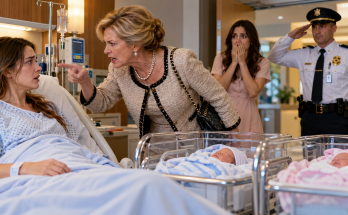
My mother carried flowers. My father carried a leather portfolio. Vanessa followed behind them, dressed in designer clothes and looking furious.
“Claire,” my father began, “we need to talk about what you’ve done.”
Not How are you feeling?
Not Are you in pain?
Not even We’re sorry we didn’t come.
Just that.
“What I’ve done?” I asked.
“You’ve interfered with the family arrangements.”
I looked at him in disbelief.
“I was in surgery yesterday.”
“We know that,” he snapped. “Your mother explained the situation.”
“My mother explained that she was too busy unpacking Vanessa’s kitchen.”
Vanessa folded her arms.
“Oh, stop making everything about yourself. Mom and Dad were helping me move. It’s not like you were alone. You had nurses.”
My mother placed the flowers on the windowsill.
“Vanessa is under a lot of stress. She has a new house, and things have been difficult for her.”
I stared at her.
“I’m in a hospital bed with a fractured leg.”
“And we came now, didn’t we?” she replied.
Daniel stood beside the door.
My father noticed him and lowered his voice.
“We’d appreciate some privacy.”
“I’m staying,” Daniel said.
My father frowned.
Then he opened his portfolio and removed a document.
“Claire, we need to discuss your grandmother’s trust. There have been misunderstandings, and we need to put everything back in order.”
I felt cold all over.
“You already know about the trust?”
“Of course,” he said quickly. “I’m your father. I should be involved in these matters.”
“Why?”
“Because you’re not thinking clearly.”
Daniel stepped forward.
“Mr. Bennett, Claire is entitled to independent legal advice. Any attempt to pressure her into signing financial documents should stop immediately.”
My father turned red.
“This is a family matter!”
“No,” I said. “It’s my money. My legal documents. My life.”
Vanessa laughed bitterly.
“You’re really going to punish all of us because we didn’t rush to the hospital the second you called?”
I looked at her.
“No. I’m going to stop rewarding people who only remember I’m family when they want something.”
My father slammed the portfolio onto the bedside table.
“Your grandmother would be ashamed of you.”
I reached for the letter beside me.
“Actually, Dad, she left me a message.”
For the first time since they entered the room, he looked afraid.
I handed him a copy of his own letter to the trustee.
He read the first paragraph.
Then the second.
His face changed.
“Where did you get this?”
“From the people you tried to convince that I couldn’t manage my own affairs.”
My mother reached for the paper.
When she read it, her hand flew to her mouth.
Vanessa stopped smiling.
I looked directly at my father.
“Now I have one question.”
He said nothing.
“Why were you trying to gain control of my grandmother’s trust six months before I was injured?”
His eyes shifted toward Vanessa.
It was quick.
Almost invisible.
But I saw it.
And so did Daniel.
Vanessa took a step backward.
“Dad,” she whispered, “you said nobody would find out.”
The room fell silent.
My mother turned toward her.
“Find out what?”
Vanessa’s face drained of color.
My father reached for her arm, but she pulled away.
Then she looked at me, tears filling her eyes.
“Claire, I didn’t know what he was planning to do. I swear I didn’t.”
“Do about what?”
She swallowed.
“The house. The money. Everything.”
Then she whispered the sentence that changed the entire conversation.
“Dad told me you had already agreed to transfer your inheritance to him. He said you were just waiting for the right time to sign the papers.”
I stared at her.
“I never agreed to that.”
“I know,” she whispered. “I know that now.”
Daniel immediately asked my parents to leave.
My father refused.
Then Patricia, who had returned to deliver an additional document, entered the room and placed a second folder on the table.
“Perhaps,” she said calmly, “we should discuss the property records before anyone leaves.”
She opened the folder.
There was a document bearing my father’s signature.
And beneath it was a date.
A date from two months before my accident.
Patricia looked at my father.
“Would you care to explain why you attempted to use your daughter’s name in a financial transaction she never authorized?”
My father’s mouth opened.
Nothing came out.
For the first time in my life, he had no explanation that could make me feel guilty.
But what Patricia revealed next was even worse.
The house Vanessa had just purchased had not been funded entirely by her mortgage.
A significant portion of the money had come from a private loan arranged through a company connected to my father.
And that company had been counting on my grandmother’s trust to secure repayment.
My parents had not simply ignored me.
They had been making plans around money that did not belong to them.
And now that I had changed my estate documents, those plans were beginning to collapse.
Part 3: The Price of Choosing the Wrong Daughter
My father finally spoke.
“This is being blown completely out of proportion.”
He said it as if we were arguing about a forgotten birthday.
Patricia remained calm.
“The records speak for themselves. Your daughter’s name was included in documents without her authorization. We will need to determine exactly how that occurred.”
“I was trying to protect the family!”
“From what?” I asked. “My own money?”
He turned toward me.
“You don’t understand how complicated these things are. Your grandmother left assets that should have benefited everyone. I was trying to make sure Vanessa had a secure future.”
“By putting my name on documents I never signed?”
He said nothing.
Vanessa was crying now.
She sat in the chair beside the window, her hands pressed against her forehead.
“I thought everything was legitimate,” she said. “Dad told me the money was already arranged. He said Grandma wanted us to have it.”
“Did you know he had contacted the trustee?” Daniel asked.
She shook her head.
“I knew he was trying to get money for the house. I didn’t know he had used Claire’s name.”
My mother began crying too.
“Please,” she said, looking at me. “We can work this out as a family.”
I wanted to believe her.
Some part of me still wanted my mother to sit beside my bed, take my hand, and tell me that none of this was my fault.
But then I remembered her text.
You’re in the hospital, not dying.
I remembered the video of her arranging pillows while I lay unable to stand.
And I realized that an apology offered only after consequences arrive is not always the same as remorse.
“Mom, did you know about the financial arrangements?”
She stared at the floor.
“Your father told me he was handling it.”
“That wasn’t my question.”
Her eyes filled with tears.
“I knew he was trying to help Vanessa.”
“Did you know he was using my inheritance?”
She didn’t answer.
That was answer enough.
Daniel explained that my parents would no longer have access to my accounts. Any disputed transaction would be reviewed, and the relevant parties would be notified through the proper legal channels. My grandmother’s trust would remain under independent management while the allegations were investigated.
He also advised me not to sign anything my family brought me, regardless of how urgently they insisted.
My father listened with clenched fists.
Then he turned toward me.
“If you go through with this, don’t expect us to come running whenever you need us.”
I looked at the hospital bed, the IV in my arm, and the flowers my mother had brought.
“You didn’t come running when I needed you yesterday.”
He flinched.
For a moment, nobody spoke.
Then my father picked up his portfolio.
“You’ll regret this.”
“No, Dad,” I said quietly. “I regret how long it took me to understand you.”
He walked out.
My mother followed him, pausing briefly at the door.
“Claire, I’m still your mother.”
I wanted to say something cruel.
I wanted to list every birthday she had forgotten, every achievement she had dismissed, and every time she had made me feel like an inconvenience.
Instead, I told her the truth.
“Then I wish you had acted like it when I called.”
She lowered her head and left.
Vanessa remained.
For several minutes, she sat without speaking.
Then she looked at me.
“I know you hate me.”
“I don’t hate you.”
“You should.”
“I don’t have the energy to hate anyone right now.”
She wiped her face.
“I’m sorry about yesterday. I saw your calls. I told myself you were probably exaggerating because you wanted Mom and Dad to come back.”
The confession hurt more than I expected.
“You saw my calls?”
She nodded.
“I saw the messages in the family group chat. Dad said you were stable and that the doctors were taking care of you. Mom said she didn’t want to leave in the middle of the move.”
I swallowed.
“And you said nothing?”
Vanessa began crying harder.
“I wanted them to stay. I wanted one day when everything was about me.”
There it was.
Not a misunderstanding.
Not an emergency that had been poorly communicated.
She had known I needed them and had decided that her day mattered more.
I turned toward the window.
“Vanessa, I hope you build a good life in that house. But I can’t keep financing it, and I can’t keep pretending we’re close when our relationship only works if I give you what you want.”
She nodded slowly.
“I understand.”
“Do you?”
She looked down at her hands.
“No,” she admitted. “Not completely. But I want to.”
She left without asking for money.
That was the first thing she had done in years that made me wonder whether change might actually be possible.
The weeks that followed were difficult.
I underwent physical therapy, learned to walk with crutches, and spent long nights replaying conversations I wished I could forget.
The financial investigation continued through the appropriate legal channels. My attorney helped me protect my assets, preserve the records, and challenge any unauthorized transactions.
My parents faced the consequences of their own financial decisions. The company connected to my father demanded repayment under its agreements, and the arrangements he had hoped to secure through my inheritance never materialized.
Vanessa had to work with her lender to make sure she could afford her new home without relying on money that had never been hers.
I did not take her house away.
I did not make public accusations to humiliate my family.
I simply stopped rescuing them.
For the first time, their problems belonged to them.
Three months after the accident, I returned home.
My leg still hurt, and I needed a cane on bad days. But I could walk from my bedroom to the kitchen without assistance.
On my first evening back, I found a letter waiting in my mailbox.
It was from my mother.
She wrote four pages about the family, about the stress of the move, and about how difficult it had been to watch my father struggle with money.
Near the end, she wrote:
I know you think we chose Vanessa over you. We were trying to keep everything together.
I read that sentence twice.
Then I placed the letter in a drawer.
Because keeping everything together had always meant asking me to carry the heaviest pieces.
A week later, Vanessa called.
She didn’t ask about the trust.
She didn’t mention the house.
She asked whether I would meet her for coffee.
I almost said no.
But eventually, I agreed.
We met at a quiet café halfway between our neighborhoods. Vanessa arrived alone, carrying no documents and asking for nothing.
“I started therapy,” she told me.
I nodded.
“I’ve spent my whole life thinking that if I didn’t get what I wanted immediately, someone was taking something away from me. I didn’t realize how much I was taking from you.”
For the first time, she apologized without blaming our parents, her husband, or her circumstances.
I accepted her apology.
But I didn’t promise to trust her again.
Trust, I had learned, was not something a person could demand simply because you shared a last name.
It was something they had to rebuild.
My father never apologized.
He sent one final message through a relative, saying that I had destroyed the family over money.
I didn’t respond.
I knew the truth.
The money hadn’t destroyed our family.
It had simply exposed the things we had spent years pretending weren’t there.
On the first anniversary of my accident, I visited my grandmother’s grave.
I brought white roses and sat beside her headstone for a long time.
I told her about the hospital, the nine calls, the documents, and the letter she had left behind.
Then I thanked her for giving me something far more valuable than twenty-eight million dollars.
She had given me permission to stop confusing obligation with love.
As I stood to leave, my phone vibrated.
A message from Vanessa appeared on the screen.
I’m proud of you, Claire. Not because of what you own. Because you finally chose yourself.
I read it once, then slipped the phone into my pocket.
Maybe one day, my family would understand what they had lost.
Maybe they wouldn’t.
Either way, I no longer needed their approval to know that I deserved better.
And that was the real inheritance my grandmother had left me.
The lesson I learned was simple: the people who love you should not have to be threatened with losing your money before they remember that you are worth showing up for.