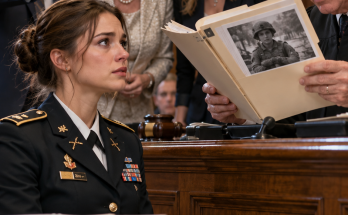
PART 1: The Envelope That Silenced the Courtroom
Ten minutes into my divorce hearing, my husband stood before a crowded courtroom in downtown Atlanta, adjusted his expensive navy suit, and announced that he deserved half of everything I owned.
My company.
My properties.
My investment accounts.
Even the inheritance my grandmother had left me before I ever met him.
Then he turned toward me and smiled.
“You can make this easy, Victoria,” he said confidently. “Sign the settlement, and we can both move on with our lives.”
I stared at him without responding.
Behind him, my mother nodded approvingly. My younger brother, Daniel, leaned back in his chair with the satisfied expression of someone who had already counted the money he expected to receive.
And beside them sat my husband’s mistress.
My own cousin, Rebecca.
She wore a cream-colored designer dress, a diamond necklace I recognized from my missing jewelry collection, and the same innocent expression she had perfected since childhood.
Three months earlier, I had discovered their affair.
Two months earlier, I had found suspicious transfers from our joint accounts.
And three weeks earlier, an accountant had shown me documents suggesting that my husband had been preparing to take control of my company long before he filed for divorce.
But none of them knew the most important thing.
I had discovered something else.
Something hidden inside my late father-in-law’s private records.
Something that could change the entire case.
My name is Victoria Bennett. I was thirty-eight years old, and I had spent the previous eleven years building Bennett Medical Technologies from a tiny office with two employees into an eighteen-million-dollar medical equipment company.
When I married Christopher Bennett, he was a junior attorney earning less than I paid my operations manager.
I never cared about the difference.
I loved him.
I believed we were building a life together.
When his law practice struggled during its first few years, I paid the office rent. When his father became ill, I arranged private nursing care. When Christopher wanted to expand his practice, I introduced him to investors who later became his biggest clients.
I never kept score.
That was my mistake.
Somewhere along the way, Christopher began telling people that my success was actually his achievement.
At business dinners, he called himself the strategist behind my company.
At family gatherings, he joked that I was lucky to have a lawyer for a husband.
And whenever someone congratulated me on a major contract, he smiled as if I had just confirmed something he already knew.
I ignored it because I thought love meant allowing the person beside you to shine.
I didn’t understand that he was slowly teaching everyone to believe my achievements belonged to him.
Then came the divorce.
Christopher’s attorney had requested an equal division of our marital property, but Christopher went much further during the hearing.
He claimed that my company had grown primarily because of his legal advice and business connections.
He demanded half its estimated value.
He also claimed that my inheritance had been mixed with marital funds, making it subject to division.
His final demand was almost unbelievable.
He wanted me to pay his legal fees.
When the judge asked whether he had evidence supporting his claims, Christopher stood straight and answered without hesitation.
“Extensive evidence, Your Honor.”
I watched him place a thick folder on the table.
He looked so certain that I almost felt sorry for him.
Almost.
My mother, Margaret, dabbed the corner of her eye with a tissue, performing the familiar role of the concerned parent.
“Christopher has sacrificed so much for this marriage,” she whispered loudly enough for nearby spectators to hear. “Victoria should do the right thing.”
I turned toward her.
“Sacrificed what, Mother?”
Her lips tightened.
“Don’t embarrass yourself.”
That sentence had followed me throughout my childhood.
Whenever I questioned why she favored my brother, she told me not to embarrass myself.
Whenever she asked me to finance one of Daniel’s failed businesses, she reminded me that family came first.
Whenever I achieved something she couldn’t control, she found a way to diminish it.
And now she was sitting beside the man trying to take everything I had built.
I turned back toward the judge.
My attorney, Nathan Cole, had been waiting patiently beside me.
He was sixty-two, soft-spoken, and famous among Atlanta attorneys for never making a threat he couldn’t support with evidence.
I reached into my briefcase and removed a sealed envelope.
“Now,” I whispered.
Nathan nodded.
He rose from his chair and approached the bench.
“Your Honor, we respectfully request permission to submit newly discovered evidence directly relevant to the ownership of the assets in dispute.”
Christopher laughed.
“Newly discovered? Convenient timing.”
His attorney stood immediately.
“Objection. The opposing party cannot introduce surprise documents without proper foundation.”
Judge Evelyn Hart lifted her eyes.
“Counsel, I will determine whether the evidence is admissible. Please sit down.”
Nathan placed the envelope before her.
The judge broke the seal.
Inside were three documents.
The first was a notarized trust agreement dated thirty years earlier.
The second was a corporate ownership record.
The third was a handwritten letter bearing the signature of Christopher’s late father, Richard Bennett.
The judge read the trust agreement first.
Her expression changed slightly.
She turned to the second document.
Then she unfolded the letter.
Christopher stopped smiling.
His father had died eighteen months earlier. Richard had been a respected attorney who spent decades building a quiet investment portfolio, and Christopher often described him as a man who never made mistakes.
But there was one thing Christopher had never told me.
Richard had once been involved in a business partnership that nearly destroyed his family’s finances.
And according to the letter in the judge’s hands, Richard had spent the final years of his life trying to correct a terrible injustice.
Judge Hart read the letter a second time.
Then she looked directly at Christopher.
“Mr. Bennett, do you recognize this signature?”
Christopher swallowed.
“My father’s, yes. But I have no idea what that document is supposed to prove.”
The judge placed the letter beside the trust agreement.
“Then perhaps you can explain why your sworn financial disclosure contradicts a corporate ownership record signed by your father.”
Christopher’s attorney leaned toward him.
My husband whispered something I couldn’t hear.
For the first time that morning, Christopher looked frightened.
My mother grabbed Rebecca’s hand.
Daniel stopped smiling.
And I finally allowed myself to breathe.
Because the documents were only the beginning.
The real evidence was still inside Nathan’s briefcase.
And when he opened it, my husband’s entire story would begin to fall apart.
PART 2: The Secret His Father Took to the Grave
Judge Hart ordered a short recess so both legal teams could examine the newly submitted documents.
Christopher caught up with me in the hallway before I reached the elevators.
“Victoria, what have you done?”
His voice was low, but I could hear the panic beneath it.
I continued walking.
“Submitted evidence.”
“You know what I mean.”
I stopped and looked at him.
For eleven years, I had studied every expression on his face. I knew the difference between his genuine smile and the smile he used when negotiating a deal. I knew when he was angry, when he was lying, and when he was preparing to make someone else feel responsible for his mistakes.
I had never seen him look like this.
“Your father left a letter,” I said. “Perhaps you should have read it before trying to take my company.”
Christopher grabbed my arm.
“Listen to me. Whatever you think you’ve found, you don’t understand the situation.”
I pulled away.
“Then explain it.”
He opened his mouth.
Nothing came out.
Behind him, Rebecca appeared from the courtroom doorway.
“Christopher, we need to go.”
I looked at her necklace.
“That’s beautiful, Rebecca. Where did you get it?”
Her fingers immediately covered the diamonds.
Christopher stepped between us.
“Don’t start something you can’t finish.”
I almost laughed.
That was the man who had once promised to protect me.
Now he was threatening me in a courthouse hallway while wearing the watch I had bought him for his fortieth birthday.
“I’m not the one who started this,” I replied.
I walked away before either of them could answer.
Nathan was waiting in a conference room with a cup of untouched coffee.
He placed the original documents on the table.
“Your father-in-law was a more complicated man than Christopher ever admitted,” he said.
“Tell me everything.”
Nathan opened a folder containing copies of old corporate records.
Thirty years earlier, Richard Bennett had founded a small medical supply company with a woman named Eleanor Shaw.
Eleanor was an engineer who had developed a specialized sterilization system for surgical equipment. Richard handled the contracts, financing, and legal structure.
They agreed to split the company equally.
But when the business became profitable, Richard allegedly used a series of amended corporate filings to transfer Eleanor’s ownership interest into a holding company controlled by his family.
Eleanor fought the decision for years.
Eventually, she disappeared from the business world, leaving behind a daughter.
My grandmother.
I stared at Nathan.
“My grandmother’s name was Eleanor Shaw.”
“I know.”
The room seemed to tilt.
My grandmother had raised me after my mother spent years treating me like an inconvenience. She taught me how to read contracts, how to negotiate, and how to recognize the difference between a promise and a legally enforceable obligation.
When she died, she left me a substantial inheritance and a sealed collection of personal papers.
I had assumed those papers concerned our family history.
Nathan explained that the trust agreement in court had been drafted to preserve Eleanor’s remaining intellectual property rights and a financial claim connected to the original company.
The claim had never been properly resolved.
More importantly, the agreement contained a provision preventing the disputed assets from being transferred to anyone outside the designated beneficiaries until the underlying ownership dispute was settled.
My grandmother had named me as her successor.
And Richard Bennett had known about the arrangement.
“He wrote the letter six months before he died,” Nathan explained. “He admitted that his family had benefited from the disputed ownership transfer. He also instructed his estate’s representatives to preserve the original records.”
“Why didn’t Christopher know?”
“He may have known some of it. But I don’t believe he understood what his father intended to do with the evidence.”
Nathan turned to the next page.
Richard had left a separate memorandum explaining that he had discovered irregularities in Christopher’s recent financial dealings.
The memorandum did not prove criminal wrongdoing by itself. But it identified several transfers requiring independent investigation.
Those transfers included payments to a company that had no employees, no visible operations, and no legitimate business relationship with my company.
The company was registered under Rebecca’s maiden name.
I closed my eyes.
So the affair wasn’t the only betrayal.
My husband had allegedly been moving money through a business connected to his mistress while preparing to claim that my company belonged partly to him.
“Can we prove it?” I asked.
“We can establish the transfers, the ownership records, and the discrepancies in his disclosures,” Nathan replied. “Whether they constitute fraud is for the appropriate court or investigators to determine. But we have enough to challenge his financial claims.”
I looked at the final document.
It was a letter from Richard to his estate attorney.
One sentence had been underlined twice.
If Christopher ever attempts to claim ownership of assets derived from Eleanor Shaw’s work, these records must be disclosed.
I read it again.
Then I understood why Christopher had been so desperate to obtain my inheritance.
He hadn’t simply wanted money.
He wanted control over the very assets his father had warned him not to claim.
When the recess ended, we returned to the courtroom.
Christopher was already standing beside his attorney, speaking rapidly and gesturing toward the documents.
His confidence had returned, but it looked forced.
Judge Hart took her seat.
“Mr. Bennett,” she said, “before we continue, I have several questions concerning your financial disclosures.”
Christopher straightened his jacket.
“Of course, Your Honor.”
“Did you disclose the transfers to Shaw Holdings?”
His face went blank.
“Shaw Holdings?”
“The company identified in the supplemental records.”
“I don’t recall that name.”
Nathan rose.
“Your Honor, we have bank records identifying multiple transfers from accounts associated with Mr. Bennett to Shaw Holdings, followed by transfers to an account associated with Ms. Rebecca Lawson.”
Rebecca suddenly stood.
“That is completely false!”
The judge struck her gavel.
“Sit down. You are not a party to this proceeding, and you will not interrupt the court.”
Rebecca sat, her face turning pale.
Christopher’s attorney requested a moment to confer with his client.
The judge refused to delay the questioning.
Then Nathan presented the most damaging document yet: an email in which Christopher discussed moving money before the divorce filing.
The email included a sentence that made my stomach tighten.
Once the settlement is signed, she won’t have the resources to challenge anything.
Christopher stared at the page.
“That email is out of context.”
“Then explain the context,” Judge Hart replied.
He said nothing.
My mother rose halfway from her seat.
“Your Honor, this is a family disagreement. Surely there is a way to settle it privately.”
Judge Hart turned toward her.
“Ma’am, please remain seated. This court is examining sworn financial statements, not family preferences.”
My mother slowly lowered herself into her chair.
For once, her reputation and her tears could not rescue the person she had chosen to protect.
But Christopher wasn’t finished.
He leaned toward his attorney and whispered urgently.
His attorney listened, then stood.
“Your Honor, my client disputes the authenticity and interpretation of the submitted materials. We request an opportunity to review the original records and conduct further discovery.”
Nathan nodded.
“That is reasonable, provided the disputed assets are preserved in the meantime.”
The judge considered the request.
Then she issued a temporary order preventing the parties from transferring or concealing the assets specifically identified in the evidence, pending further proceedings. She also ordered additional financial disclosures and set a hearing to address the disputed ownership claims.
Christopher’s face tightened.
The case was no longer going the way he had planned.
But just as the judge prepared to adjourn, Nathan approached the bench with one final document.
“Your Honor, there is another matter that may be relevant to the court’s assessment of the disputed property.”
Christopher shot to his feet.
“No!”
The word burst out before he could stop himself.
Everyone turned toward him.
Even his attorney looked startled.
Judge Hart narrowed her eyes.
“Mr. Bennett, what exactly are you objecting to?”
Christopher stared at Nathan’s document.
Then he looked at me.
And for the first time, I saw something worse than fear in his expression.
Desperation.
Because the final document was not written by his father.
It was written by Christopher himself.
And the signature at the bottom matched the one on his divorce petition.
PART 3: The Truth That Cost Them Everything
The courtroom fell silent as Nathan handed the final document to Judge Hart.
Christopher remained standing.
His attorney whispered for him to sit down, but he barely seemed to hear.
The judge examined the signature.
Then she read the first paragraph.
Her expression became unreadable.
“Mr. Bennett,” she said, “did you execute this agreement?”
Christopher adjusted his tie.
“I’d need to review the complete document before answering.”
“You signed it.”
“I don’t remember the circumstances.”
Nathan stood.
“Your Honor, the document is a signed acknowledgment dated four years ago. It concerns the ownership of the company at the center of this dispute.”
Christopher’s attorney requested permission to inspect the original.
The judge allowed it.
As the document passed between the lawyers, I watched my husband lose the last of his composure.
Four years earlier, Christopher had asked me to sign a series of documents during a complicated refinancing process.
He told me they were routine corporate acknowledgments.
I had refused to sign anything until Nathan reviewed them.
Christopher became furious.
He accused me of distrusting him.
We argued for hours.
Eventually, I discovered that one of the documents would have allowed him to claim a management interest in my company without investing any capital.
I refused to sign it.
I had forgotten about the incident.
Christopher apparently hadn’t.
The document now before the judge was his own written acknowledgment that Bennett Medical Technologies had been established with my separate funds, that its original ownership belonged to me, and that he had no independent ownership claim arising from his legal services.
It wasn’t the only evidence, and it did not automatically resolve every question about marital property. But it directly contradicted the argument he had made that morning.
The judge looked up.
“Your financial disclosure states that your contributions were essential to the creation and growth of this business. Yet this document appears to acknowledge that the company was established with funds belonging solely to your wife. Please explain the discrepancy.”
Christopher opened his mouth.
Then closed it.
His attorney asked for a recess.
This time, the judge granted it.
I watched Christopher leave the courtroom with his lawyer. He didn’t look at me.
My mother followed him into the hallway.
Rebecca remained seated for several seconds before hurriedly collecting her handbag and leaving through another door.
Daniel stayed behind.
He approached me slowly.
“Victoria, we need to talk.”
I looked at him.
“About what?”
“Mom is upset. Christopher is under a lot of pressure. Maybe we can work something out before this gets any worse.”
I stared at my brother.
“Did you know about the transfers?”
He looked away.
“Victoria—”
“Did you know?”
His silence answered the question.
I felt something inside me finally break—not my heart, but the last thread connecting my love for my family to the belief that they deserved unlimited chances.
“You knew he was trying to take my company.”
“I didn’t know it would go this far.”
“You knew enough to sit beside him and smile.”
Daniel lowered his eyes.
“I’m sorry.”
For years, I had imagined hearing those words from him.
I had imagined that they would make everything hurt less.
They didn’t.
“I’m not asking you to choose between your family and me,” I said. “I’m asking you to stop helping people hurt me.”
He had no answer.
When the hearing resumed, Christopher’s attorney announced that his client was withdrawing his request for an immediate division of the company pending further review of the financial evidence.
The judge noted the withdrawal but made clear that it did not eliminate the need to resolve the remaining claims.
She also ordered the parties to produce additional records and referred certain financial discrepancies for review by the appropriate authorities.
No dramatic arrest occurred.
No one was dragged from the courtroom in handcuffs.
Real consequences, I discovered, often begin with something much quieter.
A court order.
A preserved bank record.
A sworn statement that can no longer be explained away.
And a judge who refuses to let confidence substitute for evidence.
Over the following months, the case grew more complicated.
Independent accountants traced the transfers between Christopher’s accounts and Shaw Holdings. The investigation established that funds had been moved without the explanations Christopher had provided in his disclosures.
Some transfers were eventually returned.
Others remained disputed.
Rebecca hired her own attorney.
My mother stopped answering my calls.
Daniel sent me long messages about family loyalty, misunderstanding, and forgiveness, but none included a clear account of what he had known or when he had known it.
Christopher eventually agreed to a settlement after his financial claims became increasingly difficult to support.
The settlement preserved my separate inheritance and recognized that my company was not simply an asset he could claim half of because he had been married to its owner. The remaining marital-property questions were resolved through negotiations based on the applicable law and the parties’ documented financial interests.
I did not receive a magical fortune overnight.
I did not destroy everyone who had betrayed me.
What I received was something more valuable.
My life back.
The company continued operating.
My employees kept their jobs.
The medical equipment we manufactured continued reaching hospitals and clinics that depended on it.
And the money my grandmother had left me remained protected according to the trust’s terms.
Several months after the settlement, I visited my grandmother’s grave.
I brought fresh white roses and a copy of Richard Bennett’s letter.
For a long time, I sat quietly beneath the trees, remembering the woman who had taught me never to sign something I didn’t understand and never to confuse being generous with surrendering control of my own life.
I finally understood why she had kept those old papers.
She had not preserved them because she wanted revenge.
She had preserved them because the truth sometimes needs someone willing to protect it until the right moment arrives.
When I returned home, there was a letter waiting on my doorstep.
It was from my mother.
She wrote that she missed me.
She wrote that families made mistakes.
She wrote that she hoped I would eventually remember the good times rather than focus on the bad.
But she never mentioned the courtroom.
She never mentioned Christopher’s claims.
She never mentioned the documents or the money.
And she never apologized for choosing his side.
I folded the letter and placed it in a drawer.
I didn’t burn it.
I didn’t respond.
I simply stopped believing that reconciliation was my responsibility.
A week later, Christopher sent me a message.
I hope one day you understand that I never wanted to hurt you.
I read it twice.
Then I typed a single sentence.
Wanting the benefits of my life without respecting my rights was enough.
I blocked his number.
That evening, I stood in the glass-walled office overlooking Atlanta, watching the city lights come alive beneath the darkening sky.
Eleven years earlier, I had entered that first office with two employees, a borrowed desk, and a business plan no investor wanted to fund.
I had built something real.
I had loved people who did not deserve the power I gave them.
And I had mistaken silence for peace for far too long.
The courtroom had not made me powerful.
It had simply given me a place to present the truth.
The real victory had begun months earlier, when I stopped begging the people who betrayed me to acknowledge my worth and started protecting what I had worked to build.
My husband had entered that courtroom convinced he was about to take half of everything.
Instead, he left knowing that a confident smile could not erase a signed document, that a family name could not replace evidence, and that the woman he had underestimated was no longer willing to protect his lies.
And my mother, my brother, and my cousin learned something too.
Betrayal does not become harmless simply because it comes from family.
Sometimes the person who finally says enough is the very person everyone expected to remain silent.
And sometimes, the most devastating thing you can do to the people who underestimated you is not to destroy them.
It is to stand up, reclaim your life, and walk away without asking their permission.