My Father Left Me at a Train Station When I Was Five — Twenty-Two Years Later, He Returned Begging Me to Come Home
PART 1 — The Girl at Platform Seven
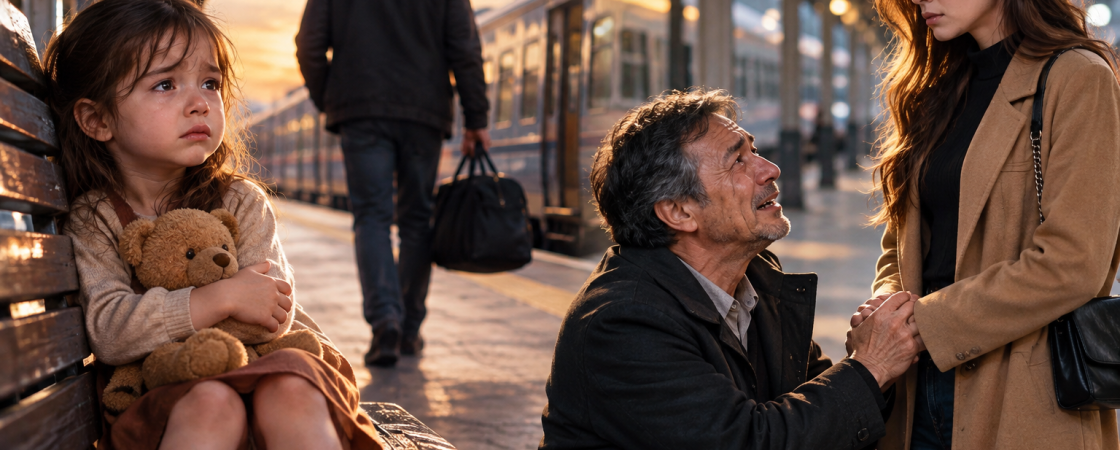
I was five years old when my father left me at a train station.
It was early morning, and the platform was almost empty.
I remember the smell of rain on the concrete. I remember the loudspeaker crackling above my head. Most of all, I remember my father’s hand wrapped tightly around mine.
He bought me a small chocolate bar and sat beside me on a wooden bench.
“Wait here, Emma,” he said.
I looked up at him.
“Where are we going?”
He smiled.
“Somewhere safe.”
I didn’t understand.
He stood up, adjusted the strap of my little backpack, and kissed the top of my head.
Then he said something I would remember for the rest of my life.
“Your father loves you. Never forget that.”
Then he walked toward the stairs.
I thought he was coming back.
So I waited.
Five minutes.
Ten minutes.
An hour.
The chocolate melted inside my hand.
The station became busier, but my father never returned.
Eventually, a woman wearing a blue railway uniform noticed me crying.
“Sweetheart, where’s your mother?”
I shook my head.
“Your father?”
I pointed toward the stairs.
“He’ll come back.”
But he didn’t.
Social workers searched for him.
Police searched for him.
There was no answer.
My father had disappeared.
No goodbye.
No explanation.
No letter.
I was placed in foster care.
And for years, I believed one terrible thing:
He had simply decided he didn’t want me anymore.
The Woman Who Raised Me
I eventually went to live with Margaret Hayes.
She was a quiet woman in her fifties who owned a small flower shop.
Her house smelled like roses and old books.
On my first night there, I asked her:
“Why did my father leave me?”
Margaret sat beside my bed.
“I don’t know.”
“Does that mean he didn’t love me?”
She took my hand.
“No, Emma.”
She paused.
“But sometimes adults make choices that children spend years trying to understand.”
Margaret never pretended to be my mother.
She never tried to erase my father from my memories.
Instead, she taught me how to build a life that didn’t depend on someone returning.
She attended every school play.
Every parent meeting.
Every birthday.
When I graduated from college, she cried harder than I did.
Eventually, I took over her flower shop.
My life became simple.
Work.
Home.
Margaret.
Flowers.
Peace.
I stopped thinking about my father.
Or at least, I tried to.
Then, twenty-two years after he left me…
He walked into my flower shop.
The Man Who Came Back
I was arranging white lilies when the bell above the door rang.
“Can I help you?”
The man standing there looked exhausted.
Gray hair.
Thin face.
Old leather jacket.
For several seconds, I didn’t recognize him.
Then he said my name.
“Emma?”
The scissors slipped from my hand.
Nobody had said my name that way in twenty-two years.
I stared at him.
He swallowed hard.
“It’s me.”
My entire body went cold.
“Dad?”
His eyes filled with tears.
He stepped toward me.
“I’ve been looking for you.”
I couldn’t move.
Then he grabbed my hands.
“Emma, please.”
His voice broke.
“We need your help.”
I pulled my hands away.
“Who is we?”
He looked toward the window.
Then back at me.
“Your family.”
I almost laughed.
“My family disappeared twenty-two years ago.”
He lowered his eyes.
“I know.”
Then he placed an old photograph on the counter.
I picked it up.
It showed my father.
My mother.
My older brother.
And another man I had never seen before.
On the back was one sentence:
If Emma ever comes back, don’t let her know the truth.
I looked at my father.
“What truth?”
He didn’t answer.
Instead, he whispered:
“Your brother is dying.”
And suddenly, I understood why they had finally come back.
But I had no idea how much they were hiding.
PART 2 — The Family That Needed Me
I didn’t go with my father that night.
I told him I needed time.
He nodded.
Before leaving, he gave me an address.
“Come tomorrow if you want answers.”
Then he disappeared into the rain.
Margaret found me sitting behind the flower shop, staring at the photograph.
She looked at it once.
Her face changed.
“Where did you get this?”
“My father came back.”
Margaret went completely silent.
“You knew him?”
She looked away.
“Not exactly.”
“Margaret.”
She sighed.
“There are things your father asked me never to tell you.”
My heart started racing.
“What things?”
She sat down.
“Your father didn’t abandon you because he stopped loving you.”
I stared at her.
“Then why?”
“Because someone was threatening your family.”
I felt the room tilt.
Margaret explained that shortly before I was left at the station, my father had discovered that my older brother, Daniel, had witnessed something dangerous involving a powerful businessman.
My father believed the only way to protect me was to make me disappear.
But there was something he hadn’t told me.
He didn’t know where I was going to end up.
He had simply left me at the station because he believed authorities would find me and keep me safe.
He never expected to lose me permanently.
I should have felt relieved.
Instead, I felt angry.
“You left me alone.”
Margaret nodded.
“I know.”
“He could have stayed.”
“Yes.”
“Then why didn’t he?”
She looked directly into my eyes.
“Because fear makes people do terrible things.”
The House on Willow Street
The next afternoon, I went to the address.
It was an old house surrounded by dead trees.
My father opened the door.
Inside, I saw a man sitting in a wheelchair.
Daniel.
My older brother.
I had only seen him in photographs.
He looked at me and started crying.
“Emma.”
I couldn’t speak.
He reached for my hand.
“I remember you.”
“You do?”
“You were five.”
His voice trembled.
“You had a red backpack.”
I looked down.
I suddenly remembered.
The red backpack.
The one my father had given me before leaving me at the station.
Daniel remembered it too.
Then he said something that made my stomach tighten.
“Dad didn’t leave you because of me.”
My father stepped forward.
“Daniel.”
“No.”
Daniel shook his head.
“She deserves to know.”
He looked at me.
“The man in that photograph wasn’t a stranger.”
I picked up the picture.
“Who was he?”
Daniel pointed at the older man standing beside our parents.
“He was our grandfather.”
I frowned.
“My grandfather died before I was born.”
Daniel nodded.
“That’s what we were told.”
Silence filled the room.
Then my father finally spoke.
“He didn’t die.”
My heart stopped.
“He disappeared.”
I stared at him.
“Why?”
My father looked toward the hallway.
“Because he left us something.”
“What?”
“A fortune.”
I almost laughed.
“So you abandoned me because of money?”
“No.”
My father looked devastated.
“The money came later.”
He opened a locked drawer.
Inside was an envelope.
My name was written on it.
EMMA.
The handwriting was unmistakably my grandfather’s.
I opened it.
Inside was a letter.
The first sentence made my hands tremble.
“If you are reading this, your father has finally brought you back.”
I looked at my father.
He wouldn’t meet my eyes.
I continued reading.
Then I reached the final paragraph.
And suddenly I understood why my father had returned after twenty-two years.
It wasn’t because Daniel was dying.
It wasn’t because they missed me.
There was something they needed from me.
Something only I could give them.
PART 3 — The Truth Behind the Abandonment
The letter explained everything.
My grandfather had created a trust before he disappeared.
But there was one condition.
The money could not be accessed by my father.
It could not be accessed by Daniel.
It could not be accessed by anyone in the family.
The trust belonged to me.
And I was the only person who could legally unlock it.
I slowly lowered the letter.
“So that’s why you came back.”
My father closed his eyes.
“Emma…”
“You needed my signature.”
He didn’t answer.
I looked at Daniel.
“And you?”
Daniel began crying.
“I was told I had months to live.”
I stared at him.
“What?”
He shook his head.
“That wasn’t true.”
My father looked furious.
“Daniel!”
Daniel continued.
“I found out the truth last month. The doctors made a mistake.”
I felt sick.
“So you lied about dying?”
“Yes.”
“Why?”
Daniel looked at the floor.
“Because Dad wanted you to come home.”
I laughed bitterly.
“Home?”
I looked around the house.
“This isn’t my home.”
My father stepped toward me.
“I know I don’t deserve forgiveness.”
“No.”
My voice shook.
“You don’t.”
He nodded.
“But I need you to know something.”
He pulled another photograph from his pocket.
It was taken the day he left me at the station.
I was sitting on the bench with my red backpack.
My father stood several feet away.
But there was something I had never noticed before.
He was crying.
On the back of the photograph were his handwritten words:
I left her to save her. God forgive me if I was wrong.
For the first time in twenty-two years, I saw the truth.
My father hadn’t walked away because he didn’t love me.
He had walked away because he was terrified.
But that didn’t erase what happened.
A child doesn’t understand sacrifice.
A child only understands that someone promised to return…
and didn’t.
The Choice
I didn’t sign the papers.
Instead, I hired my own attorney.
We discovered that the trust contained enough money to change all our lives.
But I refused to give it to my father.
I created a separate fund for Daniel’s medical care.
Then I donated the remaining money to children’s shelters and foster programs.
My father asked me why.
I told him:
“Because if you had left me somewhere safe, maybe my childhood would have been different.”
He lowered his head.
“But another child doesn’t have to experience what I did.”
Months later, my father came to the flower shop again.
He didn’t ask for money.
He didn’t ask for forgiveness.
He simply stood outside the window.
I walked out.
He looked older than before.
“I just wanted to see you,” he said.
I nodded.
For a long moment, neither of us spoke.
Then I said:
“I don’t know if I can ever call you Dad again.”
He wiped his eyes.
“I understand.”
“But I don’t hate you anymore.”
He looked at me.
And for the first time, I saw something in his face that I hadn’t seen when I was five.
Not fear.
Not desperation.
Just regret.
He turned to leave.
“Wait.”
He stopped.
I handed him a small bouquet of white lilies.
“For the years you missed.”
He held them against his chest.
And walked away.
I watched him disappear down the street.
I didn’t run after him.
I didn’t pretend everything was suddenly fixed.
Some wounds don’t disappear just because the truth finally arrives.
But that day, I learned something important:
Forgiveness doesn’t mean forgetting what someone did.
Sometimes, it simply means refusing to let the worst moment of your childhood control the rest of your life.