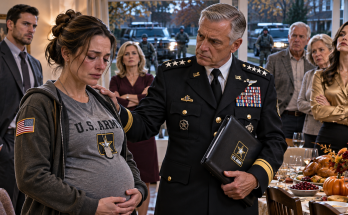
MY HUSBAND LEFT ME BLEEDING IN THE FARMYARD WHILE HIS MOTHER LAUGHED—BUT A 12-YEAR-OLD GIRL FILMED EVERYTHING FROM A NEIGHBORING BARN. THREE DAYS LATER, THE VIDEO EXPOSED A SECRET THAT DESTROYED HIS PERFECT REPUTATION.
PART 1 — THE NIGHT THE WHOLE VILLAGE HEARD ME SCREAM
“Maybe next time you’ll give my son the family he deserves!”
Those were the words my mother-in-law shouted as my husband, Victor Hale, shoved me onto the muddy ground outside our farmhouse.
I was seven months pregnant.
Rain had soaked through my clothes, and one hand instinctively covered my stomach while I tried to pull myself away from him.
Victor stood over me, furious that I had refused to sign a document he had placed on the kitchen table that afternoon.
His mother, Margaret, stood beneath the porch roof with her arms folded.
“Sign it,” Victor demanded.
“I told you I don’t understand what it says.”
“You don’t need to understand. You just need to do what your husband tells you.”
The document transferred ownership of the small property my late father had left me. Victor had been pressuring me for weeks to sign it, claiming that putting everything in his name would make our family financially secure.
But something about the document had frightened me.
My father’s lawyer had warned me never to transfer the property without independent legal advice.
When I refused, Victor’s expression changed.
He accused me of hiding money, betraying his family, and believing I was better than him.
Margaret joined in.
“After everything my son has done for you, this is how you repay him?”
I tried to stand.
Victor grabbed my arm and dragged me toward the barn.
I screamed for help.
He told me nobody would interfere because everyone in the village knew him as a respectable businessman and generous community leader.
He had donated money to the local school, paid for repairs to the church roof, and posed for photographs beside police officers during charity events.
People called him a good man.
I knew what happened when the front door closed.
For months, I had hidden bruises beneath long sleeves and made excuses for my injuries. I had convinced myself that if I stayed quiet, the baby and I might survive until I could find a safe way to leave.
That evening, I finally understood that silence was not protecting us.
Victor seized my phone and threw it onto the porch.
Then he ordered me to sign the document again.
I refused.
He stormed toward the barn, leaving me on the ground as Margaret muttered that I had brought the trouble upon myself.
Neither of them noticed the small movement behind the neighboring property’s old wooden fence.
Twelve-year-old Hannah Reed had been helping her father feed their chickens when she heard the shouting.
At first, she thought the adults were having another argument.
Then she saw me fall.
Hannah was frightened. She had seen Victor at village events and knew that adults usually listened when he spoke.
But she also knew something was terribly wrong.
She quietly took out her phone and began recording from a safe distance.
The video captured Victor threatening me over the document. It captured Margaret standing nearby and refusing to help. And it captured something neither of them realized was important.
When Victor returned to the farmhouse, he spoke to his mother in a voice that sounded completely different from the one he used when other people were listening.
“If she doesn’t sign tomorrow, we lose everything.”
Margaret answered, “Then make sure she can’t tell anyone what you did.”
Hannah stopped breathing.
She didn’t know what they meant.
But she knew she needed help.
She ran home, showed the recording to her father, and watched his expression change.
“Stay here,” he told her. “I’m calling emergency services.”
By the time the ambulance arrived, I was barely conscious.
The paramedics rushed me to the hospital, where doctors treated my injuries and monitored the baby closely.
Victor arrived later, wearing a clean shirt and carrying a bouquet of flowers.
He told the nurses I had fallen while working outside.
He even cried when he spoke about how frightened he was for his wife.
For a moment, I thought nobody would believe me.
Then a police officer entered the room.
“Mrs. Hale,” she said gently, “we need to ask you some questions about what happened tonight.”
Victor immediately stepped forward.
“My wife is exhausted. She needs rest. I’ll explain everything.”
The officer looked at him.
“Actually, Mr. Hale, we’d like to hear from her first.”
Victor’s smile faltered.
Then the officer placed a photograph on the bedside table.
It showed Hannah standing beside her father, holding her phone.
“We’ve received a recording,” the officer continued. “And there’s something on it that we’d like you to explain.”
Victor stared at the photograph.
For the first time that evening, he looked afraid.
But the most frightening discovery was still waiting to be made.
Because the document he had demanded I sign wasn’t simply a property transfer.
It was part of a plan that had begun months before I became pregnant.
And my husband’s mother had been involved from the beginning.
PART 2 — THE SECRET HIDDEN IN THE PROPERTY DEED
The next morning, I woke in a hospital room with an IV in my arm and a nurse sitting nearby.
The first question I asked was whether my baby was alive.
The nurse took my hand.
“The doctors are monitoring both of you closely. You’re in the right place, and they’re doing everything they can.”
I cried with relief.
Then I asked about Victor.
The nurse told me that police had spoken with him but would not allow him to enter my room until the immediate situation had been assessed.
For the first time in months, I could breathe without listening for his footsteps.
Later that morning, Detective Sarah Collins arrived.
She explained that Hannah’s recording had been preserved as evidence and that officers were investigating the incident.
I told her about the property document, the threats, and the way Victor had gradually isolated me from my friends.
I also explained that I had kept several messages in which he demanded that I sign away my inheritance.
Detective Collins listened carefully.
“Do you still have access to those messages?”
“Yes. They’re backed up to an account he doesn’t know about.”
She nodded.
“Please don’t delete anything. We’ll arrange for the evidence to be reviewed properly.”
Before she left, she told me something that made my stomach tighten.
Victor had already contacted several people in the village, claiming that I was unstable and that our marriage had been suffering from financial stress.
He was trying to explain the incident before anyone else could.
It was the same strategy he had used for years.
Control the story first.
Make everyone question the victim.
Then present himself as the reasonable person trying to repair the damage.
But this time, he had underestimated Hannah.
That afternoon, Detective Collins returned with a second officer.
They had reviewed the recording and found a conversation between Victor and Margaret that raised serious concerns about the property transfer.
The officers had also discovered that a company Victor controlled had recently taken out several loans.
The property my father left me was worth considerably more than the farmhouse where Victor and I lived.
If I signed the deed, he could use it as collateral.
If the company failed, I could lose the only asset my father had intended me to keep.
And if I refused, Victor risked losing access to the money he believed would save his business.
Suddenly, his obsession with the document made sense.
But that wasn’t the end.
Detective Collins placed another file on the table.
“Your father-in-law’s estate lawyer contacted us after hearing about the incident,” she explained. “He believes there may have been an attempt to alter the original inheritance documents.”
I stared at her.
“My father-in-law?”
“My apologies. Your late father’s lawyer.”
She opened the file.
Several months earlier, someone had contacted the lawyer pretending to be me. The person requested copies of the original property documents and asked whether the inheritance could be transferred without my physical presence.
The request had been refused.
The lawyer had kept a record of the communication.
The email address used for the request was connected to an account belonging to Margaret.
I felt sick.
My mother-in-law had always insisted that she wanted nothing except a peaceful family.
She had helped me prepare for my wedding. She had held my hand at my father’s funeral. She had promised that I would always have a place in her home.
And all that time, she may have been trying to gain control of my inheritance.
“Why would she do this?” I whispered.
Detective Collins didn’t pretend to know.
“That’s what the investigation is intended to establish.”
Two days later, I received a visit from Hannah and her father.
Hannah stood near the doorway, looking nervous.
“I’m sorry I recorded you,” she said. “I didn’t know if it was okay.”
I shook my head gently.
“You helped get me somewhere safe.”
Her eyes filled with tears.
“I was scared he would see me.”
“So was I.”
Her father placed a small envelope on the table.
“We brought a copy of the original video and a written statement about when and where Hannah recorded it. The police already have the evidence, but we wanted you to know that we weren’t going to let anyone pretend this never happened.”
I thanked them both.
After they left, I watched the recording with Detective Collins present.
I didn’t need to see every second.
The threats were clear. The demand for my signature was clear. And Margaret’s words made it difficult to dismiss what had happened as an ordinary disagreement.
But near the end, there was something else.
Victor had been speaking to his mother beside the barn.
He mentioned a second set of documents stored in a locked cabinet at his office.
Then Margaret asked, “And what about the money you moved before she found out?”
Victor replied, “Nobody can trace it back to us.”
The recording ended shortly afterward.
Detective Collins immediately requested that the relevant financial records be preserved through the appropriate legal process.
A review of the company’s records uncovered transfers that required further investigation. Some payments had been made to an account connected to a business Margaret had helped establish.
The money appeared to have been moved shortly before Victor began pressuring me to sign the deed.
I had believed the argument was about his pride.
Now I understood that it might also have been about money, evidence, and the fear of being exposed.
That evening, the hospital gave me an update.
My baby was still being monitored, and the doctors could not yet guarantee the outcome.
I placed both hands over my stomach and whispered that I was sorry.
I was sorry I had stayed quiet for so long.
Sorry I had mistaken endurance for safety.
Sorry I had believed that being a good wife meant giving someone endless chances to hurt me.
But I was still here.
And I was no longer alone.
The next morning, Detective Collins called.
“Mrs. Hale, we’ve found the original property deed.”
“Where?”
“In a locked cabinet at your husband’s office.”
I closed my eyes.
“What does that mean?”
“It means the document he wanted you to sign may not have been the only document involved.”
She paused.
“There’s also a letter attached to the file. It’s addressed to your husband, and it appears to have been written by your mother-in-law.”
“What does it say?”
“We’re still examining it. But one sentence stands out.”
My fingers tightened around the phone.
“What sentence?”
Detective Collins read it aloud.
“Once she signs, she will never learn what happened to the money your father left her.”
For a long moment, I couldn’t speak.
My father had left me that property because he wanted me to have security.
And the two people who claimed to be my family had apparently been working together to take it away.
But there was one question I couldn’t answer.
If the money had already been moved, where had it gone?
And why had Victor become so desperate to obtain my signature just before the debt on his company came due?
PART 3 — THE RECORDING THAT ENDED THEIR LIES
Three weeks later, I was discharged from the hospital with strict instructions to rest and attend regular medical appointments.
My baby was still being monitored, and every day brought a mixture of hope and fear.
I moved into a secure temporary residence arranged with the help of people I trusted.
For the first time in years, I could sleep without wondering whether Victor would wake me in the middle of the night to demand another explanation for something I hadn’t done.
The investigation continued.
The police obtained relevant records, interviewed witnesses, and examined the disputed property documents. Financial investigators reviewed the transactions connected to Victor’s company and Margaret’s business.
Victor denied wrongdoing.
He claimed that the recording had been taken out of context and that the property transfer was a normal business arrangement between spouses.
Margaret told investigators that she had been trying to protect her son from financial ruin.
But neither explanation accounted for the messages, the original documents, or the statements recorded in the yard.
More importantly, neither explanation changed what had happened to me.
A few days later, Detective Collins contacted me with an update.
The original property deed had never been legally transferred.
The attempted transaction had been stopped before it could be completed, and the property remained mine.
The investigators had also identified several questionable financial transfers that were now part of a broader inquiry.
Victor and Margaret were required to respond to the allegations through the legal process. Their statements would be assessed alongside the documentary evidence and witness accounts.
For the first time, I felt that the truth might survive their attempts to bury it.
Then came the hearing concerning the immediate protective measures I had requested.
I sat beside my attorney, my hands folded tightly in my lap.
Victor entered wearing a dark suit.
He looked exactly as he had at charity dinners and village celebrations: polished, confident, and certain that everyone would eventually see things his way.
When he noticed me, he shook his head as if I had disappointed him.
His attorney argued that the incident had been exaggerated and that Victor posed no continuing risk.
My attorney presented the documented threats, the messages, and the evidence collected by investigators.
Hannah’s recording was also introduced through the proper procedure.
The room fell silent as the relevant portion was played.
Victor’s own voice filled the room.
Then Margaret’s.
Neither could explain away the words they had spoken.
The judge reviewed the available evidence and issued protective orders designed to keep me safe while the case proceeded.
I walked outside afterward and stood beneath the courthouse awning.
I had imagined that seeing Victor lose control of the situation would make me feel triumphant.
It didn’t.
I felt exhausted.
I thought about the woman I had been before the marriage became frightening. I thought about how many times I had apologized simply to make the shouting stop.
And I thought about the baby I was still fighting to protect.
That was the only future that mattered to me.
Months passed.
The financial investigation continued, and the legal proceedings moved forward. The evidence led to further scrutiny of the property transfer and the money associated with Victor’s company.
I learned that justice rarely arrives in one dramatic moment. It comes through statements, records, careful questions, and people willing to tell the truth even when doing so is frightening.
Hannah and her family remained in contact with me.
Her father helped arrange practical support, while Hannah occasionally sent drawings and encouraging messages.
One afternoon, she gave me a card she had made herself.
On the front, she had drawn a little house beneath a bright yellow sun.
Inside, she had written:
I hope you and your baby have a happy future.
I kept the card beside my bed.
Then, one quiet morning, I went into labor.
The doctors moved quickly, and my mind filled with fear.
I thought of the yard, the rain, the shouting, and the moment I had believed I might never see another morning.
But this time, I wasn’t alone in a place where nobody could hear me.
I was surrounded by people whose job was to protect us.
After hours of uncertainty, I heard a small cry.
My baby had arrived.
A healthy little girl.
I held her against my chest and began to cry.
Not because the past had disappeared.
Not because every legal question had been resolved.
But because we had survived long enough to have a future.
I named her Hope.
A year later, the proceedings involving Victor and Margaret had reached a new stage. Some allegations had been formally pursued, while other financial questions remained under investigation. The outcome of each issue depended on the evidence and the legal process, not on rumors circulating through the village.
Victor could no longer use his reputation to prevent people from asking questions.
Margaret could no longer insist that everything had been a private family matter.
And I no longer felt obligated to protect either of them from the consequences of their own choices.
One afternoon, I returned to the neighboring farm with Hope in my arms.
Hannah was outside, helping her father plant flowers beside the fence.
When she saw us, she ran over with a smile.
“Is that your baby?”
“Yes,” I said. “This is Hope.”
Hannah looked at the little girl sleeping against my shoulder.
“She looks peaceful.”
“She is.”
For a moment, neither of us spoke.
Then I took Hannah’s hand.
“You were brave that night.”
She shook her head.
“I was scared.”
“Bravery doesn’t mean you aren’t scared. Sometimes it means you ask for help anyway.”
Hannah smiled shyly.
I looked toward the old barn, where everything had nearly ended for me.
The building looked ordinary now.
The fence was still there. The muddy yard had dried. Birds moved between the trees, and sunlight fell across the ground where I had once believed nobody would ever hear my voice.
But someone had heard.
Someone had chosen to help.
And because of that choice, I had been given another chance to build a life beyond fear.
I carried Hope toward the car, promising myself that she would grow up knowing something I had spent too many years learning.
Love does not demand silence.
Family does not excuse cruelty.
And no person’s reputation is more important than another person’s safety.
The video had exposed what happened that night.
But the real turning point had come when a frightened child decided that what she was seeing was wrong—and asked an adult for help.
THE END.