MY PARENTS MADE MY 7-YEAR-OLD ADOPTED SON EAT CHRISTMAS DINNER ALONE WHILE HIS COUSINS RECEIVED THEIR INHERITANCE GIFTS. THEN A LAWYER ARRIVED WITH A SEALED LETTER ADDRESSED TO MY DEAD SISTER—AND MY MOTHER BEGGED ME NOT TO READ IT.
PART 1 — THE CHILD THEY REFUSED TO CALL FAMILY
“Put that plate in the kitchen, Oliver. The family hasn’t finished eating.”
My mother’s voice cut through the Christmas music.
Seven-year-old Oliver stood beside the dining table, holding a plate of mashed potatoes and gravy. His cousins sat beneath the chandelier, laughing as they opened expensive gifts wrapped in gold paper.
Oliver wore the same blue sweater he’d worn to school the previous week. His hands were small, and his eyes moved nervously between the adults who were supposed to love him.
“Grandma,” he asked softly, “can I sit with everyone now?”
My mother, Eleanor Whitmore, didn’t even look at him.
“You can eat after the guests are finished.”
I froze in the doorway.
My name is Adrian Whitmore. I built a successful property business from a small office and a handful of clients, but the proudest decision of my life had nothing to do with money.
Three years earlier, I had adopted Oliver after my younger sister, Claire, died unexpectedly.
Claire had been his mother.
She had raised him alone, worked two jobs, and fought through more difficulties than most people knew. When she died, Oliver had nowhere to go except into the care of relatives who treated him as an inconvenience.
I couldn’t allow that.
I brought him home, adopted him, and promised him that he would never again have to wonder whether someone wanted him.
I had believed my parents would eventually accept him.
That Christmas, I discovered how wrong I was.
I walked into the dining room.
“Why is Oliver eating separately?”
My mother finally looked at me.
“Adrian, please don’t start.”
“I’m asking a simple question.”
My father, Richard, set down his wineglass.
“Your nephews and nieces are celebrating with their grandparents. Oliver can join us when he learns to behave properly.”
Oliver lowered his eyes.
“What did he do?”
“Nothing,” my mother answered. “But he needs to understand that this family has traditions.”
I looked at the children sitting around the table.
Every one of them had a beautifully wrapped present in front of them.
Oliver had none.
I crouched beside him.
“Did Grandma tell you that you couldn’t open your present?”
He shook his head.
“It’s okay, Dad. I don’t need one.”
That answer hurt more than anything my mother could have said.
A child shouldn’t have to pretend he doesn’t want to be loved.
I stood and faced my parents.
“Oliver is my son. He will sit at this table, open his presents, and be treated with the same respect as every other child in this family.”
My father gave a humorless laugh.
“You can sign whatever papers you want, Adrian. That doesn’t change his blood.”
I felt something inside me harden.
“Get out of his way.”
For the first time that evening, my mother looked frightened.
Not because I was angry.
Because she knew I had noticed something she had spent years trying to hide.
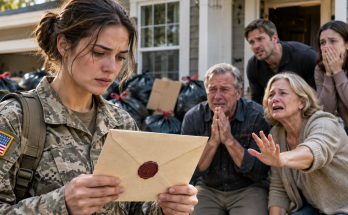
Earlier that morning, a courier had delivered a sealed envelope from a law firm in Boston. The letter was addressed to me and marked urgent.
It concerned Claire’s estate, Oliver’s adoption, and a private trust established shortly before her death.
I had assumed it was another administrative matter.
Now I wasn’t so sure.
I carried Oliver into the living room, where he finally smiled at the sight of the Christmas tree.
Then I went to my study and retrieved the envelope.
The moment I returned to the hallway, my mother appeared behind me.
“Adrian, give me that letter.”
I looked at her.
“Why?”
“It’s private family business.”
“It has my name on it.”
She reached for the envelope, but I stepped back.
My father appeared beside her.
“Listen to your mother. Some things are better left alone.”
I examined the return address.
The firm had represented my sister during the final months of her life.
Then I noticed the handwritten note beneath the seal.
To Adrian Whitmore. Regarding the true beneficiary of the Claire Whitmore Family Trust.
My mother went completely pale.
I started opening the envelope.
“Don’t!” she screamed.
The entire house fell silent.
Even Oliver turned toward us.
I looked at my mother.
She was trembling.
“Why are you so afraid of a letter from my sister’s lawyer?”
She opened her mouth, but no words came out.
Then Oliver quietly approached me and tugged at my sleeve.
“Dad?”
I knelt beside him.
“What is it, buddy?”
He glanced at my mother before whispering something that made my heart stop.
“Mommy Claire told me Grandma would be angry if you ever found out where she kept the little red book.”
I stared at him.
“What little red book?”
Oliver pointed toward my mother’s locked handbag.
“The one she took from Mommy’s house the day Mommy died.”
My mother grabbed the handbag and backed away.
And suddenly, I understood that the letter might not be about Oliver’s adoption at all.
It might be about something my sister had been trying to protect him from.
PART 2 — THE SECRET MY SISTER TOOK TO HER GRAVE
I waited until Oliver was upstairs before confronting my parents.
My mother sat rigidly on the sofa, clutching her handbag against her chest. My father paced near the fireplace, repeatedly checking his phone.
Neither looked like someone who had simply misunderstood a Christmas tradition.
They looked like people waiting for a disaster.
I placed the sealed envelope on the coffee table.
“I’m asking once. What did Claire leave behind?”
My father stopped pacing.
“Your sister was ill. She made decisions she didn’t fully understand.”
“Then why did her lawyer send me an urgent letter?”
“Because lawyers make money by creating problems,” he snapped.
I looked at my mother.
“Did you take something from Claire’s house after she died?”
Her lips tightened.
“I was grieving.”
“That isn’t an answer.”
She began to cry.
For a moment, I remembered the mother who had held me when I was a child, the woman who had cooked dinner after my father’s long shifts, the grandmother I had hoped Oliver would grow to love.
Then I remembered my son standing alone beside the dining table.
“Adrian,” she whispered, “you don’t understand what Claire did.”
“Then explain it.”
She shook her head.
My father suddenly stepped between us.
“This conversation is over.”
I looked him in the eyes.
“No. It isn’t.”
I took the envelope and went into my study, locking the door behind me.
Inside were several legal documents, a copy of Claire’s last will, and a letter written in her familiar handwriting.
The first paragraph was addressed directly to me.
Adrian, if you’re reading this, then Mom and Dad have finally learned that I didn’t change my mind.
I read the sentence twice.
Claire had known something would happen.
The letter explained that, several months before her death, she had discovered irregularities in a family investment account. Money intended for a charitable foundation had been transferred through several companies, and Claire believed that someone in our family had been using the foundation to conceal financial transactions.
She had hired an attorney to investigate.
During that process, she discovered that a substantial trust had been established in Oliver’s name.
The trust had been funded by our grandmother, who had died years earlier.
According to the documents, Oliver was its sole beneficiary.
My parents had never mentioned it.
The trust was worth considerably more than I had expected—enough to provide for Oliver’s education, healthcare, and future security.
But the letter contained another disturbing detail.
Claire believed someone had been attempting to change the trust’s beneficiary without authorization.
She had preserved evidence in a small red notebook.
The notebook Oliver had just described.
My hands began to shake.
I continued reading.
I don’t know who I can trust anymore. If something happens to me, please protect Oliver. He deserves a life that isn’t controlled by people who think money gives them the right to decide who belongs.
I stopped.
Claire had died in a single-car accident on a rainy night.
The official report had described it as a tragic loss of control on a wet road.
I had accepted that explanation.
Now, for the first time, I wondered whether she had been under pressure during the final weeks of her life.
I didn’t assume that the accident was anything other than what investigators had concluded. But I knew I needed to understand why my sister had been so frightened.
I called the law firm.
A woman named Patricia Bell answered.
After verifying my identity, she told me that Claire had requested the letter be delivered to me if certain conditions were met.
“What conditions?” I asked.
“Your parents attempted to submit a claim against the trust last month. The claim triggered a review of the original documents.”
I closed my eyes.
“What claim?”
“They argued that the trust should be transferred to the family estate because Oliver was not biologically related to your grandmother.”
I stared at the wall.
“That makes no sense. He’s Claire’s son.”
“Your grandmother’s trust contains an explicit provision protecting adopted and legally recognized descendants. The claim conflicts with that provision.”
Patricia paused.
“There’s another issue. Someone submitted a document bearing your signature, supposedly authorizing the transfer.”
“I never signed anything.”
“That’s what we suspected. We need to investigate how that document was created.”
I asked whether Claire had left any additional evidence.
Patricia confirmed that the law firm had preserved several sealed records and was prepared to cooperate with the appropriate authorities if evidence of wrongdoing emerged.
Before we ended the call, she said something that made my stomach tighten.
“Your sister also left a recorded message for Oliver. She asked us to release it to him when he was old enough to understand what she wanted him to know.”
I swallowed.
“What did she say?”
“We haven’t released it. But she included a note asking that you listen first.”
The following morning, I returned to the law firm with my attorney.
They showed me the trust documents and the disputed authorization. The signature appeared similar to mine, but I knew I had never approved the transfer.
The attorney explained that the document would need proper forensic examination before anyone could conclude who had created it.
Then she opened a separate file.
It contained correspondence between Claire and our mother.
The messages began politely. Claire asked questions about the trust. Our mother told her to stop interfering in financial matters she didn’t understand.
The messages became increasingly hostile.
In the final exchange, Claire wrote:
Oliver is a child. Whatever happens between us, you cannot punish him for being adopted.
My mother’s response was one sentence.
You have no idea what that boy’s existence will cost this family.
I read the sentence again.
It didn’t prove that my mother had caused Claire’s death or that she had committed a crime.
But it revealed something I could no longer ignore.
My parents had known about Oliver’s inheritance. They had tried to challenge it. And they had treated my son as though his adoption made him less worthy of love.
That afternoon, I returned home and asked my mother to explain the message.
She broke down.
“Your grandmother promised the trust to the next generation,” she said. “Your father and I believed it was meant for the biological children in the family.”
“The documents say otherwise.”
“Claire manipulated her!”
“Do you have evidence of that?”
She said nothing.
My father entered the room.
“Enough. That money belongs with the family.”
I looked at him.
“Oliver is the family.”
My father shook his head.
“You’re going to destroy everything we’ve built over a child you adopted.”
I stepped toward him.
“No. You are going to answer for what you’ve done to him.”
Then my phone rang.
Patricia Bell.
“We found the original red notebook,” she said. “It was stored in a secure archive with Claire’s other records.”
“What’s inside?”
“Financial entries, copies of correspondence, and a list of people who knew about the trust.”
I gripped the phone.
“Is my mother’s name on that list?”
A long silence followed.
“Yes.”
Then Patricia added:
“Your father’s name is there, too. And there’s a final page that may explain why Claire was so afraid.”
“What does it say?”
She lowered her voice.
“If anything happens to me, investigate the person who insisted on driving me home that night.”
I felt the room spin.
My father had been the last person to see Claire before her accident.
And he had never told me that.
PART 3 — THE TRUTH THAT CHANGED OUR FAMILY FOREVER
I didn’t confront my father immediately.
For the first time, I understood how dangerous assumptions could be.
Claire’s final note was a reason to investigate, not proof that anyone had caused her death.
I gave the notebook, the disputed signature, and the correspondence to my attorney. The law firm preserved the originals, and the relevant information was referred to the appropriate authorities for review.
I also arranged for Oliver to stay with a trusted family friend while I dealt with the situation.
He didn’t need to hear another argument about whether he belonged.
He needed to feel safe.
Two days later, Patricia contacted me again.
The notebook contained a receipt showing that my father had accessed a storage facility the morning after Claire’s funeral. The facility held several boxes of financial records and personal belongings.
My father had told us that Claire’s belongings had been distributed among relatives.
He had never mentioned the storage unit.
With the appropriate authorization, investigators examined the stored records.
They found additional correspondence related to the trust, including a draft request to redirect part of Oliver’s inheritance to a family-controlled account.
The draft had never been legally approved.
But the signature attached to it was another disputed copy of my own.
I had never authorized the transfer.
The evidence raised serious questions about who had prepared the documents and why.
Investigators also reviewed the circumstances surrounding Claire’s accident. They interviewed people who had spoken to her in the final weeks of her life and reexamined records connected to the family’s financial disputes.
I did not know what they would ultimately discover.
I only knew that Claire had been frightened, that she had tried to protect Oliver, and that someone had attempted to interfere with his inheritance.
For years, I had believed my parents were simply old-fashioned people who struggled to accept my decision to adopt a child.
Now I understood that their behavior might have been tied to something more calculated.
The family had built its identity around money, reputation, and the belief that inheritance belonged to those who shared its blood.
Claire had challenged that belief.
And Oliver had become the person they were trying to exclude.
A week later, my parents requested a meeting.
I agreed, but only in the presence of my attorney.
We met in a conference room at the law firm’s office.
My mother looked exhausted. My father sat with his hands folded, staring at the table.
Patricia placed a copy of the trust provision between us.
“Your grandmother’s instructions are explicit,” she explained. “Oliver is the named beneficiary, and his legal adoption does not disqualify him. Any attempt to transfer the assets must comply with the trust’s terms and applicable law.”
My father leaned forward.
“We only wanted to protect the family.”
I looked at him.
“From a seven-year-old boy?”
He said nothing.
My mother began to cry.
“I never wanted him to suffer.”
“Then why did you leave him alone while everyone else opened presents?”
She covered her face.
I waited.
Finally, she whispered, “Because every time I looked at him, I remembered Claire and everything she had done.”
I felt a deep sadness, but not the forgiveness she seemed to expect.
“Oliver isn’t responsible for what happened between you and my sister.”
“I know.”
“Then you should have treated him like a child who needed love, not a threat to your inheritance.”
My father stood.
“This family has survived for generations because we protected what belonged to us.”
I rose, too.
“That’s the problem. You believed everything belonged to you.”
I told them that Oliver would remain the beneficiary of the trust according to its lawful terms. Any disputed transaction would be handled through the legal process, and I would not allow them to pressure him or use him as leverage.
My attorney explained that the disputed documents and financial matters were still under review. No one in that room could declare guilt simply because the evidence looked troubling.
But one thing was no longer open for debate.
Oliver was my son.
And I would protect his right to grow up without being made to feel ashamed of his adoption.
Before we left, Patricia handed me a small digital recorder.
“Claire asked us to give you this after the trust documents were reviewed,” she said. “It’s her message for Oliver.”
I took it home.
That evening, I sat beside Oliver on the sofa.
He was building a tower from wooden blocks, carefully placing each one so it wouldn’t fall.
“Buddy,” I said, “I have something from your mom.”
He stopped.
“My mommy?”
I nodded.
His eyes filled with tears.
“Is she talking?”
“Yes. It’s a recording she left for you.”
He climbed onto the sofa beside me.
I pressed play.
Claire’s voice filled the room.
“Hello, my beautiful boy.”
Oliver covered his mouth.
“If you’re listening to this, then you’re older than you were when I recorded it. I wish I could be there to see you grow. I wish I could watch you open presents, learn to ride a bicycle, and ask a thousand questions about the world.”
Her voice trembled.
“But there’s something I need you to know. You were never a mistake. You were never a burden. And you never have to earn the right to be loved.”
Oliver began to cry.
Claire continued.
“Some people will tell you that family is only about blood. They are wrong. Family is about the people who show up when you’re frightened, who listen when you’re hurt, and who stand beside you when the world tells you that you don’t belong.”
I held Oliver close.
“Your Uncle Adrian loves you very much. If he is the one listening with you, I hope he has kept his promise to take care of you.”
My throat tightened.
Then Claire said her final words.
“Whatever happens, Oliver, remember this: you belong. You always did. You always will.”
The recording ended.
Oliver pressed his face against my chest and sobbed.
I held him until his breathing slowed.
For a long time, neither of us spoke.
Then he looked up at me.
“Dad, was Mommy scared?”
I thought about the notebook, the letters, and the questions that still needed answers.
“Yes, buddy. I think she was.”
“Did she know I was going to be okay?”
I kissed his forehead.
“I think she hoped you would be. And I’m going to do everything I can to make sure you are.”
The investigation continued over the following months. The disputed documents were examined, the trust remained protected under its governing terms, and the authorities assessed the financial records and the information concerning Claire’s final days.
I never promised Oliver that every question would receive an easy answer.
I promised him something more important.
That he would never have to face those questions alone.
The following Christmas, I hosted dinner at my own home.
There were no separate tables. No child was sent to the kitchen. No one was asked to prove that they belonged.
Oliver sat beside me, wearing a new green sweater and smiling as he opened a present containing a telescope.
He had become fascinated with the stars.
“Dad,” he said, looking through the instruction booklet, “do you think Mommy can see the stars from heaven?”
I looked toward the window.
“I think she would be happy knowing you’re looking up at them.”
He smiled.
Then he reached into his pocket and pulled out a small folded drawing.
It showed two people holding hands beneath a bright yellow sun.
One was a little boy.
The other was a tall man with dark hair.
Above them, Oliver had written:
MY FAMILY.
This time, he hadn’t drawn himself standing apart from everyone else.
He had drawn himself right beside me.
I hung the picture above the fireplace.
And as the Christmas lights glowed around us, I finally understood what my sister had tried to teach our family.
Inheritance can be written into a legal document.
A name can be recorded on a certificate.
But belonging cannot be measured by blood, money, or the approval of people who refuse to open their hearts.
Oliver had lost his mother.
He had nearly lost the security she had worked so hard to leave him.
But he would never again have to wonder whether his father considered him a real son.
Because when the next Christmas came, there was only one rule in my house.
Nobody at our table would ever have to earn their place in the family.
And that was the promise I intended to keep for the rest of my life.
THE END.