PART 1 — THE DAUGHTER THEY ERASED
My name is Victoria Hayes, and for twelve years, my family believed I was the biggest disappointment they had ever produced.
They believed it because my father told them so.
And because my mother, my older brother, and my younger sister had repeated his version of my life so many times that eventually, even they stopped questioning whether it was true.
My father, Richard Hayes, had spent thirty years in the United States Navy.
To him, a person’s worth could be measured by the uniform they wore, the rank displayed on their shoulders, and the number of people who stood when they entered a room.
My older brother, Daniel, had followed his footsteps.
My younger sister, Emily, was building a promising military career of her own.
And then there was me.
The daughter who had supposedly thrown everything away.
Twelve years earlier, I had left home after a bitter argument with my father.
He had wanted me to accept a comfortable assignment that would keep me close to the family and preserve the future he had planned for me.
I had refused.
“I didn’t spend my entire life training to become the person you want me to be,” I told him.
His face hardened.
“Then don’t expect this family to be waiting when you realize your mistake.”
My mother stood beside the staircase, twisting a dish towel between her hands.
She didn’t defend me.
Daniel looked down at his phone.
Emily, who was still young enough to believe our father could do no wrong, watched me with frightened eyes.
I packed one duffel bag, walked out the front door, and never looked back.
Over the following years, my family heard rumors about me.
Some were true.
Most were not.
They heard that I had been transferred overseas.
They heard that I had stopped attending family gatherings.
They heard that I rarely contacted anyone.
What they never learned was that I had continued serving.
Quietly.
Relentlessly.
And in assignments that required a level of discretion I could never explain over a family dinner.
I couldn’t tell them where I had been.
I couldn’t describe the people I had worked beside.
And I couldn’t defend myself when my father began telling relatives that I had abandoned my military career because I couldn’t handle responsibility.
Eventually, my mother stopped asking questions.
Daniel stopped answering my messages.
Emily stopped writing altogether.
I became a story they told about a daughter who had failed.
Then, one Thursday morning, I received a message from Emily.
It was an invitation to Daniel’s promotion ceremony.
No greeting.
No explanation.
Just the date, the location, and one sentence.
Dad says you can attend if you don’t make this about yourself.
I read it three times.
Then I placed my phone on the kitchen counter and stared out at the rain.
For twelve years, I had learned to live without my family’s approval.
I had learned that loneliness could become familiar.
I had learned that the people who shared your childhood did not always deserve access to your future.
But Daniel was still my brother.
And somewhere beneath all the disappointment, I still remembered the little boy who had once waited outside my bedroom because he was afraid of thunderstorms.
So I bought a plane ticket.
I arrived at the naval auditorium twenty minutes before the ceremony began.
The lobby was crowded with officers, family members, and invited guests.
My father stood near the entrance, surrounded by people who laughed at his jokes and congratulated him on his children’s accomplishments.
When he noticed me, his smile disappeared.
“Victoria.”
“Hello, Dad.”
He glanced at my simple navy-blue dress, then at the small handbag hanging from my shoulder.
“You came.”
“Emily invited me.”
“Well, don’t expect special treatment.”
“I wasn’t expecting any.”
He leaned closer.
“Daniel has worked very hard for this day. Don’t embarrass him by bringing up your own career or telling people stories they don’t need to hear.”
I stared at him.
“My career?”
He gave a dismissive shrug.
“Whatever it is you do now.”
Before I could answer, my mother appeared beside him.
She kissed my cheek without meeting my eyes.
“You look tired, sweetheart.”
It was the closest thing to affection I had received from her in twelve years.
Then she pointed toward the auditorium.
“Your seat is in the back. We have guests joining us in the front rows.”
I walked inside alone.
Daniel was already seated near the stage, speaking with several senior officers.
Emily sat beside our mother.
When she saw me, she gave a brief, uncertain wave.
I smiled at her.
She immediately turned back toward the stage.
An usher checked my invitation and directed me to the last section of seats.
As I settled into my chair, I heard two women behind me discussing the Hayes family.
“That’s the youngest daughter, isn’t it?” one whispered.
“I think so. Richard says she left the service years ago.”
“What a shame. With a father like him, you’d think she’d have done something with her life.”
I kept my eyes forward.
I had spent years learning not to react to words that revealed more about the speaker than the person being discussed.
The ceremony began.
My father was invited to the stage to deliver a short introduction.
He spoke proudly about Daniel’s dedication, Emily’s achievements, and the importance of carrying on the Hayes family tradition.
He mentioned the sacrifices our family had made.
He mentioned the deployments.
He mentioned the sleepless nights and the long separations.
Then he paused.
“My children have taught me that success comes to those who remain disciplined and committed to their purpose.”
He looked directly at Daniel.
“Some people lose their way. Others understand what service truly means.”
The audience applauded.
I felt every word settle over me like a weight.
Daniel accepted his promotion with a broad smile.
My mother wiped away a tear.
Emily clapped enthusiastically.
I applauded, too.
Because whatever my family believed about me, Daniel had earned his moment.
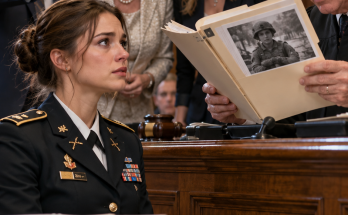
Then the auditorium doors opened.
A uniformed aide hurried inside and approached the officer coordinating the ceremony.
The officer listened, straightened immediately, and whispered something to the master of ceremonies.
A ripple of movement spread through the front rows.
My father turned toward the entrance.
His expression changed.
A four-star admiral had arrived.
The room rose to its feet.
The admiral returned the greeting, then spoke briefly with the senior officers near the stage.
He was a tall man with silver hair and a calm, commanding presence.
His uniform carried decorations that drew immediate attention.
My father stood rigidly beside the podium, clearly hoping for an opportunity to introduce himself.
But the admiral wasn’t looking at him.
He was scanning the auditorium.
His gaze passed over the front rows.
Then the middle section.
Then the back.
And suddenly, he stopped.
His eyes fixed on me.
For a moment, he appeared almost disbelieving.
Then his entire expression changed.
He said something to his aide and began walking down the aisle.
People moved aside to let him pass.
I watched him approach, confused.
My father turned around.
My mother followed his gaze.
Daniel’s smile faded.
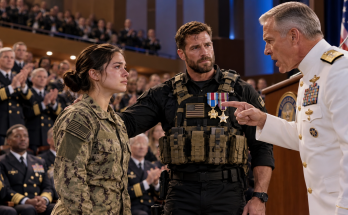
The admiral stopped directly in front of my seat.
He stood at attention.
Then he raised his hand in a formal salute.
The auditorium fell silent.
“Commander Hayes,” he said, his voice carrying through the room. “I was told you might be here, but I never expected to find you sitting in the last row.”
My mother gripped the armrest.
My father looked as though someone had suddenly pulled the floor out from beneath him.
The admiral lowered his hand, glanced toward the stage, and then looked back at me.
“Ma’am, there’s something the people in this room need to understand.”
He paused.
Then he said the words that changed everything.
“Your brother is being honored today for his promotion. But before this ceremony continues, I believe everyone should know who actually saved his life during the operation that nearly ended his career.”
Daniel stood frozen beside the stage.
My father’s face drained of color.
And the admiral turned toward the microphone.
“Because the commander who brought him home was…”
PART 2 — THE NAME BEHIND THE CLASSIFIED MISSION
“…his own sister.”
For several seconds, nobody moved.
My mother stared at me as if she were seeing a stranger.
Emily slowly rose from her seat.
Daniel’s lips parted, but no words came out.
My father stepped away from the podium.
“Admiral, with respect,” he said, forcing a laugh, “there must be some misunderstanding. Victoria left the service years ago.”
The admiral turned toward him.
“Sir, I’m familiar with Commander Hayes’s record.”
My father swallowed.
“She hasn’t been part of our family’s military tradition for a very long time.”
The admiral’s expression hardened.
“With all due respect, Captain Hayes, military service is not a family tradition. It is a responsibility. And your daughter has fulfilled that responsibility with distinction.”
A murmur spread through the auditorium.
I stood slowly.
“Admiral, this is Daniel’s ceremony. I don’t want to take attention away from him.”
He regarded me for a moment, then nodded.
“That is precisely what I expected you to say.”
He turned toward the stage.
“Please allow me to explain one thing, without discussing any classified details.”
The room settled into silence.
“Several years ago, a joint operation encountered a situation that placed multiple service members at serious risk. The mission’s original plan had failed, communications had become unreliable, and the team needed someone capable of making difficult decisions under extraordinary pressure.”
He paused.
“Commander Hayes assumed responsibility for coordinating the team’s safe withdrawal. Her decisions helped bring every member of that team home.”
Daniel’s face had become pale.
I remembered that night.
I remembered the exhausted voices over the radio.
I remembered the impossible decisions, the hours without sleep, and the fear I had refused to acknowledge until everyone was safely accounted for.
I also remembered the young officer who had been injured during the operation.
Daniel.
My brother had been there.
He had never known who was coordinating the response from the command center.
He had been evacuated before he could learn the names of everyone involved.
I had received a brief message afterward confirming that he was alive.
I had read it alone in a dimly lit office thousands of miles from home.
Then I had returned to work.
I never told my family.
I couldn’t.
And even if I could have, I wasn’t sure they would have believed me.
The admiral continued.
“Commander Hayes was later selected for responsibilities that required exceptional judgment, leadership, and discretion. Her assignments have not always been suitable for public discussion. That does not make her service less real.”
My father’s mouth tightened.
“But she’s only—”
He stopped himself.
The admiral looked directly at him.
“Only what, sir?”
My father said nothing.
For the first time in my life, I watched him struggle to find words in front of an audience.
The admiral stepped away from the microphone and approached me again.
“Commander, I apologize for the attention. I had hoped to speak with you privately, but circumstances changed when I learned you were attending this ceremony.”
“There’s no need to apologize, sir.”
He nodded.
Then he asked, “May I share one additional fact?”
I hesitated.
He understood.
“Only what is appropriate,” I replied.
He turned back toward the room.
“Commander Hayes was recently appointed to lead a specialized operational command. Her position places her among a small group of officers entrusted with coordinating complex missions across multiple units.”
A senior officer near the front nodded in recognition.
Someone behind me whispered, “She’s a commander?”
Another voice answered, “Apparently.”
My mother covered her mouth.
My father stared at the silver insignia on my uniform jacket, which he had somehow failed to notice when I arrived.
Daniel finally stepped away from the stage.
“Victoria?”
I looked at him.
He seemed smaller than I remembered.
“That operation,” he said quietly. “You were involved?”
“I was part of the team coordinating the response.”
“You knew I was there?”
“Yes.”
His eyes filled with disbelief.
“Why didn’t you tell me?”
I held his gaze.
“Because I wasn’t allowed to discuss the operation. And afterward, I thought you would eventually ask me about my life.”
He lowered his head.
“I should have.”
The words were so quiet that only those nearest us could hear them.
My father approached, his expression shifting from embarrassment to something resembling anger.
“This is unbelievable,” he said. “You expect us to accept all this without any explanation?”
I looked at him calmly.
“I don’t expect you to accept anything, Dad.”
“Then why come here?”
The question hurt more than I wanted to admit.
I glanced toward Daniel.
“Because he’s my brother.”
My father scoffed.
“And after all these years, you couldn’t have contacted us? You couldn’t have explained yourself?”
“I tried.”
He opened his mouth.
I continued before he could interrupt.
“I sent letters. I called. I left messages. I asked Mom whether you wanted to speak with me.”
My mother lowered her eyes.
“I remember some of those calls,” she whispered.
I looked at her.
“You told me Dad was busy.”
She began to cry.
“He was upset. I thought if I gave him time, things would improve.”
“Twelve years is a long time to wait for someone to stop being upset.”
She had no answer.
Then Emily came toward me.
“Why didn’t you tell me about Daniel?”
I looked at my younger sister.
“Would you have believed me?”
She flinched.
“I don’t know.”
“That’s the problem, Emily. Nobody asked.”
She wiped her cheeks.
“I thought you didn’t care about us anymore.”
“I cared every day.”
My voice nearly broke on the last word.
For a moment, we stood facing one another, surrounded by people who had just witnessed a version of our family they had never imagined.
Then Daniel spoke.
“I want to apologize.”
My father immediately turned toward him.
“Daniel, this is not the time.”
Daniel didn’t look away from me.
“Yes, it is.”
He took another step forward.
“I repeated what Dad said because it was easier than finding out the truth. I told people you had abandoned your career. I laughed when they called you a failure. I let everyone believe you were the problem because I didn’t want to question the way our family worked.”
He swallowed.
“I’m sorry, Victoria.”
I had imagined hearing those words many times.
In some versions, I forgave him immediately.
In others, I told him everything he had done to hurt me.
But standing there, with my brother looking at me through tears, I discovered that an apology could open a door without immediately repairing everything behind it.
“Thank you for saying that,” I replied.
He nodded, accepting that it was all I could offer him.
The admiral signaled to the master of ceremonies that the program could continue.
But before Daniel returned to the stage, the admiral leaned toward me.
“Commander, there is one matter we should discuss privately. Your next assignment has been approved, and I believe the timing may be important.”
I nodded.
Then he added something that made me look at him sharply.
“The review board has also authorized the release of a limited record concerning your early career. It includes documentation that may answer some questions about why you left home under such difficult circumstances.”
My stomach tightened.
“What documentation?”
He glanced toward my father.
“An official complaint filed years ago. It was investigated, and its findings were never properly communicated to you.”
My father went completely still.
I looked from the admiral to my parents.
For the first time that afternoon, my father seemed genuinely frightened.
And I realized that the story of why I had left home might not have been the story I had believed for twelve years.
PART 3 — THE TRUTH MY FATHER NEVER WANTED ME TO HEAR
The admiral arranged for us to meet in a small conference room after the ceremony.
Daniel came with us.
So did Emily.
My mother asked to join, but she hesitated at the doorway when she saw my father standing beside the window.
He had barely spoken since the admiral mentioned the complaint.
“Richard,” she whispered, “we should hear what happened.”
My father turned toward her.
“There’s nothing to hear.”
The admiral placed a thin folder on the table.
“Then this should be straightforward.”
I sat down.
For twelve years, I had believed I left home because I refused to obey my father.
That part was true.
But there had been another reason.
During my early years in the service, I had reported irregularities involving a training evaluation and the handling of personnel records. I had followed the appropriate channels, believing the matter would be reviewed fairly.
Instead, I received an unexpected notice that my conduct was under investigation.
The complaint suggested I had ignored a direct order and placed other personnel at unnecessary risk.
I knew the allegation was false.
I also knew that fighting it could damage my career.
My father had been furious when he learned of the investigation.
He told me I had disgraced the family.
He said that if I couldn’t protect the Hayes name, I didn’t deserve to carry it.
When I refused to withdraw my report, he ordered me to stop contacting him until I had learned some humility.
I left.
Months later, I was cleared of the allegations and reassigned.
But by then, my family had already accepted the version of events my father preferred.
The folder on the table contained the final review and a record of the complaint’s disposition.
The admiral opened it.
“The investigation found insufficient evidence to support the allegations against Commander Hayes. Subsequent review confirmed that her actions were consistent with her assigned responsibilities.”
My mother pressed a hand to her chest.
“You were cleared?”
“Yes,” I said.
“How long ago?”
“Years ago.”
She turned toward my father.
“Richard, did you know?”
He stared at the table.
The silence answered before he did.
“I was informed that the matter had been closed.”
“Then why did you keep telling everyone she had failed?” Daniel asked.
My father straightened.
“I was protecting this family.”
“From what?” Emily demanded.
“From embarrassment!”
His voice echoed through the room.
Then he seemed to realize what he had admitted.
He lowered his tone.
“Your grandfather built our reputation. I spent my entire career maintaining it. I couldn’t allow people to think my own daughter had been involved in misconduct.”
I stared at him.
“So you decided I was guilty even after the investigation cleared me?”
“I never said you were guilty.”
“You told relatives I couldn’t handle responsibility. You told my brother I had abandoned my career. You let Mom believe I had thrown away everything I worked for.”
“I was angry.”
“And I was your daughter.”
He looked away.
For years, I had imagined this conversation ending with a dramatic confession.
I thought he might finally explain himself in a way that made the pain easier to understand.
But the truth was smaller and uglier.
My father had been afraid of losing control over the story of his family.
And I had been easier to sacrifice than his reputation.
My mother began to cry.
“I should have asked you,” she whispered. “I should have called you and listened.”
I looked at her.
“Yes, you should have.”
She nodded, accepting the words without trying to defend herself.
Daniel pulled out a chair.
“I don’t know how to make this right.”
“You can’t repair twelve years in one afternoon,” I told him.
“I know.”
“But you can stop repeating the lie.”
He nodded immediately.
“I will.”
Emily sat beside me.
“Can I ask you something?”
“Of course.”
“When you were overseas, did you ever think about coming home?”
I looked down at my hands.
“Every holiday. Every birthday. Every time I heard a song that reminded me of our childhood.”
She began to cry again.
“Why didn’t you?”
“Because I thought coming home meant walking into the same room and asking people who had already judged me to believe me. I got tired of begging for a place in my own family.”
Emily reached for my hand.
This time, I let her hold it.
The admiral closed the folder.
“Commander, I don’t want to intrude on a family matter. But there is something else I would like you to know.”
I turned toward him.
“Your appointment is official. You will assume command of the new joint operations unit next month. The position carries significant responsibility, and your selection was based on your record, your judgment, and the confidence your colleagues have in you.”
He paused.
“Your family history played no part in that decision.”
I nodded.
“Thank you, sir.”
He smiled faintly.
“You earned the position. No one gave it to you because of your surname.”
After he left, my father remained by the window.
For a long time, neither of us spoke.
Finally, he turned around.
“I was wrong about your career.”
I waited.
He swallowed.
“I was wrong about the investigation, too.”
It was the first time I had heard him admit he was wrong without attaching an excuse.
But then he added, “I hope you understand how difficult this has been for me.”
Something inside me became very still.
There it was again.
The expectation that I should comfort him for the consequences of what he had done to me.
“I understand that you were afraid, Dad,” I said. “But you weren’t the only person who suffered.”
He lowered his eyes.
“I know.”
“No, I don’t think you do. You had a family around you. You had people who listened to your side. I had a duffel bag, a new assignment, and a name that people had already decided meant failure.”
He said nothing.
“I didn’t come here to humiliate you. I came because Daniel invited me. I wanted to see my brother get promoted.”
I stood.
“And I’m happy for him.”
Daniel rose too.
“I don’t deserve that.”
“Maybe not,” I said gently. “But he earned his promotion, and I’m not going to punish him for what Dad did.”
My father looked at me as if he wanted to say something.
Instead, he nodded.
For once, he didn’t demand the final word.
The next morning, I prepared to leave.
My mother met me outside the hotel with a small paper bag containing coffee and a sandwich.
It was such an ordinary gesture that I almost cried.
“I know this doesn’t fix anything,” she said.
“It doesn’t.”
She nodded.
“But I wanted you to have breakfast before your flight.”
I accepted the bag.
Then she asked the question I had waited twelve years to hear.
“Will you let me call you sometime?”
I looked at her carefully.
“Yes. But we need to start telling the truth, even when it’s uncomfortable.”
“I will.”
“I can’t promise everything will go back to the way it was.”
She wiped her eyes.
“I don’t want to go back to the way it was.”
For the first time, I believed she might mean it.
Daniel called that evening.
He didn’t ask about my rank or the admiral.
He asked about my life.
He wanted to know where I lived, what I enjoyed doing when I wasn’t working, whether I had friends nearby, and what I had been reading lately.
We talked for forty minutes.
It was the first conversation we had shared in years that wasn’t built around our father’s expectations.
Emily called two days later.
My mother sent a message the following week.
My father remained silent for almost a month.
Then an envelope arrived at my apartment.
Inside was a handwritten letter.
He didn’t ask me to forgive him.
He didn’t blame the military.
He didn’t mention his reputation.
He simply wrote that he had spent so many years believing that being a good father meant making his children follow the right path that he had forgotten they were allowed to choose their own.
He admitted that he had mistaken obedience for love.
At the end, he wrote one sentence.
I should have been proud of you before the admiral told me why.
I read it twice.
Then I folded the letter and placed it in my desk drawer.
I didn’t call him that day.
Forgiveness, I had learned, wasn’t an obligation that arrived the moment someone finally admitted the truth.
It was a decision I would make when I was ready.
A month later, I stood in a briefing room surrounded by officers who had earned their places through years of difficult work.
On the wall behind me, a new sign displayed my name and title.
COMMANDER VICTORIA HAYES — JOINT OPERATIONS COMMAND
No family name had earned me that position.
No family approval had made me capable of carrying its responsibility.
And no family rejection could take away the years I had spent becoming the officer I was.
After the briefing, I checked my phone.
There was a message from Daniel.
I know I can’t change the past, but I’d like to start showing up for the future. Dinner next week? Just us.
I smiled and typed back.
Yes. But you’re choosing the restaurant.
He replied almost immediately.
Fair enough. I’ve got twelve years of catching up to do.
I laughed for the first time that morning.
I still loved my family.
But I no longer needed them to rewrite my history before I could be proud of it.
They had spent twelve years believing I had disappeared because I had failed.
The truth was that I had built a life they had never bothered to understand.
And when the admiral saluted me in that crowded auditorium, the most important thing wasn’t that my father finally saw my rank.
It was that, for the first time in twelve years, I no longer needed him to.
Because I had never been the daughter who failed her family.
I had simply been the daughter who learned to stand without them.