PART 1 — The Daughter Nobody Wanted to Celebrate
My name is Emily Carter, and the day my mother told me my military career was nothing to be proud of, I was standing in front of a mirror, trying to fasten the collar of my dress uniform with trembling fingers.
I was twenty-two years old, standing on the edge of a dream I had spent four years fighting to achieve.
By noon the following day, I would graduate from the United States Military Academy at West Point and receive my commission as a second lieutenant in the United States Army.
I had survived exhausting physical training, sleepless nights, difficult examinations, leadership evaluations, and moments when I wondered whether I was strong enough to continue.
But I had continued.
Not because I wanted medals.
Not because I wanted people to salute me.
I wanted to prove to myself that the frightened little girl who had grown up feeling invisible could become someone who made a difference.
And, if I was being honest, I had spent much of those four years hoping my parents would finally look at me with pride.
My younger brother, Nathan, had always been the family favorite.
When he won a high school business competition, my parents organized a dinner at an expensive restaurant.
When he received his college acceptance letter, my mother posted it on every social media account she owned.
When he landed his first internship, my father called relatives he hadn’t spoken to in years just to share the news.
I remembered all of that because I had watched it happen from the other side of the room.
When I earned a place at West Point, my mother said, “That’s nice, Emily, but are you sure you want to spend your twenties taking orders from other people?”
When I received an academic distinction, she asked whether it came with a financial benefit.
And when I told my parents I had been selected for a competitive leadership assignment, my father barely looked up from his newspaper.
“Your brother is building a future in business,” he said. “You should think about what you’ll do when you’re finished playing soldier.”
I swallowed every response.
I kept studying.
I kept training.
And I kept hoping that graduation would finally change something.
The evening before the ceremony, I called my mother.
“Mom, I just wanted to make sure you and Dad have your travel arrangements figured out. The ceremony starts at ten.”
There was a long silence.
Then I heard her sigh.
“Emily, we need to talk about that.”
My stomach tightened.
“What happened?”
“Your father and I have decided not to come.”
For a moment, I genuinely thought I had misunderstood her.
“What do you mean you’re not coming?”
“Your brother has an important networking event this weekend,” she explained. “And we have a lot to prepare for his future. Besides, you’ve always been independent. You’ll be fine without us.”
“Mom, this is my graduation.”
“I know.”
“I’ve worked for four years for this.”
“And we’re happy for you, sweetheart, but let’s be realistic. Nathan is building a career that will support him for the rest of his life. You’re entering the military. We don’t even know where you’ll be stationed.”
I gripped the edge of my desk.
“I’m becoming an Army officer.”
“Yes, Emily. You’ve told us that a hundred times.”
Then came the sentence that stayed with me for years.
“Please don’t expect us to celebrate every decision you make just because you’ve decided it’s important.”
She ended the call before I could answer.
I sat there for nearly an hour, listening to the sounds of cadets celebrating in the hallway outside my room.
Some were calling their parents.
Others were laughing with siblings who had traveled across the country to see them graduate.
I opened my phone and looked at the last photograph I had taken with my family.
We were standing outside my brother’s university after one of his business presentations.
My mother was holding his award.
My father had an arm around his shoulder.
I was standing at the far edge of the photograph, half hidden behind another relative.
Nobody had noticed.
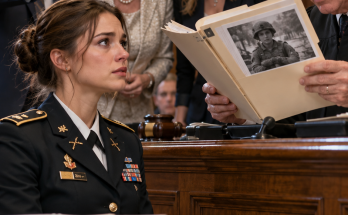
The next morning, I dressed in my uniform alone.
I straightened my collar, checked my ribbons, and pinned my hair back until not a single strand was out of place.
When I looked in the mirror, I could see the exhaustion in my face.
But I could also see something else.
Determination.
The parade ground was filled with families when the ceremony began.
Mothers wiped away tears.
Fathers leaned forward with cameras.
Little children waved miniature flags as the graduating class marched into position.
I searched the crowd one final time, even though I already knew what I would find.
Three empty seats had been reserved for my family.
I marched anyway.
When my name was announced, I stepped forward, accepted my commission, and shook the commanding officer’s hand.
He looked directly at me.
“Congratulations, Lieutenant Carter. You’ve earned your place here.”
Those words nearly broke me.
Because a man who had known me for only a few years had recognized what my own parents had refused to see.
That evening, my classmates celebrated with their families.
I sat alone in a small restaurant near campus, still wearing my dress uniform, eating a meal I could barely taste.
My phone finally vibrated.
A message from my mother.
Hope everything went well. Send us a picture when you get a chance.
I stared at those words until the screen went dark.
Then I put my phone away.
I didn’t send a picture.
I didn’t call her back.
And for the first time in my life, I stopped trying to find the perfect achievement that would finally make my parents love me the way I needed.
I reported for my first assignment three weeks later.
The work was difficult, the hours were long, and the expectations were unforgiving.
But my soldiers didn’t care whether my family approved of my career.
They cared whether I kept my promises.
So I did.
I learned to lead under pressure.
I learned to accept responsibility when things went wrong.
And I learned that respect was not something a person could demand simply because of a title.
It was something earned through the way you treated people when nobody was watching.
Over the next several years, I served in demanding assignments, completed advanced military training, and earned the trust of leaders who challenged me to become better.
My parents occasionally called.
Usually, they wanted to discuss Nathan.
He had been accepted into a prestigious MBA program.
He had met someone important at a corporate dinner.
He had received a promotion.
Every conversation returned to my brother eventually.
When I mentioned my own accomplishments, my mother would say, “That’s wonderful, dear,” before asking whether Nathan had called me recently.
Eventually, I stopped telling her anything.
I wasn’t angry anymore.
I was simply tired of offering pieces of my life to people who treated them as interruptions.
Then, in the spring of my sixth year in uniform, something happened that changed everything.
During a joint training exercise, my unit faced a complicated emergency that required quick decisions, calm leadership, and close coordination with several other teams.
I helped organize the response, kept my people focused, and worked with senior leaders to resolve the situation safely.
Afterward, my commanding officer recommended me for a highly competitive leadership program.
The recommendation opened doors I had never imagined walking through.
I completed the program, took on broader responsibilities, and eventually received an assignment that placed me among a small group of officers being considered for senior leadership roles.
I didn’t tell my parents.
I didn’t need their approval anymore.
Then an unexpected invitation arrived.
The academy wanted me to return as the keynote speaker for its annual commissioning ceremony.
The invitation described my service record, my leadership assignments, and my work mentoring young officers.
I read it twice.
For the first time since graduation, I felt proud without immediately wondering whether someone in my family would be proud of me, too.
I accepted.
What I didn’t know was that my brother had also been invited to participate in a university business leadership event scheduled for the same weekend.
And my parents, eager to celebrate what they considered the greatest achievement in their family, had already booked their flights.
They were coming to the East Coast for Nathan.
They had no idea they were about to encounter the daughter they had once refused to travel across the country to celebrate.
And they had absolutely no idea who would be standing at the microphone when the ceremony began.
PART 2 — The Name My Mother Never Expected to Hear
Two years after my parents missed my graduation, my mother was once again packing a suitcase for a ceremony.
This time, she was smiling.
I knew because my aunt sent me a photograph of her standing beside Nathan in their living room.
My brother wore an expensive suit.
My mother held a folder containing his MBA program schedule.
My father stood behind them with one hand on Nathan’s shoulder.
The caption read, The whole family is so proud of our future business leader!
I looked at the photograph for several seconds before closing the message.
Then I returned to preparing my keynote address.
The ceremony at West Point was expected to attract senior military leaders, academy faculty, distinguished alumni, families, and graduating cadets.
My responsibilities included delivering the keynote speech and participating in the recognition of the graduating class.
It was an honor I had never expected to receive so early in my career.
The academy’s communications office had published a short announcement about my return.
My name appeared beside my official photograph and a summary of my military service.
Apparently, my mother had never read it.
That didn’t surprise me.
She rarely followed anything about my career unless a relative happened to mention it.
Meanwhile, Nathan was enjoying the kind of attention he had always wanted.
My parents had reserved a hotel suite, arranged a celebratory dinner, and invited several family friends to join them for the university event.
My mother even bought a new cream-colored suit.
She wanted to look elegant in the photographs.
She wanted everyone to see how proud she was of her son.
I had spent years imagining what it would feel like to watch my family celebrate someone else while overlooking me.
But when the weekend finally arrived, I discovered something unexpected.
I didn’t feel jealous.
I didn’t feel the familiar ache of wanting to exchange places with Nathan.
I felt free.
On Friday afternoon, I arrived at the academy and met with the event organizers.
The auditorium was being prepared for the ceremony.
Rows of chairs had been arranged beneath the high ceiling.
The stage was decorated with flags, floral arrangements, and the academy’s official emblem.
Staff members checked the microphones while cadets rehearsed their entrance.
One of the senior officers coordinating the event approached me with a clipboard.
“Colonel Carter, everything is ready for tomorrow. We’ve also received confirmation from several distinguished guests.”
I nodded.
“Excellent. Is there anything else you need from me?”
He glanced at his list.
“Only your final approval of the introduction.”
I read the document.
It included my education, my commissioning, my military assignments, my leadership experience, and my commitment to developing the next generation of officers.
At the bottom was a line that made me pause.
Please welcome our distinguished alumna and keynote speaker, Colonel Emily Carter.
I had imagined hearing those words as a young cadet.
Back then, I thought success would feel like finally winning an argument with my parents.
Now I understood that success could be much quieter.
It could mean knowing who you were even when nobody from your family was watching.
That evening, my phone rang.
It was Nathan.
I nearly let it go to voicemail, but something made me answer.
“Hey,” he said. “Mom told me you’re somewhere around here this weekend.”
“I’m at West Point.”
“Right. Your military event.”
“My keynote ceremony.”
He hesitated.
“Look, I didn’t know you were going to be in the area. Mom and Dad are here for my graduation stuff, and Mom’s organizing dinner tomorrow. You should come if you want.”
I almost laughed.
“Tomorrow?”
“Yeah. It’s after the ceremony.”
I glanced at the printed schedule on my desk.
My keynote address was scheduled for the same time as his university event.
“I’m afraid I already have plans.”
“Of course you do.”
There was no hostility in his voice, only the familiar assumption that my life was a collection of obligations he didn’t need to understand.
Then he added, “Mom says you still haven’t gotten over the graduation thing.”
I looked out the window.
Beyond the glass, cadets crossed the courtyard in small groups.
“Does she?”
“She thinks you took it too personally. You know how she is. She doesn’t mean everything the way it sounds.”
I thought about the empty seats.
The message asking for a picture.
The way I had stood alone while other families celebrated.
“Maybe,” I said.
Nathan seemed relieved that I wasn’t arguing.
“Anyway, good luck with your thing.”
“Good luck with your MBA ceremony.”
We ended the call.
For a moment, I wondered whether I should tell him who the keynote speaker was.
Then I decided against it.
Not because I wanted to embarrass my family.
I simply refused to spend another evening convincing them that my life deserved their attention.
The next morning, I arrived early.
My uniform was immaculate.
My medals and ribbons were arranged according to regulation, and my shoes had been polished until they reflected the overhead lights.
An aide reviewed the final schedule with me.
“Colonel, the superintendent will introduce you shortly after the opening remarks. The livestream is already active, and the guest seating area is nearly full.”
“Thank you.”
I waited backstage while the auditorium filled.
Through a narrow opening in the curtain, I could see the audience settling into their seats.
Parents leaned toward their children.
Cadets exchanged nervous smiles.
Officers greeted former colleagues.
Then I noticed something that made my heart skip.
In the front section reserved for distinguished guests, three familiar people had just taken their seats.
My mother.
My father.
And Nathan.
My mother wore the cream-colored suit I had seen in my aunt’s photograph.
My father was adjusting his phone, preparing to record the event.
Nathan leaned toward them, speaking animatedly about his upcoming ceremony.
They had apparently arrived early for their university event and accepted an invitation to attend the academy’s commissioning ceremony beforehand.
My mother was looking at the stage.
She was smiling politely at the decorations.
She had no idea I was standing behind the curtain.
I could have walked out and confronted them.
I could have sent someone to tell them exactly who was speaking.
Instead, I took a slow breath and returned my attention to the notes in my hand.
I had spent years dreaming of a moment when my family would finally understand what they had done.
But now that the moment was here, I realized something important.
Their reaction wasn’t the purpose of my achievement.
The young officers sitting in that auditorium were.
They had worked hard to earn their place.
Some had overcome financial difficulties.
Others had faced personal losses, family doubts, or years of uncertainty.
I wanted them to understand that their worth did not depend on who showed up to applaud them.
The superintendent stepped to the microphone.
The room grew quiet.
He welcomed the audience, recognized the faculty, and thanked the families who had supported the graduating class.
Then he began introducing the keynote speaker.
My mother leaned toward my father.
Nathan crossed his arms.
The superintendent looked down at his notes and spoke clearly into the microphone.
“Today, we are honored to welcome an officer whose dedication, leadership, and service represent the very best of this institution.”
My mother stopped adjusting her sleeve.
The superintendent continued.
“She graduated from this academy, earned the trust of her fellow soldiers, and distinguished herself through years of demanding military service. She returns today not simply as a former cadet, but as a leader entrusted with helping shape the future of our Army.”
My father lowered his phone slightly.
Nathan turned toward the stage.
Then the superintendent announced my name.
“Ladies and gentlemen, please welcome our keynote speaker, Colonel Emily Carter.”
I stepped through the curtain.
The auditorium erupted in applause.
I walked toward the microphone with my shoulders straight and my eyes focused ahead.
For one brief second, I looked toward the front row.
My father’s mouth had fallen open.
Nathan was staring at me as though he had just discovered that I had been living an entirely different life.
And my mother—
Her smile had vanished.
She stared at the insignia on my uniform, then at the medals on my chest, then at the name printed in the ceremony program resting on her lap.
Her lips parted.
She whispered something to my father.
He didn’t answer.
I reached the microphone.
The applause slowly faded.
I placed my notes on the lectern, looked across the rows of young cadets, and began.
“Good morning. Before I speak about leadership, I want to tell you something I wish someone had told me when I was sitting where you are today.”
I paused.
“Your value is not determined by who shows up to celebrate you.”
My mother’s face changed.
And for the first time in years, I knew she was listening to every word.
PART 3 — The Moment My Mother Finally Understood
I didn’t mention my family during the first part of my speech.
I spoke about discipline, responsibility, courage, and the importance of earning the trust of the people who depend on you.
I told the cadets that leadership was not about appearing important.
It was about doing the difficult work when nobody was watching.
I explained that the uniform did not make anyone superior to another person.
It created obligations.
Obligations to serve with integrity, to protect the people entrusted to your care, and to accept responsibility when decisions had consequences.
The audience listened quietly.
Then I reached the final section of my address.
“There is one more lesson I want to leave with you,” I said.
“Not everyone will understand the road you choose.”
I could see several cadets nodding.
“Some people will measure your life according to their own expectations. They may believe your accomplishments are too small, your ambitions are unrealistic, or your sacrifices are unnecessary.”
My mother sat motionless.
I continued.
“You may spend years trying to convince those people that you are worthy of their approval. You may work harder, achieve more, and sacrifice things that matter to you because you believe that one day, they will finally see you.”
I let the silence settle.
“But please remember this: you do not have to spend your entire life auditioning for a place in someone else’s heart.”
A few people in the audience shifted in their seats.
I wasn’t speaking only to the cadets anymore.
I was speaking to the young woman I had been at twenty-two.
The girl who had sat alone after graduation, checking her phone for a message that never came.
The girl who had believed that if she became successful enough, her parents would finally recognize her.
“I hope you are fortunate enough to have people who celebrate your achievements,” I said. “And if you do, cherish them. Tell them what they mean to you. Show up for them when their moment arrives.”
I paused again.
“And if you ever find yourself in the position to decide whether someone’s accomplishment deserves your time, please don’t make the mistake of assuming you understand the importance of their dream simply because it isn’t your dream.”
The room was completely silent.
I finished my speech by congratulating the graduating cadets.
When I stepped away from the lectern, the applause rose so loudly that I could barely hear the music beginning in the background.
I shook hands with the superintendent and returned to my seat.
My mother was still staring at me.
She had stopped looking at my uniform as if it were a costume.
She was looking at me as though she were seeing her daughter for the first time.
After the ceremony, the audience moved into the reception hall.
Cadets gathered around their families.
Officers congratulated one another.
Photographers moved between groups, capturing smiles and handshakes.
I was speaking with a young lieutenant when I noticed my family approaching.
My father reached me first.
“Emily.”
His voice sounded different from the one I remembered.
He looked at my uniform, then at my face.
“I had no idea.”
I gave him a small nod.
“No. You didn’t.”
He swallowed.
“Your mother and I didn’t know you had reached this level.”
I wanted to ask him why he hadn’t known.
Why he hadn’t asked.
Why he had accepted years of silence as proof that everything was fine.
But I didn’t need to ask.
His expression already told me he was beginning to understand the distance between us.
Nathan stepped forward.
“Colonel Carter,” he said, trying to smile. “I guess I owe you an apology for calling your ceremony your little military thing.”
I looked at him.
“It’s all right.”
“No, it isn’t.” His smile disappeared. “I honestly didn’t understand how much you’d accomplished.”
For once, my brother wasn’t trying to turn the conversation back toward himself.
He seemed genuinely embarrassed.
Then my mother approached.
She had tears in her eyes.
“Emily, sweetheart.”
I had imagined hearing that tone from her for years.
In those imagined moments, I always rushed into her arms.
I always forgave everything.
I always felt the missing piece of my life finally click into place.
But real life was different.
I loved my mother.
I also remembered what she had said before my graduation.
Both things were true.
She reached for my hands.
“I didn’t know you had become a colonel.”
I held her gaze.
“You could have asked.”
Her eyes filled further.
“I know.”
“You could have come to my graduation.”
“I know, sweetheart.”
“You could have told me you were proud of me, even when you didn’t understand my choices.”
She lowered her head.
“I know.”
For several seconds, neither of us spoke.
Then she whispered, “I thought I was doing what was best for you.”
I took a breath.
“You thought my life would be easier if I chose something you understood. But you never asked me what mattered to me.”
My mother wiped her cheeks.
“I was wrong.”
It was the first time I could remember hearing those words from her without an explanation attached.
She looked toward the auditorium.
“When you were speaking, I realized something. I remembered your graduation day. I remember telling myself you were strong enough to manage without us.”
She shook her head.
“I used that as an excuse because I didn’t understand your choices. And because Nathan’s achievements were easier for me to explain to other people.”
My father looked down at the floor.
My mother continued.
“I made you feel as though your accomplishments mattered less simply because they were different from your brother’s. I don’t know how to make up for that.”
I watched her carefully.
For years, I had wanted an apology.
Now that I finally had one, I understood that an apology wasn’t a time machine.
It couldn’t return me to the parade field and place my parents in those empty seats.
It couldn’t give me back the evenings I had spent wondering what was wrong with me.
But it could be the beginning of something different.
“You can’t change what happened,” I told her. “But you can change what happens next.”
She nodded through her tears.
“I want to.”
I didn’t promise that everything would be fine.
I didn’t tell her that one apology erased years of disappointment.
I simply said, “Then start by listening to me. Not just when I achieve something impressive. Listen when I’m telling you about my life.”
She squeezed my hands.
“I will.”
A few minutes later, a photographer approached and asked whether our family wanted a picture together.
My mother glanced at me.
For an instant, I saw the old habit return—the urge to arrange everyone, make the moment look perfect, and present the family as though nothing difficult had ever happened.
Then she stopped herself.
“Only if Emily wants one,” she said quietly.
I looked at my father.
Then Nathan.
Then my mother.
For the first time, nobody was assuming that I would simply fit into whatever arrangement they had made.
“Yes,” I said. “I’d like that.”
We stood together for the photograph.
My father placed one hand on my shoulder.
Nathan stood beside me.
My mother took my hand instead of reaching for the camera.
The photograph wasn’t proof that our family had suddenly become perfect.
It was simply a record of the moment we decided to stop pretending the past hadn’t happened.
Later that afternoon, my parents attended a small reception with several of the officers who had worked with me.
They asked questions about my career.
They listened as I described the people who had mentored me, the assignments that had challenged me, and the young soldiers who had taught me as much as I had taught them.
For once, my mother didn’t interrupt to ask about Nathan.
And when another guest congratulated her on raising a daughter who had become a colonel, she didn’t laugh nervously or change the subject.
She looked at me and said, “Emily worked incredibly hard for this. I’m proud of her.”
I heard the words.
I appreciated them.
But I no longer needed them to believe they were true.
That evening, Nathan invited me to dinner.
My parents came, too.
We talked about his MBA, my military service, and the years we had spent assuming that each other’s lives were too different to understand.
Before we left, my mother hugged me.
“I wish I had been there,” she whispered.
I closed my eyes briefly.
“So do I.”
She began to apologize again, but I shook my head gently.
“We can’t change that day, Mom.”
“I know.”
“But we can decide what kind of family we want to be now.”
She held me for another moment.
And that was enough for that evening.
In the months that followed, my mother began calling simply to ask how I was doing.
Sometimes I answered when I could.
Sometimes I was busy, and I called her back later.
We didn’t repair everything overnight.
There were difficult conversations, uncomfortable memories, and moments when old habits threatened to return.
But there were also small changes.
My father started asking about my work without treating it as a temporary phase.
Nathan became more interested in the people and responsibilities behind my uniform.
And my mother learned that being proud of a daughter meant more than celebrating the moments other people could see.
A year later, I received a handwritten letter from her.
Inside, she had written about the day I graduated.
She admitted that she had chosen what was convenient for her rather than what mattered to me.
She wrote that she finally understood the difference between raising a child and truly seeing that child.
At the end, she wrote:
You never needed to become a colonel to deserve our pride, Emily. You deserved it when you were the young woman standing alone on that parade field. I’m sorry it took me so long to understand.
I read the letter twice.
Then I placed it in a drawer beside my academy diploma.
Not because I needed a reminder of what she had done.
But because I wanted to remember what I had learned.
For years, I believed that my greatest victory would be the day my family finally recognized my worth.
I was wrong.
My greatest victory was the day I stopped allowing their inability to see me to determine how I saw myself.
I still loved my family.
I still wanted a relationship with them.
But I no longer measured my life by the seats they occupied, the photographs they took, or the applause they offered.
I measured it by the promises I kept, the people I served, and the person I became when nobody was watching.
And if there is one thing I would tell the young woman I was at twenty-two, standing alone in her dress uniform, it is this:
Never confuse being overlooked with being unworthy.
Sometimes the people you love will fail to recognize the importance of your journey.
Sometimes they will arrive late.
And sometimes, they will never understand it at all.
Keep going anyway.
Because the life you build is still yours—even when the people you hoped would celebrate it are nowhere to be found.
And when your moment finally comes, let it belong to you.
Not to the people who doubted you.
Not to the people who ignored you.
And not even to the people who finally decide they are proud of you.
Let it belong to the person who kept going when nobody was watching.
That person was me.
And for the first time in my life, that was enough.