PART 1 — The Pilot Nobody Wanted
The first thing Major Daniel Voss gave me on my first day at Redstone Air Force Base wasn’t a mission briefing or a welcome to the squadron.
It was a bucket of dirty maintenance rags.
“Hangar three,” he said without looking up from his desk.
“Captain Evelyn Mercer,” I replied. “Reporting for assignment, sir.”
Voss slowly lifted his eyes.
He was fifty years old, with iron-gray hair, a square jaw, and the kind of confidence that made younger officers laugh at jokes that weren’t funny.
“So you’re the famous academy graduate.”
“Sir?”
“Top of your class, supposedly.”
“First out of thirty-two, sir.”
A few pilots around the ready room exchanged glances.
Colonel Richard Hayes, the squadron’s operations officer, cleared his throat.
“Captain Mercer also holds advanced qualifications in high-altitude interception and emergency aircraft recovery.”
Voss leaned back in his chair.
“Qualifications look impressive on paper.”
He pointed toward the hangar.
“Out there, the aircraft doesn’t care about your grades, your family name, or how many medals your father collected.”
My fingers tightened around my flight helmet.
“My father never asked an aircraft to care about his medals, sir.”
A silence fell over the room.
Voss stood.
“Careful, Captain. You’ve been here less than a minute.”
He walked toward me, stopping close enough that I could see the tiny scar beside his left eyebrow.
“Let me explain how things work around here. I decide who flies. I decide who leads. And I decide when someone has earned the right to wear those wings.”
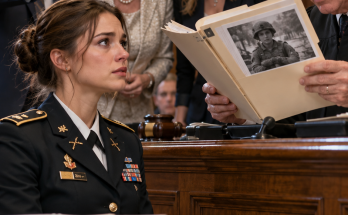
His gaze settled on the old silver pilot wings pinned beneath my new insignia.
My father’s wings.
He had worn them throughout twenty-two years of military service, through dangerous deployments, emergency landings, and the final mission from which he never returned.
I had carried them through every examination, every training flight, and every difficult day since his funeral.
“They belonged to your father?” Voss asked.
“Yes, sir. Colonel Thomas Mercer.”
Voss gave a dismissive smile.
“Another officer who became a legend after he died.”
Before I could answer, he reached toward my uniform.
“Those old things don’t belong here.”
He unpinned them.
“Sir, please don’t.”
He ignored me.
Then he dropped my father’s wings into a mug of unfinished coffee on his desk.
Several pilots stared at the floor.
One young lieutenant looked as if he wanted to speak but had forgotten how.
Voss pushed the mug toward me.
“Retrieve them, Captain.”
For one terrible second, I could hear nothing except the ticking of the wall clock.
Then I reached into the cold coffee and lifted the wings out.
I dried them carefully with a clean cloth from my pocket.
My father had once told me that the hardest part of wearing a uniform wasn’t learning to follow orders.
It was learning which things you should never surrender, even when someone outranked you.
I fastened the wings inside my flight suit pocket.
“Anything else, sir?”
Voss smiled.
“Yes. You’re assigned to simulator observation until further notice.”
“Sir, my orders authorize operational flight duty.”
“Your orders don’t run this squadron.”
He turned away.
“And someone show her where we keep the coffee.”
That afternoon, my new colleagues gave me a call sign.
Grounded.
By evening, it had become Ghost.
Because I was the pilot nobody saw in the air.
I didn’t argue.
I spent the next three days studying flight records, learning the mountain approaches, and watching the squadron’s pilots prepare for their missions.
Redstone was surrounded by rugged Nevada terrain, where sudden wind shifts and narrow valleys could turn a routine flight into a fight for survival.
I learned which aircraft had recurring mechanical problems.
I memorized the emergency landing sites.
And I noticed something strange about Tail 19, an aging F-16 that had been removed from the regular flight schedule after a series of unexplained engine warnings.
Every time I asked about it, someone changed the subject.
On Thursday evening, I found Chief Master Sergeant Arthur Bell inspecting a maintenance panel beside the hangar.
He was a weathered veteran with thirty-six years of service and hands that looked permanently stained by jet fuel.
“You’re Colonel Mercer’s daughter,” he said.
It wasn’t a question.
“Yes, Chief.”
He studied my face for a moment.
“You have his eyes.”
“You knew my father?”
Bell stopped working.
“I was his crew chief for seven years.”
He wiped his hands on a rag and looked toward Tail 19.
“Your father once brought a damaged aircraft home through a mountain storm when three other pilots said the runway was impossible.”
“He never told me that.”
“He didn’t like telling stories about himself.”
Bell lowered his voice.
“Neither did he like officers who confused authority with courage.”
I glanced toward the command building.
“Chief, I’m not looking for trouble.”
“Good. Trouble finds enough people without their help.”
He handed me a maintenance report.
“Tail 19 needs a controlled evaluation flight. The engine problem might be a faulty sensor, but nobody wants to touch it.”
“Has the aircraft been cleared for flight?”
“Not yet. The inspection is still underway.”
He tapped the report.
“If maintenance completes the checks and the aircraft is formally released, we’ll need a qualified test pilot.”
My heart began to race.
“You think I could do it?”
“I think your record deserves a fair chance.”
Then his expression became serious.
“But listen carefully, Captain. No aircraft is worth proving a point. If that jet isn’t safe, you stay on the ground.”
“I understand.”
Bell nodded toward the darkened flight line.
“Be here at zero-six-hundred tomorrow. We’ll see what the inspection tells us.”
That night, I called my mother.
She asked whether I had made any friends.
I told her I was learning the base.
I didn’t tell her about the coffee.
Before hanging up, she said something that stayed with me.
“Your father never needed everyone to believe in him, Evelyn. He only needed to know what he was responsible for.”
The next morning, I arrived at the hangar before sunrise.
Tail 19 stood beneath the maintenance lights.
Chief Bell was already there, reviewing the final inspection paperwork with two technicians.
Then the hangar doors opened.
Major Voss walked in carrying a clipboard.
He looked at me, then at the aircraft.
“What are you doing here, Captain?”
“Reporting for the scheduled evaluation, sir, pending final authorization.”
He laughed.
“You actually thought I’d let you fly that aircraft?”
Chief Bell stepped forward.
“Sir, the maintenance team is completing the required checks. The aircraft has not been released yet.”
“Then it won’t be released.”
Voss turned toward me.
“You want to prove yourself so badly? Start by learning that your career belongs to the people who command you.”
I held his gaze.
“My career belongs to the Air Force, sir.”
His smile vanished.
For a moment, nobody moved.
Then a staff officer hurried into the hangar, carrying a sealed message.
“Major Voss. Colonel Hayes needs you in the operations center immediately.”
“Why?”
“The general’s inspection team has changed its arrival time.”
Voss snatched the message.
As he read it, the color drained from his face.
He looked at the aircraft.
Then at me.
Then back at the message.
“Captain Mercer,” he said quietly, “you will report to the ready room in ten minutes.”
He turned toward the exit.
But before he left, Chief Bell caught my eye and whispered four words.
“Your father knew this.”
I stared at him.
“Knew what?”
Bell glanced at the sealed message in Voss’s hand.
“That’s what we’re about to find out.”
And at precisely 0600, a second message arrived from headquarters.
It contained one sentence that changed everything.
General Margaret Shaw was coming to Redstone specifically to meet the daughter of Colonel Thomas Mercer.
PART 2 — The Secret Behind Tail 19
By eight o’clock, the entire squadron knew that a general was coming.
Nobody knew why.
Major Voss spent the morning barking orders, inspecting uniforms, and demanding that every aircraft on the flight line look ready for a magazine cover.
He ordered the pilots to prepare their mission summaries.
He instructed Colonel Hayes to remove outdated maintenance reports from the briefing room.
And he told me to remain in the simulator building.
“General Shaw doesn’t need to see you,” he said.
“Sir, headquarters specifically requested my presence.”
Voss stepped closer.
“Headquarters requested Colonel Mercer’s daughter. They didn’t request an untested captain with an attitude problem.”
I looked at him calmly.
“Understood, sir.”
He seemed disappointed that I hadn’t argued.
“Good. Stay out of the way.”
When he left, Colonel Hayes approached my desk.
“Captain, I want you to understand something.”
“Yes, sir?”
“Major Voss has commanded this squadron for six years. He has a reputation for producing results.”
“Then why is Tail 19 still grounded?”
Hayes looked toward the door.
“That aircraft has been the subject of a command review.”
“What kind of review?”
He hesitated.
“Three months ago, a pilot reported that its engine instruments had given inconsistent readings during a training sortie. The aircraft returned safely, but the report raised questions about maintenance procedures.”
“And the aircraft was grounded?”
“Temporarily.”
“What happened afterward?”
Hayes lowered his voice.
“The paperwork was marked resolved, but the squadron never received a clear explanation of the original problem.”
I frowned.
“Who signed the closure?”
He looked away.
“Major Voss.”
Before I could ask another question, the loudspeaker announced that General Shaw’s aircraft had landed.
The base seemed to come alive.
Vehicles moved across the apron.
Officers assembled outside the command building.
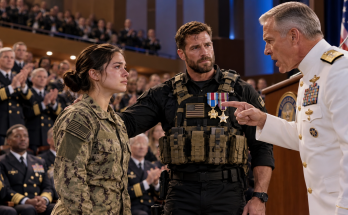
And then General Margaret Shaw entered the hangar.
She was in her late fifties, with silver hair cut close to her head and a face that showed neither impatience nor approval.
She shook Colonel Hayes’s hand.
She acknowledged the maintenance crews.
Then she walked directly toward me.
“Captain Evelyn Mercer?”
“Yes, ma’am.”
She studied me for several seconds.
“You look like your father.”
“I’ve heard that before, General.”
“I imagine you have.”
Her gaze dropped briefly to the old wings clipped inside my flight-suit pocket.
“Are those Colonel Mercer’s?”
“Yes, ma’am.”
“May I see them?”
I removed the wings and placed them in her hand.
She turned them over carefully.
Then she noticed the dark stain that remained in the grooves despite my efforts to clean them.
Her expression changed.
“Who did this?”
Before I could answer, Voss stepped forward.
“General, there was a misunderstanding during Captain Mercer’s initial orientation. I was correcting an issue of professionalism.”
Shaw slowly turned toward him.
“You corrected her professionalism by putting her father’s wings in your coffee?”
Voss went pale.
“Ma’am, I was making a point about standards.”
“Standards?”
Her voice remained quiet.
“That is an interesting word to use when discussing an officer who graduated first in her class and arrived here with outstanding flight evaluations.”
Voss swallowed.
“Her academic record doesn’t establish operational readiness.”
“No,” Shaw replied. “It establishes that someone took the time to evaluate her performance before assigning her responsibilities.”
She handed the wings back to me.
“Captain, I understand you have been assigned to simulator observation.”
“Yes, ma’am.”
“Is that because of a formal qualification deficiency?”
“No, ma’am.”
“Is it because of a medical restriction?”
“No, ma’am.”
“Then I would like to understand the basis for that decision.”
Voss intervened immediately.
“The squadron commander retains discretion over flight assignments.”
“Correct.”
Shaw looked directly at him.
“And that discretion is exercised under regulations, professional judgment, and the obligation to maintain combat readiness.”
Nobody spoke.
Then the general asked to see Tail 19.
Voss stiffened.
“Ma’am, that aircraft is undergoing maintenance review.”
“Then we shall review the maintenance.”
Chief Bell stepped forward with the inspection records.
He explained the engine warnings, the unresolved questions, and the missing documentation.
General Shaw listened without interrupting.
When he finished, she examined the paperwork.
“Who authorized the previous closure?”
“Major Voss, ma’am,” Bell answered.
Voss immediately protested.
“The maintenance team recommended the closure.”
Bell’s expression hardened.
“We recommended further testing. We did not recommend returning the aircraft to operational service.”
A murmur spread through the hangar.
Shaw raised one hand.
The room fell silent.
“Major, I want every document relating to Tail 19 preserved. No alterations. No removals. No exceptions.”
“Yes, ma’am.”
“And I want a technical review conducted by personnel who were not involved in the original decision.”
Voss nodded stiffly.
Then the general turned to me.
“Captain Mercer, if the aircraft is found airworthy and you are formally authorized to conduct the evaluation, would you accept the assignment?”
“Yes, ma’am.”
“Why?”
“Because I believe the aircraft deserves an honest assessment, General. And because a pilot should never have to guess whether the instruments are telling the truth.”
For the first time that morning, Shaw smiled.
“That sounds familiar.”
She turned to Colonel Hayes.
“Please arrange a review of Captain Mercer’s qualifications.”
Voss looked as though he had swallowed something bitter.
But the general wasn’t finished.
She asked Chief Bell to bring her the aircraft’s historical maintenance file.
When the old records arrived, Shaw opened a folder marked with a faded red tab.
Inside was a report dated eighteen years earlier.
The report concerned a training aircraft that had suffered a catastrophic engine failure over the same mountain valley.
My father had been the pilot.
I had heard the official story many times.
He had diverted the aircraft away from a populated area, ejected safely, and received a commendation for his actions.
But the report in General Shaw’s hands contained a detail I had never seen.
The engine failure had occurred during an evaluation of a new monitoring system.
The system had provided misleading readings before the failure.
And the officer responsible for approving its testing procedures had been Major Daniel Voss.
Not the commander he was today.
A younger officer.
A man whose signature appeared beneath a recommendation that the system was ready for operational use.
I stared at the page.
“General, why wasn’t this in my father’s official report?”
Shaw closed the folder.
“Because your father’s investigation focused on the aircraft failure, and the technical review concluded that the monitoring system required additional safeguards. The command determined that the issue had been addressed.”
“Was Major Voss disciplined?”
“The available records do not establish that he was found personally responsible for the failure.”
She paused.
“But your father submitted a separate recommendation that the system should never be approved without independent verification.”
I looked toward Tail 19.
The same type of monitoring system had been installed in that aircraft.
My stomach tightened.
“General, if the current warning is connected to the old system—”
“We will find out through the technical review,” Shaw said. “No assumptions. No shortcuts.”
Then she turned to Voss.
“Major, you will cooperate fully.”
“Yes, ma’am.”
But when Shaw moved toward the operations office, Voss caught my arm.
His grip was firm enough to stop me, but not enough to hurt.
“You have no idea what you’re stirring up,” he whispered.
I looked down at his hand.
He released me.
“My father taught me to ask questions when the instruments don’t make sense.”
“Your father is dead.”
The words came out before he could stop himself.
Several feet away, Chief Bell turned around.
Voss realized what he had said.
I felt the old pain rise in my chest.
But this time, it didn’t make me look away.
“Yes, sir,” I replied. “And that’s why I’m not going to waste what he taught me.”
I walked toward the maintenance team.
Behind me, General Shaw had stopped at the hangar entrance.
She had heard every word.
That afternoon, the independent technical review began.
By sunset, the team had identified an intermittent fault in Tail 19’s monitoring circuit.
It was not yet clear whether the fault affected the engine itself or only the displayed readings.
The aircraft remained grounded.
No one was permitted to fly it until the inspection was complete.
Then, at 1915, an emergency weather advisory arrived.
A severe storm system was moving toward the western mountains.
The following morning’s scheduled training exercise was under review.
And the operations center received a final update.
A military transport aircraft returning from a medical evacuation had reported an instrument malfunction and was diverting toward Redstone.
Its estimated arrival coincided with the worst part of the storm.
The transport was carrying four medical personnel and two injured service members.
The pilots were experienced.
But the aircraft’s backup navigation system had begun giving inconsistent readings.
The tower expected to guide them toward the safest approach.
General Shaw ordered the squadron to prepare an emergency support plan.
Major Voss immediately volunteered his most experienced flight leader.
Then the tower delivered another troubling update.
The storm had closed the usual approach corridor.
The transport would have to use the narrow eastern valley, where rapidly changing winds and poor visibility made navigation especially difficult.
Chief Bell looked at the terrain display.
Then he looked at me.
“Captain, your father trained in that valley.”
“Yes, Chief.”
“He developed an alternate approach procedure for poor-visibility conditions.”
I remembered the notebook my mother had given me after his funeral.
It contained handwritten diagrams, weather observations, and notes about mountain winds.
I had studied those pages during training.
I had never imagined I would need them.
Colonel Hayes hurried over.
“Captain Mercer, do you remember that procedure?”
“Yes, sir.”
“Can you explain it to the operations team?”
“Absolutely.”
I spread the charts across the table and began explaining the terrain, the wind patterns, and the safe decision points.
General Shaw listened carefully.
When I finished, she looked at the weather display.
Then she asked the question that made the room go quiet.
“Captain Mercer, if the conditions permit and your qualifications are confirmed, are you prepared to support the recovery operation?”
I glanced at Tail 19 through the hangar windows.
The aircraft was still awaiting its final technical clearance.
“I’m prepared to do my duty, General. But I won’t fly an aircraft that hasn’t been declared safe.”
Shaw nodded.
“Good answer.”
Across the room, Major Voss watched us.
For the first time since I had arrived, he looked genuinely afraid.
Not of me.
Of what the next morning might reveal.
PART 3 — The Morning Nobody Expected
At 0430, the storm arrived early.
Rain swept across Redstone Air Force Base, rattling the hangar doors and turning the runway lights into blurred streaks.
The medical transport was still airborne.
Its crew had managed to stabilize the navigation problem, but the worsening weather meant they could not safely reach their original destination.
Redstone was their best remaining option.
Inside the operations center, officers studied the radar and updated the recovery plan.
The eastern valley was becoming increasingly difficult to use.
General Shaw stood behind the operations team, asking precise questions and refusing to accept guesses as answers.
Major Voss had taken command of the squadron’s flight coordination.
He assigned two experienced pilots to the recovery support mission.
Then the technical review team entered.
Their lead engineer carried a report.
“General, we have completed the initial examination of Tail 19.”
Shaw turned.
“Is the aircraft airworthy?”
“No, ma’am. We found an intermittent electrical fault affecting the monitoring system. We cannot certify the aircraft for flight until the defective components are replaced and the system passes its required checks.”
Voss exhaled sharply.
“That settles it.”
He looked at me.
“Captain Mercer will remain on the ground.”
General Shaw didn’t respond immediately.
Instead, she asked the engineer another question.
“Are the other aircraft affected by the same defect?”
“We have no evidence of that, ma’am. The issue appears isolated to Tail 19, but inspections are continuing.”
“Proceed with those inspections. No aircraft flies without the required clearance.”
“Yes, ma’am.”
Voss turned back toward the radar.
The weather had worsened.
One of the assigned pilots reported that the winds along the eastern approach were changing faster than forecast.
The second pilot confirmed that visibility was deteriorating near the mountain ridgeline.
The squadron’s senior flight leader recommended suspending the support mission until conditions improved.
General Shaw studied the incoming reports.
“How much time does the transport have before it reaches the valley?”
“Approximately twenty minutes, ma’am.”
“And how much time before the weather makes the approach unacceptable?”
The weather officer hesitated.
“Possibly fifteen minutes. It depends on how quickly the storm develops.”
Shaw nodded.
“Then we need a decision based on the actual conditions, not optimism.”
Colonel Hayes approached with the revised approach charts.
“General, Captain Mercer’s father developed an alternate recovery procedure for this valley. She has studied it extensively and can brief the pilots on the terrain hazards.”
Voss turned sharply.
“You cannot seriously be suggesting that an inexperienced captain should lead a recovery operation.”
“I’m suggesting that we use every qualified resource available,” Hayes replied.
“She has never flown operationally with this squadron.”
“Her previous flight qualifications are documented.”
“She hasn’t flown Tail 19.”
“The aircraft is not cleared for flight,” Hayes answered. “Nobody is proposing that she use it.”
General Shaw raised her hand.
“That is enough.”
She turned to me.
“Captain Mercer, I want a full briefing on the alternate approach. Explain the risks, the limitations, and the conditions under which you would recommend abandoning it.”
I stepped toward the table.
My hands were cold.
My father’s old wings rested inside my flight suit, pressed against my chest.
I explained the valley’s changing wind patterns, the ridgeline turbulence, and the importance of maintaining safe separation from the surrounding terrain.
I also explained the procedure’s limits.
“If the crosswinds exceed the approved operating limits, the approach must be abandoned,” I said. “If the transport cannot maintain the required navigation accuracy, the crew must use the published missed-approach procedure or divert if a safe alternative remains available.”
Shaw nodded.
“What about the western corridor?”
“Not recommended under the current conditions, ma’am. The storm is building over the ridge, and the visibility reports are deteriorating.”
“What do you recommend?”
I studied the charts one more time.
“Keep the transport crew informed, preserve their options, and have the tower coordinate the safest available approach based on their actual aircraft performance and the latest weather reports. My father’s procedure can inform the briefing, but the transport commander must retain responsibility for the aircraft and follow the approved procedures.”
For several seconds, the room was silent.
Then the tower called.
The transport had reached its final decision point.
The crew reported that the aircraft was controllable, but the navigation readings remained inconsistent.
They requested updated weather and approach information.
General Shaw leaned toward the communications officer.
“Give them the latest verified information. Keep the line open.”
The tower acknowledged.
The next ten minutes felt longer than the three days I had spent being called Ghost.
The transport crew reported turbulence.
Then a brief loss of reliable navigation data.
Then a correction.
Then silence.
Every person in the operations center watched the communications panel.
Finally, the transport commander’s voice came through.
“Redstone Tower, transport aircraft is established on the approved approach. Request continuous weather updates.”
The tower responded immediately.
The aircraft continued toward the runway.
Seconds later, its landing lights appeared through the rain.
The transport descended through the gray morning sky.
For a moment, it vanished behind a curtain of rain.
Then it emerged over the runway threshold.
The wheels touched down.
The aircraft rolled safely to a stop.
Inside the operations center, someone let out a breath that sounded almost like a laugh.
The medical team rushed toward the transport.
The injured service members were transferred to waiting medical personnel.
Everyone aboard was safe.
General Shaw closed her eyes briefly, then thanked the operations team.
Only after the immediate emergency had passed did she turn to Major Voss.
“Major, I want to discuss your decisions regarding Captain Mercer.”
Voss straightened.
“General, I acted to protect squadron standards.”
“Then explain why a qualified officer was prevented from participating in planning discussions until I arrived.”
“I believed she lacked experience with this squadron.”
“Experience with a particular squadron is relevant. It is not a substitute for a documented qualification assessment.”
Voss said nothing.
Shaw continued.
“And explain why you removed a family military decoration from her uniform and placed it in a coffee mug.”
His face reddened.
“That was a mistake, ma’am.”
“It was an abuse of your position.”
The words landed harder than a shout.
Shaw instructed Colonel Hayes to document the incident and forward it through the appropriate command channels.
She also ordered a formal review of the decisions surrounding Tail 19 and the handling of its maintenance records.
The investigation would determine whether any regulations had been violated and what corrective action was warranted.
Voss was not publicly stripped of his rank.
He was not dragged away in handcuffs.
Real accountability would require evidence, a fair process, and a review of the facts.
But for the first time, he could no longer decide alone which facts were allowed to be seen.
Later that morning, General Shaw asked me to meet her outside the hangar.
The storm was moving east.
Sunlight had begun to break through the clouds, illuminating the rows of aircraft on the flight line.
She handed me my father’s wings.
“I knew Colonel Mercer,” she said.
I stared at her.
“You did?”
“I was a young operations officer when he helped develop the original mountain recovery procedures. He was demanding, sometimes stubborn, and completely unwilling to approve a plan simply because a senior officer wanted it approved.”
A small smile crossed her face.
“He once challenged a recommendation I had spent weeks preparing. He explained, in front of an entire room, that confidence was not evidence.”
I laughed softly.
“That sounds like him.”
“It was not my favorite day.”
She looked toward the runway.
“But it was one of the most useful lessons of my career.”
I turned the wings over in my palm.
“General, I thought if I could prove myself in the air, people would stop treating me like I didn’t belong here.”
“Some people will change their minds when they see your performance. Others will change only when they are required to examine their own conduct.”
She paused.
“Your job is not to make everyone respect you. Your job is to become the kind of officer whose decisions deserve to be trusted.”
I fastened my father’s wings inside my flight suit.
“What happens now, ma’am?”
“Now, your qualifications will be reviewed by the appropriate officers. You will receive the training and assignments you are authorized to receive. Tail 19 will remain grounded until its maintenance issues are resolved.”
She extended her hand.
“And Major Voss will answer for his decisions through the proper process.”
I shook her hand.
“Thank you, General.”
“Don’t thank me yet, Captain.”
She glanced toward the flight line.
“Make sure you give us a reason to be proud of you.”
Three weeks later, the maintenance team completed the repairs to Tail 19.
The faulty components were replaced.
The monitoring system passed its required tests.
The aircraft was formally cleared for the next stage of evaluation.
By then, I had completed the necessary squadron qualification reviews and additional training.
Chief Bell met me beside the aircraft on the morning of my scheduled flight.
He ran his hand along the fuselage.
“Your father would have liked this moment.”
“I hope so.”
Bell looked at me.
“He wouldn’t have wanted you to fly it just to prove Major Voss wrong.”
“I know.”
“He would have wanted you to understand every system, trust your training, and know exactly when to turn around.”
I smiled.
“That sounds even more like him.”
The canopy closed.
The engine started.
And when the aircraft lifted from the runway, I finally understood something I had missed during those first humiliating days.
I had thought the flight would prove that I deserved to wear my wings.
But my father had already taught me what those wings meant.
They were not a promise that I would always win.
They were a promise that I would take responsibility for every decision I made.
After the evaluation flight, I returned safely to base and completed my report.
The results confirmed that the aircraft was performing within the required parameters.
The squadron commander’s position was temporarily reassigned while the command review continued.
Chief Bell pinned my father’s wings back onto my uniform beside my own.
This time, nobody tried to stop him.
Colonel Hayes stood nearby, watching.
“You know,” he said, “the pilots have been asking about your call sign.”
I raised an eyebrow.
“What about it?”
“Ghost doesn’t seem appropriate anymore.”
Across the hangar, one of the young lieutenants called out, “How about Compass?”
Another suggested “Northstar.”
Chief Bell shook his head.
“No. She earned a better one than that.”
He looked at the old silver wings on my uniform.
“Legacy.”
I considered it.
Then I shook my head.
“My father had his own name. I need one of my own.”
Bell grinned.
“Fair enough, Captain.”
I looked toward the runway, where the morning sun illuminated the aircraft waiting for their next missions.
“Call me Steady.”
Because I had learned that courage wasn’t about being the loudest person in the room.
It wasn’t about proving someone wrong.
And it certainly wasn’t about risking an aircraft just to silence a bully.
Courage was knowing the rules, respecting the danger, speaking when something was wrong, and doing the work even when nobody was watching.
As I walked toward the briefing room, I passed the desk where Major Voss had once dropped my father’s wings into his coffee.
The mug was gone.
The desk had been cleared.
But I remembered the moment.
Not because it had defeated me.
Because it had forced me to decide who I wanted to become.
I touched the silver wings beneath my insignia and whispered the words my father had taught me years ago.
“Bring everyone home.”
Then I stepped into the ready room.
This time, when I announced myself, every pilot looked up.
And nobody laughed.
THE END