PART 1: THE MEDAL THAT WASN’T MINE TO EXPLAIN
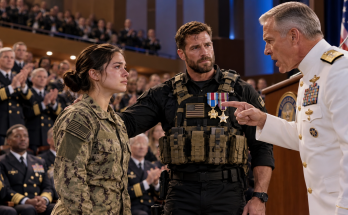
The moment my stepmother stood up and shouted that I was a disgrace to the uniform, the general stopped speaking.
Three hundred soldiers sat motionless inside the military auditorium.
My stepmother, Patricia Voss, stood in the aisle wearing a cream-colored dress, a pearl necklace, and the same expression she had worn every time my father praised me instead of her son.
“You cannot give her that medal!” she shouted. “My son is the one who saved those men!”
I stood beneath the stage lights in my Army dress uniform, my right hand resting beside my leg and my left hand holding a small, sealed envelope.
My name is Captain Rebecca Hayes.
I was thirty-five years old, and after twelve years of military service, I had learned how to remain calm when people shouted at me.
But I had never expected my own family to turn my award ceremony into a public trial.
The medal waiting on the general’s velvet cushion was the Distinguished Service Medal, awarded to soldiers whose actions had made an extraordinary difference under dangerous circumstances.
The ceremony was supposed to recognize what happened during a nighttime evacuation at Blackwater Training Range four years earlier.
Instead, my stepmother had arrived to rewrite it.
“My son, Daniel, was the only reason anyone survived that night!” she announced, turning toward the audience. “Rebecca took credit for his courage because she knew he would never humiliate his own family by fighting her in public!”
A few people shifted in their seats.
Several officers exchanged uncomfortable glances.
At the end of the second row, my stepbrother Daniel sat with his hands clasped between his knees.
He was thirty-one, a former Army lieutenant who had resigned his commission two years earlier.
He wore a dark suit, and his face looked almost gray beneath the auditorium lights.
He did not defend himself.
He did not defend me.
He simply stared at the floor.
That silence hurt more than Patricia’s accusation.
For four years, I had allowed the official story to remain incomplete.
I had refused interviews.
I had declined invitations to speak about the evacuation.
When people asked why Daniel had left the Army, I told them it was his decision to make.
And when my father begged me, shortly before his death, not to destroy the family over what had happened at Blackwater, I promised I would not.
I had kept that promise.
Until now.
General Marcus Whitaker, the officer standing beside me, slowly lowered the prepared citation.
“Mrs. Voss,” he said, “you appear to know a great deal about an operation you were not present for.”
“I know what my son told me!”
“Then perhaps your son should speak.”
Patricia turned toward Daniel.
“Tell them!” she demanded. “Tell them how you carried those men out while your stepsister stood safely behind the command vehicle!”
Daniel’s shoulders tightened.
I looked at him, silently asking him to do what he had failed to do for four years.
Tell the truth.
He looked at me for half a second.
Then his eyes dropped again.
Patricia mistook his silence for agreement.
“You see?” she said triumphantly. “He is too honorable to accuse his own sister, even when she steals his recognition.”
The general’s expression hardened.
“Captain Hayes,” he said, “before we proceed, I would like to see the envelope you brought.”
I handed it to him.
It contained a single photograph and a document bearing Daniel’s signature.
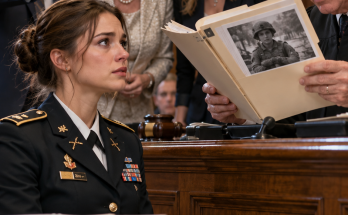
The photograph had been taken just after sunrise at Blackwater Range.
Three exhausted soldiers stood beside an overturned rescue vehicle.
One had a bandage around his forehead.
Another was wrapped in a thermal blanket.
I was kneeling beside the third man, holding pressure on his injured leg while a medic worked beside me.
Daniel was nowhere in the photograph.
Patricia laughed bitterly.
“That proves nothing. He was probably taking the picture!”
The general turned the photograph over.
On the back, someone had written a sentence in blue ink.
“For Rebecca, who came back when the rest of us thought nobody could.”
The handwriting belonged to Sergeant Michael Turner, one of the men rescued that night.
General Whitaker read the words twice.
Then he looked at Patricia.
“Mrs. Voss, your son was not the only person who gave a statement after the Blackwater evacuation.”
Her smile disappeared.
The general opened the envelope and removed the signed document.
“This is Lieutenant Daniel Voss’s original account, submitted to the investigating officer at 06:40 the morning after the incident.”
Daniel suddenly stood.
“Sir, please.”
The entire auditorium turned toward him.
It was the first time he had spoken.
General Whitaker held the document at his side.
“You signed this statement voluntarily?”
Daniel swallowed.
“Yes, sir.”
“Did you read it before signing?”
“Yes, sir.”
“Then I suggest you listen carefully to what you told the Army four years ago.”
Patricia stepped toward the stage.
“That’s enough! Whatever paper you have, my son was the hero!”
The general raised one hand, stopping her.
Then he looked directly at Daniel.
“Lieutenant, your statement says you were ordered to remain with the evacuation vehicle while Captain Hayes entered the flooded ravine.”
Daniel closed his eyes.
“It also says you abandoned your assigned position, entered the water, and became trapped yourself.”
Patricia’s face changed.
The general continued.
“Captain Hayes returned to the ravine four times. On her final attempt, she pulled you from beneath a collapsed section of fencing while the current carried both of you toward the drainage channel.”
A whisper moved through the auditorium.
Patricia shook her head violently.
“No. That’s not what he told me.”
General Whitaker looked down at the document.
“There’s more.”
Daniel took one unsteady step toward the stage.
“Please don’t read the last paragraph, sir.”
For the first time that afternoon, I felt something other than shame.
I felt afraid.
Because I knew the first part of Daniel’s statement.
I had read it years ago.
But I had never seen the final page.
The general turned the paper over.
His eyes moved across the final lines.
Then he looked at Daniel with an expression I could not understand.
“Lieutenant, you wrote that your sister saved your life.”
Daniel’s voice broke.
“Yes, sir.”
“And you wrote that the public account crediting you with the rescue was false.”
Patricia reached for the back of a chair.
The general paused.
“But this final paragraph concerns something else entirely.”
Daniel stepped forward again.
“Sir, I am asking you as a former soldier. Please.”
General Whitaker held his gaze.
“Then tell us yourself, Daniel.”
Daniel looked at his mother.
For the first time in his life, he did not look away.
“Mom,” he whispered, “you need to know why I let you believe that story.”
And when he finally explained what he had done before the evacuation began, Patricia’s hands flew to her mouth.
Because the truth was far worse than a stolen medal.
It was the reason my father had made me promise to remain silent.
And it was the reason Daniel had left the Army without ever telling anyone why.
PART 2: THE NIGHT WE ALMOST DIDN’T COME HOME
Four years earlier, Blackwater Range had been hit by a storm that meteorologists had underestimated.
Rainwater poured down the hills, turning a narrow training ravine into a violent channel of mud and debris.
Our unit had been conducting a nighttime field exercise when the evacuation order came through.
A transport vehicle had stalled near the lower access road.
Three soldiers were stranded beyond the flooded crossing, and the water was rising faster than the rescue team could reach them.
I was the senior medical officer attached to the operation.
Daniel was the junior officer responsible for coordinating vehicle movements and keeping the evacuation route clear.
We had grown up in the same house, but we had never been close.
Patricia had spent years telling Daniel that he was destined for greatness.
She told him I was naturally talented, but he was special.
When I earned my commission, she said the Army needed more officers and had lowered its standards.
When Daniel received his commission, she rented a hall and invited half the town.
I had learned to live with it.
Daniel had learned to need it.
That night, when the radio announced that three soldiers were trapped beyond the crossing, I ordered the evacuation vehicle to move to higher ground.
Daniel argued.
He wanted to take the vehicle across the lower access road.
I told him the current was too strong.
He accused me of being overly cautious.
Then he made a decision that changed both our lives.
He ordered the driver to proceed.
The vehicle slid sideways before reaching the crossing and struck a concrete barrier.
No one was killed, but Daniel was thrown against the door and suffered a serious shoulder injury.
The driver managed to climb out.
Daniel did not.
I heard his voice over the radio, shouting that he was trapped.
The three stranded soldiers were still beyond the crossing.
I had a choice.
I could remain with the medical team and wait for the specialist rescue unit, which was still several minutes away.
Or I could enter the ravine and attempt to reach the men before the water rose any further.
I secured a safety line around my waist and went in.
The first soldier was clinging to a tree branch.
I reached him and helped him attach himself to the line.
The second was trapped against a section of fencing.
I pulled him free with the assistance of another soldier on the bank.
The third man had disappeared beneath the surface.
I went back into the water.
Once.
Twice.
Three times.
On my fourth attempt, I found him caught beneath a broken metal support.
I managed to free him, but the current pulled us downstream.
The safety line snapped against a jagged piece of debris.
For several seconds, I could not tell which way was up.
When I surfaced, I saw Daniel in the water ahead of me.
He had somehow escaped the vehicle, but his injured shoulder prevented him from swimming properly.
He was being dragged toward the drainage channel.
I could have continued toward the bank.
Instead, I turned.
I reached him just before the current carried him beneath a collapsed fence.
The metal caught his jacket.
He disappeared under the water.
I dove, found his sleeve, and pulled until the fabric tore.
Then I caught him around the chest and forced us both toward a shallow section near the bank.
By the time the rescue team reached us, Daniel was unconscious.
I had a dislocated shoulder, a deep cut along my forehead, and a fractured wrist.
The three stranded soldiers survived.
So did Daniel.
The next morning, while I was receiving treatment at the field hospital, Daniel gave his statement to the investigating officer.
He admitted that he had disobeyed my order.
He admitted that he had endangered the evacuation.
He admitted that I had saved his life.
He also admitted something that should have ended his military career.
Before the exercise began, Daniel had received a warning about the deteriorating weather.
He had ignored it because he wanted to complete the route before another unit.
He believed a successful exercise would impress the brigade commander and secure him a coveted assignment.
Instead, his decision had put six people in danger.
The Army began an investigation.
My father arrived at the hospital that afternoon.
He was pale, exhausted, and frightened.
He told me Patricia had heard rumors about Daniel’s mistakes.
She had already contacted people in their hometown, insisting that her son had rescued everyone.
My father asked me to let the investigation proceed quietly.
He said Daniel was young.
He said one terrible decision should not define his entire life.
I reminded him that three men could have died because of that decision.
He nodded.
Then he said something I have never forgotten.
“Your brother knows what he did, Rebecca. He will have to live with it. But if this destroys him completely, I don’t know what will become of him.”
I wanted to tell him that protecting Daniel would not help him.
I wanted to tell him that silence was already destroying all of us.
But my father was sick, and I could see how desperately he wanted his family to remain together.
So I agreed not to speak publicly about the investigation.
The Army completed its review.
Daniel was formally disciplined.
He was removed from his position and reassigned while the command considered further action.
Then the local newspaper published its story.
Someone had told a reporter that Daniel had pulled three soldiers from the water.
The article appeared before the official account was finalized.
Patricia seized on it.
She told everyone Daniel had been decorated for bravery.
She said he had saved me, too.
When I refused to challenge her publicly, she treated my silence as confirmation.
Daniel could have corrected her at any moment.
Instead, he allowed the story to spread.
At first, I thought he was ashamed.
Then my father became seriously ill.
Daniel visited him every day.
Patricia told my father that her son was finally receiving the recognition he deserved.
My father smiled whenever she spoke.
I watched him grow weaker, and I kept my promise.
I never explained what had really happened at Blackwater.
After my father died, I stopped visiting their house.
I focused on my work.
The Army eventually reviewed the evidence again, including testimony from the rescued soldiers and the original radio recordings.
My recommendation for the medal had been delayed by the investigation, administrative reviews, and the difficulty of assembling all the evidence.
When the award was finally approved, I almost declined the ceremony.
Then Sergeant Michael Turner called me.
“Captain,” he said, “I have waited four years to see your name on that citation. Don’t let anyone take this away from you.”
So I agreed to attend.
I never imagined Patricia would come.
And I never imagined Daniel would sit silently while she accused me in front of three hundred soldiers.
But the general’s question had changed everything.
Now Daniel stood in the auditorium, facing the mother who had spent years defending him.
“Tell them why you let me take the blame,” he said.
Patricia stared at him.
“What are you talking about? You told me you saved those men!”
“I know what I told you.”
“You were the one in the newspaper!”
“I know!”
His shout echoed through the room.
Then his voice fell.
“I knew Rebecca saved me. I knew she went back into that water when she could have left me there. And I knew I had caused the accident.”
Patricia began shaking her head.
“No. You were injured. You weren’t thinking clearly.”
“I was thinking clearly enough to sign the statement.”
The general placed the document on the podium.
Daniel looked at it as though it weighed more than any medal.
“The final paragraph says I was offered a chance to correct the public record before the Army completed its review,” he continued. “I refused because I was afraid of losing my career.”
He turned toward me.
“I thought I could fix it later. I thought I could make everything right after I got another assignment.”
He paused.
“Then Mom started telling everyone I was a hero.”
Patricia’s face hardened.
“You were a hero!”
“No, Mom. I made a mistake. Rebecca saved those men. She saved me. And I let you turn her into a liar because I was too much of a coward to tell you the truth.”
A long silence followed.
Then General Whitaker asked the question that none of us had expected.
“Lieutenant, why did you leave the Army?”
Daniel looked toward the floor again.
This time, he did not stay silent for long.
“Because I couldn’t stand hearing people call me brave.”
He reached inside his jacket and removed a folded sheet of paper.
It was a letter.
He placed it on the podium beside his original statement.
“I wrote this to Rebecca four months after the accident,” he said. “I never sent it.”
I stared at the letter.
The general did not touch it.
Daniel pushed it toward me.
“There’s something in there you need to know. Something I should have told you before Dad died.”
I unfolded the paper.
The first few lines were an apology.
Then I reached the final paragraph.
My hands went cold.
Daniel had written that, on the night of the evacuation, he had received an urgent radio message from a soldier warning that the lower crossing was already unsafe.
He had not simply ignored the weather report.
He had heard a direct warning from someone on the ground.
And he had ordered the vehicle forward anyway.
But that was not the worst part.
The final sentence read:
“Dad found out what I did before the official investigation began, and he made me promise that if anyone ever asked, I would tell them the whole truth.”
I looked up.
“Daniel,” I whispered, “Dad knew?”
Daniel’s eyes filled with tears.
“Yes.”
Then he turned toward the general.
“Sir, there’s one more thing. My father didn’t ask Rebecca to stay silent just to protect me.”
He swallowed hard.
“He asked her because I told him I had already confessed everything to the Army, and he believed me.”
I stared at my stepbrother.
For six years, I had thought my father understood the full truth and had chosen to protect Daniel anyway.
Now I realized he might have died believing his son had already done the right thing.
And Daniel had allowed him to believe it.
Patricia reached for her son’s arm.
“Stop talking,” she whispered.
Daniel stepped away from her.
“No. Not this time.”
General Whitaker turned to the audience.
“The ceremony will continue. But before Captain Hayes receives her medal, I believe everyone in this room deserves to hear the official record.”
He opened a second folder.
The document inside carried a classification marking and a signature from the Army’s investigative command.
Daniel stared at it.
His face drained of color.
“Sir,” he whispered, “I didn’t know you had that report.”
The general looked directly at him.
“Your original statement was not the only evidence recovered from Blackwater Range.”
He lifted the folder.
“The investigation uncovered a recording that changes one important detail about that night.”
Daniel took a step backward.
And for the first time since he entered the auditorium, Patricia looked at her son as if she no longer recognized him.
PART 3: THE TRUTH MY FATHER NEVER HEARD
General Whitaker did not immediately read the report.
Instead, he asked the audience to remain seated.
Then he turned to me.
“Captain Hayes, I want you to understand something. This ceremony is about your actions. It is not a punishment hearing for your brother.”
I nodded, although my throat had tightened.
The general continued.
“The investigation confirmed that you entered the floodwaters four times, rescued three stranded soldiers, and returned to retrieve Lieutenant Voss after he became trapped. Your actions directly contributed to the survival of every person involved.”
He paused.
“Your medal is not being awarded because your brother failed. It is being awarded because you acted with extraordinary courage when other people needed you.”
Those words should have been enough.
But I was still thinking about my father.
I had spent years believing that silence was the final kindness I could offer him.
Now I wondered whether it had robbed him of the truth he deserved.
General Whitaker opened the second folder.
“The additional recording was recovered from the command vehicle’s communications system. It contains a conversation between Lieutenant Voss and the operations desk shortly before the evacuation began.”
Daniel covered his mouth with one hand.
Patricia whispered his name.
The general read from the transcript.
“At 21:17, the operations desk advised Lieutenant Voss that the lower crossing should not be used because of rapidly rising water.”
He looked at Daniel.
“Your response was that you could complete the movement before the storm reached the route.”
Daniel nodded once.
The general continued.
“At 21:21, Captain Hayes issued a direct instruction to move the vehicle to higher ground and await the rescue team.”
He turned another page.
“At 21:23, Lieutenant Voss ordered the driver to proceed toward the crossing.”
No one in the auditorium moved.
Then the general read the final entry.
“At 21:26, following the vehicle’s collision, Lieutenant Voss transmitted a distress call. During that call, he stated that Captain Hayes had warned him not to proceed.”
Patricia’s knees seemed to weaken.
She gripped the chair beside her.
Daniel looked at me.
“I was going to tell them,” he whispered.
I could barely hear him.
“I know that’s not enough. But I was going to.”
“When?” I asked.
He had no answer.
“When were you going to tell them, Daniel? After the newspaper article? After Dad died? After you watched me stand on this stage while your mother called me a thief?”
He lowered his head.
“I don’t know.”
It was the first honest answer he had given me in years.
Patricia shook her head.
“You’re making him sound like a criminal. He was trying to save people!”
“He was trying to impress his commander,” I said.
My voice was steady now.
“And he made a terrible decision. People could have died. He knows that. I know that. But what happened afterward was a separate choice.”
I looked at Daniel.
“You could have told the truth.”
He nodded.
“Yes.”
“You could have corrected the newspaper.”
“Yes.”
“You could have stopped your mother from humiliating me today.”
His eyes filled.
“Yes.”
For a moment, I saw the eleven-year-old boy who had once followed me around our father’s backyard, asking me to teach him how to climb the old oak tree.
I remembered helping him with his homework.
I remembered defending him when children at school mocked him for being smaller than the other boys.
I remembered the day he had called me his sister for the first time without adding the word step.
I had loved him long before either of us wore a uniform.
But love could not turn a lie into the truth.
Patricia suddenly began crying.
“I only wanted my son to have something to be proud of.”
Daniel turned toward her.
“You had plenty to be proud of, Mom.”
“Then why didn’t you tell me?”
“Because I was ashamed.”
“You could have told me!”
“I tried!”
His voice cracked.
“I told you after the investigation began. I told you that Rebecca saved me. I told you the newspaper got it wrong.”
Patricia froze.
The general lowered the report.
Daniel reached into his pocket and removed a small, worn notebook.
“I wrote it all down,” he said. “Every conversation. Every time I tried to correct the story. Every time you told me that people would forget about me if I admitted what happened.”
Patricia stared at the notebook.
“I never said that.”
“You said that if I confessed, Dad would never look at me the same way again.”
Her lips parted.
“You told me our family had already suffered enough. You said Rebecca would understand because she was stronger than I was.”
He wiped his face with his sleeve.
“And I used your words as an excuse to keep lying.”
The auditorium was utterly silent.
Patricia sat down slowly.
For years, she had believed she was protecting her son.
Now she was hearing how her protection had become another reason for him to remain trapped in the worst moment of his life.
I looked at the medal on the podium.
I no longer wanted it because it proved I had been right.
I wanted it because three soldiers had gone home to their families.
Because Daniel had survived.
Because I had done what I could, even when I was frightened.
And because courage did not mean never making mistakes.
Sometimes it meant admitting what you had done when the truth would cost you everything.
General Whitaker closed the folder.
“The Army has reviewed this matter. Captain Hayes’s award stands. Lieutenant Voss’s disciplinary record remains part of his official service history, and any further administrative questions will be handled through the appropriate channels.”
He looked at Daniel.
“You are not required to destroy yourself to prove you are sorry. But you are responsible for telling the truth.”
Daniel nodded.
“Yes, sir.”
Then the general turned toward me.
“Captain Hayes, if you are ready, I would like to finish this ceremony.”
I stepped forward.
He lifted the medal from its cushion and pinned it to my uniform.
The room rose to its feet.
The applause began quietly, then grew until it filled the auditorium.
I looked at the rows of soldiers.
Some were crying.
Others were standing at attention.
Sergeant Michael Turner, the man from the photograph, stood near the back with his hand raised in salute.
I returned it.
For the first time in six years, I did not feel that I had to hide what happened at Blackwater.
When the applause ended, Daniel approached the stage.
He stopped a few feet away.
“I don’t expect you to forgive me,” he said.
I looked at him for a long moment.
“Good. Because I can’t give you that today.”
He nodded.
“But I hope someday you will.”
“Maybe someday,” I replied. “But if that day comes, it won’t be because you finally apologized in front of an audience. It will be because you tell the truth when nobody is watching.”
He swallowed and nodded again.
“I understand.”
Patricia remained in her chair.
Her face was pale, and her hands trembled in her lap.
As I passed her on my way out, she reached for my sleeve.
“Rebecca,” she whispered. “I was wrong.”
I stopped.
For years, I had imagined what I would say if she ever admitted it.
I had prepared speeches in my head.
I had imagined making her understand every humiliation, every family gathering where I was treated like an outsider, every time she praised Daniel by diminishing me.
But standing there, looking at the woman who had spent six years defending a lie, I discovered that I had nothing left to prove.
“I hope you learn from this,” I said.
Then I walked away.
Outside, the afternoon sun stretched across the parking lot.
Sergeant Turner caught up with me beside my car.
“You did it, Captain,” he said.
I looked down at the medal on my uniform.
“No,” I replied. “We all got home. That’s what matters.”
He smiled sadly.
“Your father would have been proud.”
I thought about that for a long time.
My father had loved both of us.
He had tried to protect his son from the consequences of one terrible decision, and he had asked me to remain silent because he believed it was the only way to keep our family together.
But families cannot survive on silence forever.
Sometimes the truth arrives too late to repair everything.
Sometimes an apology cannot restore what was lost.
And sometimes the bravest thing a person can do is stop protecting the lie.
Three weeks later, Daniel sent me a letter.
This time, he did not ask me to forgive him.
He wrote that he had contacted the men from Blackwater and apologized to each of them.
He had also written to the local newspaper, correcting the original article and acknowledging that I had led the rescue.
At the end, he wrote one sentence that I read several times.
“I spent six years trying to become the hero Mom believed I was, when I should have spent those six years becoming the man you thought I could be.”
I folded the letter and placed it in my desk.
I still wear my medal.
Not because it erased what happened.
Not because it made my family whole.
But because it reminds me of the night I entered the water four times, even when I was afraid.
And it reminds me that the truth does not become less true because someone we love cannot bear to hear it.
My stepmother wanted the world to believe her son was a hero.
My stepbrother wanted to believe it, too.
But that day, in front of three hundred soldiers, he finally chose something more difficult than being admired.
He chose to tell the truth.
And for the first time in six years, I could look at him without wondering which version of my brother was standing in front of me.