PART 1
The night my stepfather invited six military officers into our home to humiliate me, he made one mistake he would spend the rest of his life regretting.
He assumed that because I never bragged about my career, I had accomplished nothing worth respecting.
My name is Captain Victoria Hayes.
I am thirty-four years old, an officer in the United States Air Force, and the daughter of a woman who had spent the last four years trying desperately to keep peace with a man who believed respect could be demanded but never needed to be earned.
My stepfather, Richard Coleman, had been married to my mother for five years.
During that time, he had developed an extraordinary talent for making everyone around him feel small.
He criticized my mother’s cooking, complained about the neighbors, and regularly reminded our family that he had once worked as a civilian contractor on military installations.
Somehow, in Richard’s version of events, that experience had transformed him into an expert on military leadership.
He frequently told people he understood how officers thought.
He claimed he could recognize a weak commander within minutes.
And whenever I visited home, he treated my uniformed career as though it were an embarrassing hobby.
“Flying around and pushing papers isn’t the same as doing real work,” he once told me.
I didn’t argue.
I had learned that certain people interpreted silence as weakness because they couldn’t imagine someone being strong enough not to respond.
My mother, Eleanor, always tried to change the subject.
“Victoria has worked very hard,” she would say quietly.
Richard would wave his hand dismissively.
“Hard work means nothing without results.”
Then he would launch into another story about the time he supposedly advised a senior military commander during a major overseas operation.
I knew the truth.
Richard had never been a commissioned officer.
He had never commanded a military unit.
And the impressive stories he told at neighborhood gatherings were mostly borrowed from other people’s experiences.
But I had never exposed him.
Not because I feared him.
Because my mother loved him, and I had hoped he might eventually become the man he pretended to be.
That hope ended on a Friday afternoon.
I had returned to our hometown in Virginia for a few days of leave before reporting to my next assignment.
My mother had prepared my favorite meal, and for the first time in months, she seemed genuinely happy.
Then Richard walked into the dining room carrying his phone.
“Victoria, I have some wonderful news,” he announced.
I looked up from my plate.
“What is it?”
“I’ve invited some colleagues over tomorrow evening.”
He paused dramatically.
“Six military officers. Serious professionals. People who have actually served their country.”
My mother stopped arranging the silverware.
“Richard, I thought we were having a quiet weekend.”
“We are,” he replied. “I’m simply giving Victoria an opportunity to learn something.”
I put down my fork.
“Learn what?”
“Humility.”
He smiled as if he had just delivered a brilliant speech.
“You’ve spent years hiding behind a uniform, yet you never tell us anything meaningful about your work. I suspect that’s because there isn’t much to tell.”
My mother looked at me apologetically.
I could have told Richard about the missions I had supported, the long nights spent coordinating operations, and the responsibility that came with making decisions when the consequences could affect hundreds of lives.
But some of my work was classified.
And the rest wasn’t something I needed to announce over dinner to prove my worth.
So I simply said, “I hope your guests enjoy the evening.”
Richard seemed disappointed that I hadn’t become angry.
He leaned forward.
“One more thing. You’ll be serving dinner.”
“Excuse me?”
“You heard me. My guests are important people, and I won’t have you sitting there pretending you’re their equal.”
My mother dropped a spoon.
“Richard, that’s enough.”
He turned toward her.
“Don’t interfere, Eleanor. This is precisely the problem. Nobody has ever taught her her place.”
The room became painfully quiet.
I looked at my mother.
Her eyes were lowered, and her fingers were trembling.
That was the moment I stopped worrying about protecting Richard’s reputation.
The next morning, I made one phone call to confirm a detail about the dinner arrangements.
Then I sent a brief message to a former colleague.
I didn’t tell him what Richard had said.
I didn’t need to.
When Saturday evening arrived, Richard had transformed our dining room into a miniature military banquet.
He wore a dark suit with a flag pin on his lapel.
He had placed his old contractor identification card in a display frame near the entrance, apparently hoping someone would ask about it.
At precisely six-thirty, the doorbell rang.
Six officers entered wearing their dress uniforms.
Richard greeted them with exaggerated confidence, shaking hands and calling everyone “sir” whether the person was a man or a woman.
Then he pointed toward the kitchen.
“My stepdaughter will be bringing out the food,” he explained. “She’s in the service herself, but she’s still learning how things work.”
One of the officers glanced at him.
“Your stepdaughter is in the military?”
“Technically,” Richard replied with a dismissive laugh. “Nothing particularly important.”
I stood behind the kitchen doorway and heard every word.
Then I heard another voice.
A deep, composed voice belonging to someone Richard had been trying to impress since the first moment his guests arrived.
“Mr. Coleman,” the voice said, “you mentioned your stepdaughter’s name was Victoria?”
“Victoria Hayes,” Richard answered. “Why?”
There was a brief silence.
Then the officer asked a question that made my mother look up from the kitchen counter.
“Captain Victoria Hayes?”
Richard laughed.
“I suppose that’s her official title.”
The officer didn’t laugh with him.
Instead, he slowly turned toward the kitchen.
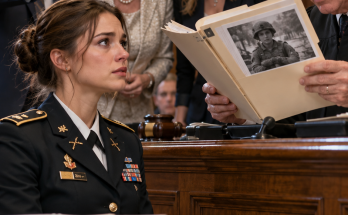
And when I stepped into the dining room wearing my blue dress uniform, his expression changed completely.
Because the man standing at the head of Richard’s table wasn’t merely another officer.
He was Major General Thomas Whitaker.
And he knew exactly what I had done during an operation that had never appeared in a newspaper.
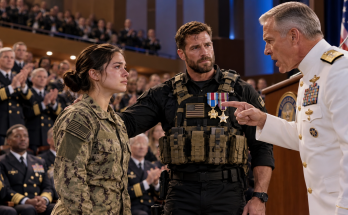
“Captain Hayes,” he said, rising from his chair.
Then he turned toward the other officers.
“Everyone, please stand.”
Richard’s smile vanished.
But what happened next was far more devastating than a room full of officers standing to attention.
Because the general looked directly at Richard and said, “Before we begin dinner, I believe we need to discuss what you’ve been telling these people about your military experience.”
PART 2
For several seconds, nobody moved.
Richard stood beside his chair with one hand resting on its polished wooden back.
His face had gone pale, but he tried to recover by forcing out a laugh.
“General, I think there’s been some misunderstanding.”
General Whitaker remained standing.
“Has there?”
Richard gestured toward me.
“My stepdaughter never told us she knew you personally.”
“I wasn’t aware that I was required to disclose my professional relationships to my family,” I replied calmly.
One of the other officers looked down at the framed identification card near the entrance.
“Mr. Coleman, you said you served as a senior military adviser.”
Richard nodded quickly.
“That’s right. I worked closely with military leadership for years.”
The officer picked up the frame and examined it.
“This is a civilian contractor identification card.”
“Yes, but my responsibilities were extensive.”
“Perhaps,” the officer replied. “But that doesn’t make you a military commander.”
Richard’s jaw tightened.
“I never said I was a commander.”
My mother slowly raised her head.
“Richard, you’ve told people you retired as a command sergeant major.”
The words seemed to drain the remaining color from his face.
For the first time that evening, Richard looked at my mother as though he had forgotten she was in the room.
“I was speaking figuratively.”
“Figuratively?” she repeated.
“You told my sister that you had led soldiers overseas. You told our neighbors that you had earned military honors. You even told Victoria she wasn’t a real professional because she hadn’t reached your level.”
Richard turned toward me.
“This is ridiculous. We’re supposed to be having dinner.”
General Whitaker placed a hand on the back of his chair.
“Then let’s make the facts clear before we sit down.”
He explained that he had met me three years earlier during a complex joint operation involving several military agencies.
I had been responsible for coordinating intelligence assessments under enormous pressure.
During the operation, a critical report arrived with conflicting information, and several teams were preparing to act on assumptions that could have placed personnel at unnecessary risk.
I had identified the discrepancy, requested independent verification, and helped establish a safer course of action.
The operation had succeeded without the loss of the personnel involved.
General Whitaker had been overseeing the broader mission.
He remembered the details because, as he later told me, my decision had demonstrated something he valued more than confidence or rank.
Judgment.
“You don’t need to shout to be a leader,” he said to the room. “And you don’t need to humiliate someone else to demonstrate authority.”
His gaze shifted toward Richard.
“Captain Hayes has earned the respect of her colleagues through her work. She doesn’t need to advertise it at a dinner table.”
Richard’s mouth opened, but no words came out.
Then one of the other officers spoke.
“I believe we’ve met before, Mr. Coleman. You attended a veterans’ association event last year, didn’t you?”
Richard nodded cautiously.
“You introduced yourself as a retired senior enlisted leader.”
The officer shook his head.
“I remember because several people asked which unit you had served with. You changed the subject.”
The room fell silent again.
I watched Richard’s carefully constructed identity begin to collapse beneath the weight of simple questions.
There were no dramatic accusations.
No shouting.
No threats.
Just people asking him to explain the things he had repeatedly claimed.
And he couldn’t.
Finally, he turned toward me.
“You planned this.”
I shook my head.
“No, Richard. You invited these people here. You chose the stories you told them. You decided I should stand in the kitchen because you thought my career made you look important.”
He stared at me.
“You could have told me who you were.”
“I did.”
“When?”
“Every time I told you I was an officer, and you dismissed my work because it didn’t fit your idea of success.”
My mother covered her mouth.
Richard looked toward her, searching for the familiar support that had always protected him from uncomfortable conversations.
“Eleanor, tell them this has gone too far.”
But my mother didn’t rush to rescue him.
Instead, she stood up.
“I’ve spent five years defending you,” she said, her voice trembling but clear. “I’ve explained your insults, excused your lies, and told myself that underneath all of this, you were simply insecure.”
Richard’s expression hardened.
“You’re embarrassing me in front of these people.”
“No,” she replied. “I’m finally admitting how embarrassed I’ve been.”
Nobody interrupted her.
She took a breath.
“You told me Victoria was wasting her life. You told me she needed a man to teach her discipline. And tonight, you ordered my daughter to serve people you considered more important than her.”
Richard tried to speak.
My mother raised one hand.
“I’m not finished.”
She looked at me, and I saw tears gathering in her eyes.
“I’m sorry I let him treat you that way in your own home.”
For the first time since arriving, I felt the tension leave my shoulders.
I crossed the room and took her hand.
“You don’t have to apologize for his choices, Mom.”
“But I do have to take responsibility for mine,” she whispered.
General Whitaker quietly asked the other officers to give us a few minutes.
As they moved toward the adjoining sitting room, Richard remained beside the table, staring at the uniform he had mocked only hours earlier.
Then he noticed the small silver insignia on my jacket.
His expression changed again.
“Wait,” he said. “That operation you mentioned. The one from three years ago.”
I turned toward him.
“What about it?”
He swallowed.
“I heard about that mission. Everyone said the officer responsible had been recommended for a special assignment.”
General Whitaker answered before I could.
“She was.”
Richard stared at me.
“Why didn’t you tell us?”
I looked at him for a long moment.
“Because I wanted to come home and be your daughter’s sister-in-law, your wife’s daughter, and a member of this family.”
I paused.
“Not a résumé you could use to impress your friends.”
Richard sank into his chair.
For once, he had nothing to say.
I thought the evening was over.
Then my mother walked toward the sideboard, opened a drawer, and removed a thick envelope.
She placed it in front of Richard.
“I found this in your desk last week,” she said. “I was waiting for you to explain it.”
Richard looked at the envelope.
His hands began to shake.
Because whatever was inside it had nothing to do with my military career.
And judging by his expression, it was the one thing he had been hoping none of us would ever discover.
PART 3
Richard didn’t touch the envelope.
He stared at it as though it had suddenly become something dangerous.
My mother stood beside the sideboard, her face pale but determined.
“What is it?” I asked.
She looked at Richard.
“Ask him.”
He immediately shook his head.
“This is a private matter between my wife and me.”
“Then you should have kept it out of the family home,” my mother replied.
I had seen people remain calm during difficult briefings, emergency situations, and moments when every second mattered.
But I had never seen Richard look so frightened by a simple envelope.
Finally, my mother opened it herself.
Inside were several letters, printed emails, and a document bearing the name of a veterans’ charity where Richard had volunteered as a fundraiser.
The letters showed that he had repeatedly introduced himself to the organization as a retired senior military leader.
He had used that claim to gain access to fundraising events and persuade donors that he possessed special knowledge of military families’ needs.
At first, I assumed the documents concerned nothing more than his exaggerated stories.
Then I noticed a series of emails about a donation account.
My mother read the first page silently.
Then she sat down.
“Richard,” she whispered, “what happened to the money?”
He stood abruptly.
“I was going to replace it.”
“Replace what?”
“The money was only temporary.”
My mother looked at him with disbelief.
“How much?”
He wouldn’t answer.
General Whitaker, who had returned after hearing the raised voices, remained near the doorway.
He didn’t interfere.
He simply listened as Richard finally admitted that he had used part of the charity’s funds to cover personal expenses after a business investment had failed.
He insisted that he had intended to repay everything.
He claimed that no one had suffered.
But the correspondence indicated that the charity had already postponed assistance to several military families while its finances were reviewed.
My mother began to cry.
Not because Richard had embarrassed her in front of important people.
Because she had believed his stories about honor, responsibility, and service.
She had believed he was the kind of man who would never exploit the very people he claimed to admire.
“How could you?” she asked.
Richard looked toward me.
“Victoria, you understand how complicated financial problems can become. You know how people make mistakes.”
I took a slow breath.
“Yes. People make mistakes.”
For a moment, hope flickered across his face.
Then I continued.
“But a mistake is not the same as repeatedly lying about your qualifications, using those lies to gain people’s trust, and taking money that was supposed to help families.”
He looked away.
“I didn’t mean for it to happen.”
“Then you need to make it right.”
General Whitaker explained that the charity would need to handle the matter through its own leadership and appropriate legal channels.
He made no threats and offered Richard no special treatment.
The other officers quietly confirmed that they would provide any relevant information they personally knew if the organization requested it.
The evening had become something far more serious than a family argument.
And for once, Richard could not control the story by speaking louder than everyone else.
My mother asked him to leave the house that night.
He stared at her in disbelief.
“Eleanor, you’re choosing your daughter over your husband?”
“No,” she replied. “I’m choosing honesty over another five years of pretending.”
He looked at me one final time.
“You must be very pleased with yourself.”
I shook my head.
“I’m not pleased, Richard. I wanted you to be a decent man. I wanted Mom to be happy. I wanted to come home without having to defend the life I’ve built.”
My voice softened.
“But I won’t help you keep hurting people just to protect your pride.”
He collected his coat and left without another word.
The officers stayed long enough to make sure my mother was all right.
General Whitaker approached me near the front door.
“Captain, I hope you understand that none of us stood up because of your uniform alone.”
I glanced toward the dining room.
“Then why did you?”
“Because respect is a habit,” he answered. “The uniform simply reminds us of the responsibility behind it.”
He paused.
“Your stepfather thought authority meant making someone else feel small. You demonstrated that real authority means knowing when you don’t have to.”
After he left, the house became quiet.
My mother and I sat together in the kitchen until well past midnight.
She told me things I had never known.
How Richard had gradually discouraged her from visiting old friends.
How he criticized her whenever she disagreed with him.
How she had begun apologizing automatically, even when she had done nothing wrong.
I listened without interrupting.
Then I told her something I had learned during years of military service.
“You don’t have to wait until someone becomes a terrible person in every possible way before you’re allowed to set boundaries.”
She wiped her eyes.
“I should have stood up for you sooner.”
“Maybe,” I said gently. “But you stood up for me tonight.”
Over the following weeks, my mother contacted the charity and cooperated with its review.
Richard was required to answer for the financial decisions he had made, and the organization pursued the appropriate process to recover the money.
My mother also sought independent advice about her finances and living arrangements.
She didn’t make every decision overnight.
But she stopped allowing fear of Richard’s reaction to decide everything for her.
As for me, I returned to my assignment.
I didn’t tell my colleagues the whole story.
I didn’t need to.
A few months later, I received a handwritten letter from my mother.
Inside, she wrote that she had begun volunteering with a local organization supporting military families.
She said she wanted to do something useful with the years she had spent believing that honor was something people proved through impressive stories.
At the bottom of the letter, she had written one final sentence.
I finally understand that the strongest person in the room isn’t always the one everyone is afraid to disappoint.
I kept that letter in my desk.
Not as a reminder of Richard’s humiliation.
As a reminder of what happened when my mother finally found the courage to speak.
And whenever someone mistakes quietness for weakness, I remember that Saturday evening.
The evening a man invited six officers into his home to prove he was important.
The evening he ordered a woman to serve dinner because he believed her achievements meant nothing.
And the evening he discovered that the person he had been trying hardest to diminish was never the one who needed to prove her worth.
Because a uniform can earn attention, a title can command a room, and a lie can impress people for a while.
But character is what remains when the truth finally walks through the door.