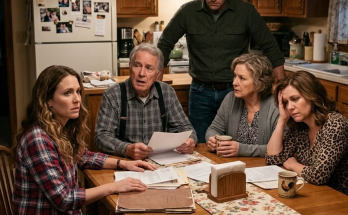
My Son Shut the Door on Me at Christmas After 14 Years of Paying His Bills—So I Canceled Every Payment That Night, and by Christmas Morning, He Had Called Me 25 Times
PART 1 — The Christmas Eve He Turned Me Away
My name is Margaret Whitmore, and I used to believe that a mother’s love meant showing up for her children, even when they stopped appreciating what she did for them.
For fourteen years, I helped my son Daniel build the comfortable life he now enjoyed. I contributed toward his mortgage, covered his children’s private-school expenses, paid insurance bills, and transferred money whenever he called with another emergency. I never kept a tally because I thought I was helping the people I loved most.
Then came the Christmas Eve that changed everything.
I was standing outside Daniel’s beautiful home in Maplewood, New Jersey, with snow collecting on my coat. In one hand, I carried a freshly baked turkey casserole. In the other, I held a red gift bag filled with presents for my two grandchildren, Emma and Noah.
I had spent the entire afternoon preparing the food. I had wrapped every present myself, carefully writing each child’s name on the tags.
Through the front window, I could see the Christmas tree glowing beside the fireplace. People moved around the dining room, laughing and carrying plates. Claire’s parents were there, along with several cousins and family friends.
It looked like the kind of Christmas I had dreamed of giving my son when he was a little boy.
I pressed the doorbell.
A few moments later, Daniel appeared.
He opened the door only a few inches and looked at me as though I were a stranger trying to sell him something.
“Mom? What are you doing here?”
I smiled, hoping he was joking.
“Merry Christmas, sweetheart. I brought the casserole you like, and I have presents for the children.”
His expression didn’t change.
“You weren’t supposed to come.”
I glanced past his shoulder. I could hear my grandchildren laughing somewhere inside.
“I thought we were having Christmas together.”
Daniel stepped onto the porch and pulled the door nearly shut behind him.
“Mom, we didn’t invite you.”
For a moment, I genuinely couldn’t understand the words.
I had spoken to him three days earlier. He had asked whether I could help cover an unexpected bill before the holidays. I had transferred the money that same afternoon.
He hadn’t mentioned that I wasn’t welcome for Christmas.
“Daniel,” I said quietly, “I’m your mother. I came to see my grandchildren.”
He rubbed his forehead impatiently.
“Claire’s parents are here. We have other guests. This isn’t a good time.”
I looked down at the food in my hands.
“I won’t stay long. I just want to give the children their presents.”
Before he could answer, a little voice called from inside.
“Daddy, who is it?”
I recognized Noah’s voice immediately.
Daniel didn’t even hesitate.
“Nobody, buddy. Wrong house.”
Then he looked directly at me.
“Please go home, Mom. Don’t make this embarrassing.”
I stood completely still.
Behind him, I caught a glimpse of Claire holding a wineglass. She looked toward the doorway, saw me, and quickly turned away.
Noah called again, asking whether Grandma had come.
Daniel raised his voice just enough for the child to hear.
“I told you, nobody’s here.”
Then he closed the door.
Not slowly. Not apologetically.
He shut it firmly in my face.
I remained on the porch, staring at the polished wood while snowflakes landed on the lid of my casserole dish.
For fourteen years, I had helped pay for the house behind that door.
I had helped make sure the children had school supplies, warm clothes, and opportunities their father sometimes struggled to afford. I had sent money when Daniel said the mortgage was overdue and when Claire said the children needed something important.
Yet I couldn’t even be allowed inside to hand them Christmas presents.
Eventually, I walked back to my car.
I placed the casserole on the passenger seat and set the gift bag carefully on the floor. I didn’t cry until I reached the end of the street.
When I arrived home, the house was silent.
My husband had passed away six years earlier, and Christmas had never felt quite the same without him. Still, I had always found comfort in knowing that Daniel and the grandchildren were part of my life.
That evening, even that small comfort seemed to disappear.
I put the casserole in the refrigerator and placed the gifts beneath my own Christmas tree.
Then I sat at the kitchen table, looking at my phone.
I kept telling myself Daniel would call.
Perhaps he would realize how cruel he had been. Perhaps he would apologize and invite me over the following morning.
At 10:47 p.m., my phone finally rang.
Daniel’s name appeared on the screen.
My heart lifted before I could stop it.
“Hello, sweetheart.”
Instead of an apology, I heard laughter in the background.
Then Daniel spoke.
“Mom, I hope you’re not planning to tell everyone how you showed up uninvited and embarrassed yourself.”
I gripped the phone.
“I only wanted to see the children.”
“You should have called first.”
“I called you on Tuesday.”
“Well, we were busy. You can’t just assume you’re invited everywhere.”
I closed my eyes.
Then I heard Claire laughing.
Daniel continued, sounding amused rather than ashamed.
“And another thing, Mom. Don’t think paying a few bills means you can buy yourself a seat at my table.”
For several seconds, I couldn’t speak.
He had asked for my help so many times that I had stopped questioning it. When his business struggled, I helped. When the mortgage payment was short, I helped. When the children needed school expenses covered, I helped.
I had never asked for a place at his table in exchange.
I had only wanted to be treated like his mother.
Then Daniel said something that finally made the last fragile piece of my hope disappear.
“Honestly, Christmas is easier without all this drama. Maybe next year you’ll learn to wait for an invitation.”
He laughed again.
I looked toward the presents beneath my tree.
Then I looked at the framed photograph of Daniel as a little boy, sitting on his father’s shoulders on Christmas morning.
I remembered the child who used to run into my bedroom before sunrise, begging me to come downstairs because Santa had arrived.
I remembered working extra shifts so he could attend college.
I remembered sitting beside him when his first business nearly failed, promising that one difficult season wouldn’t define his future.
I had spent years protecting him from hardship.
Somewhere along the way, I had taught him that my love would always be available, even when his kindness wasn’t.
“Good night, Daniel,” I said.
He sounded surprised.
“That’s it?”
“Yes.”
I ended the call.
For the first time in fourteen years, I didn’t feel the urge to explain myself, defend my intentions, or beg my son to understand how much he had hurt me.
Instead, I opened my laptop.
And I began looking at the payments I had been making on his behalf.
PART 2 — The Fourteen Years of Payments He Thought Would Never End
My laptop displayed a list of recurring transfers I had arranged over the years.
Some were small. Others were substantial.
There was a monthly contribution toward Daniel’s mortgage, a payment for the children’s school expenses, a transfer toward the insurance on his family’s vehicles, and a regular deposit I had labeled simply Family Assistance.
There were also payments I had almost forgotten about.
A loan I had helped him repay after his business suffered a difficult year.
An emergency fund I had established so he would never have to worry about an unexpected household expense.
Several automatic transfers he had requested because, according to him, managing the bills himself had become too stressful.
I scrolled through the records.
Month after month.
Year after year.
I added the amounts together, checking each figure carefully.
The total was far greater than I had ever imagined.
I sat back in my chair.
I wasn’t angry because I had spent money on my son. I would have gladly spent it again if it had genuinely helped him build a better life.
What hurt was realizing how little he seemed to value the person providing it.
Daniel had apparently grown so accustomed to my assistance that he no longer saw it as generosity.
He saw it as something he was entitled to receive.
And I had allowed that belief to continue for too long.
At 11:18 p.m., I opened the first payment arrangement.
The screen asked whether I wanted to cancel the recurring transfer.
My finger hovered over the confirmation button.
I thought about the grandchildren. I thought about whether they might be affected by the decision.
I loved Emma and Noah more than I could explain. They were innocent in all of this, and I had no intention of punishing them for their father’s behavior.
But I also knew that sending Daniel money without limits was not the same thing as caring for the children.
If I wanted to help my grandchildren in the future, I could find ways to do that directly, responsibly, and with their well-being in mind.
I didn’t need to keep funding a household where I was treated as an inconvenience.
I pressed Cancel Payment.
Then I confirmed.
I moved to the next transfer.
And the next.
Mortgage contribution.
Canceled.
Monthly business assistance.
Canceled.
Vehicle insurance transfer.
Canceled.
Automatic emergency deposit.
Canceled.
Each time, I read the confirmation carefully before moving on.
I wasn’t acting out of revenge. I was ending arrangements that had continued without any meaningful appreciation or mutual respect.
By midnight, I had reviewed every recurring payment connected to Daniel’s household.
I also removed the automatic replenishment from the emergency account I had maintained for his family. I left my own savings untouched and made a note to speak with my financial adviser after the holidays about the best way to handle any future gifts intended specifically for my grandchildren.
Then I closed the laptop.
The house was quiet.
Outside, snow covered the garden and the branches of the old maple tree in my front yard.
For the first time that evening, I felt as though I could breathe.
I made myself a cup of tea, warmed a small portion of the casserole, and sat down at the kitchen table.
I didn’t feel triumphant.
I felt sad.
A mother never dreams of the day she has to reconsider how she supports her own child. I had wanted Daniel to become independent, thoughtful, and generous. I had wanted him to remember the sacrifices his father and I had made for him.
Instead, he had mistaken my patience for weakness.
At 12:36 a.m., my phone lit up with a message from Claire.
Daniel says you were upset tonight. We hope you’ll calm down and enjoy Christmas.
I read it twice.
There was no apology.
No acknowledgment of what had happened at the door.
No mention of the presents or the food I had carried through the snow.
I placed the phone facedown.
I didn’t respond.
At 1:12 a.m., another message arrived.
This time, it was from Daniel.
Just so we’re clear, please don’t make this a financial issue. The family has obligations, and we have always counted on your help.
I stared at the screen.
He had spent the evening telling me that my financial support didn’t entitle me to a place in his home.
Now, barely two hours later, he was reminding me that his household depended on that same support.
I typed a reply.
Then I deleted it.
I typed another.
Deleted that one too.
Finally, I decided there was nothing I needed to say in the middle of the night.
The canceled payments would speak for themselves.
I went upstairs, changed into my pajamas, and lay awake for a long time.
I wondered what Daniel would think when he discovered the transfers were no longer arriving.
I wondered whether he would be angry, frightened, or simply confused.
Most of all, I wondered whether he would remember the woman who had stood outside his house with a casserole and Christmas presents, hoping only to hug her grandchildren.
Before falling asleep, I made one promise to myself.
I would not let guilt persuade me to reverse my decision simply because Daniel became upset.
If he wanted to rebuild our relationship, I would listen.
If he wanted to apologize, I would hear him out.
But I would no longer pay for the privilege of being treated with basic kindness.
At 6:03 on Christmas morning, my phone began ringing.
It was Daniel.
I let it ring while I finished making coffee.
He called again.
Then a third time.
By the time I sat down at the table, there were eleven missed calls.
I hadn’t even opened my messages yet when another call came through.
Then another.
I looked at the screen and whispered to the empty kitchen, “Now you know what it feels like when someone doesn’t answer.”
But I still didn’t pick up.
Because I had no idea that by noon, my son would be standing on my doorstep, and the first thing he said would reveal just how much he had misunderstood the meaning of family.
PART 3 — By Christmas Morning, He Had Called Me 25 Times
By 8:15 a.m., I had twenty-five missed calls from Daniel.
There were messages from Claire, too, each one more urgent than the last.
Mom, please call us.
The mortgage transfer didn’t arrive.
The insurance payment is showing as canceled.
We need to talk about what happened.
I sat at the kitchen table and read them without responding.
I was not pleased that Daniel was suddenly worried. I was not celebrating his discomfort.
I was simply noticing something I had failed to recognize for years.
When I had stood outside his home the night before, carrying gifts for his children, he had treated my presence as a problem.
Now that my money was no longer arriving automatically, he was treating my silence as an emergency.
At 8:42 a.m., he called again.
This time, I answered.
“Mom!” he exclaimed. “Finally. What is going on?”
“Good morning, Daniel. Merry Christmas.”
“Don’t do that. You know what I’m talking about. The payments have stopped.”
“Yes,” I said calmly. “I canceled them.”
There was a long silence.
Then he laughed once, sharply, as if he couldn’t believe what he had heard.
“You canceled everything?”
“I canceled the automatic financial assistance I had been providing.”
“But why would you do that without telling me?”
I looked at the coffee in my cup.
“Why did you close the door on me last night without telling me you didn’t want me there?”
“That is completely different.”
“Is it?”
He began speaking faster.
“Mom, we have bills. We have commitments. You know that. You can’t suddenly decide to do something like this on Christmas morning.”
“I didn’t suddenly decide, Daniel. I made a decision after thinking about what happened.”
“You’re punishing us because of one misunderstanding!”
“One misunderstanding?” I repeated.
He fell silent.
I continued, keeping my voice steady.
“I came to your home with food and presents for your children. You told them nobody was at the door. Then you called me later to laugh about it and told me I couldn’t buy a place at your table.”
“I was upset. I didn’t mean it like that.”
“You sounded quite certain when you said it.”
He sighed loudly.
“Mom, Claire’s family was here. We didn’t have room for everyone.”
I glanced toward the gifts still sitting beneath my Christmas tree.
“Then you could have told me that kindly. You could have invited me for another day. You could have let me hand the children their presents.”
Daniel didn’t answer.
For the first time, he seemed unable to find an explanation that made his behavior sound reasonable.
Finally, he said, “Fine. I’m sorry you felt hurt. But this financial thing is going too far.”
I closed my eyes.
I’m sorry you felt hurt.
Not I’m sorry I hurt you.
Even then, he was trying to make the problem my reaction instead of his actions.
“Daniel, I love you,” I said. “I have loved you every day of your life. Helping you and your family has been a privilege. But I am not going to continue sending money automatically while being treated as though I have no place in your life.”
“So what, you’re cutting us off?”
“I’m ending the financial arrangements I chose to make. You and Claire will need to manage your household finances yourselves. If I decide to give something directly to Emma or Noah in the future, that will be a separate decision.”
He was quiet for several seconds.
Then his voice hardened.
“You know what? Maybe we don’t need your help anyway.”
I felt a familiar ache in my chest, but I didn’t retreat from my decision.
“I hope you can manage comfortably. I truly do.”
I ended the call.
For the next hour, I tried to enjoy Christmas morning.
I called my sister, who lived two towns away. I wished my neighbors a happy holiday. I heated the casserole I had prepared the previous evening and ate breakfast beside the tree.
It wasn’t the Christmas I had imagined.
But it was peaceful.
At 10:26 a.m., someone knocked on my front door.
I opened it and found Daniel standing on the porch.
He was wearing the same dark coat from the night before. His hair was messy, and he looked as though he hadn’t slept.
For a moment, I saw the little boy he had once been, standing outside my bedroom on Christmas morning, waiting for permission to come in.
Then he spoke.
“Mom, we need to fix this.”
I stepped aside, but I didn’t hug him.
“Come in, Daniel.”
He walked into the living room and immediately looked toward the kitchen table, where my laptop was still closed beside my coffee cup.
“Can you reverse the payments?” he asked.
I pulled out a chair.
“Sit down.”
He remained standing.
“The bank says the mortgage contribution is gone. Claire is worried about the insurance. We have school expenses coming up, and the business account is already tight.”
I listened without interrupting.
When he finally stopped, I asked a simple question.
“Did you come here to apologize for last night, or did you come because the money stopped?”
His face changed.
“That’s not fair.”
“Please answer me.”
He looked away.
“I came because both things matter.”
It was the first honest answer he had given me that morning.
I nodded toward the chair again.
This time, he sat.
I took a slow breath.
“Daniel, I don’t expect you to agree with every decision I make. I don’t expect you to invite me to every gathering or rearrange your life around me. You are an adult, and you have your own family.”
He stared at the table.
“But I do expect basic respect. If I am not invited, tell me. If you need space, say so. Don’t humiliate me at your door and then laugh about it afterward.”
His eyes began to redden.
“I didn’t think you’d take it that badly.”
I felt tears gathering behind my own eyes.
“That is part of the problem, sweetheart. You didn’t think about how it would feel at all.”
He finally looked at me.
For the first time since arriving, he seemed to understand that I wasn’t simply angry about one Christmas invitation.
I was grieving fourteen years of believing that my generosity had brought us closer, only to discover that it had allowed resentment and entitlement to grow between us.
“I was wrong,” he whispered.
I didn’t rush to comfort him.
He swallowed hard.
“I shouldn’t have shut the door on you. And I shouldn’t have said those things on the phone. I was embarrassed that you showed up when Claire’s family was here, and I handled it terribly.”
“Why were you embarrassed by your own mother?”
He rubbed his face.
“I don’t know. I wanted everything to look perfect. Claire’s parents have always been sensitive about money, and I didn’t want anyone asking questions about how much help we receive.”
I looked at him for a long moment.
“So you were willing to hurt me to protect an image?”
He didn’t answer.
He didn’t need to.
I stood and walked to the kitchen window. Snow still covered the garden, and the morning sun was beginning to break through the clouds.
When I turned back, Daniel was staring at his hands.
“I can’t promise you that I’ll restart those payments,” I told him. “I need time to reconsider what kind of help is appropriate, and I need to know that our relationship can exist without money being at the center of it.”
He nodded slowly.
“I understand.”
“I also want to see Emma and Noah. I love them, and I don’t want them caught in the middle of this. We can arrange visits directly and make sure they know their grandmother loves them.”
His eyes filled with tears.
“They asked about you this morning.”
My heart tightened.
“What did you tell them?”
He looked ashamed.
“I told them I had handled things badly. I said I needed to make it right.”
That was the first thing he had said that gave me hope.
Not because it erased what happened, but because he had finally begun taking responsibility for it.
We sat quietly for several minutes.
Then I walked to the refrigerator and brought out the casserole I had prepared the previous evening.
“Would you like some breakfast?”
Daniel looked at me, surprised.
“You still have it?”
“Of course. I made it for Christmas.”
He lowered his head and began to cry.
I didn’t pretend everything was suddenly forgiven. I didn’t promise to restore his financial support. And I didn’t tell him that one apology could erase fourteen years of unhealthy expectations.
Instead, I placed a plate on the table and sat across from him.
For the first time in a long while, we talked without discussing bills, transfers, or emergencies.
We talked about the children. We talked about his father’s old Christmas traditions. We talked about the things we had stopped sharing because money had gradually replaced honest conversation.
Before Daniel left, he stood beside the front door for a long moment.
“Mom,” he said quietly, “I’m sorry I made you feel like you weren’t part of the family.”
I reached for his hand.
“You have never needed my money to make me your mother.”
He nodded, tears in his eyes.
“I know that now.”
I wanted to believe him.
But I also understood that rebuilding trust would take more than one emotional Christmas morning. It would take consistent actions, honest conversations, and respect even when there was nothing financial to gain.
After he left, I returned to the living room and picked up the gift bag I had carried through the snow the night before.
I decided I would arrange another day to give the presents to my grandchildren.
Not to prove a point. Not to force my way into Daniel’s home.
Simply because I loved them.
That evening, I sat beside my Christmas tree and thought about the lesson the past twenty-four hours had taught me.
Love does not mean accepting every form of treatment from the people we love.
Generosity does not require us to sacrifice our dignity.
And being a good mother does not mean financing an adult child’s life forever, especially when that support has become an expectation rather than a gift.
I still loved Daniel. I always would.
But from that Christmas forward, my help would come with clear boundaries, and my relationship with him would have to stand on something stronger than automatic bank transfers.
Because money can pay a mortgage, cover tuition, and keep the lights on.
It cannot buy genuine affection.
And no mother should ever have to purchase a place in her own family’s heart.