PART 1 — The Comment
For ten years, my mother-in-law, Beatrice, had made family dinners feel like examinations.
She never insulted me directly.
She preferred little comments.
“Are you sure you want dessert?”
“Maybe choose the smaller plate.”
“That dress is… ambitious.”
I learned to smile and ignore her.
Then my daughter Clara turned seven.
And somehow, Beatrice decided the same rules should apply to her.
It happened on a Sunday evening at our house.
The table was crowded with food.
My husband, Daniel, sat beside me. His younger brother and his wife were across from us, while Beatrice sat at the head of the table like she owned the room.
Clara had been talking excitedly about a drawing she made at school.
She had barely touched her vegetables.
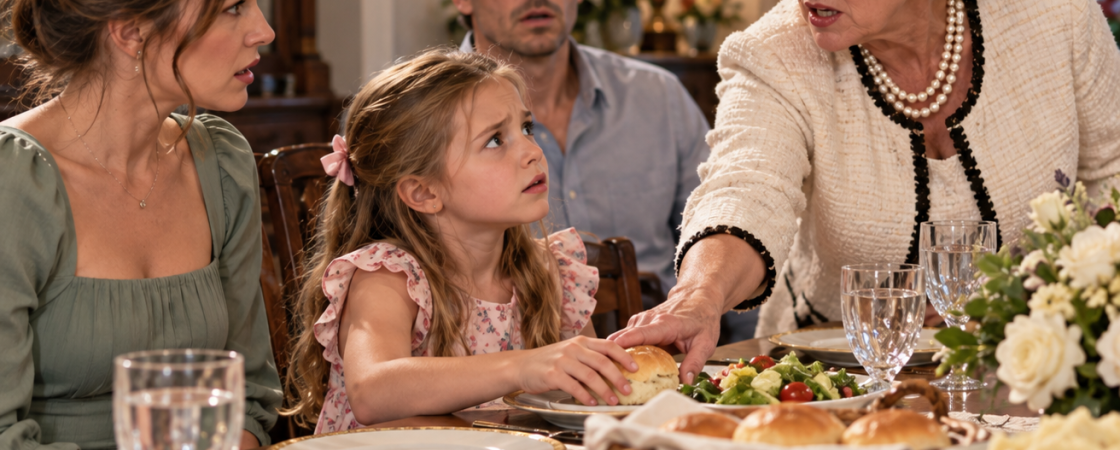
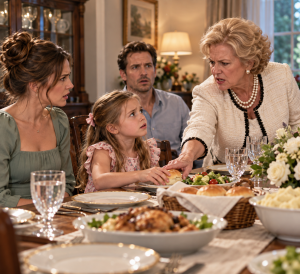
When she reached for a second dinner roll, Beatrice suddenly put her hand over Clara’s wrist.
“That’s enough, sweetheart.”
Clara looked confused.
Beatrice smiled.
“You really need to start watching your weight.”
The room went silent.
I felt my entire body tense.
Beatrice continued.
“Those dresses are getting tight already. We don’t want you growing out of everything before the summer, do we?”
My husband stopped eating.
I looked at him.
His jaw tightened.
But before either of us could speak, Clara looked down at her roll.
Then she looked back at her grandmother.
“Grandma?”
“Yes, sweetheart?”
Clara tilted her head.
“Why do you always talk about people’s bodies when we’re eating?”
Beatrice froze.
Nobody moved.
Clara continued innocently.
“Mommy says dinner is supposed to be about being together.”
My husband’s brother suddenly looked down at his plate.
His wife covered her mouth.
Beatrice’s smile disappeared.
But Clara wasn’t finished.
She pointed toward the kitchen.
“Mommy also said food isn’t bad.”
Then she smiled.
“So why are you making everyone feel bad about eating?”
Silence.
I looked at my daughter.
She had no idea she had just said something that would change our family forever.
Beatrice slowly removed her hand from Clara’s wrist.
“I was only trying to help.”
Clara nodded.
“Okay.”
Then she reached for the roll.
“And I’m still hungry.”
My husband finally spoke.
“Clara, take the roll.”
She smiled.
“Thank you, Daddy.”
Beatrice stared at him.
Daniel didn’t look away.
For the first time in ten years, he had chosen his daughter’s feelings over his mother’s approval.
But the evening was far from over.
Because after dinner, Beatrice followed Daniel into the kitchen.
And I heard her say:
“You’re really going to let your wife turn our granddaughter against me?”
Daniel answered quietly.
“No.”
There was a pause.
Then he said:
“I’m going to stop you from hurting her.”
I stood in the hallway.
And I realized something.
My daughter had spoken one innocent sentence.
But she had finally said what all of us adults had been too afraid to say.
PART 2 — The Truth Comes Out
Beatrice left shortly afterward.
She didn’t say goodbye to me.
She barely looked at Clara.
But the next morning, she called Daniel.
Then she called me.
Then she called several other family members.
By lunchtime, she had created an entirely different version of what happened.
According to her, I had “poisoned” Clara against her.
She claimed Clara’s comments had been rehearsed.
She even told Daniel that I was deliberately trying to destroy their relationship.
I didn’t respond.
Instead, I asked Daniel to come home early.
When he arrived, I showed him something.
An old notebook.
I’d started keeping it years ago.
Not because I wanted revenge.
Because I had begun questioning whether I was imagining the constant criticism.
Every comment was written down.
Every gathering.
Every remark.
Every time Beatrice had criticized my body in front of relatives.
Daniel read the pages silently.
Then he looked at me.
“Why didn’t you show me this?”
I smiled sadly.
“Because every time I tried to tell you, you said she didn’t mean anything by it.”
He lowered his eyes.
“I did.”
“You were protecting her.”
“I know.”
Then Clara walked into the room.
She was holding a drawing.
“Mommy?”
“Yes?”
“Can I show Daddy?”
She handed him the paper.
It was a picture of our family.
There were five people.
Me.
Daniel.
Clara.
Our dog.
And a tiny figure standing far away from everyone else.
Daniel pointed at it.
“Who’s that?”
“Grandma.”
My heart sank.
“Why is she over there?”
Clara shrugged.
“She always tells people what they should look like.”
Daniel’s expression changed.
“Does Grandma say things like that to you often?”
Clara nodded.
“Sometimes.”
“How often?”
She thought.
“Lots.”
I felt sick.
Daniel knelt beside her.
“Why didn’t you tell us?”
Clara looked confused.
“Because Mommy says grown-ups sometimes say silly things.”
Daniel looked at me.
I could see tears in his eyes.
I hadn’t realized how much our daughter had already noticed.
That evening, Daniel called his mother.
“Mom, we’re not bringing Clara to your house anymore.”
Beatrice exploded.
“You can’t keep my granddaughter from me!”
Daniel remained calm.
“Until you understand what you’ve been doing, yes, I can.”
“She needs discipline!”
“She needs to eat without being ashamed.”
“You’re letting your wife control you!”
“No.”
He paused.
“I’m protecting my daughter.”
Beatrice hung up.
For two weeks, there was silence.
Then something unexpected happened.
Daniel’s sister called me.
She confessed that Beatrice had been making comments about her weight since she was twelve.
Then Daniel’s cousin called.
She had similar stories.
Then another relative.
And another.
Suddenly, the family realized this wasn’t about Clara.
It had never been about Clara.
It was a pattern that had been passed from one generation to another.
And someone finally decided to break it.
But Beatrice wasn’t ready to accept responsibility.
Instead, she announced something that shocked everyone.
She said she was going to host a family dinner.
And she promised she had something important to say.
PART 3 — The Dinner Nobody Expected
Three weeks later, we arrived at Beatrice’s house.
I almost didn’t go.
But Daniel wanted to.
“We need to hear what she has to say,” he told me.
Clara held my hand as we walked inside.
The dining room looked exactly as it always had.
Perfect table settings.
Crystal glasses.
Beautiful food.
And Beatrice sitting at the head of the table.
Everyone was there.
Her children.
Her grandchildren.
Her siblings.
Even several relatives who hadn’t spoken to each other in months.
Beatrice stood.
“I asked everyone to come because I owe this family an explanation.”
Nobody spoke.
She looked at Clara.
Then at me.
“I’ve spent most of my life believing that criticizing people was the same as helping them.”
Her voice shook.
“I thought if I pointed out someone’s flaws first, I was protecting them from the judgment of others.”
She took a breath.
“But I was wrong.”
Clara watched her carefully.
Beatrice continued.
“I hurt my children.”
She looked at Daniel.
“I hurt my grandchildren.”
Then she looked at me.
“And I hurt you.”
I didn’t know what to say.
Beatrice wiped her eyes.
“When Clara asked me why I always talked about people’s bodies at dinner, I realized something.”
She smiled sadly.
“She understood what I had spent decades refusing to understand.”
She walked toward Clara.
“Can I ask you something?”
Clara nodded.
“Do you remember what you told me that night?”
Clara thought for a moment.
“You asked why you talked about people’s bodies.”
Beatrice laughed softly.
“Yes.”
Then she knelt.
“I want you to know something.”
Clara listened.
“You never have to change your body to make someone else comfortable.”
Clara smiled.
“Okay.”
Beatrice looked at me.
“I should have said that years ago.”
I felt tears forming.
Not because everything was suddenly fixed.
But because, for the first time, she wasn’t defending herself.
She was taking responsibility.
Dinner began.
Clara reached for a dinner roll.
Beatrice noticed.
For one second, the entire table became quiet.
Then Beatrice smiled.
“Would you like butter with that?”
Clara nodded.
“Yes, please.”
Beatrice passed her the butter.
No comment.
No warning.
No criticism.
Just butter.
Clara took a bite.
Then she looked at her grandmother.
“Grandma?”
“Yes?”
“Can I have dessert too?”
Everyone at the table held their breath.
Beatrice smiled.
“Of course.”
Clara grinned.
“Then I’ll have two cookies.”
The room erupted in laughter.
Even Beatrice laughed.
And something inside me finally loosened.
The next morning, I found Clara drawing at the kitchen table.
“What are you drawing?”
“Our family.”
She showed me the picture.
This time, everyone was standing together.
Even Grandma.
I smiled.
“That’s beautiful.”
Clara looked up.
“Mommy?”
“Yes?”
“Grandma is learning.”
I hugged her.
“She is.”
Then Clara returned to her drawing.
And I realized that my daughter had taught all of us something that night.
You don’t always need a perfect speech to change a family.
Sometimes all it takes is a child asking one honest question that adults have spent years avoiding.
“Why are you making everyone feel bad about eating?”