PART 1: THE DAY I BURIED MY ENTIRE WORLD
When my parents refused to attend the funeral of my husband and our two children because they had a birthday celebration to attend, I thought I had discovered the cruelest thing a family could do.
Six months later, when my name appeared in a national headline, those same people came knocking on my door, desperate to get back into my life.
But by then, I had learned something they never expected me to learn: sometimes, losing everything is the moment you finally discover who never truly loved you.
My name is Claire Miller, and before that terrible Thursday morning, I believed I had an ordinary, happy life.
My husband, Ethan, was the kind of man who warmed the car before waking me up on winter mornings.
He remembered how I liked my coffee, kissed my forehead before leaving the house, and never went to sleep without asking whether I was okay.
Our daughter, Lily, was seven years old and had a laugh that could fill an entire house.
She loved drawing pictures of our family, usually giving everyone enormous heads and tiny feet.
Our four-year-old son, Noah, was a little tornado of energy who believed that dinosaurs lived under his bed and that his father could fix absolutely anything.
On the refrigerator hung Lily’s latest drawing.
It showed four stick figures holding hands beneath a yellow sun.
Above them, in crooked pink letters, she had written, “MY FOREVER FAMILY.”
I used to smile every time I saw it.
I never imagined that one day I would stand alone in that kitchen, staring at the same drawing, wondering how a single morning could erase an entire lifetime.
That Thursday, Ethan left early with the children.
He had promised to take them to a little breakfast restaurant near the highway before driving Lily to school and dropping Noah at preschool.
I had stayed home because I had a terrible headache.
Ethan had kissed my forehead and told me not to worry about breakfast.
“Sleep for another hour, sweetheart,” he had said.
“We’ll bring you something delicious.”
Those were the last words he ever spoke to me.
At 9:17 a.m., my phone rang.
I was still half asleep when I answered.
“Is this Claire Miller?” a man asked.
“Yes. Who is this?”
“Ma’am, my name is Officer Daniels with the Virginia State Police. I need you to listen carefully.”
Something in his voice made my stomach tighten.
“There has been a serious accident involving a vehicle registered to your husband.”
I sat upright.
“Where is my husband? Are the children with him?”
There was a pause.
“An accident occurred on Interstate 95 outside Richmond. A commercial truck crossed the median and struck your husband’s SUV. Emergency crews responded immediately.”
My fingers began to shake.
“Please tell me they’re okay.”
“I’m very sorry.”
Those three words changed my life forever.
Ethan was gone.
Lily was gone.
Noah was gone.
The truck driver had reportedly fallen asleep behind the wheel.
The collision was devastating, and the medical teams could do nothing to save my family.
I survived because I had stayed home.
For months afterward, that fact tortured me more than I could explain.
I kept imagining the morning differently.
What if I had gone with them?
What if I had insisted on driving?
What if I had asked Ethan to leave ten minutes later?
Grief turned every ordinary detail into an accusation.
I barely remember driving to the hospital.
I remember fluorescent lights, a paper cup of water I couldn’t drink, and a nurse who sat beside me while I repeated my children’s names as if saying them enough times might somehow bring them back.
At one point, I found myself standing inside the hospital chapel.
My hands were streaked with dirt and ash from the roadside where I had fallen to my knees after arriving at the accident scene.
My phone felt impossibly heavy.
I needed my parents.
Whatever our differences, whatever old arguments we had endured, I believed that when my world collapsed, my mother and father would come running.
My father answered on the fourth ring.
In the background, I heard music, laughter, and the clinking of glasses.
“Dad,” I whispered. “Something terrible has happened.”
“Claire? What’s wrong? We’re in the middle of something.”
“Ethan was in an accident.”
The music continued behind him.
“What kind of accident?”
“He’s dead, Dad.”
The noise on the other end seemed to fade.
I forced myself to continue.
“Lily and Noah were with him. They’re gone too.”
For several seconds, nobody spoke.
Then I heard my mother asking what was happening, followed by the sound of a chair scraping against the floor.
“What do you mean they’re gone?” she demanded when she took the phone.
“They died this morning, Mom.”
I broke down.
I cried so hard that I could barely breathe.
“The funeral is Friday. Please, Mom. I can’t do this without you. Please come.”
My mother began crying, but her tears did not bring me comfort.
I heard my father take the phone back.
“Friday?” he asked.
“Yes, Friday. I need my family there.”
He sighed.
“Claire, Friday is Melissa’s birthday dinner. We’ve had the reservation for weeks, and the whole family is coming.”
For one moment, I genuinely thought I had misunderstood him.
“Dad, my husband and my babies are dead.”
“I know you’ve suffered a terrible loss.”
“Then please come!”
“Your sister has been looking forward to this birthday for months. We can’t simply abandon her celebration.”
I pressed my free hand against my mouth.
“I’m asking you to stand beside me while I bury my children.”
His answer was quiet, measured, and unforgettable.
“Today is your sister’s birthday. We can’t come.”
Then he hung up.
I remained on the chapel floor long after the phone went dark.
I called my mother again.
She didn’t answer.
I sent Melissa a message.
Please, I know it’s your birthday, but Lily and Noah are gone. I need you. Please come to the funeral.
She read the message.
She never replied.
On Friday morning, the sky was gray, and a cold wind moved through the cemetery.
Three caskets rested beneath a canopy.
The largest belonged to Ethan.
The two smaller ones beside it belonged to our children.
White roses covered their lids.
I had chosen the flowers because Lily loved roses, while Noah always called white flowers “snow flowers.”
I could not bear the thought of their final resting places being decorated with anything they would not recognize.
Ethan’s parents, Margaret and Robert, stood on either side of me.
Margaret had barely slept since the accident.
She held my hand so tightly that my fingers ached, but I never asked her to let go.
My parents’ seats remained empty.
Melissa’s seat remained empty.
The relatives who had filled our family gatherings with loud conversations and holiday photographs were nowhere to be seen.
Only my Aunt Ruth came from my side of the family.
She had driven six hours after learning about the accident from an old neighbor.
When she arrived, she wrapped her arms around me and cried into my shoulder.
“I’m so sorry, sweetheart,” she whispered. “I’m so, so sorry.”
I wanted to ask why she was the only one who came.
Instead, I held her as if she were the last remaining piece of my childhood.
When the pastor began speaking, I stared at the three caskets and felt something inside me break beyond repair.
I had buried my husband.
I had buried my children.
And, without realizing it until that moment, I had also buried the belief that my parents would ever love me the way I had spent my life hoping they would.
Three days later, my mother finally sent a message.
Hope you’re managing. Melissa was very hurt that you didn’t call her on her birthday.
I read it once.
Then twice.
Then a third time, because I could not believe those words had come from the woman who had given birth to me.
She did not ask whether I was eating.
She did not ask whether I could sleep.
She did not ask how I had survived standing beside three graves.
She was worried that Melissa felt hurt.
I placed my phone on the table and stared at the empty chairs in my kitchen.
Ethan’s coffee mug still sat beside the sink.
Noah’s tiny shoes remained beneath the bench.
Lily’s school jacket hung beside the front door.
The house was full of everything my family had left behind.
And suddenly, I understood that the people who shared my blood had chosen not to share my pain.
That evening, I made a decision.
I would stop begging them to love me.
I would stop explaining why my grief mattered.
And I would stop allowing people who abandoned me at my darkest moment to decide whether I deserved compassion.
I didn’t know it yet, but that decision would change everything.
PART 2: SIX MONTHS OF SILENCE—AND THE SECRET MY FAMILY NEVER BOTHERED TO ASK ABOUT
The first month after the funeral passed in a blur of paperwork, sleepless nights, and terrible silences.
I had to obtain three death certificates.
I met with insurance representatives who spoke in rehearsed phrases.
I answered questions about the accident that I could barely remember hearing the first time.
Every form asked me to write my family’s names.
Every signature reminded me that I was now the only person left to write them.
I learned how to make telephone calls without crying.
I learned how to sit through meetings while feeling as though I were watching my own life from somewhere far away.
But I could not learn how to enter my children’s bedrooms.
Lily’s room still smelled faintly of strawberry shampoo.
Her stuffed rabbit lay beneath the blanket, one ear folded over the other.
On her desk sat a half-finished drawing of a birthday cake she had planned to make for me.
Noah’s room was even harder.
His toy dinosaurs were arranged in a crooked line across the carpet.
His favorite blue pajamas remained folded at the foot of his bed because I had washed them the night before the accident.
Sometimes, I would stand in his doorway and whisper, “Mommy’s here, baby.”
Then I would remember.
And the silence would swallow me again.
During those first weeks, Ethan’s parents visited almost every day.
Margaret brought food even when I couldn’t eat.
Robert repaired a loose cupboard door because he said Ethan would have wanted the house looked after.
Neither of them pressured me to talk.
They simply stayed.
My own parents, meanwhile, sent a few messages.
My father wrote, Let us know when you’re feeling better.
My mother sent a photograph of a new dress she had bought.
Melissa posted pictures from her birthday celebration, smiling beside a large cake while our cousins crowded around her.
The caption read, Surrounded by the people who matter most.
I stared at that photograph for a long time.
I had been surrounded by three coffins less than twenty-four hours before she took it.
Yet somehow, in her version of the world, my absence was the only thing worth noticing.
I stopped responding.
At first, I thought they would eventually realize how badly they had hurt me.
I imagined my father arriving at my door with an apology, my mother crying as she admitted that she should have come, and Melissa finally acknowledging that her birthday could have waited.
I kept waiting for the telephone to ring with something resembling remorse.
It never did.
Instead, my parents continued with their lives.
They attended family dinners.
They celebrated holidays.
They sent photographs to the group chat and discussed vacations as though nothing extraordinary had happened.
When Mother’s Day arrived, my mother posted a long message about how precious children were and how a mother’s love never ended.
I closed the application.
I couldn’t understand how someone could write those words while refusing to acknowledge the grandchildren she had lost.
Then came Melissa’s engagement announcement.
She sent a message to the family group chat with a photograph of her diamond ring.
I’m getting married! We want everyone there to celebrate our happiness.
My mother responded with dozens of heart emojis.
My father immediately offered to pay for the reception.
An aunt asked whether I would help organize the decorations.
I stared at the screen, my hands trembling.
Nobody had asked whether I could bear to attend a wedding after losing my husband.
Nobody had asked whether the sound of children laughing might make me collapse.
They were planning another celebration, and once again, they expected me to adjust myself around it.
I left the group chat.
That night, I finally allowed myself to cry without trying to stop.
Not because I had lost my parents.
Because I had spent thirty-four years hoping they would become the parents I needed, and I was finally beginning to accept that they might never be.
Then came the financial settlement.
The truck driver’s employer had initially offered a settlement that would have covered the immediate expenses but did not adequately account for the deaths of three members of my family.
Ethan’s parents encouraged me to speak with a lawyer.
“You don’t have to decide anything immediately,” Robert told me. “But you deserve someone who will make sure every fact is examined.”
I agreed.
The investigation revealed a troubling history of safety violations involving the transportation company.
The truck had been involved in earlier maintenance concerns, and records raised questions about whether the company had taken sufficient steps to prevent exhausted drivers from operating dangerous vehicles.
My lawyer, Daniel Brooks, explained that the legal process could take months, perhaps longer.
I nodded.
Money was the last thing on my mind.
“What do you want out of this, Claire?” he asked during our second meeting.
I looked down at the photographs I had brought.
One showed Ethan holding Noah on his shoulders.
Another showed Lily sitting beside a birthday cake, her cheeks covered in frosting.
“I want the truth,” I said. “And I don’t want another family to go through this.”
Daniel was quiet for a moment.
“Then we’ll pursue both.”
The legal proceedings became an unexpected reason to get out of bed.
I read reports.
I attended meetings.
I asked questions until I understood what had happened.
I refused to let the case become merely another file on someone’s desk.
When the company attempted to minimize its responsibility, Daniel challenged the evidence.
When its lawyers suggested the crash was simply an unavoidable tragedy, our team examined the safety records and the decisions that had preceded it.
I was not seeking revenge against strangers.
I wanted accountability.
And I wanted Ethan’s name to mean something beyond the date on his death certificate.
By the fifth month, Daniel had begun discussing the possibility of a substantial settlement.
The negotiations were confidential, and I told almost nobody about them.
I did not want my grief to become a family announcement.
I especially did not want my parents to hear about money before they had ever bothered to ask how I was surviving.
There was another reason I kept the proceedings private.
During the weeks after the funeral, I had started researching child passenger safety, driver fatigue, and the support available to families who lost loved ones in road collisions.
I discovered that many grieving parents and spouses faced the same impossible combination of trauma, paperwork, and financial uncertainty.
Some had to return to work within days because they could not afford to stop.
Others could not pay for counseling.
Some struggled for months to understand the legal process after a fatal accident.
I began writing down ideas in a notebook.
At first, the notes were only a way to keep myself occupied.
Then they became a plan.
I wanted to create a foundation that would help families affected by fatal road accidents.
It would provide grants for grief counseling, help eligible families navigate legal and insurance paperwork, and support public education about driver fatigue and road safety.
I wanted to call it the Lily and Noah Foundation.
When I told Margaret, she began crying.
“They would have loved that,” she whispered.
For the first time in months, I felt a small, fragile warmth inside me.
Not happiness.
Nothing could bring me happiness in the way I had known it before.
But purpose.
I began working with Daniel, a nonprofit adviser, and several road-safety advocates.
We discussed funding, governance, independent oversight, and how to ensure that the foundation would help people who needed it most.
I was determined that every dollar would be accounted for.
I did not want my children’s names used as decoration on a website.
I wanted their names attached to something that could genuinely save lives and support families.
Then, exactly six months after the accident, the settlement was finalized.
The amount was $18.7 million.
The figure appeared enormous in the documents, but when Daniel placed the final papers in front of me, all I could think about was the morning Ethan had promised to bring me breakfast.
No amount of money could buy that morning back.
I asked Daniel to help structure the settlement responsibly, establish the foundation, and ensure that the money would support its mission for years to come.
He agreed.
A public announcement was scheduled for the following Tuesday.
I had no idea how quickly everything would change.
On Tuesday morning, I was sitting in the foundation’s temporary office when my phone began vibrating.
At first, I ignored it.
Then Daniel walked in holding his tablet.
“Claire,” he said, “you should probably see this.”
A news outlet had published the headline:
WIDOW OF I-95 CRASH VICTIMS AWARDED $18.7 MILLION; LAUNCHES FOUNDATION IN MEMORY OF HUSBAND AND CHILDREN.
The article described the accident, the legal settlement, and my plans for the Lily and Noah Foundation.
It included a photograph of Ethan with the children.
Within an hour, other news outlets had picked up the story.
My phone filled with missed calls.
A cousin who had not contacted me since the funeral sent a message asking whether the foundation was accepting donations.
An uncle wrote that he had always admired my strength.
Then my mother’s name appeared.
I let the phone ring.
It stopped.
A minute later, she called again.
Then my father.
Then Melissa.
By noon, I had received more messages from my family than I had received during the previous six months combined.
My father wrote, Claire, sweetheart, we saw the news. Please call us. We need to talk.
My mother sent a voice message through tears.
“Claire, darling, we had no idea you were going through all this. Why didn’t you tell us?”
I listened to it twice.
I almost laughed, but the sound died in my throat.
They had known my husband and children were dead.
They had known the date of the funeral.
They had known I had begged them to come.
They had simply decided that none of it was important enough to interrupt a birthday dinner.
Now they wanted to know why I hadn’t told them about the settlement.
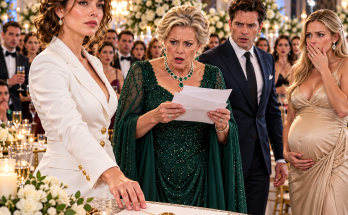
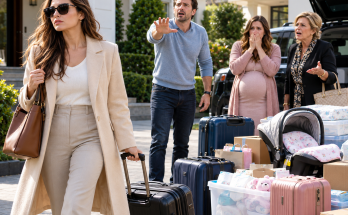
That evening, someone began pounding on my front door.
I walked toward it slowly.
Through the window, I saw my father standing on the porch.
My mother was beside him, clutching her handbag.
Melissa stood behind them, dressed in a cream-colored coat, her face pale.
My father knocked again.
“Claire! Open the door. We’re your family!”
I placed my hand on the doorknob.
For six months, I had imagined this moment.
I had imagined them arriving with flowers and apologies.
Instead, they had arrived after reading a headline.
I opened the door but did not step aside.
My father looked at me, then past me into the house.
“Claire,” he said, his voice suddenly warm, “we’ve been so worried about you.”
I looked directly into his eyes.
“Really?”
My mother began crying.
“Please, sweetheart. Let us come inside.”
Melissa stepped forward.
“We need to talk about everything that’s happened.”
I kept one hand on the door.
“Everything?” I asked.
Nobody answered.
I took a breath.
“Then let’s start with the funeral.”
For the first time since I had known them, my family had nothing to say.
PART 3: THE HEADLINE THAT BROUGHT THEM BACK—AND THE ANSWER THEY NEVER EXPECTED
My father was the first to recover.
He straightened his jacket and gave me the expression he had used throughout my childhood whenever he believed I was being unreasonable.
“Claire, we know the funeral was difficult. Nobody is denying that.”
I stared at him.
“Nobody is denying it?”
He glanced at my mother, apparently expecting her to help.
“We made a mistake,” he continued. “We should have handled things differently.”
I waited.
He did not say he was sorry.
He did not say he should have come.
He did not say that my husband and children deserved to be mourned by the people who had called themselves their family.
Instead, he looked past me again.
“Could we please come inside? This isn’t a conversation to have on the porch.”
I stepped aside, but only because I wanted to hear what they had come to say.
They entered the living room.
My mother sat on the edge of the sofa, twisting a tissue between her fingers.
Melissa remained standing near the fireplace, glancing around at the framed photographs on the shelves.
One photograph showed Ethan holding Lily and Noah at the beach.
Melissa looked at it for a moment, then turned away.
My father cleared his throat.
“First, we want you to know how proud we are of what you’ve accomplished.”
I almost closed my eyes.
There it was.
Not grief.
Not regret.
Pride in an accomplishment.
He spoke about the settlement, the foundation, and the newspaper coverage.
He said that I had shown remarkable strength and that our family had always known I was capable of great things.
I listened without interrupting.
When he finished, I asked a simple question.
“Did you read the part about the funeral?”
My mother began crying harder.
“Claire, please.”
“Did you read that I buried my husband and two children while you celebrated Melissa’s birthday?”
“We were overwhelmed,” my father replied.
“You were overwhelmed?”
“We didn’t know how to respond.”
“I told you exactly what I needed. I begged you to come.”
My mother pressed the tissue against her mouth.
“We thought you would have Ethan’s parents with you.”
“They were there. They held me upright because I couldn’t stand.”
My voice began to shake.
“His mother could barely breathe from crying, and she still came. His father stood beside me while they lowered his grandchildren into the ground. Aunt Ruth drove six hours because she heard what happened from a neighbor.”
I looked at my father.
“You lived less than an hour away.”
He lowered his eyes.
“Claire, we can’t change the past.”
“No,” I said. “You can’t.”
For a moment, the room was completely silent.
Then Melissa finally spoke.
“I didn’t know you were going to stop talking to us forever.”
I turned toward her.
“You read my message.”
She frowned.
“What?”
“The message I sent you on your birthday. I told you Ethan and the children were dead. I begged you to come. You read it and didn’t answer.”
Her face reddened.
“I was upset. It was my birthday, and everything happened so suddenly.”
“So suddenly?” I repeated.
I could hardly believe what I was hearing.
“My children died in a car accident. Your birthday dinner was planned weeks in advance. You had time to choose.”
Melissa folded her arms.
“I was grieving too.”
That sentence nearly broke what little patience I had left.
“You were grieving?”
“They were my niece and nephew!”
“Then where were you?”
She opened her mouth but said nothing.
I continued before she could invent another excuse.
“You could have come for ten minutes. You could have stood at the back of the church. You could have sent flowers. You could have called me the next morning and asked whether I was still alive.”
Tears ran down her cheeks.
“I didn’t know what to say.”
“You didn’t need the perfect words, Melissa. You needed to show up.”
My father stood abruptly.
“This is exactly why we needed to come here. You’re angry, and we understand that, but we can’t spend the rest of our lives being punished for one terrible decision.”
I looked at him in disbelief.
“One terrible decision?”
“You’re turning this into something it doesn’t need to be.”
I felt the room tilt around me, not from weakness, but from the sheer effort of remaining calm.
For six months, I had imagined receiving an apology.
I had imagined that perhaps, after seeing the consequences of their absence, they would finally understand.
Instead, they were asking me to move on before they had even acknowledged what they had done.
My mother reached for my hand.
“Sweetheart, we’re still your parents. We love you.”
I gently pulled my hand away.
“If you love me, why did I have to beg you to attend my children’s funeral?”
She began sobbing.
My father looked irritated.
“Your sister had a very important birthday celebration. There were guests who had traveled to attend.”
I stared at him for several seconds.
Then I nodded.
“Thank you.”
He looked confused.
“For what?”
“For finally reminding me that nothing I could ever go through would be important enough to interrupt your plans.”
I walked to the front door and opened it.
My father looked at me as though he couldn’t believe what I was doing.
“Claire, don’t be ridiculous.”
“Please leave.”
My mother stood, crying openly.
“Where are we supposed to go? We’re your family.”
I held the door open.
“You were my family when I was begging you to come to the funeral. You chose not to be there.”
Melissa wiped her face.
“Are you seriously going to cut us out of your life because of money?”
That question made everything suddenly clear.
They had heard the headline.
They had seen the settlement amount.
And somehow, they had managed to turn six months of grief into an argument about money.
I looked at her.
“This has nothing to do with money.”
“Then why won’t you forgive us?”
“Because you haven’t asked me to forgive you. You’ve asked me to stop talking about what you did.”
Nobody moved.
I continued, my voice quieter now.
“The settlement doesn’t bring Ethan back. It doesn’t bring Lily back. It doesn’t bring Noah back. I would give every dollar tomorrow if I could have one more ordinary morning with them.”
My mother covered her face.
For the first time that evening, I saw something resembling genuine shame in her expression.
But shame was not an apology, and tears were not proof of change.
I opened the door wider.
“I’m not going to argue with you tonight. I need you to leave.”
My father stared at me for a long moment before walking outside.
My mother followed him.
Melissa was the last to cross the threshold.
She paused beside me.
“Claire, you can’t do this forever.”
I looked at her.
“I don’t know what forever looks like anymore. I thought I had it with my husband and children.”
She looked down.
Then she walked away.
I closed the door and locked it.
For several minutes, I stood in the hallway with my forehead against the wood.
I was shaking.
Not because I regretted what I had said.
Because I had finally stopped asking the people who hurt me to become the people who would heal me.
The next morning, Daniel called.
He had seen the news coverage and wanted to discuss the foundation’s public launch.
“There’s a lot of attention on you now,” he explained. “We should make sure the announcement stays focused on the mission.”
I agreed.
The Lily and Noah Foundation would not become a public argument about my parents.
It would not be used to humiliate my sister.
It would not become a way for me to punish people.
It would help families.
That was the only revenge I wanted: to make something good from a tragedy that should never have happened.
Over the following weeks, the foundation established its first assistance program.
We partnered with qualified counselors and road-safety organizations.
We created a transparent application process for families facing grief-related expenses and practical difficulties after fatal collisions.
I insisted on independent financial oversight and published clear guidelines explaining how the funds would be used.
When the foundation officially launched, Ethan’s parents stood beside me.
Margaret held my hand as I spoke.
“I cannot save my husband,” I told the audience. “I cannot save my children. But I can make sure their names are attached to something that helps another family survive the worst day of their lives.”
I looked at the photographs behind the podium.
Ethan was smiling in one, with Noah sitting on his shoulders and Lily wrapping her arms around his waist.
“I want families to know that grief should never have to be faced alone. And I want every driver, every company, and every person responsible for road safety to remember that one careless decision can change an entire family forever.”
When I finished, the audience stood.
I cried as they applauded.
Not because I felt victorious.
Because, for the first time since the accident, I felt that my children were part of something living.
Months passed.
The newspaper coverage eventually faded, but the foundation continued its work.
We helped families access counseling, connected them with legal resources, and supported educational efforts focused on preventing fatigue-related collisions.
I still had terrible days.
Some mornings, I woke up believing I heard Noah running down the hallway.
Sometimes, I bought strawberries because Lily loved them, only to remember that there was nobody waiting at home to eat them.
I kept their bedrooms.
I kept Ethan’s coffee mug.
I kept the drawing on the refrigerator.
I also began learning that moving forward did not mean leaving them behind.
Then, nearly a year after the accident, my mother sent a letter.
Not a text.
Not a message asking me to call.
A handwritten letter, delivered to my mailbox.
I left it on the kitchen table for two days before opening it.
Inside, she wrote that she had spent months thinking about the funeral.
She admitted that she had allowed my father’s excuses and Melissa’s expectations to determine what she did that day.
She wrote that she had been afraid of confronting the reality of my loss and had chosen the easiest path instead.
The last paragraph was the one I read most carefully.
I cannot ask you to pretend that day never happened. I cannot ask you to trust me simply because I am your mother. I can only tell you that I was wrong, that I am ashamed, and that I am sorry I left you alone when you needed me most.
For the first time, she had not asked me to stop being angry.
She had not mentioned the settlement.
She had not asked about the foundation.
She had simply acknowledged what she had done.
I sat at the table and cried.
I cried for the mother I had wanted all my life.
I cried for the daughter I had been, always trying to earn a little more attention.
And I cried because an apology, however sincere, could not return me to the day before everything changed.
I did not immediately invite her back into my life.
Instead, I wrote a short reply.
Thank you for acknowledging what happened. I need time, and I need you to understand that rebuilding trust will require more than words. If we ever have a relationship again, it must begin with honesty, accountability, and respect for my boundaries.
I mailed it the next morning.
My father never sent a letter.
Melissa eventually sent a message saying she hoped we could be sisters again.
I replied that I would consider a conversation when she was ready to acknowledge what had happened without making excuses.
I did not know whether either relationship would recover.
And, for the first time, I understood that I did not have to decide immediately.
My life no longer revolved around convincing my family to choose me.
It revolved around remembering the people who had loved me without conditions and honoring the lives that had been taken far too soon.
On the second anniversary of the accident, I visited the cemetery with Margaret and Robert.
We brought white roses for Ethan and small bouquets for Lily and Noah.
I knelt beside my children’s graves and placed Lily’s drawing beneath a protective cover near the flowers.
The paper had faded, but the words remained visible.
MY FOREVER FAMILY.
I touched the letters with my fingertips.
“I miss you every day,” I whispered. “I wish I could tell you everything that’s happened.”
The wind moved softly through the trees.
For a moment, I remembered Ethan’s voice telling me to sleep another hour.
I remembered Lily laughing at her own drawings.
I remembered Noah running toward me with his arms wide open.
And I finally understood something I had been too broken to see during those first terrible months.
The money had not saved me.
The newspaper headline had not saved me.
Even the foundation, meaningful as it was, could not save me from grief.
What saved me was the slow realization that my life still had value, even after the people I loved most were gone.
That I could protect their memory without allowing bitterness to become the only thing left of me.
That I could forgive someone someday without pretending they had never hurt me.
And that family was not simply the people who shared your last name.
Family was Margaret holding my hand at three graves.
Family was Robert quietly repairing a broken cupboard because he knew Ethan would have wanted it done.
Family was Aunt Ruth driving six hours to stand beside me when everyone else chose a birthday dinner.
Family was the person who showed up when there was nothing to gain.
As I stood to leave, my phone vibrated.
It was a message from my mother.
I’m thinking of Lily, Noah, and Ethan today. I’m sorry I wasn’t there when you needed me. I know I cannot change that.
I read it, then slipped the phone into my pocket.
I did not reply that day.
Maybe one day I would.
Maybe I wouldn’t.
But I no longer needed her response to determine whether my grief was real or whether my children’s lives mattered.
They mattered before the headline.
They mattered before the settlement.
They mattered when their graves were fresh, when the church was nearly empty, and when I sat alone in a silent kitchen wondering how I could possibly survive another morning.
And they would matter long after every newspaper had moved on to another story.
My parents had missed the funeral because they believed a birthday celebration could not be postponed.
Six months later, they discovered that the daughter they had ignored had turned her unimaginable loss into a mission that could help other families.
They came looking for me when the world began paying attention.
But the greatest change was not that they suddenly wanted to be part of my life.
It was that I no longer needed them to be.
Because I had finally learned that the people who abandon you at your lowest point do not get automatic access to the person you become when you rise again.
And sometimes, the most powerful response to betrayal is not revenge, public humiliation, or a dramatic declaration.
Sometimes, it is simply closing the door, choosing peace, and building a life that no longer depends on the people who once made you beg for love.
THE END.