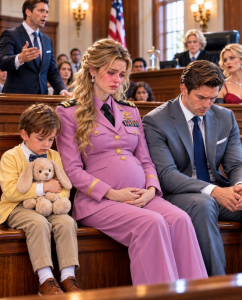
PART 1 — The Little Boy Who Knew Too Much
Eight months pregnant, I stood inside a Missouri courtroom while my husband smiled at the woman who had helped destroy our marriage. I surrendered our mansion, our savings, our cars, and even my legal claim to the company I had spent seven years helping him build. My husband, Julian Vance, believed I was a defeated woman with nowhere to go. His mistress, Clara Sterling, believed she would soon be living in my bedroom, wearing my jewelry, and raising her future with the man she had stolen from me. Neither of them knew that the smallest person in the courtroom was carrying a truth powerful enough to bring their carefully constructed world crashing down. My name is Audrey Vance, and the morning my marriage ended was the morning I discovered that losing everything was sometimes the only way to expose what had been hidden.
Seven years earlier, Julian had been the kindest man I had ever known. We met at a charity dinner in St. Louis, where he was still struggling to turn his small construction company into a successful business. He had an old car, an inexpensive suit, and a smile that made me forget how uncomfortable the crowded ballroom was. I was working as a financial analyst, and I had saved enough money to buy a modest apartment. Julian told me his dream was to build homes for families who had spent their lives believing they could never afford one. I believed in that dream before the rest of the world did. I helped him organize his accounts, negotiated with suppliers, worked through the night preparing proposals, and invested most of my savings when his company nearly collapsed during its first year.
When Julian’s business finally began to flourish, he told everyone that our success belonged to both of us. When he bought his first expensive watch, he kissed my forehead and promised that one day he would buy me a house with a garden large enough for our children to play in. I remembered those words when we married. I remembered them when his first wife died years earlier, leaving him with a little boy named Leo, who was barely two years old at the time. I remembered them when I became Leo’s stepmother and promised the frightened child that he would never have to wonder whether someone loved him. I helped him learn to ride a bicycle, sat beside him during thunderstorms, and read the same bedtime story so many times that I could recite every page without opening the book.
For years, I believed we were building a family. Then Julian changed.
His business grew larger, his schedule became busier, and his phone began following him everywhere. He started taking calls outside, turning the screen facedown during dinner, and returning home long after Leo had fallen asleep. Whenever I asked whether something was wrong, he accused me of being suspicious. I tried to convince myself that success had simply made him tired. I was pregnant with our second child when I discovered Clara Sterling.
She was the newly appointed director of marketing for Julian’s company. She was beautiful, confident, and always dressed as though every room belonged to her. At first, I welcomed her into our home because Julian insisted she was an important employee. She complimented my cooking, admired my jewelry, and once placed her hand on my growing belly while telling me how lucky I was to have such a successful husband. I remember the way she looked at Julian when she said it. It was not the look of an employee admiring her boss. It was the look of a woman waiting for something she believed already belonged to her.
The truth arrived on a rainy Thursday evening. I had gone to the company office to bring Julian the medical documents he had forgotten at home. His assistant had left for the day, and the corridor was dark except for the light beneath his office door. I heard laughter inside. Then I heard Clara say, “How much longer are you going to pretend that you still love her?”
Julian answered without hesitation.
“Until the divorce is finished. After that, everything will be easier.”
My fingers went numb around the envelope.
Clara asked what would happen to the house, the business, and the money. Julian laughed and told her not to worry. He had already moved several assets into companies she controlled, and he planned to make me believe that fighting him would cost more than walking away.
Then he said something that broke the last piece of my heart.
“Audrey is too emotional to notice what is happening. She’ll sign anything if I tell her it’s the best thing for the children.”
I could barely breathe. I had spent years helping him understand every number in his business. I knew the company was worth far more than he admitted, and I knew the documents he was describing were not ordinary business arrangements. Yet I did not burst through that door. I did not scream or throw the envelope at him. I walked away quietly, went home, and sat on the floor of the nursery we had prepared for our daughter.
That night, I cried until my eyes hurt.
The following morning, Julian returned home carrying white roses. He placed them on the kitchen counter and told me that our marriage had become unhealthy. He said he wanted a divorce and that he had already spoken to an attorney. When I asked whether Clara was involved, he looked directly into my eyes and lied.
“There’s no one else, Audrey. We simply don’t belong together anymore.”
I looked at the man who had once promised to love me forever and realized that I no longer recognized him.
I could have exposed everything immediately. I could have hired an aggressive legal team and fought over every account, every property, and every company share. But Julian controlled most of our visible assets, and I suspected that the money he had hidden was connected to something more serious than an affair. So I did something he never expected.
I told him I would not fight him over the house or the money.
His expression changed so quickly that I almost smiled.
“You’re serious?” he asked.
“Completely.”
He studied me as though he were searching for a trick. Then he hugged me, not because he was sorry, but because he believed he had won.
Within days, he had prepared an agreement that appeared to give him nearly everything. The mansion, the vehicles, the investment accounts, and his controlling interest in the company would remain with him. I would receive a modest monthly allowance for the children and enough money to rent a small apartment. My attorney warned me repeatedly that I should not sign anything without a full financial investigation. I listened carefully, but I did not tell him everything I had discovered.
Instead, I asked for time to review the paperwork.
During those weeks, I quietly collected copies of financial statements, business emails, and transaction records that I had legitimate access to through my former work with the company. I also contacted an independent forensic accountant. What she found was worse than an affair. Several transfers appeared to have been made through shell companies, and some of the signatures on financial documents did not match the originals. I did not know the full explanation, but I knew enough to understand that Julian was desperate to complete the divorce before anyone looked closely.
Then Clara made her first mistake.
She sent me a message from an unfamiliar number.
Enjoy your last days in that house. Soon, Julian and I will have the life you couldn’t give him.
I read it twice. Then I saved it.
A week later, I found Leo sitting alone in the hallway outside his bedroom. He was holding his worn stuffed rabbit, a gift from his late mother, and staring at the carpet.
“What’s wrong, sweetheart?” I asked.
He looked up at me with frightened eyes.
“Is Daddy going to make you leave?”
I knelt beside him, even though the pressure of my pregnancy made it difficult.
“Your father and I are going to live in different homes, but that doesn’t mean you have to stop loving either of us.”
He hugged me so tightly that I felt his little shoulders shaking.
“Can I come with you?”
My heart broke. Legally, Leo was Julian’s son from his first marriage, and the custody arrangements were complicated. I had no intention of making promises I could not keep. I simply held him and told him that I would always love him, no matter where he lived.
Then he whispered something I would never forget.
“Clara says you won’t be here when the baby comes.”
I pulled back and looked at him.
“What do you mean?”
He shook his head, frightened by his own words.
“Nothing. I wasn’t supposed to tell.”
Before I could ask another question, Julian appeared at the end of the hallway. His face darkened when he saw Leo in my arms.
“Why are you filling his head with nonsense?” he demanded.
“I’m not,” I replied. “He came to me.”
Julian took Leo by the shoulder and led him away. As they disappeared around the corner, Leo turned back and looked at me. His lips moved silently.
I’m sorry.
Two days before the divorce hearing, I received a call from the forensic accountant. She had identified records that could be important, but she advised me not to confront Julian before the documents could be properly reviewed. My attorney requested additional time to investigate, but Julian’s lawyers objected, insisting that the agreement was voluntary and that I had already accepted its terms.
The hearing proceeded.
I entered the courtroom wearing a pink maternity suit, my hands resting protectively over my unborn daughter. Julian sat across from me in an expensive navy suit. Clara sat beside him, wearing a red dress and a diamond necklace I recognized from a jewelry receipt I had once found in his desk.
Judge Eleanor Norris reviewed the agreement.
“Mrs. Vance, you understand that this settlement transfers the marital home, the vehicles, and the listed financial assets to your husband?”
“Yes, Your Honor.”
“And you understand that you are relinquishing your claim to the business interests specified in this document?”
“Yes.”
My attorney looked devastated. Julian looked delighted.
Clara leaned toward him and whispered something. Both of them smiled.
Judge Norris glanced at me over her glasses.
“Mrs. Vance, I must ask you one final time. Are you certain this is your decision?”
I thought about the nursery, the lies, the money transferred behind my back, and the frightened little boy who had begged me not to leave him.
“I am certain I want the truth to come out, Your Honor.”
Julian’s smile flickered.
Before the judge could respond, the courtroom doors opened. A court officer hurried toward the bench and whispered something to her. Judge Norris listened, then looked toward the hallway.
“Bring the child in, please.”
Julian stood abruptly.
“What child?”
The judge did not answer him.
A moment later, Leo appeared in the doorway. He wore his yellow cardigan, his little shoes were untied, and he was clutching his stuffed rabbit so tightly that its ears were folded beneath his fingers.
When he saw me, he ran forward.
“Audrey!”
I caught him as carefully as my pregnant body allowed. He buried his face against my shoulder and began to cry.
Judge Norris waited until he had settled beside me.
“Leo,” she said gently, “you told me in the hallway that you knew something important about your father’s divorce. You are not in trouble. I want you to tell the truth in your own words.”
Leo looked at his father.
Julian’s face had turned pale.
“Leo, sweetheart,” he said, forcing a smile, “you don’t need to say anything. We can talk about this at home.”
Leo tightened his grip on the rabbit.
“But you said I had to keep the secret.”
Clara suddenly stood.
“Your Honor, this is inappropriate. He’s a child. He doesn’t understand what he’s saying.”
Judge Norris raised her hand.
“Sit down, Ms. Sterling.”
Clara obeyed, but her fingers were trembling.
Leo looked from his father to Clara, then down at the rabbit in his lap.
“Daddy told Clara that when the baby was born, Audrey would have to go away,” he whispered. “He said they were going to take her to a place where nobody could find her.”
A gasp moved through the courtroom.
Julian jumped to his feet.
“That’s a lie!”
Leo flinched so violently that I pulled him close.
Judge Norris struck her gavel.
“Mr. Vance, you will remain silent until I give you permission to speak.”
Then Leo said the words that made Clara reach desperately for Julian’s hand.
“And I heard Clara say that if Audrey didn’t sign the papers, they would make sure she never got to take the baby home.”
The courtroom fell completely silent.
Because Leo had not finished.
He slowly opened the worn stuffed rabbit’s little fabric pocket and pulled out a folded piece of paper.
“Daddy said this was supposed to disappear,” he whispered. “But I took it because I was scared.”
He handed the paper to the court officer.
And when Judge Norris unfolded it, the expression on her face changed.
“Mr. Vance,” she said quietly, “I suggest you contact your attorney immediately.”
Julian stared at the document as if he had just seen his own grave.
For the first time since our marriage began to crumble, my husband looked genuinely afraid.
I did not yet know what was written on that paper.
But I was about to discover that my six-year-old stepson had been carrying the one secret Julian could not afford to let the world see.
PART 2 — The Secret Hidden Inside the Rabbit
Judge Norris asked the court officer to deliver the folded paper to the clerk, who carefully scanned it into the case record before passing the original to the judge. I could hear the clock ticking above the courtroom doors. Leo sat beside me with his head pressed against my arm, and I kept one hand on his shoulder while the other rested on my pregnant belly.
Julian had stopped shouting.
That frightened me more than his anger ever had.
He leaned toward his attorney and whispered rapidly. His attorney opened a folder, examined a page, then looked back at Julian with an expression that suggested even he had not been told everything.
Judge Norris read the paper twice.
“Mr. Vance, do you recognize this document?”
Julian swallowed.
“I don’t know what that is.”
The judge lifted her eyes.
“That is not what I asked you.”
His attorney rose.
“Your Honor, we request a recess to review the document and determine its relevance.”
“Granted. But the proposed settlement will not be entered today. I am also ordering that the financial issues raised in this proceeding be referred for appropriate review. Any question of immediate safety involving the children must be addressed separately and without delay.”
Julian’s face tightened.
“You can’t stop this divorce because a six-year-old found a piece of paper.”
“I can refuse to approve an agreement when credible concerns require further examination,” the judge replied. “And you would be wise not to interrupt me again.”
During the recess, Leo refused to leave my side. I took him to a quiet room near the court clerk’s office and asked whether he wanted water. He shook his head and stared at his rabbit.
“Did I do something bad?” he asked.
I knelt in front of him.
“No, sweetheart. You did not do anything wrong by telling the truth.”
“Will Daddy hate me?”
The question nearly destroyed me.
I took both his little hands in mine.
“Whatever happens, you are not responsible for the choices grown-ups make.”
He began to cry again.
I held him until his breathing slowed, wondering how long he had been carrying this fear alone. Leo was only six. He should have been worried about birthday cakes, school projects, and whether his favorite cartoon would be on television. Instead, he had been listening to conversations no child should ever have to hear.
A few minutes later, my attorney, Daniel Mercer, entered the room. He had been reviewing the document with the clerk and had spoken to the judge’s staff.
“Audrey,” he said carefully, “we need to talk about what that paper might mean.”
He explained that it appeared to be a draft instruction connected to a company transfer. The names on the page included Julian, Clara, and a holding company that had recently received substantial payments from Julian’s business. The document also contained a handwritten note about completing certain transfers before the divorce was finalized.
It was not, by itself, proof of every wrongdoing we suspected. But it connected several transactions that had previously appeared unrelated.
“Where did Leo find it?” Daniel asked.
I turned to the little boy.
Leo rubbed the rabbit’s ear.
“I was in Daddy’s office. Clara was there. They were talking, and Daddy put the paper on the desk. He told her to put it away. Later, when I went looking for my crayons, I saw it on the floor.”
“Why did you keep it?”
“Because Clara said Audrey was going to disappear.”
His voice was so small that I had to lean closer to hear him.
“I thought if I had the paper, they couldn’t make you disappear.”
I closed my eyes for a moment.
For years, I had believed I was the one protecting Leo. I had never considered that he might have been trying to protect me.
Daniel gently asked him whether he had heard anything else. Leo said that Julian and Clara often argued about a safe in the home office. Clara wanted the documents inside it destroyed before the divorce hearing. Julian had told her that once the settlement was signed, nobody would be able to question where the money had gone.
Then Leo remembered something else.
“There’s a little black box behind Daddy’s books,” he said. “Clara has a key. She said it had the other papers.”
Daniel and I exchanged a look.
We did not send Leo back to search the house. We did not ask him to do anything dangerous or confront his father. Daniel simply wrote down what the child had said and notified the appropriate authorities that there might be additional records requiring lawful preservation.
When we returned to the courtroom, Julian was no longer smiling. Clara sat several seats away from him, staring at her phone. The expensive confidence she had worn that morning had begun to crumble.
Judge Norris called the hearing back to order.
“Mrs. Vance, do you wish to continue with the settlement as originally presented?”
Daniel stood before I could answer.
“Your Honor, my client requests that the agreement be withdrawn from consideration until a complete financial review can be conducted. We also request that the court consider temporary arrangements protecting the children’s welfare.”
Julian laughed bitterly.
“She’s changed her mind because she thinks she can take my money.”
I turned toward him.
“No, Julian. I changed my mind because I finally understand what you were trying to hide.”
He stared at me.
For one moment, I saw the man I had married, the man who had once sat on the kitchen floor with me while we calculated how to pay our bills. Then the memory disappeared beneath the face of a stranger who believed money made him untouchable.
Clara suddenly stood.
“Julian, you told me the documents were handled.”
He turned toward her so quickly that his chair scraped the floor.
“Be quiet.”
But the words had already escaped.
Judge Norris looked at Clara.
“Ms. Sterling, what documents are you referring to?”
Clara’s mouth opened, then closed.
“I meant the divorce paperwork.”
“Then you should have no difficulty explaining that statement.”
Clara sat down.
During the next hour, the judge heard preliminary arguments and reviewed the information submitted by both attorneys. She made it clear that the divorce itself could proceed through the proper legal process, but she would not approve a settlement based on incomplete financial disclosures while serious questions remained unresolved.
The court also arranged for Leo to leave with a trusted family member while temporary care arrangements were reviewed. I was permitted to say goodbye to him in the hallway.
He hugged me and whispered, “I told them everything.”
“You told them what you remembered,” I replied. “That was brave.”
“Will you still be my Audrey?”
I kissed his forehead.
“Always.”
Then he was led away, and I returned to the courtroom alone.
Julian was waiting near the doors.
“You have no idea what you’ve done,” he said.
I looked at him calmly.
“I know exactly what I did. I stopped pretending that your lies were my responsibility.”
His jaw tightened.
“You think the court will believe you over me?”
“I don’t need anyone to believe me without evidence.”
For the first time, he seemed to understand that I was no longer the frightened wife who had spent years trying to save his reputation.
That evening, Daniel called with an update. The court had not made any final finding of wrongdoing, but the documents were significant enough to justify further investigation. We would need bank records, company records, and independent verification of the transfers. Some of the transactions might have legitimate explanations. Others appeared to require answers that Julian had not provided.
I sat alone in my small apartment, looking at the unopened box of baby clothes beside the couch.
I had no mansion anymore. I had no luxury car. I did not know how much money I would eventually recover, or whether Julian would face consequences beyond the divorce. My daughter would soon be born into a life very different from the one I had imagined for her.
Yet for the first time in months, I felt something I had nearly forgotten.
Peace.
Then my phone rang again.
It was Daniel.
“Audrey, the financial investigator has found something else,” he said.
“What is it?”
“One of the companies receiving Julian’s transfers appears to have been funded through an account connected to a trust established for Leo after his mother’s death.”
I sat up straight.
“That can’t be right.”
“I haven’t reached a final conclusion. But the records suggest money may have been moved out of the trust without the required authorization.”
I thought about the little boy’s worn rabbit, the document he had hidden inside it, and the fear in his voice when he asked whether his father would hate him.
“Does Leo know?” I whispered.
“I don’t think he understands the financial details. But there may be more records, and we need to protect the child’s interests while the facts are established.”
I stared at the dark window.
Julian had not merely betrayed his wife. If the records were accurate, he might also have betrayed his own son.
And the next morning, Clara made a decision that would change everything.
She contacted Daniel through her attorney and requested a confidential meeting.
She claimed she had evidence that Julian had been lying to her, too.
But she had one condition.
She would speak only if she could be protected from retaliation.
PART 3 — The Truth That Cost Him Everything
Three days later, I gave birth to a healthy baby girl.
I named her Grace.
She had tiny fingers, a soft cry, and a small patch of golden hair that reminded me of the photographs Julian and I had taken during our first year of marriage. When the nurse placed her in my arms, I cried so hard that I could barely see her face.
I had spent months believing my daughter would enter a broken family with no security, no home, and no future. Yet as she slept against my chest, I realized that a child’s future was not determined by the size of the house she entered. It was determined by the people who chose to protect her, tell her the truth, and love her without conditions.
Julian did not visit the hospital.
He sent a message through his attorney asking that all communication remain related to the legal proceedings. I read it once and put my phone away. There would be time to deal with him later.
For now, I wanted to hold my daughter and breathe.
Two days after Grace was born, Daniel visited me with an update about Clara’s proposed meeting. Her attorney had provided preliminary records showing that she had received money from one of the companies under investigation. She claimed Julian had told her the payments were legitimate compensation for consulting work. However, several messages appeared to contradict his explanation.
Daniel emphasized that the evidence still needed to be authenticated and examined. Clara’s willingness to cooperate did not automatically make her innocent, and the court had not yet determined who was responsible for what.
But her messages revealed a disturbing pattern.
Julian had promised Clara that the divorce would be finalized before anyone questioned the business transfers. He had also told her that I would never have access to the company’s records once I signed the agreement.
Then there was a message sent the night before the hearing.
Once Audrey signs, the trust problem becomes mine to manage. Leo won’t understand any of it, and no one will listen to a child.
I read those words twice.
Leo had been right to be afraid.
The authorities continued examining the records, and the court appointed appropriate representation to ensure that Leo’s interests were considered independently of his parents’ conflict. I was not allowed to treat the investigation as a personal victory, nor did I want to. The money belonged wherever the law and the evidence determined it belonged. If Leo’s trust had been misused, it needed to be protected for his future.
Meanwhile, the divorce proceedings were reopened for further review of the financial disclosures. Julian’s attorneys attempted to argue that the transfers were ordinary business transactions, but the missing documentation and inconsistent statements made the questions harder to dismiss.
When I returned to court several weeks later, I carried Grace in a small blanket. My attorney had advised me not to expect a dramatic ending. Legal cases were rarely solved by one perfect speech or one shocking revelation. They were solved through records, testimony, careful investigation, and decisions that sometimes took months.
I understood that now.
Still, when I entered the courtroom and saw Julian sitting alone at the table where Clara had once laughed, I felt the weight of everything that had happened.
He looked older. His expensive suit was still immaculate, but his eyes were tired, and his hands kept moving over the papers in front of him.
Clara had agreed to provide a formal statement through her attorney. She appeared at the hearing separately from Julian and did not look at him. She confirmed that she had received payments from companies Julian controlled and that he had represented those payments as legitimate. She also acknowledged receiving instructions to keep certain communications private until the divorce was completed.
Her testimony did not settle every question. She was still required to answer for her own actions, and the investigators continued to verify her statements. But she provided information that helped explain why several transactions had been concealed from the financial disclosures.
Then came the question of Leo’s trust.
The records showed that money intended for his future had been transferred into accounts connected to Julian’s business network. Some payments had been recorded as loans, but the documentation was incomplete, and the required approvals could not initially be located.
Julian’s attorney argued that the transfers had been temporary and that the money was expected to be returned. The court ordered a fuller accounting rather than accepting that explanation without evidence.
When Judge Norris spoke, her voice was firm.
“Mr. Vance, the issue before this court is not whether you are a successful businessman. It is whether you have fully disclosed the relevant assets and whether the proposed settlement is fair, lawful, and supported by accurate information.”
Julian stared at the table.
For months, he had acted as though my willingness to leave the marriage meant I had surrendered my right to ask questions. He had mistaken my desire for peace for weakness.
Now every question he had avoided was waiting for an answer.
The judge declined to approve the original settlement. She ordered additional disclosures, directed that the disputed trust funds be protected pending review, and instructed the parties to work through the proper legal process for resolving the remaining issues. Questions involving possible financial misconduct were left to the relevant investigators and authorities.
There was no immediate arrest. No instant confession. No magical moment when every dollar was returned and every wound disappeared.
But Julian could no longer control the story simply by speaking the loudest.
After the hearing, I waited in a quiet corridor while Daniel spoke with the clerk. Julian approached me slowly.
“Audrey.”
I turned.
He looked at Grace sleeping in my arms.
“She’s beautiful,” he said.
“Yes, she is.”
He swallowed.
“I never wanted things to turn out this way.”
I almost laughed, but I did not want to give him the satisfaction of believing that my anger was still controlling me.
“You wanted the house, the money, the company, and Clara. You wanted all of it without having to answer for how you got it.”
“That isn’t fair.”
“Then explain the records.”
He looked away.
For several seconds, neither of us spoke. Then he asked the question I had been waiting for.
“Do you hate me?”
I looked down at my daughter.
“No,” I said. “I spent too long trying to save you from the consequences of your own choices. I don’t have the energy to hate you anymore.”
His eyes filled with tears, but I could not tell whether they came from regret, fear, or the realization that he could no longer persuade me to protect him.
“Can we fix this?” he asked.
“Not by pretending it never happened.”
I walked away before he could respond.
Over the following months, the investigation continued. Some disputed transactions were explained by business records, while others remained contested. The accounting ultimately identified funds that had to be restored to Leo’s trust under a court-supervised arrangement. The divorce settlement was revised after the financial disclosures were completed, and the final terms reflected the evidence rather than Julian’s original demands.
I did not receive everything I had once imagined I would have. I did not need to.
I secured a safe home for Grace and myself, and I continued to advocate for Leo’s welfare through the appropriate legal arrangements. His relationship with me was never something I could simply claim by right, but the adults involved understood how important our bond had become to him. With professional guidance and careful attention to his needs, we were able to preserve meaningful contact without forcing him to choose between the people he loved.
One Saturday afternoon, several months after the hearing, Leo came to visit.
He was wearing his yellow cardigan again. His stuffed rabbit had been repaired, and someone had carefully sewn its loose ear back into place.
He stood in my doorway, staring at Grace sleeping in her cradle.
“Can I hold her?” he asked.
I smiled.
“Of course. We’ll sit together, and I’ll help you.”
He climbed onto the couch beside me. I placed Grace carefully in his arms while keeping my hands around both children. Leo looked down at his baby sister with the serious expression of someone entrusted with something precious.
“She’s so little,” he whispered.
“She is.”
“Will she know me when she gets bigger?”
I brushed the hair away from his forehead.
“She will know the stories we tell her about you. And she’ll know how much you loved her before she could even open her eyes.”
Leo smiled for the first time in what felt like forever.
Then he looked at me.
“Audrey, are you going to leave again?”
I felt tears gather in my eyes.
“I will never stop caring about you, Leo. Whatever changes happen in our lives, that will always be true.”
He leaned against my shoulder.
For a long time, we sat together without speaking. Outside, sunlight fell across the garden of the modest house I had rented after leaving Julian. It was nothing like the mansion I had surrendered. The kitchen was smaller, the floors creaked, and the backyard was barely large enough for a little table and two chairs.
But it was peaceful.
There were no whispered arguments behind locked doors. No expensive gifts used to cover lies. No one telling a child that love was something he had to earn by keeping secrets.
I eventually learned that Clara had ended her relationship with Julian after the investigation began. Whatever promises they had made to each other could not survive the pressure of the truth. Julian continued dealing with the legal and financial consequences of the disputed transactions, and his business was forced to undergo changes he had once believed he could avoid.
I never celebrated his suffering.
I celebrated the day Leo stopped apologizing for telling the truth.
I celebrated the day Grace slept through the night.
I celebrated the first time I laughed without feeling guilty for being happy.
And I celebrated the morning I finally understood that I had not lost my entire life when I left my marriage. I had lost the version of my future that depended on a man who no longer deserved my trust.
One evening, as I tucked Leo into bed during a visit, he handed me his stuffed rabbit.
“Can you keep it safe for me until next time?”
I held the little toy carefully.
“Of course.”
He hesitated, then asked, “Do you think Daddy will ever be good again?”
I sat beside him.
“I think people can make better choices, Leo. But they have to be honest about the choices they’ve already made.”
He considered that for a moment.
“Even if they hurt people?”
“Especially then.”
He nodded and closed his eyes.
As I watched him fall asleep, I thought about the courtroom where everything had changed. I remembered standing there eight months pregnant, surrounded by people who believed I was surrendering because I had been defeated. I remembered Clara’s laughter, Julian’s confidence, and the little boy who walked through those doors carrying a stuffed rabbit and a secret he was terrified to tell.
They had thought I was giving away my future.
They had never understood that I was refusing to let money determine what I was willing to tolerate.
My husband had taken the house, the cars, and the life we once shared. But he could not take away the truth, the love I had given Leo, or the chance to raise Grace in a home where kindness mattered more than appearances.
And the greatest lesson I learned was not that a little boy could destroy a powerful man’s lies.
It was that a child should never have to become brave enough to protect the adults who are supposed to protect him.
Because the day Leo walked into that courtroom, he did not walk in carrying a weapon.
He walked in carrying the truth.
And sometimes, the truth is the one thing money cannot buy, power cannot silence, and fear cannot keep hidden forever.